Rüdiger Heimgärtner (2022). Human Factors of ISO 9241-110 in the Intercultural Context. In: Advances in Ergonomics In Design, Usability & Special Populations: Part III. AHFE Open Access, vol. 20. https://doi.org/10.54941/ahfe1001297
ISO 9241-110 describes seven dialog principles that should be applied in human computer interaction design. In this paper, some ideas are presented regarding the question whether these dialog principles are valid in general with the same strength or when used in different cultures around the world if there are differences in their applicability and subsequently how this question can be tackled. First, the influence of culture on the user’s interaction with the system and on usability and usability engineering is elucidated. Second, cultural differences and methods to describe cultural differences such as cultural models are presented. Third, the analysis of the influence of culture on dialog principles is exemplified by the dialogue principle "suitability of the task". Finally, the results are discussed and challenges are identified. The ideas in this paper pave the way for deeper research in this area.
Globalization leads to the development of products for other cultures. Therefore, intercultural product development and intercultural usability engineering is needed ((Honold, 1999)). The usability of user interfaces (UI) depends on the cultural context of use as well as on the cultural imprint of the users (age, sex, language, education, knowledge, experience, religion, self-conception, dealing with power, politics, wealth, income, infrastructure) (cf. (Honold, 1999), (Röse, 2005), (Rüdiger Heimgärtner, 2012)). To reach intercultural usability of a product, detailed cultural knowledge of the specific user habits is necessary for a designer in order to develop products that fit all customer needs in cultural contexts. Even if it is impossible that one UI designer has all this specific information from all relevant user groups worldwide, he must have a profound knowledge of the circumstances in his own cultural environment in order to be sensitive to relevant aspects in other cultures (cf. (Thomas, Kinast, & Schroll-Machl, 2010)). In addition, the people involved in intercultural UI design should at least know the basic structures and principles from cultural studies in order to consider other cultures in their work (cf. (Thomas et al., 2010)) such as quantitative cultural models (cf. (Hofstede, Hofstede, & Minkov, 2010)). This is augmented by working within an intercultural HCI designer team (cf. (Schoper & Heimgärtner, 2013), (Rüdiger Heimgärtner, Tiede, & Windl, 2011)) using the usability engineering process for interactive systems which is defined in the European Standard EN ISO 9241-210:2010 (cf. (DIN, 2010)).
In this paper, I raise the question of how standards acknowledged by CEN and ISO can be internationally valid, i.e. if they apply independently of cultures on a national level. An analysis of the dialogue principles specified in the English version EN ISO 9241-110:2006 (E) of DIN EN ISO 9241-110:2008-09, which supersedes DIN EN ISO 9241-110:2006-08 (cf. (DIN, 2006)) is done in order to identify aspects that are influenced by culture and to decide if it is necessary to change or adapt them in order to hold in intercultural contexts. First, cultural influences that affect interactive systems and their usage are presented followed by the description of the resulting discipline called "intercultural usability engineering". Then the dialogue principles for designing utilizable interactive systems are shown and the influence of culture on them is identified using cultural models. Finally, the implications of these relationships are listed for further research.
INFLUENCE OF CULTURE ON THE USER’S INTERACTION WITH THE USER INTERFACE Culture as a set of facts, rules, values and norms (structural conditions) representing an orientation system (cf. (Thomas et al., 2010)) is established by collective programming of the mind (cf. (Hofstede et al., 2010)) within a group of individuals that can influence Human-Machine Interaction (HMI) in different ways. Masao Ito and Kumiyo Nakakoji already demonstrated the influence of culture on UI design in 1996 for the modes „hear“ and „speak“ between a user and the system (cf. (Masao & Kumiyo, 1996)). In the „hear mode“, the presentation of information from the system to the user takes place within the phases perception, association and inference. From the first to the last phase cultural dependency increases: colors and forms in the perception phase depend less strongly on culture than standards in language and metaphors within the phase of associating meaning. Finally, the inference mechanisms in the last phase that are based on logic and social norms depend strongly on culture. In the „speak mode“, the directives to the system by the user happen in four phases. First, the user recognizes the possibilities of system usage. For example, he grasps the meaning of the layout, selects alternatives, or initiates functions. Then he tests their applicability by checking semantic consistency using trial and error. In the third phase, he determines the expectation of the system regarding his actions and acknowledges the system instructions in the final phase. Cultural dependence increases from phase to phase. Hence, culture significantly influences HMI on all levels of the interaction model (cf. also the acting level model according to (Heinecke, 2011)). In addition, these process phases involve the perception of time, which is highly dependent on culture (cf. (Edward T Hall, 2006)). For example, in Japan, on the one hand, short system response time is very important. On the other hand, Japanese users are obviously more patient doing long-winded tasks than users from European countries (cf. (Lee, 2002)).
Cultural models characterizing cultures can be used to analyze the influence of culture on the behavior of users with interactive systems and filling the usability engineering process with life (cf. (Marcus & Baumgartner, 2004)). One type of cultural models are cultural dimensions, which serve to describe the behavior and values of members of certain cultures like uncertainty avoidance, individualism or collectivism or even power distance ((Hofstede et al., 2010)). For HMI, those cultural dimensions are most interesting that are directly connected to communication, information, interaction and dialog design, i.e. the cultural dimensions concerning the culturally different concepts of space, time and communication (cf. chapters 1, 5 and 10 in (Edward T Hall, 2006)). Space and time are physical variables influencing the communicative behavior of human beings, which form the social processes of a group of humans and their culture: by learning certain kinds of behavior, the human being matures according to his cultural environment. Following (Hofstede et al., 2010), during the intensive learning phase in childhood, primary culture imprints the human being with certain rules, norms and desired ways of behavior to which the members of the group adhere. Therefore, the influence of the cultural imprinting of the user on his behavior in interactions with other communication partners is immense. This is also valid for HMI because communication in HMI is also determined by the interaction between user and system: culture influences the interaction of the user with a computer system or a machine because of the movement of the user in a cultural surrounding (cf. (Röse, 2005)). Thereby, culture has direct influence on the interaction of the user with the system. Therefore, cultural differences in interpersonal communication can and must be transferred to the interaction with technical devices ((Röse, 2005)). Cultural dependencies in user system interactions particularly concern interaction and dialog as well as information architecture design (cf. (Röse, 2005), (Rüdiger Heimgärtner, 2012)).
INFLUENCE OF CULTURE ON USABILITY AND ON USABILITY ENGINEERING The usability of a system strongly depends on how the user can cope with the system (cf. (DIN, 2010)). The user articulates his desires and hence his needs regarding the usability of the system. However, in addition to the common misunderstandings between developers and users, which lead to different product designs, there are also misunderstandings because of cultural conditions. There is not only a different comprehension of the requirements of the product but also culturally dependent perspectives and views of them (cf. (Rüdiger Heimgärtner et al., 2011)).
Hence, the developer needs much more intercultural knowledge to understand the user of another culture. Furthermore, he needs competency regarding intercultural communication to enable the exchange of information with the user and to know exactly which product the user is likely to have (cf. (Honold, 1999)). Therefore, the design, implementation and use of interactive systems should not only meet the general usability criteria but also take into account cultural issues (for instance represented by cultural dimensions), which address relevant topics such as schedule, presence, privacy, authority, control, awareness, safety, error, trust, comfort, coordination, conflict, communication and collaboration as well as interaction style, thinking and action models (cf. (Rüdiger Heimgärtner, 2013; Liang, 2003)). For this purpose, existing cultural models can be taken into account in the process of product design in the context of intercultural usability engineering. For instance, the cultural dimension “Individualism/Collectivism is connected to and has an effect on usability.” ((Vöhringer-Kuhnt, 2002): 17).
As mentioned before, the preconditions for intercultural usability engineering are knowledge about the cultural differences in HMI and its considerations in product design and product realization ((Honold, 1999); (Röse, 2005); (Rüdiger Heimgärtner, 2012)). “Intercultural” usability engineering is a method for designing products of good usability for users from different cultures. “Intercultural” in this context refers to the special methods that are necessary to do usability engineering for different cultures (cf. (Honold, 1999)), i.e. a person from one culture is doing usability engineering for another culture. The “interculturally overlapping situation” provided by a technical system is the most interesting (cf. (Honold, 1999)). These "critical interaction situations" arise if a product is defined and formed within one culture and this product is then transferred and used in another culture. Therefore, (Honold, 1999) made the approach of (Thomas et al., 2010) using “overlapping interaction situations” available for HMI design. At the transfer of a technology or a product from the developer's country to another country, a change of cultural environment takes place (cf. e.g., (Honold, 1999), (Röse, 2005), (Clemmensen & Clemmensen, 2012)). First, the product developers must be sensitized to the difficulties of cultural influences on product development and product use. Then cultural factors influencing HMI must be provided to the developers and considered in the product. This requires knowledge in software ergonomics and intercultural UI design as well as in selecting and analyzing the correct usability engineering methods and their application in the intercultural context. In contrast, if the currently implemented functionality of a system of a certain culture is used as a basis for the analysis of UI characteristics, it may lead to erroneous or simply wrong design guidelines because those requirements need not necessarily match the real needs of the user in the designated cultural contexts. Therefore, the user’s needs must be collected for every user or at least for the desired user groups (e.g., Chinese and German users). Challenges thereby are that the same data can have different meanings in different cultures due to the experiences within one’s own, since every culture has its own values, symbols and behavior patterns with meanings and interpretations connected to them. These aspects have an effect on the coding or decoding of news during communication (cf. (Röse, 2005)). Moreover, miscommunication has negative effects on the usability of the product. Therefore, at the collection of culture specific user requirements and culture specific assessment of the concepts used, it must also be examined how far the currently approved methods of usability engineering are suitable for use in the intercultural context.
HCI DIMENSIONS (Bernsen, Dybkjær, & Dybkjær, 1998) characterizes HCI dialogs as transmitting pieces of information during user system interaction. HCI dimensions (HCIDs) describe the “style of information processing” and the “interactional characteristics” of the user with the system (cf. (Rüdiger Heimgärtner, 2012)). HCIDs are derived from the basic physical dimensions of space and time as well as from their sub-dimensions frequency, speed, duration, density and order) (cf. Table 1).
TABLE 1: HCI Dimensions.
HCI dimensions (HCIDs) represent the characteristics of HCI by describing the HCI style of the user, i.e. the path of information processing and the interaction style exhibited by the user based on the concepts of “information” and “interaction”. Frequency, density, order and structure are concerned particularly during information processing; frequency and speed are concerned during interaction behavior. HCI dimensions can be regarded as main factors relevant for HCI design, because they denote the basic classes for variables useful for HCI design (cf. (Rüdiger Heimgärtner, 2012)).
The view of space, time and mental aspects is strongly culture dependent (cf. (Edward T Hall, 2006)). HCI is, therefore, also culture dependent, because HCI dialogs, interaction, information presentation and with that HCI generally are strongly linked with time (interaction, communication) and space (layout, structure) as well as the mental aspects (relations, thoughts) (cf. (Preim & Dachselt, 2010), (Honold, 2000), (Röse, 2005)).
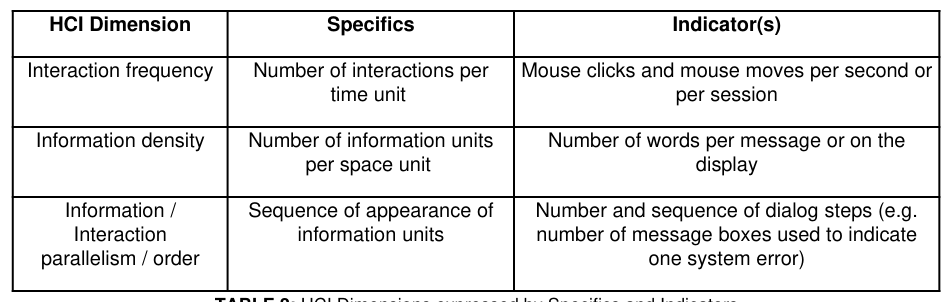
At least one potential indicator as a measurement variable is necessary to constitute the specifics of an HCI dimension (cf. (Rüdiger Heimgärtner, 2012)). Table 2 shows examples of indicators for some HCI dimensions.
TABLE 2: HCI Dimensions expressed by Specifics and Indicators
For example, the indicator “number of information units per space unit” belongs to the HCI dimension “information density” and can be expressed by the number of words displayed on the screen. The HCI dimension “interaction frequency” contains the variable “number of interactions per time unit” represented by the number of mouse clicks per second. Therefore, the differences in HCI style can be captured using specifics and indicators represented by HCI dimensions.
RELATIONSHIP BETWEEN CULTURAL DIMENSIONS AND HCI DIMENSIONS The following reflections are the basis for the analysis of the dialog principles in the intercultural context in the next section. Cultural models such as cultural dimensions relate to culturally different concepts of time orientation, space and communication that underlie human behavior (cf. Hall). Frequency and speed are derived from the usage of time and they depend on the kind of time orientation and communication rate. Action chains can explain order and sequential interactions. Density of communication networks and context orientation determine the (density and strength of) context during HCI taken into account by the user (cf. (Rüdiger Heimgärtner, 2013)). For instance, relationship oriented cultures communicate, and hence, their members interact with each other more frequently than task oriented cultures because of more dense communication networks (cf. (Edward T Hall, 2006)). “Communication network” in this case represents the structure of communication channels within a culture. The density of such a communication network depends on the relationship orientation and the context of information usage (cf. (Edward Twitchell Hall, 1989):61). The more dialogs are carried on at a particular time, the higher is the communication speed. The amount of data and data transfer speed is higher when more dialog steps are taken within a certain time period as is the case in relationship oriented cultures.
It can be supposed that interaction frequency and interaction speed as well as information density and information transfer speed are higher for relationship oriented cultures which exhibit rather more parallel information processing in contrast to task oriented cultures. In addition, different time orientation can also have implications concerning information density, information context and information speed. For example, parallel or sequential information processing could be explained by action chain orientation or poly-chronic vs. mono-chronic time orientation. In addition, the less the sensitivity for interference, the more the people feel safe and the less the people resultantly avoid uncertainty or unexpected situations because they feel safe (cf. (E. T. Hall, 1983): 44 and also (Honold, 2000): 35 et seq.). (Kralisch, 2006) writes: “It appears that the cultural dimension of Uncertainty Avoidance is the most important determinant of a user’s perception of information need.” ((Kralisch, 2006): 208). This is also supported in the HCI field by (Trillo, 1999) who investigated intelligent agents. He states that an intelligent agent provides information that is more explicit for low context oriented users and high context oriented users require less explicit information from intelligent agents. Moreover, in dense communication networks, there is higher information exchange because there are many senders per receiver. The probability of the arrival of another piece of information during an already ongoing process of information reception or processing is high. Hence, the mental stress of a recipient of a culture with a low density communication network exposed to a culture with high communication networks density is high, if many pieces of information have to be processed, because a low information frequency is expected (cf. (E. T. Hall, 1983): 41). For example, the high information flow in traffic crossing a junction in China is overwhelming and provokes a high mental workload for a German driver or passenger. The Chinese pedestrians deal successfully with the vehicles by bypassing them as usual without causing accidents. Furthermore, task oriented cultures use a direct conversation style, less complex dialogs as well as more frequent and more linearly structured explanation dialogs because of low context orientation in contrast to relationship oriented cultures. The latter use an indirect conversation style and implicit communication structures with inverted and less linear explanations but more complex dialogs because of dense communication networks. Furthermore, it can be assumed that task-oriented users abhor redundancy in the presentation of information in contrast to relationship- oriented users. According to (E. T. Hall, 1983), relationship-oriented cultures have a higher communication speed in contrast to task-oriented cultures. They communicate more frequently with each other than task-oriented cultures. Hence, they should interact more frequently with each other. Both, interaction frequency and interaction speed should be higher. It is, therefore, reasonable to assume that both information density and information frequency are higher as well. These thoughts support the correctness of the HCIDs being related to basic patterns of behavior which are represented in cultural dimensions.
According to the results of an empirical study done by the author, some of the correlations between the cultural dimensions and the HCI dimensions as well as their values were identified (cf. (Rüdiger Heimgärtner, 2012)). It is reasonable to assume that variables connected to HCI design representing HCIDs like information speed (distribution speed and frequency of information), information density (number and distance of information units) or information order (appearance in sequence and arrangement of information units) correlate with the culturally different basic patterns of behavior stated by (Edward T Hall, 2006) even if until now the causal correlations are not known. Nevertheless, some of the generated hypotheses derived from this have been confirmed empirically (cf. (Rüdiger Heimgärtner, 2013)).
INFLUENCE OF CULTURE ON DIALOGUE PRINCIPLES ISO 9241-110 "[..] deals with the ergonomic design of interactive systems and describes dialogue principles which are generally independent of any specific dialogue technique and which are applicable in the analysis, design and evaluation of interactive systems." (cf. English version of DIN EN ISO 9241-110:2008-09, p. 4). Even if part 110 of ISO 9241 relates to all kinds of interactive systems, it does not cover the specifics of all contexts of use such as safety critical systems or collaborative work. In my view, another special context of use is the intercultural context that must be considered in order to apply the dialog principles of ISO 9241-110 correctly in intercultural contexts: questions concerning the interaction level, the mind and the cognition as well as the behavior of users in applying the dialogue principles in cultural contexts are either not answered or only partly so until now. How can or must we use the dialogue principle "controllability" in the intercultural context correctly in order to evaluate how different cultures interfere and affect navigation within applications? How are other dialogue principles such as "suitability for individualization" involved or how can they be involved in the intercultural context? Are there significant improvements when comparing an application without taking into account intercultural differences with the adapted version of the application? Can users from different cultures have different experiences when interacting with applications from their own or other cultures? This question concerns the whole user experience (UX) affecting all dialogue principles. Such questions in relation to the framework of applying dialogue principles, the dialogue requirements and the dialogue techniques must be answered by research to provide useful hints for designers and developers of user interfaces in order to apply the dialogue principles correctly in intercultural contexts. Many such questions need to be answered regarding the compatibility of the dialogue principles in intercultural contexts. In the following, some initial thoughts will be presented providing a basic answer to the question of how cultural influences possibly affect the dialog principles of ISO 9241-110 and their application in intercultural contexts.
Dialog Principles According to the English version of DIN EN ISO 9241-110:2008-09, a dialogue is the "interaction between a user and an interactive system as a sequence of user actions (inputs) and system responses (outputs) in order to achieve a goal" (ISO 9241-110, p. 6). Furthermore, the specifics of a dialogue which satisfies user needs within the identified context(s) of use is called a dialogue requirement. Dialogue principles are a set of general goals (intended outcome) for the design of dialogues. Section 4.2 of ISO 9241-110 describes the relationships between dialogue principles: "The dialogue principles are not strictly independent and can semantically overlap. It may be necessary to achieve a “trade-off” between principles in order to optimize usability. The applicability and the priority given to each principle will vary with the specific field of application, user groups and the dialogue technique chosen. This implies taking into account the following aspects: goals of the organization; needs of the intended (end) user group; tasks to be supported; available technologies and resources. The relevance and relative importance of each principle is determined by the particular context of use. Each of the principles needs to be considered in analysis, design and evaluation; however, principles might vary in their relative importance depending on the context of use and other design requirements. In practice, within design situations for an interactive system, compromises will be made." (English version of DIN EN ISO 9241-110:2008-09, p. 8). In this section of ISO 9241-110 it is admitted that dialogue principles sometimes cannot strictly be separated from each other when it comes to their application. In addition to this variability of the use of the dialogue principles according to the context of their application, the author claims that culturally sensitive aspects in the definitions of the dialog principles must be considered and analyzed in order to know how to correctly apply the dialogue principles in the intercultural context.
In the following, this task will be tackled exemplarily for the first dialogue principle of ISO 9241-110 ("Suitability for the task") in order to confirm the hypothesis that dialogue principles are "culturally sensitive", i.e., they change their characteristics in intercultural contexts because they contain concepts that change their meaning and/or extension when applied in intercultural contexts. In this case, one method of analyzing dialogue principles for their application in intercultural contexts using cultural models is exemplified. Culturally sensitive concepts in the definitions of the dialogue principles, i.e. those concepts that are strongly influenced by culture, are highlighted as bold and italic by the author.
Suitability for the task "An interactive system is suitable for the task when it supports the user in the completion of the task, i.e. when the functionality and the dialogue are based on the task characteristics (rather than the technology chosen to perform the task)." (English version of DIN EN ISO 9241-110:2008-09, p. 8).
The dialogue should present the user with information related to the successful completion of the task. However, presentation of information as well as the requirements to complete the task and even the task itself can be culture specific (cf. (Windl & Heimgärtner, 2013)). If the needs of the task are culture specific, the required quality, quantity and type of information to be presented is also culture specific.
Furthermore, according to the standard, presenting the user with information not needed for the successful completion of relevant tasks should be avoided. However, according to some cultural dimensions such as uncertainty avoidance ((Hofstede et al., 2010)), network density ((Edward Twitchell Hall & Hall, 2009)) or relationship orientation ((Halpin & Winer, 1957)), this dialogue principle probably must be weakened. Nevertheless, the note and the first part of the example to clause 4.3.2 in this standard are also correct for intercultural contexts:
"NOTE: [..] the presentation of inappropriate information could lead to decreased task performance and unnecessary mental workload. [..] Example: In a context where travelers want to book a hotel room for a specific date, the dialogue system displays only hotels with available rooms for this specific date. Information about other hotels in the area that are booked out, or additional information about travelling, such as sightseeing spots, is only displayed on request." (English version of DIN EN ISO 9241-110:2008-09, p. 8). However, the number of pieces of information presented as well as its frequency and order can vary in different cultures (cf. (Rüdiger Heimgärtner, 2012)). Here the dialogue principle "conformity with user expectations" comes into play. A user from one culture expects information where a user from another culture expects information only on request.
The general goal for dialogue design that the format of input and output should be appropriate to the task can be easily met by taking localization kits (cf. (Symmonds, 2002), (Fissgus & Seewald-Heeg, 2005)) and internationalization guidelines (cf. (VDMA, 2009), (W3C, 2010)) into account when designing for intercultural contexts. For instance, "EXAMPLE 1 A currency conversion application designed for travelers converting currencies displays converted amounts with a precision that is suitable for the target currency (e.g. two decimal digits for most European currencies). EXAMPLE 2 A dialogue which is purely intended for a domestic market states this clearly to the user." (English version of DIN EN ISO 9241-110:2008-09, p. 8).
Automatic default setting for typical input values according to the task seems to be culturally independent at the first sight. However, for this purpose, it can be necessary for the system to identify the user in order to provide reasonable default data. This in turn can be problematic in cultures with high uncertainty avoidance or power distance (cf. (Hofstede et al., 2010)), which has effects on the user's information needs as mentioned above and on the willingness of the user to provide personal information for identification purposes to the system (such as email address or passwords).
Another general goal of this dialog principle for the design of dialogues is the following: "The steps required by the dialogue should be appropriate to the completion of the task, i.e. necessary steps should be included and unnecessary steps should be avoided." (English version of DIN EN ISO 9241-110:2008-09, p. 8). The steps required by the dialogue to complete the task depend on the culturally influenced concepts "task" and "required steps". According to mono-causal or multi-causal thinking, the user expects more or fewer steps to complete the task (cf. (Röse, Zühlke, & Liu, 2001)). Again, the dialogue principle "conformity with user expectances" is strongly involved here. Also the channels for inputs and outputs offered by the dialogue system can vary here and can be differently loaded according to the cultural imprint of the users (cf. users showing holistic or analytic perception, cf. (Nisbett & Miyamoto, 2005)).
These are just some aspects that should be considered in using the dialog principle "suitability for the task" in intercultural contexts. Furthermore, all of these and more aspects must be analyzed in more depth in order to derive recommendations about how to apply this dialogue principle correctly in intercultural contexts. The analysis of the remaining dialogue principles is the object of future research − once again the culturally sensitive concepts in their definitions, which should be analyzed in detail as well as related to cultural and HCI dimensions, are indicated in bold italic by the author: Self-descriptiveness
"A dialogue is self-descriptive to the extent that, at any time, it is obvious to the users which dialogue they are in, where they are within the dialogue, which actions can be taken and how they can be performed." (English version of DIN EN ISO 9241-110:2008-09, p. 10).
Conformity with user expectations "A dialogue conforms with user expectations if it corresponds to predictable contextual needs of the user and to commonly accepted conventions." (English version of DIN EN ISO 9241-110:2008-09, p. 10).
Suitability for learning "A dialogue is suitable for learning when it supports and guides the user in learning to use the system." (English version of DIN EN ISO 9241-110:2008-09, p. 12).
Controllability Ergonomics In Design, Usability & Special Populations III
"A dialogue is controllable when the user is able to initiate and control the direction and pace of the interaction until the point at which the goal has been met." (English version of DIN EN ISO 9241-110:2008-09, p. 13).
Error tolerance "A dialogue is error-tolerant if, despite evident errors in input, the intended result may be achieved with either no, or minimal, corrective action by the user. Error tolerance is achieved by means of error control (damage control), error correction, or error management, to cope with the errors that occur." (English version of DIN EN ISO 9241- 110:2008-09, p. 14).
Suitability for individualization "A dialogue is capable of individualization when users can modify interaction and presentation of information to suit their individual capabilities and needs." (English version of DIN EN ISO 9241-110:2008-09, p. 15).
DISCUSSION AND CONCLUSIONS If ISO 9241-110 claims to be valid internationally as an international standard, then it must be possible to apply the content of ISO 9241-110 across nations independently at least from their cultural contexts on national level. However, the analysis of the use of the dialogue principle "suitability for the task" in the intercultural context using cultural dimensions at national level indicated that the existing dialogue principles defined in ISO 9241-110 should be used with care in order to be successfully applied in intercultural contexts. If just one of the dialogue principles in ISO 9241-110 cannot be applied internationally because of conflicting intercultural contexts at a national level, an optimization or adaptation of the dialogue principles is required in order to correctly function in intercultural contexts at least at a national level.
Even if the analytical ideas provided in this paper are preliminary and must be investigated and described in depth in order to become generally valid, they can be considered to be a reasonable basis for future research. In addition, the presented examples bridging the gap between dialogue principle and culture should be sufficient to provide impressions about how the usage of the dialogue principles in intercultural contexts can be affected. Nevertheless, the postulated hypothesis that dialogue principles are "culturally sensitive", i.e., changing their characteristics in intercultural contexts because they contain concepts that change their meaning and/or extension when applied in intercultural contexts, must be verified in further empirical studies. Last but not least, a profound discussion regarding the relationship between dialogue principles and culture is still outstanding.
REFERENCES
Bernsen, Niels Ole, Dybkjær, Hans, & Dybkjær, Laila. (1998). Designing interactive speech systems (2. print. ed.).
London: Springer. Clemmensen, Torkil, & Clemmensen, Torkil. (2012). Usability Problem Identification in Culturally Diverse Settings. Information Systems Journal, 22(2), 151-175. doi: 10.1111/j.1365-2575.2011.00381.x DIN. (2006). DIN EN ISO 9241-110 Ergonomics of humans-system interaction Part 110: Dialogue principles.:
Beuth. DIN. (2010). DIN EN ISO 9241-210 Ergonomische Anforderungen der Mensch-System-Interaktion Teil 210: Prozess zur Gestaltung gebrauchstauglicher Systeme. Berlin: BeuthVerlag. Fissgus, U., & Seewald-Heeg, U. (2005). Software Localization. IT -MUNCHEN-, 47(4), 220-225. Hall, E. T. (1983). The Dance of Life. The Other Dimension of Time, New York: Anchorbooks: Doubleday. Hall, Edward T. (2006). The silent language. Hall, Edward Twitchell. (1989). Beyond culture. New York: Anchor Books. Hall, Edward Twitchell, & Hall, Mildred Reed. (2009). Understanding cultural differences : Germans, French and
Americans. Boston, Mass. u. a.: Intercultural Press. Halpin, A. W., & Winer, B. J. (1957). A factorial study of the leader behavior descriptions. In R. M. Stogdill & A.
E. Coons (Eds.), Leader behavior: Its description and measurement. Columbus, OH: Bureau of Business Research, Ohio State University.
Heimgärtner, Rüdiger. (2013). Reflections on a Model of Culturally Influenced Human Computer Interaction to Cover Cultural Contexts in HCI Design. International Journal of Human-Computer Interaction. Heimgärtner, Rüdiger (2012). Cultural Differences in Human-Computer Interaction (Paperback B: Einband - flex.
(Paperback) ed. Vol. 1): Oldenbourg Verlag. Heimgärtner, Rüdiger, Tiede, Lutz-Wolfgang, & Windl, Helmut. (2011). Empathy as Key Factor for Successful Intercultural HCI Design. Paper presented at the Proceedings of 14th International Conference on Human- Computer Interaction, Orlando. Heinecke, Andreas M. (2011). Mensch-Computer-Interaktion (2. überarb. u. erw. Aufl., 2012 ed.): Springer Verlag. Hofstede, Geert H., Hofstede, Gert Jan, & Minkov, Michael. (2010). Cultures and organizations : software of the
mind (3. ed.). Maidenhead: McGraw-Hill. Honold, Pia. (1999). Cross-cultural Usability Engineering: Development and State of the art. Paper presented at the Proceedings of HCI International (the 8th International Conference on Human-Computer Interaction) on Human-Computer Interaction: Ergonomics and User Interfaces-Volume I - Volume I. http://dl.acm.org/citation.cfm? id=647943.742510&coll=DL&dl=GUIDE&CFID=145069547&CFTOKEN=47400189 Honold, Pia. (2000). Interkulturelles usability engineering: Eine Untersuchung zu kulturellen Einflüssen auf die
Gestaltung und Nutzung technischer Produkte (Als Ms. gedr. ed. Vol. 647). Düsseldorf: VDI Verl. Kralisch, A. (2006). The Impact of Culture and Language on the Use of the Internet Empirical Analyses of Behaviour and Attitudes. (Dissertation), Berlin. Lee, Yeonsoo. (2002, 19.11.2002). Introduction. from http://www.csulb.edu/web/journals/jecr/issues/20024/paper3.pdf Liang, S. F. M. (2003). Cross-Cultural Issues in Interactive systems. Paper presented at the Proceedings of the
International Ergonomics. Ergonomics in the Digital. Age. Marcus, Aaron , & Baumgartner, Valentina-Johanna (2004). "Mapping User-Interface Design Components vs.
Culture Dimensions in Corporate Websites,". Visible Language Journal MIT Press, 38(1), 1-65,. Masao, Ito, & Kumiyo, Nakakoji. (1996). Impact of culture on user interface design International users interface (pp. 105-126). New York: John Wiley & Sons, Inc. Nisbett, R.E. , & Miyamoto, Y. . (2005). The influence of culture: holistic versus analytic perception. Trends in
Cognitive Sciences, 9(10), 467--473. Preim, B., & Dachselt, R. . (2010). Interaktive Systeme -- Band I: Grundlagen, Graphical User Interfaces, Informationsvisualisierung. Berlin, Heidelberg.: Springer Verlag. Röse, K. (2005). The Development of Culture-Oriented Human Machine Systems: Specification, Analysis and
Integration of Relevant Intercultural Variables. In M. Kaplan (Ed.), Cultural Ergonomics, Advances in Human Performance and Cognitive Engineering Research (4 ed.). Netherlands: Elsevier. Röse, K., Zühlke, D., & Liu, L. (2001). Similarities and Dissimilarities of German and Chinese Users. In G.
Johannsen (Ed.), Preprints of 8th IFAC/IFIP/IFORS/IEA Symposium on Analysis, Design, and Evaluation of Human-Machine Systems (pp. 24-29). Germany, Kassel. Schoper, Yvonne, & Heimgärtner, Rüdiger. (2013). Lessons from Intercultural Project Management for the Intercultural HCI Design Process. In Aaron Marcus (Ed.), Design, User Experience, and Usability. Health, Learning, Playing, Cultural, and Cross-Cultural User Experience (Vol. 8013, pp. 95-104): Springer Berlin Heidelberg. Symmonds, Nicholas. (2002). Internationalization and localization using Microsoft .NET. Berkeley, Calif.: Apress. Thomas, A. , Kinast, E.-U. , & Schroll-Machl, S. (2010). Handbook of intercultural communication and
cooperation. Basics and areas of application. Göttingen: Vandenhoeck & Ruprecht. Trillo, N. G. (1999). The cultural component of designing and evaluating international user interfaces Proceedings of the 32nd Annual International Conference on System Sciences, 1999. HICSS-32 (Vol. 3, pp. 1-6). Hawaii. VDMA. (2009). Software-Internationalisierung Leitfaden. Frankfurt a.M.: VDMA Fachverband Software. Vöhringer-Kuhnt, T. (2002). The Influence of Culture on Usability. (M.A. master thesis), Freie Universität Berlin. W3C. (2010). W3C Internationalization activity. Windl, Helmut, & Heimgärtner, Rüdiger. (2013). Intercultural Design for Use - Extending Usage-Centered Design
by Cultural Aspects. Paper presented at the HCII 2013, Las Vegas.
LISTED IN THE AHFE DIGITAL BOOKSTORE CATALOGUE
Explore the complete digital volume
Advances in Ergonomics In Design, Usability & Special Populations: Part III
Read this individual research paper free through the original publisher, or explore the full digital proceedings book.
ISBN 978-1-4951-2108-1
Explore this ISBN in the AHFE Bookstore ↗Listed in the July 2026 bookstore catalogue; search by ISBN to confirm current availability · Digital book purchase optional