Soo Li Choong, Khairul Nazri Abd Wahib, Mohd Nizam Najmuddin, Saharudin Busri (2021). Industrial Design Modeling for a WiFi Base Station Device. In: Advances in Affective and Pleasurable Design. AHFE Open Access, vol. 14. https://doi.org/10.54941/ahfe100582
This paper presents the methodologies and the systematic approaches in the industrial design development process to incorporate aesthetic and affective elements in a WiFi Base Station device. EQUID (Ergonomics Quality in Design) design approach was applied where users’ requirements were identified in early design stage utilizing Kawakita Jiro (KJ) method. Benchmarking and trend analysis were also conducted in early stage to understand market trends, compare features and faults in existing product in the market, at the same time finding opportunities for improvement in our own product. The development of the fashion driven shape of the WiFi Base Station Device, the color chosen and the branding profile creation were also discussed in the paper. By using a user centered design approach, several design concepts and prototypes have been developed and user’s emotions towards each concept in focus group have been captured. The survey was carried out at the end of this paper to assess the design effectiveness.
The WiFi Base Station device is an Access Point (AP) for outdoor and indoor use, enabling Customer Premises Equipment (CPE) device which is part of the solution to bridge the digital divide in Malaysia, are designed to link individuals to the Internet. Current existing products in the market lack aesthetic appeal and unlikely in fulfilling emotional attributes. Most of them looks similar and quickly identified as boring square boxes with antennas and some features to cater for the interconnect functionality. As a result, these products portray and establish industrial, or sometimes military image to one’s thought while it may not necessarily be that way. Thus, these products have failed to establish long lasting product branding and differentiate itself in competition.
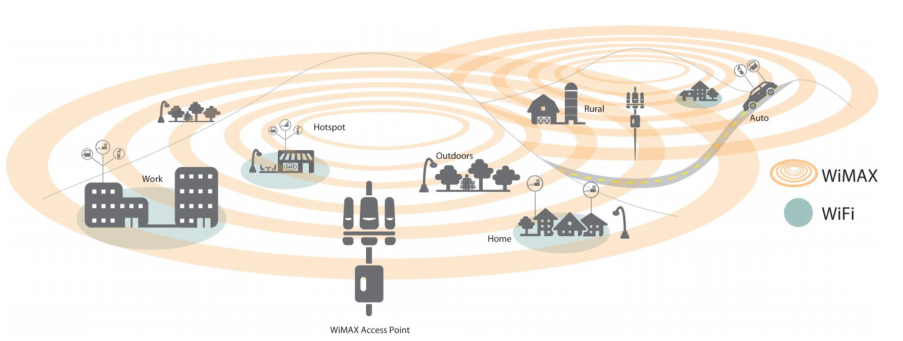
Figure 1. WiFi Base Station Application
In our effort to change the playing field, we have taken a step ahead to incorporate human factors and pleasurable emotion in the product outlook by applying Ergonomics Quality In Design (EQUID) (IEA, 2009) design approach. EQUID is an International Ergonomics Association (IEA) initiative to promote the integration of ergonomics into the design process where the HFE aspects and concerns are addressed during the feasibility stage, conceptual sketches and technical discussions during the design development cycle. During the ID development stage of a WiFi Base Station device, some tools which commonly used in the conventional PDP were used to address Emotional Design and Product Aesthetics’ concerns and opportunities such as Understanding User Needs through i.e Kawakita Jiro (KJ) Analysis and Benchmarking. The following sections describe the activities carried out to institutionalize ergonomics quality in Industrial Design in designing a product that meet user’s affective requirements.
USER REQUIREMENTS It is important to design a product with specifications that meet customer demands. Initial product specifications can be generated through competitive benchmarking and market analysis against successful products in the market. These aim to understand market trends, compares features and faults in existing products in the market, at the same time finding opportunities for improvement in the development of own product. By doing so, initial user requirements can be established which will act as the design guideline to be implemented in the design which will eventually be a final, user centred product. In most cases, the initial user requirements can be very broad and these user requirements can usually be grouped separately into functional requirements and affective requirements.
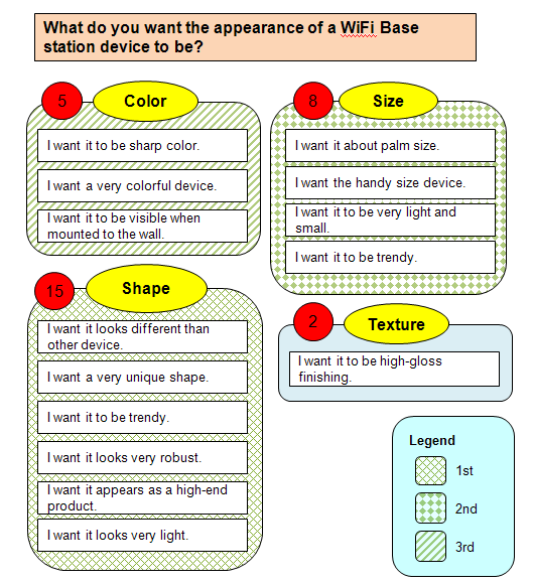
KJ Analysis At the preliminary stage of the EQUID process, initial design specifications for the product were established by translating the user needs into design requirements. This will ensure the design meets customers’ needs and expectations. User needs, in other word, Voice of Customer (VOC) were gathered and categorized into different major titles as shown in Figure 2. The VOC were then prioritized using KJ analysis. The analysis result showed shape is the most important industrial design criteria for the WiFi Base Station device with the highest scoring, followed by size and color.
Figure 2. KJ Anaysis
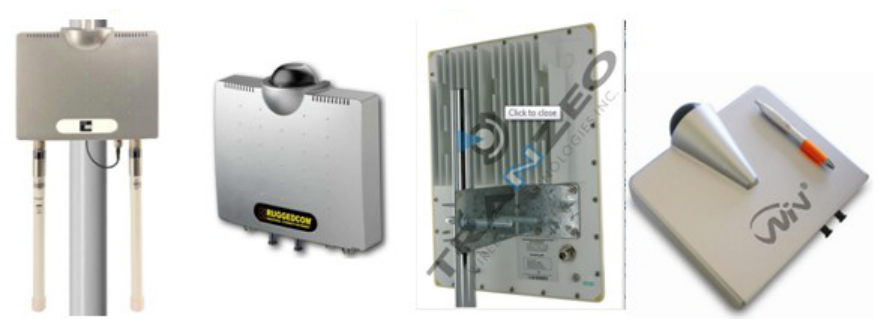
Benchmarking and Trend Analysis After the design requirements had been identified using KJ analysis, trend analysis and design benchmarking were performed as well to benchmark against similar existing products in the current market to determine the targeted affective keywords. Affective requirements are those pertaining to the look and feel as well as the pleasure a user experiences when using the product. Affective requirements are becoming more important in product design nowadays as they drive the emotion of the users when using the product. The affective descriptors captured from the benchmarking that related to the ID of this WiFi Base Station product including high performance, robust, and classic. This was the opportunity for us to improve from the existing market products by adding new affective descriptors to the new ID of this WiFi Base Station product.
Figure 3. Benchmarking Products
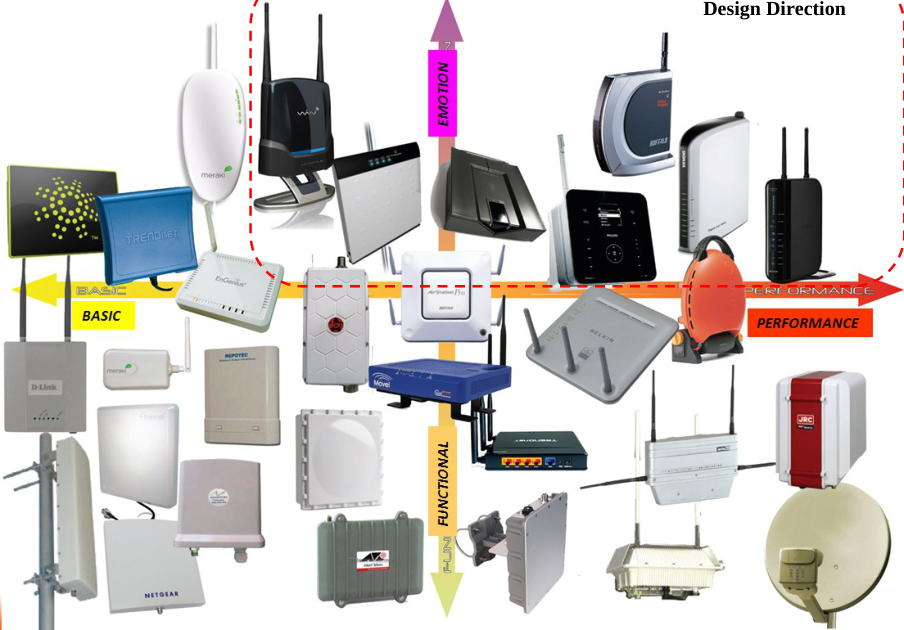
Trend analysis enabled us to understand the direction of the ID design for the current product as demonstrated in Figure 4. In order to be stood out in the market, the product ID design should have more emotional elements while appears as a high performance product. And hence, the design trend direction of the WiFi Base Station Device had been identified and new affective descriptors were added to the ID including minimalist, trendy and elegant.
Design Direction
Figure 4. Trend Analysis
ID DESIGN In this section, after many concept reviews and design tweaks, a few design concepts had been developed based on the identified design requirements.
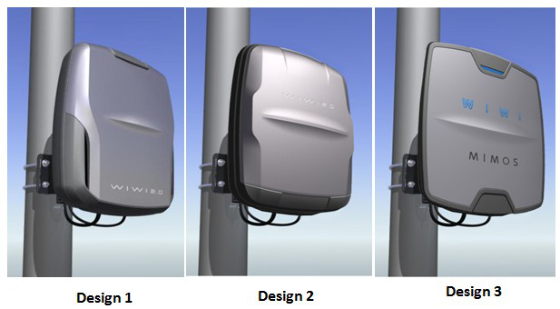
Figure 5. Three ID Design Concepts
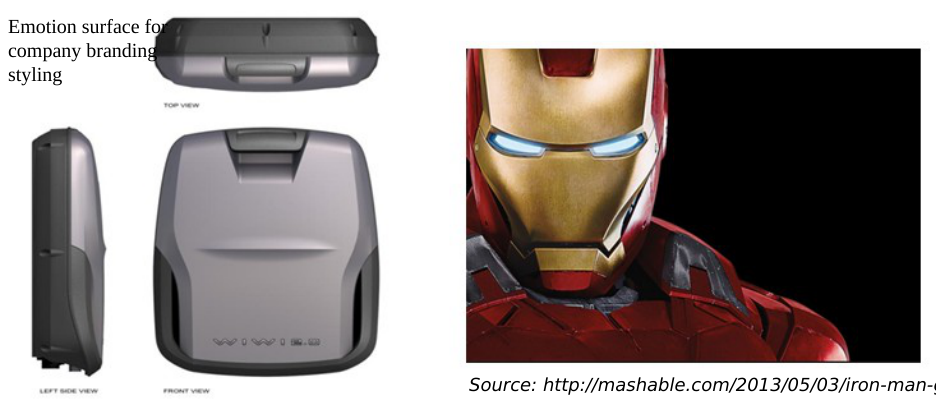
In order to be appeared as high performance and robust product, a rectangular shape with round was chosen to be the shape of this product. Based on the benchmarking, rectangular shape is widely used in most of the robust products such as military-grade walkie talkie, outdoor enclosures and so on. It is also becoming a trendy shape in recent years as we can see in most of the smart phone devices. On top of that, some profile styling and curves had added to the ID in order to make it becomes more trendy and fashionable. Design 1 is fashion driven design as it had embedded the styling of Iron Man as shown in Figure 6.
Besides the trendy styling, the emotion surface for company branding styling was also embedded into the ID of the WiFi Base Station device as illustrated in Figure 6 as well. Other than shape, color plays an important role in creating an impressive ID. Research conducted by the secretariat of the Seoul International Color Expo when asked to approximate the importance of color when buying products, 84.7 percent of the total respondents think that color accounts for more than half among the various factors important for choosing products. (Jill Morton, 2010). Three colors were considered in the ID concepts including white that associates to safe, basic, purity, efficiency, simplicity, and black that associates to elegance, mystery, expensive (empower-yourself-with- color-psychology.com, 2009-2014) and titanium color, a new color trend in the market recently that used on high performance products such as Tissot water proof watch, Nissan Fairlady Z, Lexus IS that gives impression of high performance, trendy, elegance. However, the final color will be decided based on the survey on the users on their preference color for this product.
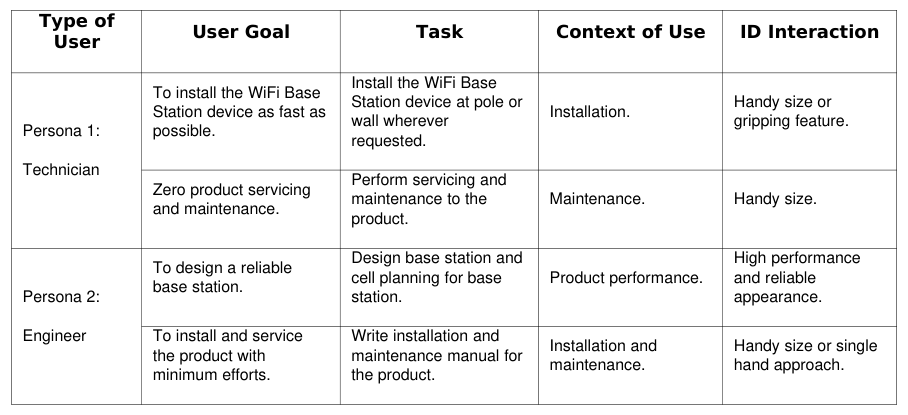
USER CENTERED DESIGN In this section of the development, the ID was evaluated and reviewed with the aim to satisfy the user requirement set forth in the previous process. As we know, ID is more on the appearance and the outlook of a product, however, it correlates with some functional features as well. The traditional design rule is always form follows function. And hence, the functions and the context of use of this WiFi Base Station device need to be captured as well. By establishing the user model, the goal of the design in the context of human factors and ergonomics could be clearly stated. This could be accomplished by defining the user scenario and personas whereby task-centric scenarios were put under careful consideration and how design features could affect user interaction. Two different personas were studied in this case: i) technician; ii) engineer. These two user categories are different due to their educational and experiential level. The interaction of the user with the product were scrutinized and understood in detail by the user task-centric method. Also, their expectation on the ID of this product could also be addressed. In this process, the ID design was reviewed and iterated based on the developed user model and criteria.
Table 1: User Task Model of WiFi Base Station Device
DESIGN ASSESSMENT
Method
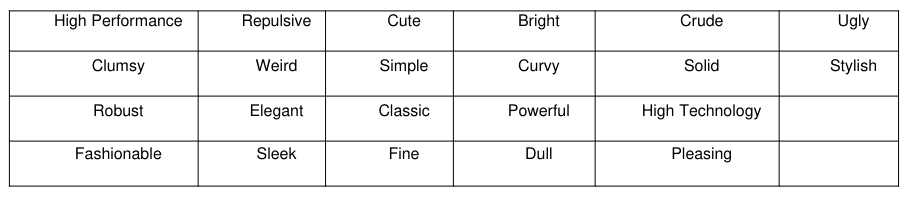
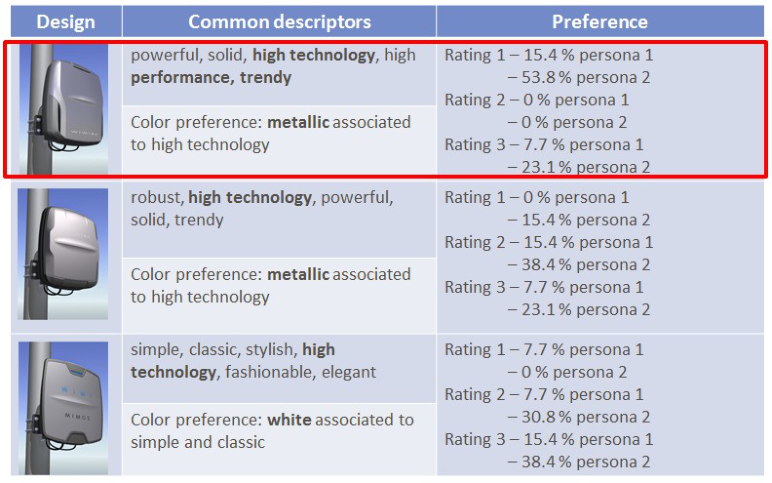
Three designs above were given to the two groups of personas as mentioned above. They are required to write their affective descriptors for each ID design and rate their preference. Rating 1 is the most preferred and rating 3 is the least preferred. Table 2 below shows some examples of affective descriptors given to the respondents as reference and they were allowed to write other descriptors which were not in the table.
Table 2: Example of Affective Descriptors
Results
Figure 7. ID Design Survey Results
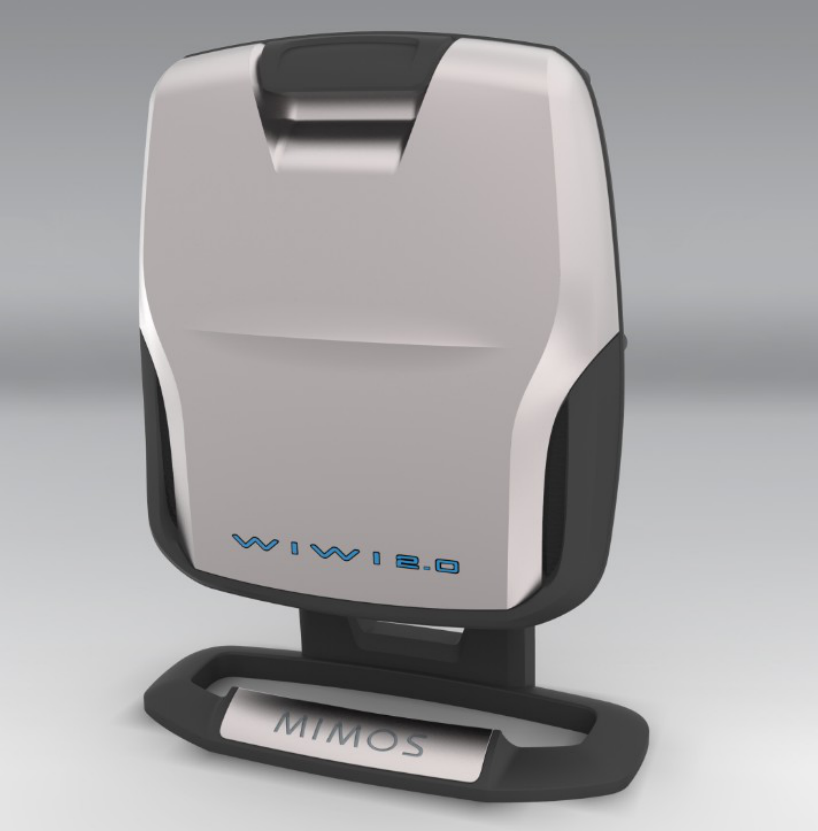
The above result (see Figure 7) shows design 1 was the most preferred design by both personas. The design gave the impression of powerful, high technology and trendy to them which had met the initial design requirements. This also showed more than 50% of the persona 2 voted for design 1 as their expectation on the ID was a high technology appearance product. The color preference for the design was metallic color (in this case we selected the titanium color) which associated to high technology as well. Figure 8 illustrates improved ID for the WiFi Base Station device based on the inputs and survey results.
Figure 8. Improved ID of WiFi Base Station
CONCLUSIONS
The need to address Emotional Design and Product Aesthetic aspects for Industrial Design demands structured methodologies which the focal issues normally revolves around visual fluency and perceived hedonic quality while primarily satisfies the usefulness and ease of use. The systematic process, in conformance to EQUID framework, supported by an empirical scientific checklist helped designers to capture user requirements both functional and affective design. With new user requirements addressed, the new product is aesthetically more appealing and more likely to fulfill emotional attributes.
REFERENCES
Busri, S. (2009), “WiWi 1.8 ID Review”, unpublished. Busri, S. (2010), “Industrial Design for WiWi 2.0”, unpublished. Choong, S.L., Munir. F., Saidin, S., W. Sulaiman, W. M. A., Senin, N (2012), “Modeling MEMS Sensor Device for Green House Application”, 2nd International Conference of the South East Asian Network of Ergonomics Societies (SEANES). IEA (2009), EQUID. Communication at the EQUID Technical Committee Meeting, IEA 2009 Congress, Beijing, China. Khalid, H.M. (2009), “HumanFactors in Product Design, Mastery Level Course”, Damai Sciences, Kuala Lumpur. Morton. J. (2010), Why Color Matters, The Website:
http://www.colorcom.com/research/why-color-matters Packaging Color. The website: http://www.empower-yourself-with-color-psychology.com/packaging-colors.html Reynolds, C., Picard, R.W., “Designing for Affective Interactions”, The Website:
http://www.agent.ai/doc/upload/200605/reynolds-Designing_for_Affective_Interactions.pdf Wahib, K.N. (2010), “Adopting EQUID in MIMOS Product Design and Development Process: The Framework”, unpublished. Wong, S.J., Senin, N., Wahib, K.N., (2011), “User Centered Approach in Affective Design of a Handheld PC”, 10th International Symposium on Human Factors in Organisational Design and Management (ODAM).
LISTED IN THE AHFE DIGITAL BOOKSTORE CATALOGUE
Explore the complete digital volume
Advances in Affective and Pleasurable Design
Read this individual research paper free through the original publisher, or explore the full digital proceedings book.
ISBN 978-1-4951-2109-8
Explore this ISBN in the AHFE Bookstore ↗Listed in the July 2026 bookstore catalogue; search by ISBN to confirm current availability · Digital book purchase optional