Aline Santos, Ana Ferrari, Fausto Medola, Anselmo Frizera, Frode Sandnes (2021). Physical Activity of Brazilian Adults with Visual Impairment: A Descriptive Study. In: Human Systems Engineering and Design (IHSED2021): Future Trends and Applications. AHFE Open Access, vol. 21. https://doi.org/10.54941/ahfe1001202
Physical activity (PA) contributes to a healthy lifestyle, while physical inactivity can be considered a public health concern, especially among adults living with a disability. This study set out to investigate the PA levels of Brazilian adults with visual impairments. Findings suggest that most of the participants met the WHO recommendation and, therefore, were considered physically active. Older adults and adults with obesity had lower levels of moderate-intensity PA. Adults with total blindness had lower levels of moderate PA than adults with partial blindness and low vision. In addition, household chores were responsible for the higher levels of moderate-intensity PA among women.
Physical activity (PA) is any type of movement produced by the muscles that require energy expenditure (World Health Organization, 2020). To be considered as physically active, the World Health Organization (2020) recommends that adults should do at least 150 minutes of moderate-intensity PA or at least 75 minutes of vigorous-intensity PA throughout the week.
Regular PA has many physical and psychological health benefits, contributing to the prevention of several diseases including cardiovascular diseases, diabetes, obesity, hypertension, cancer, and depression (Bauman, 2004; Silva et al., 2019, World Health Organization, 2020). Still, it has been estimated that approximately one third of the world population is not physically active (Silva, Marques and Reichert, 2018). Among visually impaired adults, the level of PA is even lower if compared to adults without disability (Sadowska and Krzepota, 2015). According to Silva, Marques and Reichert (2018), 40% of Brazilians adults with visual impairment do not meet the WHO PA recommendations.
Physical activity can be measured subjectively and objectively. Subjective measures include validated questionnaires, for example, the widely used International Physical Activity Questionnaire Short-Form (IPAQ-SF), which has been translated and validated in several countries (Barbosa et al., 2019). However, self-reported measures can overestimate time spent in PA (Kingsley et al., 2019). To obtain more accurate and reliable data, studies have used activity monitors and accelerometers to objectively measure the levels of PA (Bajaj et al., 2018; Barbosa et al., 2019).
The ActiGraph is a commercially available wearable activity monitor, composed of a triaxial accelerometer, that provides the intensity levels of PA and it is frequently used in research (Bajaj et al., 2018; Collins et al., 2019). ActiGraph can be worn on several parts of the body, including the hip, ankle, and wrist. Although many studies wore the ActiGraph around the waist, the use of accelerometers on the wrist can improve participant wear-time (Kingsley et al., 2019).
Even though some studies focused on the PA levels of visually impaired adults (Holbrook et al., 2009; Sadowska and Krzepota, 2015; Silva, Marques and Reichert, 2018, Barbosa et al., 2019), there is still unanswered questions regarding the relationship between visual impairment and PA, especially in low-GDP countries such as Brazil (Silva, Marques and Reichert, 2018). This study therefore set out to investigate the PA practice of Brazilian visually impaired adults.
Human Systems Engineering and Design (IHSED 2021) https://openaccess.cms-conferences.org/#/publications/book/978-1-7923-8987-0
MATERIALS AND METHODS
A total of 11 adults with visual impairment were recruited in Bauru, Brazil, between October 2019 and March 2020 using convenience sampling. The participants mostly comprised volunteer and former students of the Lar Escola Santa Luzia para Cegos. This study was approved by the Ethics Committee of the School of Architecture, Arts and Communication, at the São Paulo State University - UNESP (Process n. 3.488.703). Participants were informed about the study and their verbal consent was obtained.
Participants were asked to wear the ActiGraph GT9X Link activity monitor (ActiGraph Corporation, Pensacola, FL, USA) during one week on the wrist. They received instructions on how to position the monitor on the wrist and were instructed to maintain their daily activities, removing the monitor while sleeping and during water-based activities such as bath or swimming. A journal was kept over the phone to follow the routine of participants regarding time intervals of wear and non-wear, and activities performed throughout the day.
Data was sampled at 100Hz and analyzed in 60s epochs using the Actilife software (Actilife, version 6, ActiGraph, Pensacola, FL, USA). Intervals with at least 60 consecutive minutes of zero counts were considered non-wear time and were removed from the analysis, according to the algorithm proposed by Troiano et al. (2008).
Participants’ data were excluded if (i) they presented mobility problems or health problems that influenced their daily mobility, and (ii) recorded less than three days of wearing the activity monitor (including at least one day during the weekend). The data from the first and the last day (initialization and return) were discarded. Day- samples were discarded if less than 480 min of physical activity were recorded during a day. Two participants were excluded due to mobility and health problems and one was excluded because the requirements of the monitor usage were not achieved. Two participants reported to have slept with the monitor, so in these cases a filter was applied based on the time they declared to have slept and woke up according to their journal.
The classification of physical activity levels was established according to the cut- off proposed by Troiano et al. (2008). The authors established the following counts/min intervals: 0-99 counts for sedentary behavior; 100-2019 counts for light physical activity (LPA); 2020-5998 counts for moderate physical activity (MPA); and > 5999 counts for vigorous physical activity (VPA). Participants who met the recommendation of at least 30 minutes of moderate-to-vigorous physical activity (MVPA) were considered physically active. Descriptive statistics were computed using JASP version 0.14.1.
RESULTS AND DISCUSSION
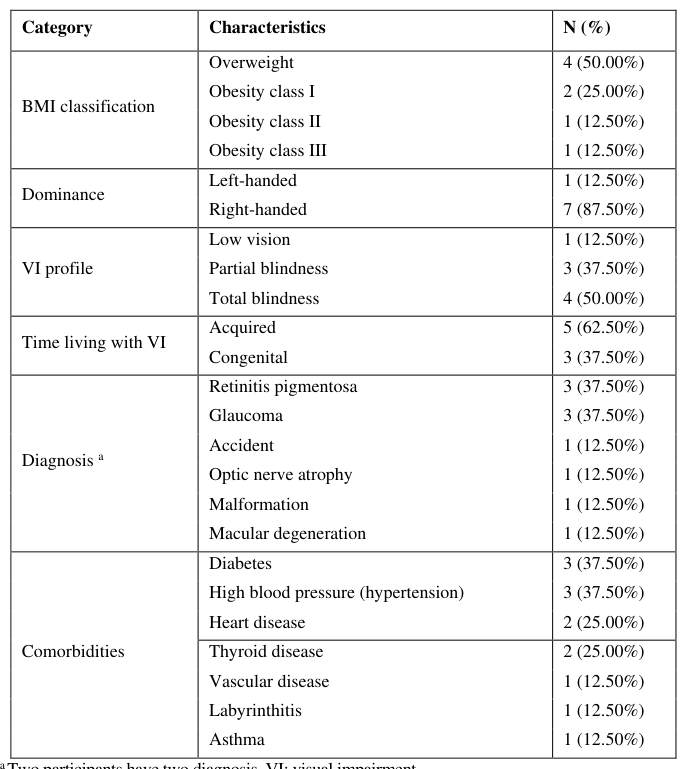
The final sample was composed of 8 adults with visual impairment, aged 30 to 70 (mean age = 52.13 ± 12.78), 62.50% male (n = 5), 37.50% female (n = 3), 50% self-
Human Systems Engineering and Design (IHSED 2021) https://openaccess.cms-conferences.org/#/publications/book/978-1-7923-8987-0 declared totally blind, 37.50% partially blind, and 12.50% self-declared as low vision. All the participants had completed the Orientation and Mobility course and used a mobility aid to assist their daily locomotion: 87.50% used a white cane, and one person (12.50%) used a camping walking stick. Regarding body composition, our sample presented an average height and weight of 1.64 m (SD 0.08) and 84.63 kg (17.23), respectively. Our study revealed an average of body mass index (BMI) of 31.47 kg/m2 (SD 6.47), with half of the sample being classified as overweight, and the other half considered obese, according to World Health Organization categories (World Health Organization, no date). Similar results were reported by Holbrook et al. (2009). All the participants chose to wear the ActiGraph on the left wrist. Table 1 lists participant details.
Table 1: Physical characteristics of participants (n = 8).
a Two participants have two diagnosis. VI: visual impairment.
Human Systems Engineering and Design (IHSED 2021) https://openaccess.cms-conferences.org/#/publications/book/978-1-7923-8987-0
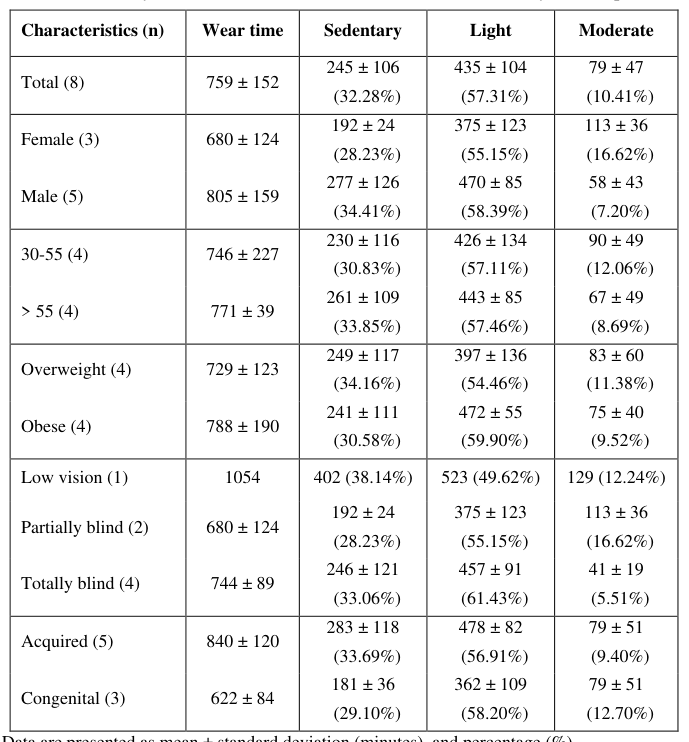
Participants spent 89.63% of the day on sedentary and light activities, 57.31% on light physical activities and 10.41% on moderate physical activities (approximately 79 minutes). Vigorous physical activities were not observed in this sample. The activity monitor was used, on average, for 4 valid days (SD 1.13) for 759 min/day (SD 152). Most participants (87.50%) met the WHO minimum recommendation of MVPA and, therefore, were considered physically active (≥ 30 min/day of MVPA). Only one person (12.50%), did not meet the WHO physical activity recommendations (MVPA = 29 min/day). Table 2 lists the distribution of time spent on PAs with different intensities.
Table 2: Daily distribution of wear time and PA levels assessed by ActiGraph.
Human Systems Engineering and Design (IHSED 2021) https://openaccess.cms-conferences.org/#/publications/book/978-1-7923-8987-0
Overall, women exhibited higher levels of MVPA than men. According to the journal, women’s MVPA counts correlated with household chores. Espinel et al. (2015) also observed that household chores were the main source of light and moderate intensity physical activities in Australian older adults.
Regarding age range, younger participants (aged 30 to 55) had higher levels of MVPA, which corroborates the results of Silva, Marques and Reichert (2018) that older individuals were more likely to be inactive. Considering the aging of the world population and the relationship between ageing and visual impairment, this result may suggest the need for initiatives that promote the practice of PA. Participants with obesity had lower levels of MPVA. Given the association of obesity with reduced psychosocial health, and the benefits that regular PA has on comorbidities including obesity, PA should be further encouraged (Saris et al., 2003). The International Association for the Study of Obesity (IASO) suggests at least 45 minutes of MVPA to prevent the transition to overweight and obesity (Saris et al., 2003).
Totally blind participants showed lower levels of MPVA (41 ± 19 min/day) than participants with low vision and partial blindness (117 ± 30 min/day); however, the time living with visual impairment (congenital or acquired) did not reveal any differences. Participants presented high levels of MVPA (87.50% were considered active), which is similar to observations reported by Silva, Marques and Reichert (2018). However, this finding should be interpreted with caution as it may not be representative of the visually impaired population. Although ActiGraph is considered an accurate instrument, comparisons with previous work are challenging. Sadowska and Krzepota (2015) and Silva, Marques and Reichert (2018) evaluated the PA of visually impaired adults using version GT3x worn on the participants’ hip, while version GT9X Link worn on the wrist was used in this study. The wrist-worn monitor was chosen due to its wear practicality, which facilitates the wearability for visually impaired people, and the potential to improve the participant wear-time (Kingsley et al., 2019). Different versions of instruments and placement on different parts of the body make it difficult to compare the observations fairly. Although accelerometers worn on the wrist have been used in large-scale studies (Wennman et al., 2019; Liu et al., 2021), the results should be interpreted with caution.
Limitations of this study include the small sample size and large variations in types of visual impairment. Therefore, the current findings may not be representative for all people with visual impairment. Also, due to the small sample size, results were presented with descriptive statistics. Another aspect that should be taken into consideration in this study is the cut off points adopted to classify the intensity of activities. To the best of our knowledge, there is not a validated cut-point for determining the intensity of PA for ActiGraph worn on the wrist. The algorithms available at the Actilife software are validated for the waist. Troiano et al. (2008) algorithm was chosen for this study because it presented the closest data to the routine reported by the participants in their journal. For example, the cut-point proposed by Sasaki, John and Freedson (2011) showed an overestimation of time spent in MVPA.
Human Systems Engineering and Design (IHSED 2021) https://openaccess.cms-conferences.org/#/publications/book/978-1-7923-8987-0
CONCLUSIONS
This study explored the levels of PA among a small sample of adults with visual impairments. The results indicate that the sample was physically active according to the WHO recommendations. However, we observed differences among the sample regarding the MVPA. Household chores were the main source of physical activity among women, who had higher levels of MVPA in comparison to men. Participants with total blindness had less than half of MVPA than participants with partial blindness and low vision. We also observed that older adults and adults with obesity had lower levels of MVPA. Considering that physical inactivity is a global health concern, and given the benefits of PA to the health, well-being, and quality of life, it is important to provide initiatives to stimulate the practice of PA among people with visual impairment.
ACKNOWLEDGMENTS
This work was supported by São Paulo Research Foundation (FAPESP) under Grant 2019/14438-4, National Council for Scientific and Technological Development - CNPq (Process 310661/2017-0; Process 427496/2016-0) and Coordenação de Aperfeiçoamento de Pessoal de Nível Superior – Brasil (CAPES) – Finance Code 001. We also would like to thank Lar Escola Santa Luzia para Cegos de Bauru for the support and to all of the participants in this study.
REFERENCES
Bajaj, R. et al. (2018) ‘Validating the accuracy of an activity monitor in a visually impaired older population’, Ophthalmic and Physiological Optics, 38(5), pp. 562–569. Barbosa, D. G. et al. (2019) ‘Rating of perceived capacity: A proposal to predict
adequate levels of physical activity in visually impaired individuals’, Journal of Sports Medicine and Physical Fitness, (October 2018), pp. 274–282. Bauman, A. E. (2004) ‘Updating the evidence that physical activity is good for health: an epidemiological review 2000–2003’, Journal of Science and Medicine in Sport, 7(1), pp. 6–19. Collins, J. E. et al. (2019) ‘Validation of the fitbit charge 2 compared to the actigraph
GT3X+ in older adults with knee osteoarthritis in free-living conditions’, PLoS ONE, 14(1), pp. 1–14. Espinel, P. T. et al. (2015) ‘Older adults’ time in sedentary, light and moderate intensity activities and correlates: Application of Australian Time Use Survey’, Journal of Science and Medicine in Sport, 18(2), pp. 161–166.
Human Systems Engineering and Design (IHSED 2021) https://openaccess.cms-conferences.org/#/publications/book/978-1-7923-8987-0
Holbrook, E. A. et al. (2009) ‘Physical activity, body composition, and perceived quality of life of adults with visual impairments’, Journal of Visual Impairment and Blindness, 103(1), pp. 17–29. Kingsley, M. I. C. et al. (2019) ‘Journal of Science and Medicine in Sport Wrist-
specific accelerometry methods for estimating free-living physical activity’, Journal of Science and Medicine in Sport, 22(6), pp. 677–683. Liu, W. et al. (2021) ‘Relationships between College Students’ Sedentary Behavior, Sleep Quality, and Body Mass Index’, International Journal of Environmental Research and Public Health, 18(8): 3946. Sadowska, D. and Krzepota, J. (2015) ‘Assessment of Physical Activity of People
with Visual Impairments and Individuals who Are Sighted Using the International Physical Activity Questionnaire and Actigraph’, Journal of Visual Impairment & Blindness, 109(2), pp. 119–129. Saris, W. H. M. et al. (2003) ‘How much physical activity is enough to prevent unhealthy weight gain? Outcome of the IASO 1st Stock Conference and consensus statement’, Obesity Reviews, 4(2), pp. 101–114. Sasaki, J. E., John, D. and Freedson, P. S. (2011) ‘Validation and comparison of
ActiGraph activity monitors’, Journal of Science and Medicine in Sport, 14(5), pp. 411–416. Silva, F. M. et al. (2019) ‘The sedentary time and physical activity levels on physical fitness in the elderly: A comparative cross sectional study’, International Journal of Environmental Research and Public Health, 16(19), pp. 1–11. Silva, R. B. P. Da, Marques, A. C. and Reichert, F. F. (2018) ‘Objectively measured
physical activity in Brazilians with visual impairment: Description and associated factors’, Disability and Rehabilitation, 40(18), pp. 2131–2137. Troiano, R. P. et al. (2008) ‘Physical activity in the United States measured by accelerometer’, Medicine and Science in Sports and Exercise, 40(1), pp. 181– 188. Wennman, H. et al. (2019) ‘Gender, age and socioeconomic variation in 24-hour
physical activity by wrist-worn accelerometers: the FinHealth 2017 Survey’, Scientific Reports, 9(1), pp. 1–9. World Health Organization (2020) Physical activity. Available at: https://www.who.int/news-room/fact-sheets/detail/physical-activity (Accessed: 14 May 2021). World Health Organization (no date) Nutrition - Body mass index - BMI. Available at: https://www.euro.who.int/en/health-topics/disease-prevention/nutrition/a- healthy-lifestyle/body-mass-index-bmi (Accessed: 14 May 2021).
Human Systems Engineering and Design (IHSED 2021) https://openaccess.cms-conferences.org/#/publications/book/978-1-7923-8987-0
LISTED IN THE AHFE DIGITAL BOOKSTORE CATALOGUE
Explore the complete digital volume
Human Systems Engineering and Design (IHSED2021): Future Trends and Applications
Read this individual research paper free through the original publisher, or explore the full digital proceedings book.
ISBN 978-1-7923-8987-0
Explore this ISBN in the AHFE Bookstore ↗Listed in the July 2026 bookstore catalogue; search by ISBN to confirm current availability · Digital book purchase optional