Yi Lin Wong (2021). Dynamics among User, Management and Policy: A Case Study of Playgrounds during the COVID-19 Pandemic in Hong Kong. In: Human Systems Engineering and Design (IHSED2021): Future Trends and Applications. AHFE Open Access, vol. 21. https://doi.org/10.54941/ahfe1001129
Playgrounds were also closed off to prevent children from having close contacts with others to prevent the spread of the COVID-19 pandemic. Field visits were carried out to investigate the situation. It was found that many play facilities were closed off by using barrier tapes and barricades, and some children and their caregivers still played in the playground. However, the management company and policy-makers were unable to respond to children's and caregivers’ needs. The paper thus suggests a user-management-policy (UMP) model illustrating the ideal communication and collaboration among user, management company and policy-makers in an existing facility.
Human Systems Engineering and Design (IHSED 2021) https://openaccess.cms-conferences.org/#/publications/book/978-1-7923-8987-0
INTRODUCTION
Since early 2020, the Hong Kong Government had adopted different kinds of social distancing measures to prevent the spread of COVID-19. One of the social distancing measures concerned the number of persons involved in group gathering in public space. Before February 24, 2021, group gathering in public space was limited to only two persons (HK01, 2021). In order to maintain usual everyday life to the largest extent, the organizers of public events and business activities had adopted different measures to keep the number of social gathering. For instance, some organizers would assign standing points for every two persons when queueing. They would use different kinds of boards to make partitions for every two persons. Regardless of the effectiveness of pandemic prevention, these methods are widely adopted in Hong Kong. However, when public facilities are concerned in a public space, the measures are totally different. Public facilities are managed by different government departments and some non- government organizations (NGOs) depending on the location and use of the facilities. However, the management tasks are often outsourced to private management companies. In order to prevent people to gather in the public spaces and use public facilities that are managed by them, their staff would use barrier tapes to enclose the area and the facilities to stop people from using them. Figure 1 shows a set of facilities for playing Chinese chess and a recycling hub for used clothes. The set of facilities for playing Chinese chess was closed off by barricades and barrier tapes. The recycling hub was wrapped by barrier tapes. Although it is still understandable to enclose the Chinese chess facilities, it is exaggerated for the property management company to take such measure. It is also questionable why the recycling hub had to be closed. Residents even put their used clothes onto the hub, as they could not throw the clothes inside the hub.
Figure 1. Chinese chess facilities (left) and recycling hub for used clothes (right) during the COVID-19 pandemic
Human Systems Engineering and Design (IHSED 2021) https://openaccess.cms-conferences.org/#/publications/book/978-1-7923-8987-0
Many public facilities were being treated similarly. One of the most significant public facilities that were closed off was the play facilities in the children’s playground. As play is important for children’s development and play is children’s ‘business’ (Brett, Moore & Provenzo, 1993; Bruner, 1975; James, 1993), stopping children to play in playgrounds had overlooked children’s needs to some extent. Provided that Hong Kong’s homes are generally small, and most children in an ordinary family have very limited space for play at home, they had lost an outdoor place for them to release their energies. In order to address and understand the issue, the paper aims at examining the situation of play facilities in Hong Kong during the COVID-19 pandemic and develop models to analyze the situation PLAY FACILITIES DURING THE COVID-19 PANDEMIC
Overview As play is important for children’s development and play is children’s ‘business’, the need to play became more overwhelming when the social distancing measures persisted. In the previous year, the Hong Kong Government had closed public children’s playgrounds for several times, as children have a lower personal hygiene awareness and thus a higher chance to get infected. This policy was applicable in all playgrounds managed by the Leisure and Cultural Services Department and Housing Department. The Leisure and Cultural Services Department requires members of the public to wear masks, keep a social distance when using play facilities (The Government of the Hong Kong Special Administrative Region, 2021a). The number of people gathering in the playground should not exceed the maximum number of people involved in group gathering as stated in the social distance measure. The Housing Department urges the caregivers to sanitize children’s hands before using the facilities. Caregivers should not allow children with fever or symptoms of respiratory tract infection to enter playgrounds (The Government of the Hong Kong Special Administrative Region, 2021b).
Despite the enactment of this policy, some Hong Kong caregivers complained about playground closure (HK01, 2021). They stated that facilities such as tennis court and basketball court were still open to the public, and a temperature checking point that was managed by staff was set up at the entrance of the court. Disney Land was also open to the public during the pandemic. It was questionable why public playgrounds were still close for such a long period. Children were in need to use playgrounds to play, and the caregivers believed that it was necessary to reopen the playgrounds. From this piece of news, it is clear that caregivers and children understand the importance of playgrounds in the community Field visits
Human Systems Engineering and Design (IHSED 2021) https://openaccess.cms-conferences.org/#/publications/book/978-1-7923-8987-0
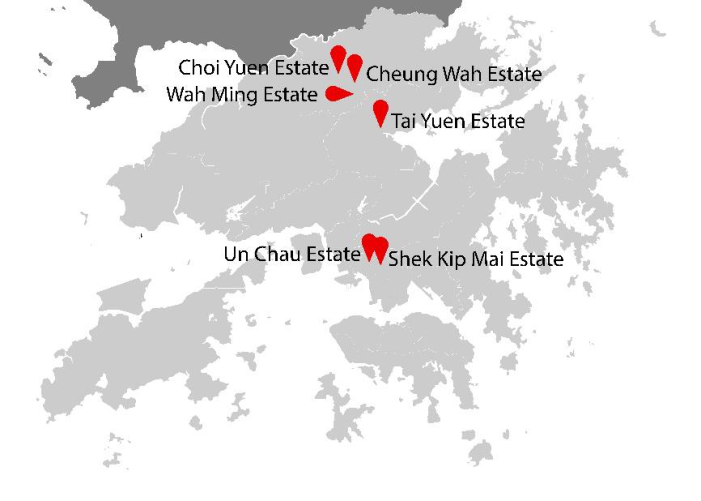
Field visits were carried out during the closure period. Playgrounds in six Hong Kong public housing estates were visited to investigate the status of the facilities. The locations of the six public estates are shown in Figure 2 below.
Figure 2. Locations of the playgrounds in the six public housing estates.
Photos were taken to record how the management company closed off the play facilities in playgrounds. Other facilities that were related to the playgrounds were also investigated.
FINDINGS Play facilities and facilities next to them
It was found that all play facilities were closed off in the visited playgrounds in the six public housing estates. However, the play areas or the playgrounds were not closed. Notices were posted on the barricades that were used to close off the play facilities to explain the reason for closure (Figure 3). On the notice, it was clearly stated that the reasons were to enhance cleansing and to maintain hygiene.
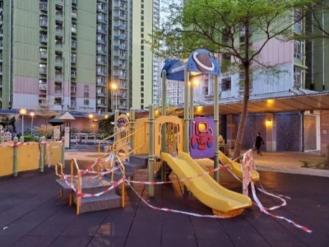
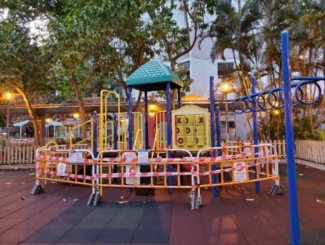
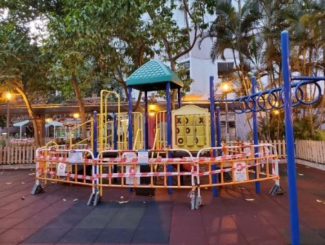
Play facilities were closed off using barrier tapes (Figure 4) and/or barricades (Figure
Human Systems Engineering and Design (IHSED 2021) https://openaccess.cms-conferences.org/#/publications/book/978-1-7923-8987-0
5). In Figure 4, the barrier tapes were loosened, and the staff from the management company or security staff had no intention to fix them.
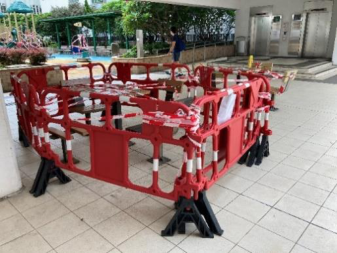
As mentioned above, barricades were also used to close off play facilities. Figure 5 shows a play facility being closed off using barrier tapes and barricades. The functions of the barrier tapes were to fix the barricades and to stop people from moving the barricades away. Other facilities such as the overhead leaders or rings (the facility in blue in Figure 5) had no barrier tapes around them.
Figure 3. Notices on the barricades that were used to close off the play facilities.Figure 4. A play facility being closed off using barrier tapes.Figure 6. Seats next to a playground.Figure 5. A play facility being closed off using barrier tapes and barricades.
Facilities next to the playgrounds were also closed off. These include benches that allow caregivers to take rest and wait for their children in the playgrounds. The benches were closed off by using barricades as shown in Figure 6. Although the benches could also be used by other residents in the public housing estates without exceeding the maximum number of group gathering, the management company still chose to stop people from using them.
Human Systems Engineering and Design (IHSED 2021) https://openaccess.cms-conferences.org/#/publications/book/978-1-7923-8987-0
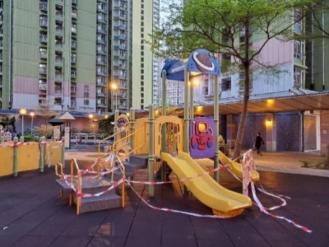
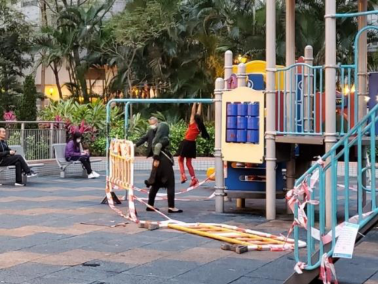
Users Although the management company did not allow residents from using the playgrounds and the play facilities, some children and their caregivers ignored the notice and were playing there. In Figure 7, a girl and her caregiver entered the closed- off area, and the girl played at the overhead ladder. The barricade fell off, and the barrier tapes were loosened.
Most of these children and caregivers were not intended to go to the playground to play. They only stayed in the playground for few minutes, and they would go away. Most of them were passing by, as the security staff would approach them to request them to leave.
Figure 7. Seats next to a playground.
DISCUSSIONS Based on the findings and field observation, it is clear that there is a mismatch between the government policy and the expectation of the users. Policy-makers did not consider users’ needs. The management company staff followed the policy, adopted corresponding measures to the playgrounds and avoided users from using the play facilities. Obviously, there is a relationship among the policy, users, and the management. The ‘Policy-Implementation-Management’ (PIM) model developed by Siu and his colleagues depicts the relationships among different parties (Siu, 2009; Siu, Lu & Xu, 2009), and it may be applicable to analyze the findings. In the model, policy, implementation and management are interrelated. In order to build a quality public space for the users, policy-makers have to communicate with the designers on how the facilities should be built. Designers have to communicate with the management company to decide how the facilities are managed. A feedback system is needed for these three parties to improve policy, implementation and management. The public, i.e., the users, is the center of the model, and all decisions made should
Human Systems Engineering and Design (IHSED 2021) https://openaccess.cms-conferences.org/#/publications/book/978-1-7923-8987-0 fit users’ needs. Communications are needed between the users and the other parties.
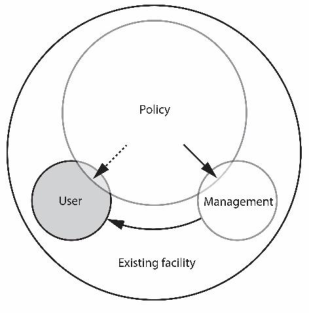
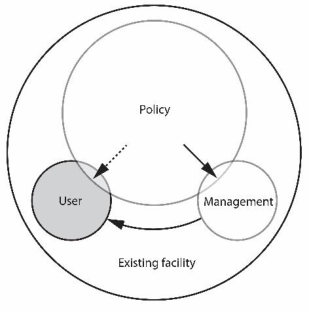
The model explicates an ideal relationship and collaboration among policy-makers, designers, and management company. However, it seems that the model is more applicable when the design of the public facility is still in the developmental stage. Nevertheless, the elements in the model are useful to analyse the current phenomenon observed in the playgrounds. Figure 8 shows the relationships among policy, user and management during playground closure. Different from the ‘implementation’ in the PIM model, the implementation element in Figure 8 refers to a fixed design that is already built at the site. Designers may also be able to involve in the implementation of design; however, in the case of playgrounds, designers can only be involved in how other supporting facilities can be implemented. All other elements have to work in this fixed environment. In Figure 8, users were not the center of the issue. They had to passively follow the policy and the measures adopted by the management company. No feedback system was given to users and the management company to express their needs and difficulties.
Figure 8. Relationships among user, management and policy (UMP) during playground closure (the dotted line represents indirect communication).Figure 9. Ideal relationship between user, management and policy (the UMP model) (the dotted line represents indirect communication).
A more ideal relationship among user, management and policy (UMP) is illustrated in Figure 9. In this model, the user is the center of all issues. Considerations in policy and management should fit the users’ needs despite the fixation in the existing facilities. Although there is no direct communication between policy and user, policy- makers should also be sensitive to users’ needs by making use of the information from the mass media and also feedback from the management company. In this way, different effective measures would be able to introduce to fit users’ needs. The UMP model is applicable when the facility already exists, and no further change in the design is expected.
Human Systems Engineering and Design (IHSED 2021) https://openaccess.cms-conferences.org/#/publications/book/978-1-7923-8987-0
CONCLUSIONS
The paper reviews the issue of the public facility closure during the COVID-19 pandemic. Playgrounds and play facilities, that are considered as the most important public facilities for children, were also closed off. Therefore, field visits were carried out to investigate the situation. It was found that although play facilities were closed off by using barrier tapes and barricades, some children and their caregivers still approached the facilities and played in the playground. This shows their pressing need for playing; however, the management company and policy-makers were unable to respond to this need. The paper suggests a user-management-policy (UMP) model illustrating the ideal communication and collaboration among user, management company and policymakers in an existing facility. It is believed that this model could be applicable in many existing public facilities to improve their quality of and the services provided by them.
ACKNOWLEDGMENTS
The authors would like to acknowledge the support provided by The Hong Kong Polytechnic University for the research.
REFERENCES
Brett, A., Moore, R.C. and Provenzo, E.F. Jr. (1993) The Complete Playground Book.
New York: Syracuse University Press. Bruner, J. (1975) ‘Play is Serious Business’, Psychology Today, 8, p.83. Charltons (2020) Hong Kong Government Announces New Social Distancing Measures. Available at: https://www.charltonslaw.com/hong-kong- government-announces-new-social-distancing-measures/ HK01 (2021) A Hong Kong Father Complains LCSD seven times, Requesting to
Reopen Children’s Playground. Available at: https://www.hk01.com/隠形香港 /605095/港爸七度投訴康文署-求解封兒童遊樂場-非人人有錢到主題樂園 James, A. (1993) Childhood Identities: Self and Social Relationships in the
Experience of the Child. Edinburgh: Edinburgh University Press. Siu, K.W.M. (2009) ‘Quality in Design: Policy, Implementation and Management’, in Siu, K.W.M. (ed.), New Era of Product Design: Theory and Practice. Beijing: Beijing Institute of Technology Press, pp. 3-15. Siu, K.W.M., Lu, J.Y. and Xu, P. (2009) ‘Design Standard of Tactile Guide Paths in
China, Policy, Implementation and Management’, in Gomes, J.F.S. and Meguid, S.A. (eds.), Proceedings IRF’2009: Integrity, Reliability & Failure: Challenges and Opportunities. Porto: Edicốes Instituto de Engenharia Mecanica e Gestao Industrial, pp. 421-422.
Human Systems Engineering and Design (IHSED 2021) https://openaccess.cms-conferences.org/#/publications/book/978-1-7923-8987-0
The Government of the Hong Kong Special Administrative Region (2021a) Housing Authority to reopen children's play facilities tomorrow, Available at: https://www.info.gov.hk/gia/general/202103/31/P2021033100459.htm The Government of the Hong Kong Special Administrative Region (2021b) Latest
arrangements for LCSD public services. Available at: https://www.info.gov.hk/gia/general/202103/31/P2021033000598.htm
Human Systems Engineering and Design (IHSED 2021) https://openaccess.cms-conferences.org/#/publications/book/978-1-7923-8987-0
LISTED IN THE AHFE DIGITAL BOOKSTORE CATALOGUE
Explore the complete digital volume
Human Systems Engineering and Design (IHSED2021): Future Trends and Applications
Read this individual research paper free through the original publisher, or explore the full digital proceedings book.
ISBN 978-1-7923-8987-0
Explore this ISBN in the AHFE Bookstore ↗Listed in the July 2026 bookstore catalogue; search by ISBN to confirm current availability · Digital book purchase optional