Sonia Cueva Ortiz, Cesar Guevara (2021). People interaction as the driving force of the knowledge city. In: Human Systems Engineering and Design (IHSED2021): Future Trends and Applications. AHFE Open Access, vol. 21. https://doi.org/10.54941/ahfe1001132
Several authors defend that the interaction between people of diverse areas help the interchange of information, and with this the production of innovation. Barcelona's knowledge city, under the 22@Barcelona Plan, modify its land use looking for the confluency of the different interested parts and the city hall through the 22@ Society promotes the creation of the 22@Network association. The objective of this association is to start this innovative milieu through the strengthening network between the stakeholders. This organizes meetings in rotative but improvised spaces. Thus, the questions which guide this paper are: Do knowledge city spaces strengthen the spontaneous interaction? Do these interactions events contribute to the construction of an inclusive city?The objectives of this work are: i). Identify the stakeholders in the construction of the knowledge city, in the different phases of the 22 @ plan, ii). Identify the different actions, both physical and social, aimed at interaction for innovation, and iii). Describe the type of interactions that are promoted through the 22 @ Network and its variants through both public and private institutions, and an approach to spontaneous interaction. To develop these objectives, a qualitative method is used, based on a case study. It starts with a review of the official documentation of the plan and its background, interviews with various stakeholders and participant observation between 2013 and 2016. This work seeks to give greater clarity to the actions that help build the so-called innovative environment, its successes and shortcomings in terms of interaction for innovation, inclusion and equity. We found that changes in land use arise prior agreement of actors from the public, private, academic and, to a certain extent, social sectors. The process involved a constant tension among the various actors due to their different interests. It reveals a very active society, whose power struggle is taking shape on the territory, with a strong intervention of the public and private sector. The interactions of innovation are mainly preconceived by the 22@Network association. This is an interaction aimed at joining forces, with no room for dissent, with low representation of the community. We also found that there is a synergy of spontaneous interaction that goes beyond what was foreseen and the district analysed.This work delves into an important area of the knowledge city, in the construction of the innovative milieu, whose progress is of fundamental importance when a large number of cities on four continents allocate resources to its construction.
Human Systems Engineering and Design (IHSED 2021) https://openaccess.cms-conferences.org/#/publications/book/978-1-7923-8987-0
INTRODUCTION
Studies about knowledge cities (Alfaro Navarro et al., 2017; Castells & Hall, 2001) or knowledge society and its economic change (Camagni, 2017) or its innovative milieu (Dezi et al., 2018) explain as the interaction between people of diverse knowledge areas as of diverse level of the productive chain, produce an important interchange of information which can lead an innovation putting into action the so-called innovative milieu. Barcelona's knowledge city, under the 22@Barcelona Plan, municipality through the 22@ Society promotes the creation of the 22@Network association. The objective of this association is start this innovative milieu through the strengthening network between the stakeholders. This organizes meetings in rotative but improvised spaces. Thus, the questions which guide this paper are: Do knowledge city spaces strengthen the spontaneous interaction? Do these interactions events contribute to the construction of an inclusive city?
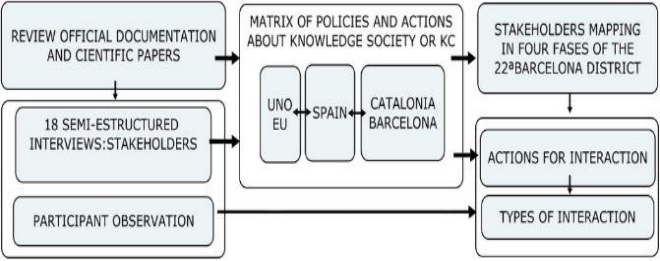
The objectives of this work are three: i). identify the stakeholders in the construction of the knowledge city, in the different phases of the 22 @ plan, ii). Identify the different actions aimed at interaction for innovation, and iii). Describe the type of interactions that are promoted. To develop these objectives, a qualitative method is used, based on a case study. It starts with a review of the official documentation of the plan and its background, 18 semi- structured interviews with stakeholders and participant observation between 2013 and 2016. We constructed a matrix of policies and actions with that information and at same time we identified stakeholders, actions and types of interactions (see fig.1).
Figure 1. Tools and work methodology This work seeks to give greater clarity to the actions that help build the so-called innovative environment, its successes and shortcomings in terms of interaction for innovation, inclusion and equity. This is structured in five parts, first for introduction, three were we development the objectives and at final the conclusion a short discussion.
Human Systems Engineering and Design (IHSED 2021) https://openaccess.cms-conferences.org/#/publications/book/978-1-7923-8987-0
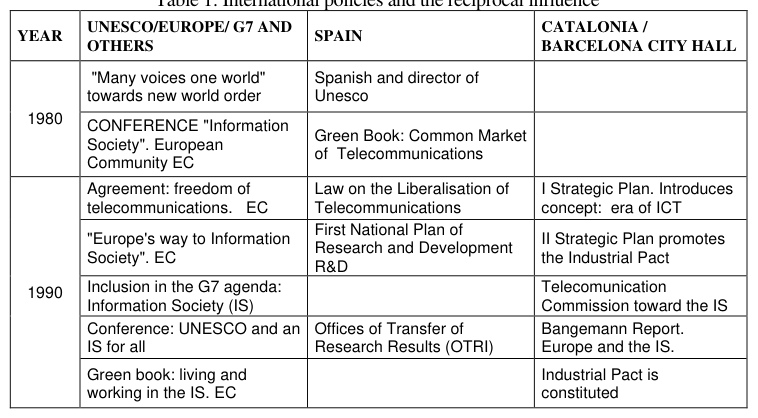
STAKEHOLDER OF THE KNOWLEDGE CITY Actors are identified at various stages of the 22@Barcelona plan, starting with the actions preceding the plan, planning, implementation and finally operation stage. Among the background, a favorable political environment is identified, a two-way influence between Catalonia and the European Commission EC regarding the construction of the Information Society IS. The EC establishes policy guidelines such as agreement on the liberalization of telecommunications by 1998, the UNESCO Conference analyzed the information society (IS) and discussed the world order stability and its economic system. In the 1996 the EC published the Green paper. Living and working in the information society.
Spain aligns itself to these policies through the same Spanish as at the time of disagreements about the IS in UNESCO, he became president (1987) and that in the mid-90s he is president of the Group of Experts of the European Council of Research for the knowledge-based economy. In the same way, one of the representatives of Spain for the European Union, he is a Catalan very related and visionary in relation to the new era that was being implanted.
At the local level, the first (I) strategic plan (SP) refers to a new economy, although its reference to the influence of knowledge is still unclear. In the 1990s, documents and policies for the different government levels consolidated the IS, and later, the knowledge society. In1997 the industrial pact with a strategic plan toward the IS is constituted. The third (III) SP aims ‘to promote the new social and urban economic transformation that the information knowledge society and 21st century requires’(Barcelona Municipality, 1999, p. 63) and moves ‘toward the information city’ (See Table 1).
Table 1: International policies and the reciprocal influence YEAR UNESCO/EUROPE/ G7 AND OTHERS SPAIN CATALONIA / BARCELONA CITY HALL
Human Systems Engineering and Design (IHSED 2021) https://openaccess.cms-conferences.org/#/publications/book/978-1-7923-8987-0
In the 2000s, international agreements and national plans supported the building of a knowledge society, and the funding programs ‘Impact’, ‘Implant’, and ‘Incorporate’ promoted innovation. In the same line, in Barcelona, these policies were applied to urban legislation through the Metropolitan General Plan Modification MPGM, where the pilot plan polygons were delimited. The MPGM describe in its second capitol the knowledge city and the 22@district.
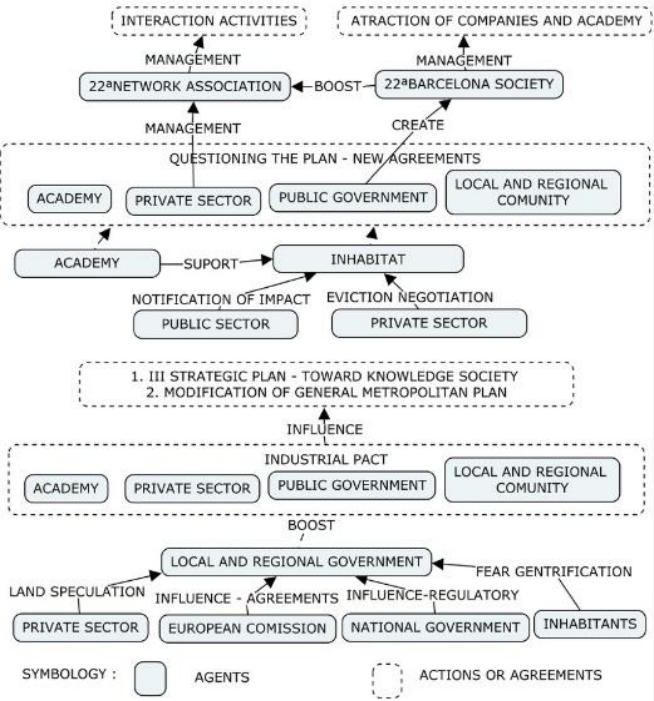
Through the Industrial Pact agreed in the II Strategic Plan, the public and private area that promotes it, brings together the academy, the two largest workers' unions, a large number of neighborhood leaders, including the general association of neighborhoods of Barcelona. We can be seen in the map of actors (see fig.2.), in the different stages, the various actors who intervened. They enter into a habitual power struggle, where despite the advantage of the private sector, the intervention of the community with the support of the academy is still interesting and constant. In this case, as also described by Metaxiotis and Ergazakis (2008), it is observed that public and private actors have a special role in the development of interaction for innovation.
ACTIONS FOR ACTIVE THE INNOVATIVE ENVIRONMENT The Modification of the Metropolitan General Plan (MPGM) introduced the name ‘22@’, which symbolizes the knowledge industries or ‘@activities’, where ‘@’ is associated with the intensive use of ICT, or the activities aim to raise the knowledge society (Barcelona Municipality, 2000). It intended to shape the innovative milieu IM, so the new land-use permitted the development of KC institutions, which shaped the definition of the five innovation clusters. This police permit changes the industrial use for 22@ activities use, this is: high education, research centers, productive high technologic firms, house and business services, and others (Cueva-Ortiz & Cruz-Cárdenas, 2021). The plan brings together the
Human Systems Engineering and Design (IHSED 2021) https://openaccess.cms-conferences.org/#/publications/book/978-1-7923-8987-0 different actors to shape a limited territory but at same time organize them in five clusters. The municipality created the 22@ public society which must development of the IM, this is impulse the location of international firms, research center and the others institution. This society offers a space in the knowledge city and at same time promote the creation of 22@ network association for boost the IM, one association conformed mainly by private firms.
The 22@ network association have its antecedent before the plan in the called Barcelona breakfast. Then the strategies for impulse the IM, or the interaction for innovation
Figure 2. Map of knowledge city stakeholder are public, private and academic. Public and private part have interested in the IM, the bigger inversion come from public sector but bigger initiatives are managed by private sector. The
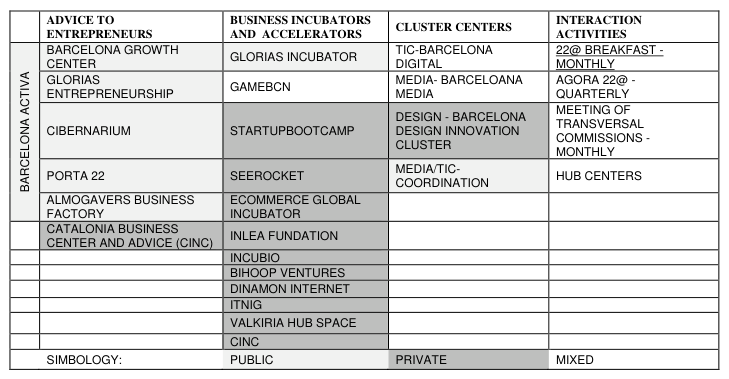
Human Systems Engineering and Design (IHSED 2021) https://openaccess.cms-conferences.org/#/publications/book/978-1-7923-8987-0 academic and community join of these activities, but specially as individual user or client, rarely the community take part in the management. The community intervenes when its rights are violated, with an interesting ability to anticipate the processes in which it could be involved, with a broad capacity for convocation and understanding at broad levels, relying largely on the advice of the academy. Strategies identified to promote interaction are: a) the creation of clusters, with their coordination centres; b) the monthly meeting of the transversal commissions, in which all institutions have their representative c) the 22@ breakfast that takes place once a month, open to the public upon registration.
In addition to these, there are other strategies with entities that support the knowledge society such as: d) education in technological tools, e) support for entrepreneurs with work spaces, financing, accompaniment, encouragement and awards for entrepreneurship, support in the search for financing, f) redirection of employment objectives, g) promotion of networking space/time included in traditional events as well as in various international events (see table 2).
Entrepreneurs get support from public entities, but also from private companies aimed at strengthening entrepreneurship by providing various services such as: spaces for spontaneous and planned networking, incubators and business accelerators, coworking spaces. This environment of interaction for innovation, shows that it has opted for the
Table 2: Activities of interaction for innovation and type of entities which development them ADVICE TO ENTREPRENEURS BUSINESS INCUBATORS AND ACCELERATORS CLUSTER CENTERS INTERACTION ACTIVITIES
Human Systems Engineering and Design (IHSED 2021) https://openaccess.cms-conferences.org/#/publications/book/978-1-7923-8987-0
TYPES OF INTERACTION PROMOTED IN THE 22@DISCRICT Our participative immersion in the activities developed and services offered, allowed us to experience first-hand, how this trained medium is attractive and creates hope especially in new professionals, but also in unemployed workers. The business platform built has a guided path and free service, where anyone can access very diverse and useful courses framed in technology and current reality, or in support of entrepreneurship. Anyone can access a space in business incubators, get interviews with investors, share time with entrepreneurs who have already traveled the road. This allows you to access free advice and talk directly with representatives of European funds, or others, seeking to finance profitable projects. An entrepreneur can also have support and advice for the formation of small and medium enterprises.
The type of interaction in the first strategy group is quite controlled. The actors of the interaction are generally the business people or entrepreneurs located in the area, plus the representatives of the public and academic sector that the 22@network association invites. At one of these events, i.e. the breakfast, a professional, an independent student, or any other person who has registered and approved, can join in.
Interaction can be much more spontaneous and feel horizontal in the second group of strategies, but in both urban and architectural spaces, spaces designed for spontaneous interaction are missing. On the public space there are no spaces that allow the interaction of groups, even the largest public space in the area remained between fences until 2016, including several years in which the area was already in operation. Likewise, if we observe the spaces where the 22@breakfast takes place, we will see that they are generally the access hall or the anterooms of a meeting room. This shows that generally the architects who designed the buildings did not handle concepts such as those of the innovative environment, they did not think of spaces to promote interaction.
Public space is also very devoid of spaces for interaction, there are large spaces arranged as access halls to the buildings that exalt, but are not provided with chairs or comfortable rooms or activities that attract. There is a single space of no more than 20m in the entire developed area, with unconventional furniture and provided with nature, which is always occupied with people resting, eating, socializing, etc.
Both the organization and the spaces are designed for the interaction of different groups, but spontaneous interaction is neglected, without foreseeing spaces that facilitate it.
CONCLUSIONS AND DISCUSSION The fact of leaving interaction in the hands of the private sector has meant that spaces such as clusters and meetings of transversal commissions allow only two options, which are adhesion or abstinence from being part of a project. There are no spaces for reflection or criticism, to discuss the relevance, benefit or detriment of a decision. The interaction for innovation should include society in general, the citizen, the academic, the conformation of
Human Systems Engineering and Design (IHSED 2021) https://openaccess.cms-conferences.org/#/publications/book/978-1-7923-8987-0 the innovative environment should provide spaces for spontaneous interaction, for reflection that includes society, without the pressure of particular interests.
The innovative environment formed in Barcelona, around the empowerment of entrepreneurship and the creation of a platform for entrepreneurs, which is also seen in other cases (Bruzzi et al., 2020), shows us that any other approach must be built in a way that is capable of guiding the society that needs to start its professional career. Beyond its disposition towards capitalist politics (Charnock et al., 2014), it is interesting to see how within its objectives, and under its political-economic guidelines, it manages to propose a space that involves and motivates those who enter it.
Despite the fact that in the theory of the city of knowledge, or of the smart city, a great role is given to the academy, from high-level training to research and the generation of knowledge (Fernandez-Anez et al., 2017; Teirlinck & Spithoven, 2019), to the Reviewing all the phases of the Barcelona case, it can be seen that it is the public and private actors who at all times seek to integrate the academy, without it getting involved in a real way, or in the development of the plan, in which makes sketches that are not considered, not even the operation itself, but simply joins in continuous training projects that companies propose, or in research that is presented at breakfasts organized by the 22 @ network association. In this case, the most important role that a real involvement of the academy can be seen is in the defense of the industrial heritage that the KC wanted to overthrow and that together with the population joined the inventory of industrial heritage. To this can be added an event isolated from the case study, such as the establishment of the Barcelona Knowledge Campus that seeks to direct the University towards the construction of the Knowledge Society (Grau et al., 2012; UB & UPC, 2009), (Guevara & Penas, 2020).
REFERENCES
Alfaro Navarro, J. L., López Ruiz, V. R., & Nevado Peña, D. (2017). The effect of ICT use and capability on knowledge-based cities. Cities, 60, 272–280. Barcelona Municipality. (1999). III Strategic economic and social plan of Barcelona
(1999-2005). Barcelona Municipality. (2000). Modification of General Metropolitan Plan.
22@Barcelona District. Bruzzi, C., Ivaldi, E., Musso, E., & Penco, L. (2020). The Role of Knowledge City Features in Nurturing Entrepreneurship: Evidence from EU Cities. In T. U. B. Series (Ed.), Urban Studies and Entrepreneurship (pp. 53–76). Springer Nature. Camagni, R. (2017). Technological Change, Uncertainty and Innovation Networks:
Towards a Dynamic Theory of Economic Space. In R. Capello (Ed.), Seminal Studies in Regional and Urban Economics (pp. 65–92). Springer. Castells, M., & Hall, P. G. (2001). Tecnópolis del mundo : la formación de los complejos industriales del siglo XXI (Pascual Mo). Alianza Editorial. Charnock, G., Purcell, T. F., & Ribera-Fumaz, R. (2014). City of rents: The limits to the
Barcelona model of urban competitiveness. International Journal of Urban and Regional Research, 38(1), 198–217. Cueva-Ortiz, S., & Cruz-Cárdenas, J. (2021). Knowledge Cities: ICT and Urban
Human Systems Engineering and Design (IHSED 2021) https://openaccess.cms-conferences.org/#/publications/book/978-1-7923-8987-0
Components. In L. Y. (eds) Markopoulos E., Goonetilleke R.S., Ho A.G. (Ed.), International Conference on Applied Human Factors and Ergonomics AHFE 2021: Advances in Creativity, Innovation, Entrepreneurship and Communication of Design (pp. 181–188). Springer, Cham. Dezi, L., Pisano, P., Pironti, M., & Papa, A. (2018). Unpacking open innovation neighborhoods: le milieu of the lean smart city. Management Decision. Fernandez-Anez, V., Fernández-Güell, J. M., & Giffinger, R. (2017). Smart City
implementation and discourses: An integrated conceptual model. The case of Vienna. Cities, 78, 4–16. Grau, D., Font, J., & Torras, N. (2012). The Knowledge Fair: An Activity for High School Students | Elsevier Enhanced Reader. Procedia. Social and Behavioral Sciences. Guevara, C., & Penas, M. S. (2020). Surveillance Routing of COVID-19 Infection Spread
Using an Intelligent Infectious Diseases Algorithm. IEEE Access : Practical Innovations, Open Solutions, 8, 201925–201936. Metaxiotis, K., & Ergazakis, K. (2008). Exploring stakeholder knowledge partnerships in a knowledge city: A conceptual model. Journal of Knowledge Management, 12(5), 137–150. Teirlinck, P., & Spithoven, A. (2019). The R&D knowledge base in city-agglomerations
and knowledge searching in product innovative SMEs. Entrepreneurship and Regional Development, 31(5–6), 516–533. UB, & UPC. (2009). Barcelona Knowledge Campus. Sumamos capacidades.
Multiplicamos la excelencia.
Human Systems Engineering and Design (IHSED 2021) https://openaccess.cms-conferences.org/#/publications/book/978-1-7923-8987-0
LISTED IN THE AHFE DIGITAL BOOKSTORE CATALOGUE
Explore the complete digital volume
Human Systems Engineering and Design (IHSED2021): Future Trends and Applications
Read this individual research paper free through the original publisher, or explore the full digital proceedings book.
ISBN 978-1-7923-8987-0
Explore this ISBN in the AHFE Bookstore ↗Listed in the July 2026 bookstore catalogue; search by ISBN to confirm current availability · Digital book purchase optional