With the development of architectural technology and the advance of people’s aesthetic taste of building, floor-to-ceiling windows design have currently become a popular choice of large buildings such as office buildings or university libraries. Ensuring beauty of the building, however, floor-to-ceiling windows can’t block direct sunlight.The ensuing problem is that more and more students and office workers are suffering from direct sunlight while working at specific areas.A research is conducted on a campus library focused on the students’ attitude towards light and heat environment and helped the author determined the existing light and heat problems in working areas.The results of the research showed that almost everyone has problem with the direct sunlight. As the sunlight shines from different angles because of the rotation of Earth, every area has a specific time period that the sunlight is directly shined on. During that period, direct sunlight has a significant negative influence on whoever working in the area. None of the existing designs can block the sunlight at a specific area during a specific time period.Based on the pain points of the working process, this study designed a portable product called “SUNSHADE” for improving light and heat comfort. The main functional design is as following.1.portable size: The sunshade curtain is hidden inside the device when it’s not used. So the device has a shape of cuboid when closed, thus making it easy to carry, and can be placed anywhere the user wants.2.easy to control: The SUNSHADE has a corresponding mobile phone application which can easily control this device to lift or not.3.automatic adjustment: The design can automatically change the lifted height of the sunshade curtain according to environment parameters collected by sensors built inside the device in order to keep a specific area covered from direct sunlight. This auto mode can be turned on or switched off on the mobile phone application.4.information collection and display: When a relative large amount of SUNSHADE is used in a specific area, like a library, SUNSHADE can collect the data of environmental parameters such as temperature and humidity and publish them on the application, allowing user to be informed of the latest information of building environment.The working efficiency of this SUNSHADE design is tested in a thermal simulation. We run the simulation according to the real size of library and the exact size of the product. The results suggest the product has expected efficiency in blocking sunlight.The principle significance of the study is as follows:The study discusses the pain points faced by urban officers and students. The study focuses on the indoor thermal evaluation. The study works on the improving of indoor light and heat comfort by designing a product, which is relatively less accomplished ever. By using such technology, the proposed design not only provides a solution to the light and heat problem in urban buildings, but also provides an insight of the internet of future intelligent household appliances, aiming at building a better living and working environment.Therefore, this study is an innovative design targeting intelligent household appliances.
Intelligent Human Systems Integration (IHSI 2022): Integrating People and Intelligent Systems https://openaccess.cms-conferences.org/#/publications/book/978-1-7923-8988-7
INTRODUCTION
It is a well-known fact that thermal comfort is a subjective evaluation of satisfaction with the surrounding environment. According to ASHRAE-55, thermal comfort has been defined as the condition of mind which illustrates satisfaction with the thermal environment, and thermal sensation is related to heat balance between the human body and its ambient thermal condition. Nowadays, people are increasingly moving to pursuing satisfaction, especially satisfaction with the environment. Therefore, it is of practical significance to improve the ambient thermal and light condition (Alwetaishi et al., 2021).At present, a lot of traditional urban buildings such as libraries are using full-transparent floor-to-ceiling windows which allow people observing from both inside and outside. While ensuring the beauty of the building, the indoor environment is relatively less considered of light and heat comfort. Individuals are more likely to suffer from extra heat and glare (Liu et al., 2020).
The mostly used existing solutions to light and heat improvement are curtains and louvers. These two designs are providing reliable performance in shading external sunlight (Palmero- Marrero and Oliveira, 2010). Still, two shortcomings of these two kinds of fixed shading devices can be found (Lee et al., 2016). One is that both the louver and the traditional curtains can hardly meet the aesthetic needs of external observation of the building. These two kinds of device are hanged to the wall. They cause the look from outside of the building to be a mess. The other shortcoming is that most of these fixed sunshade curtains are impossible to move (Koç and Maçka Kalfa, 2021). These two kinds of fixed curtains make it difficult to adjust for specific areas after the installation is completed (Xue et al., 2020).
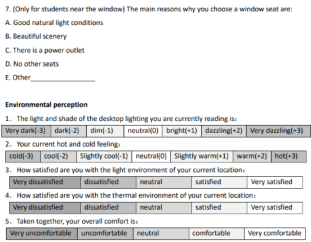
RESEARCH PROCEDURE We specifically choose the library in Shanghai Jiao Tong University as the research scene, as it’s the mostly used area in the university. The library contains many floor-to-ceiling windows and lack efficient shading devices. A questionnaire focused on occupants’ personal attitudes towards thermal comfort was distributed in the library to collect subjective data. The questionnaire used in the investigation is shown in Figure 1. A total of 239 samples were obtained in the field survey.
Intelligent Human Systems Integration (IHSI 2022): Integrating People and Intelligent Systems https://openaccess.cms-conferences.org/#/publications/book/978-1-7923-8988-7
Figure 1. Thermal and light comfort questionnaire sued in the study Analysis of the research data
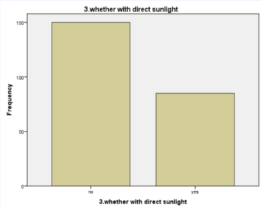
Because the major objective of this research is to assess the influence of direct sunlight and the interviewees’ opinions on both light and heat environment of the library, we summarized their locations in the library. By analyzing whether their locations are near the windows or exist direct sunlight, we may reach more precise conclusions in subsequent analyses (Fig. 2). It shows that the number of interviewees choosing to stay by the window (111) is slightly lower than the number of interviewees choosing not to stay by the window (128). Figure shows that the number of interviewees choosing to stay somewhere without direct sunlight is nearly twice as much as the number of interviewees choosing to stay somewhere with direct sunlight.
Figure 2. An overview of the basic information: (a) whether by window (b) whether with direct sunlight
Intelligent Human Systems Integration (IHSI 2022): Integrating People and Intelligent Systems https://openaccess.cms-conferences.org/#/publications/book/978-1-7923-8988-7
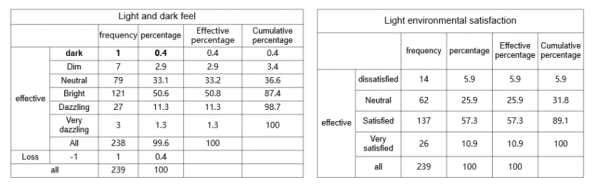
As is shown in figure 3(a), the data of interviewees’ feelings on the thermal comfort and their feelings on the thermal environmental satisfaction is collected. According to the data collected, interviewees' feelings about the library's environment are mainly warm, and more than two thirds of them are satisfied with the present environment. Still, dissatisfied cases exist, considering the environment being too hot or cold.
In figure 3(b), the data of light and dark feel of the interviewees and the light environmental satisfaction is listed. Generally, interviewees feel bright about the library's light environment, more than half of the interviewees think that the library light environment is satisfying, but there are still some interviewees thinking that the library light environment is too dark or harsh, and they are not satisfied with the current light environment. In addition to different individual feelings of differences, the main reason is speculated that the main impact is the different seats of the light environment is inconsistent.
(a)
(b)
Figure 3. An overview of the basic information: (a) hot and cold feel (b) thermal environmental satisfaction For library readers, the current light and thermal environment of the library is generally warm and bright, and the overall satisfaction of the reader experience is relatively high. However, the data reflects that some readers still have poor experience under the current situation of the library.
The problem of direct sunlight has caused a serious negative impact on the reader’s experience, which is mainly reflected in the light and heat environment. Direct sunlight can cause glare, reflections on the computer screen, high ambient temperature, and many other
Intelligent Human Systems Integration (IHSI 2022): Integrating People and Intelligent Systems https://openaccess.cms-conferences.org/#/publications/book/978-1-7923-8988-7 light and thermal uncomfortable conditions. These are the current library main problems in the photothermal environment. In addition to the objective conditions such as direct sunlight and regional environmental differences, the individual conditions of different readers, such as studying habits, personal wear, and subjective feelings also affect the overall comfort of the final photothermal environment.
DESIGN DEVELOPMENT Based on the pain points concluded from the research, this study proposed a smart design of a portable sunshade for improving light and heat comfort, thus constructing a sun responsive shading system. The final design includes two parts: the portable sunshade and the APP to provide corresponding services.
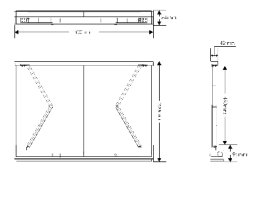
Design of product The product uses a customized shell as main part. The photosensitive sensor, temperature and humidity sensor, and total solar radiation intensity sensor are integrated in the 3D printed shell of the lifting part, and they are connected to the single-chip microcomputer. The sunshade curtain is rolled up and hidden inside the main part while not activated, thus making the product a portable size. The sunshade curtain can be controlled to lift. The user uses the corresponding APP to control the height of the curtain. The design can automatically change the lifted height of the sunshade curtain according to environment parameters collected by sensors built inside the device to keep a specific area covered from direct sunlight. In case the users have personal needs, this auto mode can be switched on or off on the mobile phone application. The product and the mobile phone application work together to implement information collection and display. When a relatively large number of this product are used in a specific area, like a library, sensors in them can collect the data of environmental parameters such as temperature and humidity and publish them on the application, allowing users to be informed of the latest information of the building environment.
Figure 4. Product usage scenario
Intelligent Human Systems Integration (IHSI 2022): Integrating People and Intelligent Systems https://openaccess.cms-conferences.org/#/publications/book/978-1-7923-8988-7
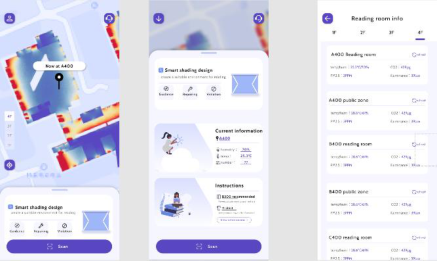
Design of APP The APP is designed to control the product and inform users of environment information. Based on the expectations of the design, we proposed a smart design of portable sunshade. First, users can register an account in the initial page. We provide two methods for registering. Users can use their school accounts or telephone numbers to register. After registering, the location of user will be shown on the map of the area where the SUNSHADE is available. Sliding the bottom from below, the detail information of the environmental parameters and users’ distribution are shown, including the current humidity, temperature, carbon dioxide concentration and particulate matter 2.5 concentration.
`
Figure 5. Using interface
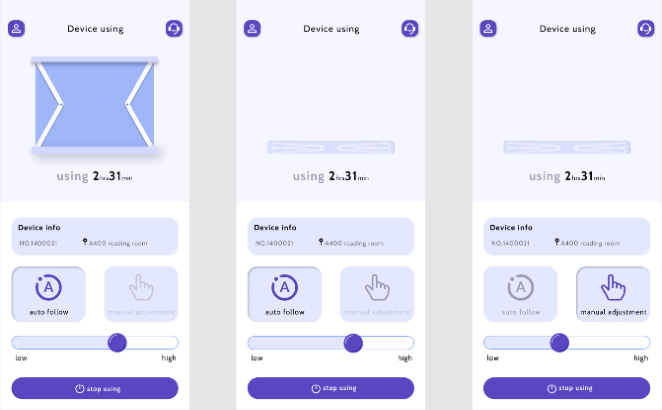
If the user has decided to use one of the SUNSHADE devices, he or she can choose either to scan the QR code on the device or to enter the number of the device on the application to unlock the SUNSHADE device. After successfully unlocking one of these devices, the controlling interface shows the device information, which includes the number and location. Considering the light and heat environment in different areas has significant variation and different individual has various personal feelings upon the environment, a specific function is designed. The users can choose from auto adjustments and manual adjustments. When choosing the auto follow mode, the SUNSHADE will adjust the height of sunshade curtain itself, keeping its user shaded. If the user has other personal needs, he or she can turn on the manual adjustment mode, which allows them to choose from the range of completely closed to completely open by sliding a slide block. If the users find any problem of the device, such as mechanical malfunctions, they can use the report button at the top right corner to report their feedback. There will be staff working on the feedback.
Intelligent Human Systems Integration (IHSI 2022): Integrating People and Intelligent Systems https://openaccess.cms-conferences.org/#/publications/book/978-1-7923-8988-7
Figure 6. Controlling interface
CONCLUSIONS
Based on the existing thermal and light environment, this study conducts research on the library users and analyzed the data. Through the pain points concluded from the data, this study proposes a portable design of a product for improving light and heat comfort and a corresponding mobile phone application. The study aims to provide solutions to indoor thermal comfort and suggestions for future indoor householding design. In the future, it is hoped that the concept of portable intelligent sunshade device can serve a larger user group and help everyone improve thermal and light feeling.
ACKNOWLEDGEMENTS
We owe gratitude to the students and teachers in the library of Shanghai Jiao Tong University, who volunteered to take part in this study. Thanks also to Xinrui Yan, Hantian Wu, Mingxiang Wang for their research support. This research was funded by Science and Technology Commission of Shanghai Municipality.
Intelligent Human Systems Integration (IHSI 2022): Integrating People and Intelligent Systems https://openaccess.cms-conferences.org/#/publications/book/978-1-7923-8988-7
REFERENCES
Alwetaishi, M., Al-Khatri, H., Benjeddou, O., Shamseldin, A., Alsehli, M., Alghamdi, S., Shrahily, R., 2021. An investigation of shading devices in a hot region: A case study in a school building. Ain Shams Eng. J. https://doi.org/10.1016/j.asej.2021.02.008 Koç, S.G., Maçka Kalfa, S., 2021. The effects of shading devices on office building energy
performance in Mediterranean climate regions. J. Build. Eng. 44. https://doi.org/10.1016/j.jobe.2021.102653 Lee, K.S., Han, K.J., Lee, J.W., 2016. Feasibility study on parametric optimization of daylighting in building shading design. Sustain. 8, 1–16. https://doi.org/10.3390/su8121220 Liu, G., Chen, X., Zhang, Y., Wang, Z., Teng, R., Li, C., 2020. Luminous Environment
Measurement and Simulation Analysis of a University Library, Environmental Science and Engineering. Springer Singapore. https://doi.org/10.1007/978-981-13-9528-4_94 Palmero-Marrero, A.I., Oliveira, A.C., 2010. Effect of louver shading devices on building energy requirements. Appl. Energy 87, 2040–2049. https://doi.org/10.1016/j.apenergy.2009.11.020 Xue, J., Hu, X., Sani, S.N., Wu, Y., Li, X., Chai, L., Lai, D., 2020. Outdoor thermal comfort
at a university campus: Studies from personal and long-term thermal history perspectives. Sustain. 12, 1–17. https://doi.org/10.3390/su12219284
Intelligent Human Systems Integration (IHSI 2022): Integrating People and Intelligent Systems https://openaccess.cms-conferences.org/#/publications/book/978-1-7923-8988-7
LISTED IN THE AHFE DIGITAL BOOKSTORE CATALOGUE
Explore the complete digital volume
Intelligent Human Systems Integration (IHSI 2022): Integrating People and Intelligent Systems
Read this individual research paper free through the original publisher, or explore the full digital proceedings book.
ISBN 978-1-7923-8988-7
Explore this ISBN in the AHFE Bookstore ↗Listed in the July 2026 bookstore catalogue; search by ISBN to confirm current availability · Digital book purchase optional