Xinhui Li, Jiong Fu (2022). Design of Smart Household Beauty Apparatus Targeting the Young Consumers. In: Intelligent Human Systems Integration (IHSI 2022): Integrating People and Intelligent Systems. AHFE Open Access, vol. 22. https://doi.org/10.54941/ahfe100939
The Chinese daily cosmetics market has significantly grown in the past two years. Given the current climate whereby consumers have higher demands of external appearance, the apparition of instruments is a mere question of time. After conducting thorough interviews and desk research, it was assessed that there is a rapidly growing demand for skin care products and household beauty products amongst Chinese consumers. Simultaneously, with the advances in the development of smart technologies, smart products are penetrating the beauty apparatus market. The effect of beauty apparatuses has been widely recognized in China. This paper, therefore, delves into the improvement of user experience with household beauty apparatuses. Moreover, a new scheme has been proposed to design intelligent household beauty apparatus, thereby improving the pain points of current skincare products and devices. New beauty apparatuses are emerging in the market, and relevant technologies have been incorporated to assist the functioning of the appliances. Through a thorough analysis of the household beauty apparatus in the current market, the author summarizes their functions, features, effect, merits, and drawbacks. Moreover, after conducting a comprehensive user survey, the author determines that the pain point to be addressed is that the steps are too trivial in the use of household beauty apparatus.Based on the established pain points and existing intelligent technologies, the author proposed a new design scheme for beauty apparatus to be used in daily skincare. Furthermore, a Single Chip Microcomputer was used to simulate partial functions and established a model satisfying human-computer ergonomics. The main functional design of the beauty apparatus is as follows:(1) Smart sense of skin: After pressing the start button, the head of the apparatus comes into contact with the skin, and the apparatus will automatically detect skin and start working. (2) Automatic limit of liquid flow: When the apparatus comes into contact with the skin, the essence is automatically squeezed out on the skin. The ingredient of the essence will also vary with the position of contact. (3) Beauty auxiliary function: When the apparatus comes into contact with the skin, the auxiliary beauty function is initiated for skincare and penetration of essence, such as ultrasonic wave, red, and blue light. The shape of the product is determined based on the popular shapes of beauty apparatus in the market. The main shape follows the design philosophy of roundness, simplicity, and neatness to increase affinity with users. The handle is ergonomically designed to ensure comfort when holding. The product is also equipped with a charging base.The innovation of the structural design lies in that a certain space is provided within the handle for safe storage of the inner core of the skin moisturizer. This method obviates the hassle of application, and the process of skincare is directly completed with the apparatus.Finally, tests were conducted among five target users, and experienced experts in skincare were invited to evaluate the design skin. The results suggest that users gave positive feedback regarding the product, believing that it effectively solved some of their problems. The experts remarked that this was a meaningful, innovative attempt in the field of skincare apparatus.The principal significance of the study is as follows:The research discusses the pain points faced by users during skincare and studies the available innovative technologies regarding beauty apparatuses in use flows under the background of the evolving Chinese consumer markets and providing innovative thinking for the further development of household beauty apparatus.Furthermore, the proposed design scheme will provide solutions to trivial issues such as inadequate absorption and skincare, from the users’ perspectives.Therefore, this study is an innovative design targeting household beauty apparatus.
Intelligent Human Systems Integration (IHSI 2022): Integrating People and Intelligent Systems https://openaccess.cms-conferences.org/#/publications/book/978-1-7923-8988-7
INTRODUCTION
As consumers’ increasing cognition and requirements of their appearance in China, the market of chemicals used in daily life reflects a remarkable growth capability (Davies & Raskovic, 2018). Intellectualization draws more and more concerns from the market of chemicals used in daily life in order to fulfill people’s requirements for beauty.
In today’s skincare field, intelligent products have change part of consumers’ habit of using products through intelligence revolution. For example, La Roche-Posay, a brand under L'Oréal, rolled out a telescoping sensor to monitor personal UV exposure, positively guiding its users to conduct safe sun protection behaviors. Similar products with intelligent technologies are emerging in the market. Influencing the habit of using products by intelligent technologies, in essence, is to provide consumers with better experience. Intelligent skincare products change consumers’ habit of using them, which are in line with the inexorable trend of consumption upgrading (Bin, 2018).
The author hopes to explore the sore point of consumers in skincare by investigating and studying the current situation and trend of development of skincare industry, and seek reasonable solutions from the application of intelligent technologies in skincare.
PRE-DESIGN ANALYSIS In order to look for the direction of design, the author wrote an in-depth questionnaire for interview based on the analysis of the skincare market and under the guidance of experts in the daily chemical industry (Zhi, 2019), and then produced a report for reference in the design of intelligent daily chemicals.
Personal in-depth interviews were adopted to collect as many as details and users’ needs. 7 target users whom the designed product will serve were interviewed at home. Discussions were held on three aspects, including the experience in skincare, trend of the skincare industry and trend of intellectualization. Each interview lasted for about 90 minutes.
The trend of skincare is concluded as follows according to the interviews and literature information.
Younger consumers. Teenagers are aware of the marginal social benefits brought by a perfect complexion at increasingly earlier ages. They start to take care of their skin from their secondary school age, and most college students protect their skin more meticulously.
Simpler skincare. Accelerated pace of life and increasing life pressure wear out people who start to be tired of daily skincare. Part of consumers will reduce their use of skincare products and sacrifice effectiveness for more breathing space.
Revolution of new technologies. Nanotechnology and other technology offer new opportunities to enable the production of the product (Zhou et al. 2021), while radio
Intelligent Human Systems Integration (IHSI 2022): Integrating People and Intelligent Systems https://openaccess.cms-conferences.org/#/publications/book/978-1-7923-8988-7 frequency and infrared technologies have been widely applied in the production of skincare tools(Beasley & Weiss,2014).
DESIGN CONCEPT Breakthrough points of design are concluded by collecting and sorting users’ behaviors and thoughts during the in-depth interviews.
In busier daily life, people have higher requirements for skincare, but they can spend less time on it, leading to contradictions. Therefore, it’s concluded that a skincare tool which reduces steps and guarantees the effect can address current problems facing consumers in daily skincare. The tool should be designed to be smaller for easily fetching, and compatible with other skincare products which can be introduced with the help of the tool. The product is designed to be an intelligent skincare tool in the preliminary conception.
ANALYSIS OF RELEVANT TECHNOLOGIES The author sorted and concluded technologies which can be used in the product after analyzing a large number of literature and online resources.
Analysis the mechanism of skincare tools. Mainstream skincare tools on the market adopts technologies including ultrasonic introduction, electro-ionic introduction, MASS vibration, radio frequency (RF), red/blue spectrum LED, infrared radiation (IR), EMS microcurrent and cooling (Reddy & Hantash, 2009). Given the frequency of use and effect, IR, red/blue spectrum LED and ultrasonic are more suitable for daily skincare tools.
Analysis of sensing technology for skin test. The design requires that a process should be begun when the device touches users’ skin on their faces. In order to achieve this goal, sensing technology can be adopted to judge whether the tool touches skin. After investigation and study, the author considers that a sensor for skin test is applicable to this design. First, a sensor for skin test can generate acute signal intensity from skin touch (a slight touch), which has been widely applied to various kinds of intelligent products that need to sense the skin or implement an action by touching the skin. Secondly, users only need to attach the sensor on an inside wall of the plastic or metal casing to ensure the product’s aesthetic and waterproofness.
Analysis of automatically dispensing limited liquid. This tool requires to be equipped inside with an automatically limited liquid dispenser. Now, there’s a new Liquid extractor which can control the runtime and the liquid dispensed by a circuit wafer and is applicable to transmitting liquid materials of different viscosities or with granules via its peristaltic
Intelligent Human Systems Integration (IHSI 2022): Integrating People and Intelligent Systems https://openaccess.cms-conferences.org/#/publications/book/978-1-7923-8988-7 pump, which can avoid damage to materials during transmission(Lvwen, 2010). This tool is for technical reference in the final solution through technical analysis.
DESIGN DEVELOPMENT Supported by the aforesaid design investigation and study, the author redesigned the process of using the domestic skincare tool in this research in order to improve users’ satisfaction in usage, and carried out product development targeting this process.
Functional design Three innovative functions of the product developed in the research are proposed on the basis of users’ sore point in order to address the tediousness of skincare steps and other problems.
Intelligent skin sensor. The sensor starts to work after a user press the “on” button and touch the skin with the device’s head.
Automatically limited liquid dispenser. Each time when the tool touches the skin, it will automatically dispense essence on the skin, and the components of the essence differ according to the number of touches.
Auxiliary functions for skincare. auxiliary functions will be started each time when the tool touch the skin, including ultrasonic and red/blue spectrum LED for skincare and essence introduction.
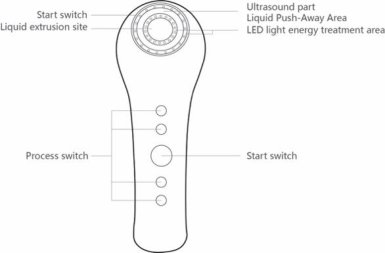
Process of using the skincare tool is as follows. The tool starts working when a user presses the button controlling all the process, and the entire skincare process begins when the user touches the skin with the device’s head. The head will dispense limited toner and generate IR when the tool first touches the skin, and IR will be turned off when the device leaves the skin; the head will dispense essence, generate red light and ultrasonic when the head touches the skin for the second time; the head will dispense another essence, generate red light and ultrasonic when the head touches the skin for the third time; the head will generate blue light when it touches the skin for the fourth time; the device will be off when it stops touching the skin. During the abovementioned process, the switch of modes is determined by whether the tool touches the skin and how many times it touches the skin, which can be operated easily. Besides, a user can control the four sub-processes by 4 small buttons (Figure 1).
Intelligent Human Systems Integration (IHSI 2022): Integrating People and Intelligent Systems https://openaccess.cms-conferences.org/#/publications/book/978-1-7923-8988-7
Figure 1: Illustration for the product functions
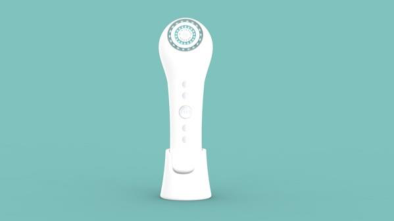
Exterior Design The author investigated and studied the styles and features of popular skincare tools on the market, sorted and analyzed collected information. Thereafter, the design with a round, simple and clear style is adopted. The main body of the product is a handheld skincare tool with 5 buttons and a charging base. The product with a white matt exterior can reduce users’ eyestrain. There’s a metallic colored button on the handle; a pit is designed to help spread toner and essence evenly and easily, and avoid leaks (Figure 2).
Figure 2: Renderings of the product
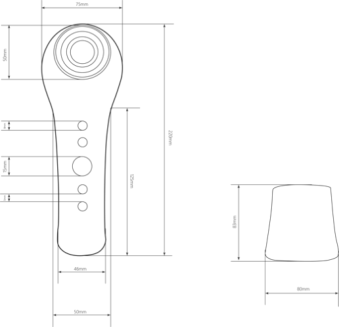
According to the Chinese adults’ body size in GB10000-1988 (1988) and GB/T16252- 1996(1996). The handle is designed to be 125mm in length (longer than adults’ hand width but not their hand length); considering the style requirements, the handle’s maximum outer diameter is designed to be 50mm, while the minimum outer diameter is 46mm. Functional buttons are distributed according to the frequency of utilization. The average widths of male and female thumb joints are about 21mm and 19mm. The middle button is with the diameter of 15mm, other four buttons are with the diameter of 8mm, and the distance between each button is 5mm for the fingertip’s width is shorter than the width of a thumb joint and mistaken
Intelligent Human Systems Integration (IHSI 2022): Integrating People and Intelligent Systems https://openaccess.cms-conferences.org/#/publications/book/978-1-7923-8988-7 touches should be avoided. The diameter of the part where the tool touches the skin is designed to be 50mm. The size of the product’s main body is 72*220*75 (mm) and the size of the base is 80*83*80 (mm) (Figure 3).
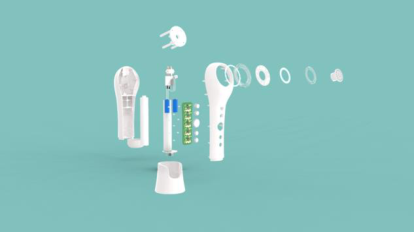
Figure 3: Diagram of each size of the tool In addition, the product structure was simply designed (Figure 4).Figure 4: Renderings of exploded product structure
DESIGN EVALUATION The final evaluation includes the user test and the expert assessment. At the end, the user test was conducted in the five target users. In the test, each tested person held a product model while watching a demonstration video, and graded according to Likert Scale while experiencing the product style and functions. The result shows that the users were relatively satisfied with the product. They thought they had a cordial feeling towards the product’s
Intelligent Human Systems Integration (IHSI 2022): Integrating People and Intelligent Systems https://openaccess.cms-conferences.org/#/publications/book/978-1-7923-8988-7 appearance, and the product could effectively reduce the time of using a skincare tool, improving their satisfaction with domestic skincare. In addition, sophisticated skincare experts with long working experience in the daily chemical industry were invited to assess the design plan of the intelligent skincare tool. They suggested that the plan can effectively address some problems facing users in usage and pointed that the innovative shot is of guiding significance in skincare devices.
DISCUSSION AND CONCLUSION This project aims to design and study domestic skincare products with a promising future, and hopes to improve users’ satisfaction in usage through innovations in design. This research discussed users’ sore point in skincare, studied innovations that can be made in the process of using domestic skincare tools in the context of impacts brought by intellectual technologies, and provided innovative thoughts for the further development of domestic skincare tools. This research has received certain user recognition in the functional design of the product, but there are still many details to be improved in the style. For example, a round, symmetrical and regular shape can increase the closeness between the product and users, but these features reduce the product’s sense of science and technology (Yang & Jiang, 2021). Besides, the design has some shortages due to the limits of the author’s abilities and time. For example, the current model hasn’t realized all functions and applied them in the product. Therefore, technologies will be improved. In addition, a small range of user test cannot fully reflect the design effect. Hence, a user test with more participants should be organized. In conclusion, the research is to design a product which can improve users’ satisfaction in using domestic skincare tools. In the future, we hope that the design concept of this project can serve more users who require domestic skincare and help them improve their satisfaction.
REFERENCES
Davies, H., & Raskovic, M. (2017). Understanding a changing China. Taylor & Francis. Bin X. (2018). Another Life and Death Batter among Traditional Cosmetic Companies: Intelligent [Enclosure Movement]. J. Chinese Cosmetics. 7, 20--31 (in Chinese) ZhiYan.org, https://www.chyxx.com/industry/201910/792688.html (in Chinese) Zhou, H., Luo, D., Chen, D., Tan, X., Bai, X., Liu, Z., ... & Liu, W. (2021). Current Advances
of Nanocarrier Technology-Based Active Cosmetic Ingredients for Beauty Applications. Clinical, Cosmetic and Investigational Dermatology, 14, 867. Beasley, K. L., & Weiss, R. A. (2014). Radiofrequency in cosmetic dermatology. Dermatol Clin, 32(1), 79-90. Reddy, B. Y., & Hantash, B. M. (2009). Emerging technologies in aesthetic medicine.
Dermatologic clinics, 27(4), 521-527. Lvwen, L. (2010). An automatic limited liquid dispenser.CN201457929U (in Chinese)
Intelligent Human Systems Integration (IHSI 2022): Integrating People and Intelligent Systems https://openaccess.cms-conferences.org/#/publications/book/978-1-7923-8988-7
GB 10000-1988(1988). Human dimensions of Chinese adults. State Bureau of Technical Supervision Press, Beijing GB/T16252-1996(1996). People’s Republic of China National Standard: Adult Hand Size.
China Standard Press, Beijing Yang, H., & Jiang, Z. (2021, July). Appearance Design Method of Household Beauty Instrument Based on Kansei Engineering. In International Conference on Applied Human Factors and Ergonomics (pp. 1056-1063). Springer, Cham.
Intelligent Human Systems Integration (IHSI 2022): Integrating People and Intelligent Systems https://openaccess.cms-conferences.org/#/publications/book/978-1-7923-8988-7
LISTED IN THE AHFE DIGITAL BOOKSTORE CATALOGUE
Explore the complete digital volume
Intelligent Human Systems Integration (IHSI 2022): Integrating People and Intelligent Systems
Read this individual research paper free through the original publisher, or explore the full digital proceedings book.
ISBN 978-1-7923-8988-7
Explore this ISBN in the AHFE Bookstore ↗Listed in the July 2026 bookstore catalogue; search by ISBN to confirm current availability · Digital book purchase optional