Xinying Wu, Ming-Gang Yang, Zishun Su (2022). Pleasurable emotions of product design. In: Intelligent Human Systems Integration (IHSI 2022): Integrating People and Intelligent Systems. AHFE Open Access, vol. 22. https://doi.org/10.54941/ahfe1001003
improving product attractiveness and usability has become a new direction of product design. In the past, the functional aesthetics pursued in product design was gradually replaced by emotional experience. The new usability is transformed into positive emotional needs. As an emotion type with research value in positive emotion, pleasant emotion has gradually become a new usability issue in emotional design. Therefore, the construction of product form pleasant emotion evaluation system helps designers to develop products that meet market orientation according to the combination of aesthetic experience and pleasant design evaluation system. Under the guidance of emotional design theory, through the systematic research of pleasure design, combined with aesthetic pleasure criteria and aesthetic principles, this study constructs a product pleasure evaluation system. A new research method and systematic evaluation scheme are proposed for the future product design research in the context of pleasant emotion.
Intelligent Human Systems Integration (IHSI 2022): Integrating People and Intelligent Systems https://openaccess.cms-conferences.org/#/publications/book/978-1-7923-8988-7
INTRODUCTION
Pleasant emotion is one of human positive emotions. Is a positive emotional state (Norman, D. A. 2004), which is the focus of psychologists. Because pleasant emotion is closely related to people's life, pleasant emotion is also the key research direction of designers in industrial design. With the advent of the era of product design experience, the change of form obeying emotion is at the forefront of product design. In the process of gradual improvement of material life, consumers' emotional needs are also gradually increasing. Products can affect people's emotions and bring people happiness, anger, safety, anxiety and other emotions (Marzano, S. 1998). Products can arouse consumers' positive or negative emotions (Desmet, P. M. A. 2012), and positive emotions have a pleasant effect. Positive emotion can increase the purchase rate of products and make products discussed in a positive way (Desmet, P. M. A. 2010). Pleasure design has become a new human factor, indicating that the pleasure perceived by consumers from products will affect the purchase decision (Jordan, P. W. 2000). In the product experience, consumers' positive emotions can trigger purchase intention (Pham, M. T. 1998) and repurchase intention (Westbrook, R. A. and Oliver, R. L.,1991). Many studies also show that today's product design can not only focus on function, but also pay more attention to emotional feelings and positive emotions obtained in product experience. Consumers also begin to focus on the added value of products, hoping that products will bring pleasure, wealth and more value to their lives (Lewis, D. and Bridger, D.,2001). Consumers can get positive emotion and fun from the shape and appearance of the product (Creusen, M. and Snelders, D.,2002). In the initial stage of product design, designers should consider the pleasant emotion. This new human factor, based on usability, breaks through and surpasses usability, so as to make the product more experiential and attractive. This paper proposes a visual cognition oriented product pleasure evaluation design method, and uses fuzzy Delphi method to establish the evaluation index of aesthetic principle and pleasure degree. Based on the user's visual cognition and emotional needs, the product form design evaluation method is established to make the product form design more in line with the perceptual cognition.
RELATED WORKS Pleasure Emotion Design Theory
Emotion belongs to the category of emotional psychological activities. In the initial study of positive emotion, Immanuel Kant (Immanuel Kant. 2005) divided pleasant emotion into two forms: rational pleasure and perceptual pleasure. Perceptual pleasure comes from sensory system (vision, hearing, touch, smell and taste). Rational pleasure is a deep emotional reflection. Seligman divides happiness into: 1. Body pleasures, for example, obtained through instinctive eating. 2. Higher pleasures. Through sensory transmission and psychological reflection, physical pleasure
Intelligent Human Systems Integration (IHSI 2022): Integrating People and Intelligent Systems https://openaccess.cms-conferences.org/#/publications/book/978-1-7923-8988-7 belongs to higher pleasure, which is guided by cognition. 3. Gratifications. Through a higher level of psychological cognition (Wen-Chih Chang and Tyan-Yu Wu, 2009). Tiger makes an in-depth study on human pleasure based on the research results of psychologist Mihaly Csikszentmihalyi, summarizes the framework of pleasure acquisition, and puts forward four types of pleasure (physical pleasure, social pleasure, psychological pleasure and ideology) (Lionel Tiger. 2010). On the basis of Tiger's theoretical framework, Jordan extended pleasure to product design and pointed out that pleasure is a relational emotion between consumers and products. Pleasure products are the combination of emotional, happy and practical interests conveyed by products to consumers (P. W. 1998). Norman believes that pleasure is a positive emotional state under the synergistic action of beauty, happiness and fun. Based on the demand hierarchy theory proposed by psychologist Maslow AH. (Maslow AH. 1970), he uses the neurobiological emotional framework to put forward three-level theories for product emotional design: instinct level, behavior level and reflection level, and puts forward the importance of emotion in design decision- making. Desmet P.M.A. (Desmet, P. M. A. 2010) integrated Jordan's pleasure method and Norman's three-level emotional framework to explore the attraction of emotional products at three levels According to consumers' emotional reactions to products, a product emotional design method and nine product emotional sources are proposed, and the pleasure is evaluated. Based on the aesthetic experience of product design, Paul Hekkert (Hekkert P. 2006) puts forward four principles of pleasure design, which further explains that consumers' pleasure of products is the joint action of demand, aesthetics and experience, and is also in step with Norman's three-level theory. Tyan-Yu Wu (Tyan-Yu, Wu et al. 2017) used the unity in aesthetics as the starting point to study, and came to the conclusion that the consistency of products can affect consumers' emotion, and the high consistency of product form can arouse greater pleasure.
In this study, consumers' pleasure from product appearance is taken as the research direction. After integrating the pleasure design theory in the field of product design, it is found that there are many overlapping parts between the theories. Combined with the common characteristics of the above theories, this study considers that Norman's emotional theory is more in line with the needs of the research theory, and studies the visual aesthetic pleasure as the main way to stimulate the sense of pleasure.
Ways to Produce Pleasure Pleasure design is a branch of emotional design. Pleasant emotion is one of the main positive emotions of human beings. The general mode of emotion is divided into four progressive parts: stimulation, experience, awakening and behavior (Zhaolan Meng. 2005). The arousal to the end of emotion is not a single processing program of the brain, but a coherent processing program of the brain and psychology triggered by stimuli. The more important the stimulus is to the function of the human system, the higher the relative emotional value. Based on the theory of emotional psychology, it can be concluded that human pleasure is roughly generated by two ways: 1. The
Intelligent Human Systems Integration (IHSI 2022): Integrating People and Intelligent Systems https://openaccess.cms-conferences.org/#/publications/book/978-1-7923-8988-7 senses are stimulated by external things, which leads to more direct positive emotions, forms a rapid cognitive chain, and enables the brain to quickly generate pleasant emotions. 2. Through human memory or self-recognition experience, self-recognition and processing of things touched can stimulate the cerebral cortex to produce positive emotions. Release chemicals that make yourself happy, creating a sense of pleasure. Therefore, we can conclude that in the field of product design, the way to produce pleasure is to bring physical direct pleasure after the senses receive the product shape stimulation and experience stimulation. Then, it carries out cognition through nerve transmission to the brain to produce positive psychological and cognitive pleasure.
Aesthetic Pleasure Aesthetics initially refers to sensory perception and perceptual knowledge, and later gradually developed into the satisfaction of sensory pleasure (Goldman, A. 2001). The premise of aesthetic pleasure is that aesthetics plays a role. The appearance of product modeling is designed to meet our senses. When consumers see a product, aesthetics will affect consumers' first feeling of the product, and will evaluate the product according to their own aesthetic experience (Hagtvedt, Henrik and V. M. Patrick, 2008). Aesthetics restricts the form of products and affects the decision- making process of consumers from sensory cognition to the whole aesthetic judgment. Thomas Aquinas mentioned that people re recognize the impression of things obtained by internal feeling and external feeling, and feel pleasure through the beauty of things themselves (Boas. George and Russell. Bertrand, 1947). This shows that in the process of human cognition of things, beauty society brings more pleasant emotions, and a relationship link is formed between aesthetics and cognition. Aesthetics is not only a key factor affecting product design, but also a prerequisite for aesthetic pleasure at the level of emotional cognition.
Aesthetics has always been a theory constantly discussed in the design field, and aesthetics plays a vital role in design. As a perceptual science, aesthetics comes from human emotional cognition from the perspective of epistemology, which belongs to psychological cognition. Human beings have the concept of beauty from the generation of beauty. Therefore, the source of beauty and human cognition cannot be discussed separately. How to trigger beauty in the process of human sensory cognition has also become one of the entry points of aesthetics. In the study of aesthetics in the field of science, Allesch defined aesthetics as sensory experience science. Norman has also been committed to how to transform the aesthetic feeling at the sensory level into the pleasure at the reflective level (Norman, D. A. 2004). Leder put forward the aesthetic judgment model in the theory of psychology. In this model, the aesthetic experience is divided into five stages and two types of output (aesthetic emotion and aesthetic judgment), and the aesthetic cognition and ordinary cognition are made separately. Emphasize the importance of cognitive judgment to art cognition (Leder H et al. 2011). In the field of neuroscience and psychological cognition, aesthetic cognition has been recognized as having multimodal function (Schifferstein, Hendrik. 2008). These studies show that aesthetic cognition is an important process of human
Intelligent Human Systems Integration (IHSI 2022): Integrating People and Intelligent Systems https://openaccess.cms-conferences.org/#/publications/book/978-1-7923-8988-7 psychological activities. With consumers' attention to product beauty and the development of cognitive psychology, aesthetic cognition has become a comprehensive research approach integrating emotional cognition, value judgment, decision-making and implementation.
Psychological research shows that pleasant emotion is a psychological reaction caused by aesthetics. Consumers' aesthetic demand for products affects instinctive emotional experience. Aesthetic form plays a role in awakening human aesthetic cognition (Ingarden, R. 1961). Aesthetic form, also known as aesthetic principle, is a relatively common aesthetic theory (Seeley, W. P. 2013), such as consistency, balance, order, diversity and typicality, which provides basic principles for human aesthetic cognition. Aesthetic principle is the reference principle for designers to design products. It plays an important role in product design. Aesthetic principles can make in-process products better interact with consumers and drive the generation of positive emotions. It can be seen that aesthetic principles are closely related to pleasure design. On the one hand, the aesthetic principle determines the aesthetic degree of product modeling, on the other hand, it stimulates consumers to produce emotional changes through product modeling. Therefore, aesthetic principles can be used to evaluate the pleasure of product modeling in design.
ESTABLISHMENT of PLEASURE DESIGN EVALUATION SYSTEM BASED ON FDM Fuzzy Delphi Method
When setting evaluation indexes in pleasure design, it is necessary to screen the indexes. Because the evaluation indexes are complex and can not accurately evaluate the design system, it is necessary to use Delphi method to determine the evaluation indexes. The traditional Delphi method solicits expert opinions anonymously, and needs to be investigated for many times to achieve the unity of expert opinions. There is a certain fuzziness, which will lead to the deviation of evaluation results. Therefore, on this basis, Fuzzy Delphi method (FDM) (Murray, T. J. et al. 1985) is used to solve the problem. Fuzzy Delphi method is a method to deal with complex evaluation indexes and evaluate the construction of optimal indexes. FDM applies fuzzy theory to Delphi method, which can effectively reduce the number of investigations and improve the accuracy (Ishikawa, Akira, et al. 1993). This study quantitatively screened the product pleasure emotion indicators through FDM method, and finally determined the aesthetic principles and pleasure design evaluation system.
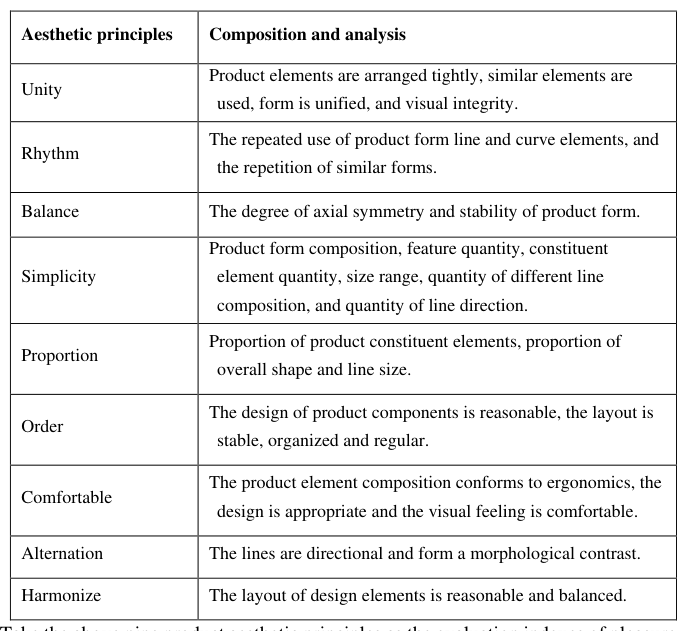
Determining of Evaluation Index for Pleasant Design Aesthetic principle is the key factor affecting product pleasure, and it is most appropriate to take it as an evaluation index. After sorting out the existing aesthetic
Intelligent Human Systems Integration (IHSI 2022): Integrating People and Intelligent Systems https://openaccess.cms-conferences.org/#/publications/book/978-1-7923-8988-7 principles, it is found that there are many problems, such as large number, unclear field, high repeatability and weak pertinence. This study combs the literature related to aesthetics. Combined with the modern product aesthetics research theory, the aesthetic principles in the product field (Pham, B. L. 1999) are summarized as follows Table 1:
Table 1: Analysis on the Factors of Aesthetic Principles Aesthetic principles Composition and analysis
Take the above nine product aesthetic principles as the evaluation indexes of pleasure design, and further screen the indexes according to the Fuzzy Delphi method.
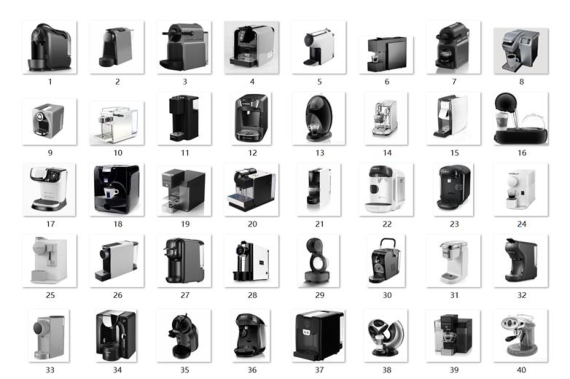
Establishing Expert Evaluation Triangular Fuzzy Number According to the indicators determined in 3.2, an expert questionnaire survey was conducted, and the scores were divided into 10 grades. The higher the score, the more important the indicator is. The capsule coffee machine was selected as the model of the test product, and a total of 96 samples were collected (Individual samples are shown in the Figure 1. The expert cognitive triangular fuzzy number (TFN) was
Intelligent Human Systems Integration (IHSI 2022): Integrating People and Intelligent Systems https://openaccess.cms-conferences.org/#/publications/book/978-1-7923-8988-7 established according to the survey scale. The DM evaluation of evaluation scale index n is divided into two parts: conservative cognition and optimistic cognition, which are expressed by 𝐶n and 𝑂𝑛 respectively.
Figure 1. Excerpts from sample sets
𝑛 , 𝐶𝑀𝑎𝑥
As shown in Figure 2, let the conservative cognitive triangular fuzzy number of index 𝑛 be formula 𝐶𝑛= (𝐶𝑀𝑖𝑛
𝑛, 𝐶𝑀𝑖𝑑 𝑛 , 𝑂𝑀𝑎𝑥
𝑛 ), and the optimistic cognitive triangular fuzzy number be formula 𝑂𝑛= (𝑂𝑀𝑖𝑛
𝑛 , 𝑂𝑀𝑖𝑑
𝑛 ) , where 𝐶𝑀𝑖𝑛
𝑛 and 𝑂𝑀𝑖𝑛
𝑛 are the minimum values of conservative cognition and optimistic cognition, and 𝐶𝑀𝑎𝑥
𝑛 and 𝑂𝑀𝑎𝑥
𝑛 are the maximum values of conservative cognition and optimism. Formulas 𝐶𝑀𝑖𝑑
𝑛 and 𝑂𝑀𝑖𝑑
𝑛 are geometric averages of cognitive values. The overlapping area between TFN is gray, represented by 𝑍𝑛. Formula 𝑍𝑛 is used to calculate the expert consensus. If there is no overlapping area between two TFNs, it proves that there is no ambiguity in the expert opinion.
Intelligent Human Systems Integration (IHSI 2022): Integrating People and Intelligent Systems https://openaccess.cms-conferences.org/#/publications/book/978-1-7923-8988-7
Figure 2. Two triangular fuzzy numbers.
Figure available in the original PDF paper.
According to FDM calculation rules:
𝑛 (1)
𝑍𝑛= 𝐶𝑀𝑎𝑥
𝑛 −𝑂𝑀𝑖𝑛 𝑛 (2) 𝑀𝑛= 𝑂𝑀𝑖𝑑 𝑛 −𝐶𝑀𝑖𝑑
If 𝑍𝑛≤𝑀𝑛, it means that the opinions of the experts are unanimous. If 𝑍𝑛≥𝑀𝑛, repeat the investigation until the result tends to converge.
Let formula 𝐺𝑛 be the consensus degree of experts, then:
𝐺𝑛= arg max 𝜇𝑍(𝑥) (3) Where 𝜇𝑍(𝑥) represents the membership function of triangular fuzzy function 𝑍𝑛. 𝐺𝑛 is the recognition value that maximizes 𝑍𝑛. the greater the value, the higher the expert consensus and the higher the importance of the index. The geometric mean of 𝐺𝑛 is the index threshold.
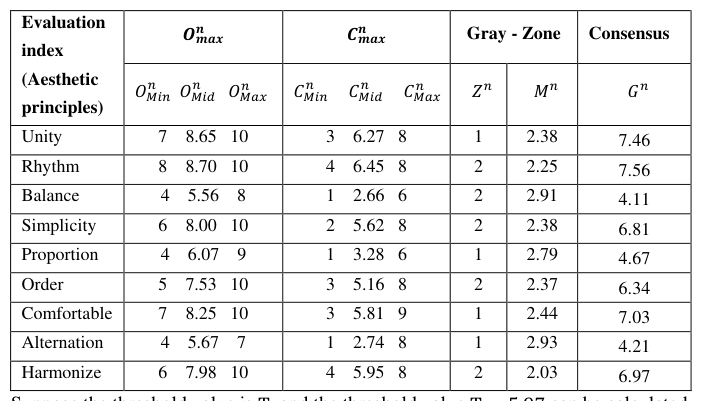
The statistical results obtained after FDM are shown in Table 2:
Table 1: FDM calculation results
Intelligent Human Systems Integration (IHSI 2022): Integrating People and Intelligent Systems https://openaccess.cms-conferences.org/#/publications/book/978-1-7923-8988-7 should be eliminated. Through the analysis of the results, it is finally determined that: unity, rhythm, simplicity, order, comfortable and harmonize are the evaluation indicators for pleasant design.
CONCLUSIONS
The generation of pleasant emotion is closely related to the aesthetic principles of product form. Using the aesthetic principles as the evaluation system can well reflect the degree of product pleasure. Due to the large number of aesthetic principles and lack of pertinence, it is necessary to screen them by experts. Delphi method can scientifically screen the evaluation indicators. Because there is a certain fuzziness between the scores of experts, it is necessary to de fuzziness them. Fuzzy Delphi method can determine the rationality of evaluation index more effectively than traditional Delphi method, and shows a certain effectiveness. After fuzzy operation, the accuracy of evaluation indexes is improved, which ensures the scientificity and objectivity of various indexes, and provides a reliable evaluation system for the pleasant evaluation of product design.
REFERENCES
Norman, D. A. (2004). Emotional design. New York: Basic Books. Marzano, S. Thoughts. Blaricum (1998): The Netherlands: V+K Publishing. Desmet, P. M. A. (2012). Faces of Product Pleasure: 25 Positive Emotions in Human-Product Interactions. International Journal of Design Desmet, P. M. A. (2010).Three levels of product emotion. KEER Jordan, P. W. (2000). Designing pleasurable products. London: Talyor & Francis. Pham, M. T. (1998). Representativeness, relevance, and the use of feelings in
decision making. Journal of Consumer Research, 25(2), 144-159. Westbrook, R. A., & Oliver, R. L. (1991). The dimensionality of consumption emotion patterns and consumer satisfaction. Journal of Consumer Research, 18(1), 84-91. Lewis, D., & Bridger, D. (2001). The soul of the new consumer. London: Nicholas
Brealey Publishing. Creusen, M., & Snelders, D. (2002). Product appearance and consumer pleasure. In W. S. Green & P. W. Jordan (Eds.), Pleasure with products: Beyond usability 69-75. Immanuel Kant (2005). The Practical Anthropology. Shanghai People's Publishing
House. Shanghai. (2005) Wen-Chih Chang & Tyan-Yu Wu(2009). The development of a scale for the assessment of consumer pleasure evoked by product appearance. Psychological Testing, 56(2), 207-233. Lionel Tiger(2010). The pursuit of pleasure. Theatre Dance & Performance
Training, 1(1), 36-54. P. W. (1998). Human factors for pleasure in product use. Applied Ergonomics, 29(1), 25-33.
Intelligent Human Systems Integration (IHSI 2022): Integrating People and Intelligent Systems https://openaccess.cms-conferences.org/#/publications/book/978-1-7923-8988-7
Maslow AH. (2006). Motivation and Personality. New York: Harper & Row. (1970) Hekkert P.: Design aesthetics: principles of pleasure in design. Psychology ence, 48(2). Tyan-Yu, Wu, T. Chueh-Yung, & S. Cian-Yu (2017). Unity enhances product
aesthetics and emotion. International Journal of Industrial Ergonomics 59:92-99. Zhaolan Meng(2005).Emotional psychology. Peking University Press. Beijing. Goldman, A. The Aesthetic. In B. Gaut & D. Mc Iver Lopes (Eds.) (2001).The Routledge companion to aesthetics (pp. 181-192). London: Routledge. Hagtvedt, Henrik & V. M. Patrick (2008). Art Infusion: The Influence of Visual Art
on the Perception and Evaluation of Consumer Products. Journal of marketing research 45:379-389. Boas, George, & Russell, Bertrand (1947). A History of Western Philosophy.
Philosophy & Phenomenological Research. Leder H, Belke B, Oeberst A & Augustin D. A. (2011). A model of aesthetic appreciation and aesthetic judgments. British Journal of Psychology 95. (4):489-508 Schifferstein, Hendrik N J & P. Hekkert. (2008).Product Experience. Ingarden, R. (1961). Aesthetic experience and aesthetic object. Philosophy and
Phenomenological Research. Seeley, W. P. (2013). Art, Meaning, and Perception: A Question of Methods for a Cognitive Neuroscience of Art. British Journal of Aesthetics 4:443-460. Murray, T. J., L. L. Pipino & J. P. Vangigch.(1985) .A pilot study of fuzzy set
modification of Delphi. Residential Treatment for Children & Youth 5.1:76- 80. Ishikawa, Akira, et al. (1993). The max-min Delphi method and fuzzy Delphi method via fuzzy integration. Fuzzy Sets & Systems 55.3:241-253. Pham, B. L. (1999). Design for aesthetics: interactions of design variables and
aesthetic properties. Proceedings of SPIE - The International Society for Optical Engineering 3644:364-371.
Intelligent Human Systems Integration (IHSI 2022): Integrating People and Intelligent Systems https://openaccess.cms-conferences.org/#/publications/book/978-1-7923-8988-7
LISTED IN THE AHFE DIGITAL BOOKSTORE CATALOGUE
Explore the complete digital volume
Intelligent Human Systems Integration (IHSI 2022): Integrating People and Intelligent Systems
Read this individual research paper free through the original publisher, or explore the full digital proceedings book.
ISBN 978-1-7923-8988-7
Explore this ISBN in the AHFE Bookstore ↗Listed in the July 2026 bookstore catalogue; search by ISBN to confirm current availability · Digital book purchase optional