Qiaoling Zou, Zishun Su, Lei Zou, Dongning Li (2023). The design guide and scenario of virtual reality education APP. In: Intelligent Human Systems Integration (IHSI 2023): Integrating People and Intelligent Systems. AHFE Open Access, vol. 69, pp. 797–804. https://doi.org/10.54941/ahfe1002903
Virtual reality education App is the product of the application of virtual reality technology in education, it is a new paradigm of educational technology in the digital age. In this study, Kano model was used to assess the learners' needs for specific design elements in the virtual reality education App from the perspective of user needs. Through the survey method verification, the learner has the high expectation to 7 attributes, carries on the optimization design to these aspects to have the good effect. According to the results, the concrete design scheme of virtual reality education App is summarized in order to guide the development of virtual reality education App in the future.
Virtual reality (VR) refers to an interactive virtual environment that inte- grates sight, hearing, smell, touch, and taste generated by comprehensive technologies such as computer modeling technology, space, sound, and visual tracking technology. It uses virtual reality technology to create virtual reality art for the purpose of immersive experience. In such a virtual space, users can interact with computers with the help of data headsets, data gloves, data clothing, sound aggregators, voice recognition and other devices to obtain sensory experiences similar to real ones (Langer, 1977). It has been a hot spot in the world in recent years. With the advancement and development of science and technology, virtual reality has been applied in many fields such as education, design, medicine, architecture, military, etc., and has achieved fruitful results. The application of virtual reality in education can make use of this new information technology to create new applications for education. To a great extent, it can promote the learning interest of learners and the rapid absorption of knowledge, provide real-time feedback for teachers and learners, and have a very interactive, personalized, immersive classroom tea- ching experience, at the same time, construct different types of new teaching models (Liu & Ren, 2019). Based on the characteristics of virtual reality, vir- tual reality application (App) can provide more immersive, interactive and
multi-sensory stimulation virtual reality environment than traditional edu- cation applications (Rasheed et al., 2015). This kind of environment can provide learners with a better learning experience-embodied learning experi- ence, instead of simply listening, students can fully engage, touch, and feel in the learning process, so as to improve the learning effect of students.
At present, there have been many successful practices of virtual reality education App. In the field of engineering, virtual reality laboratory can help learners role-play, more convenient to carry out skills. Rely on virtual reality technology to create a virtual laboratory, the environment and equi- pment are virtual, it can appropriately increase the auxiliary equipment of the experiment according to the actual needs, reduce the purchase cost of the experimental articles. In the field of philosophy and history, virtual reality library can help learners build a huge database. It can not only build a virtual platform according to the library in the real world, but also present docu- ments and books to learners realistically through the App, so that learners can learn without limitation of time and space. In addition, virtual reality educa- tion App used in the field of special education has had unexpected benefits. Singapore has used virtual reality technology to create virtual Reality Pink Dolphin for teaching content for children with autism spectrum Disorder (ASD) to help them improve their social and communication skills. Virtual reality dolphins reduce the cost of using real dolphins, which is conducive to the popularization of this education (Tsolakidis et al., 2018). Therefore, how to design virtual reality education App, so that learners can improve learning speed and learning quality through the App is particularly important.
METHOD
This topic will use the Kano model to analyze the needs of users of virtual reality education App, which will help designers classify the attributes of the needs of users of virtual reality education App, then, users’ demands that are favorable to the design of virtual reality education App are selected to guide designers to design more popular virtual reality education App. The specific process is divided into the following four steps: Capture the Elements of User Requirements
In this process, no less than 20 learners will be interviewed to obtain their demand for virtual reality education App. The selected students are all school students or adults who have the desire or need to continue learning. Then, after the evaluation of experts in related fields, the initial user requirements (Table 1 shows) are as follows.
Design User Demand Questionnaire Design user demand questionnaire according to initial user demand, then the relevant parameters were obtained through the questionnaire data. Based on Kano questionnaire design principles, the positive and negative bipolar problems are set for each user’s requirements (Table 2 shows), the respondent only needs to make a choice in the corresponding location.
The Design Guide and Scenario of Virtual Reality Education APP 799
Table 1. User requirements.
Table available in the original PDF paper.
No. Requirement terms No. Requirement terms X1 Have a boot video of a novice action
X11 Color harmony
X9 Have more text learning content X2 The interface is easy to operate X10 Have more interactive links X3 Have Graphics or text to guide the operation X4 Have sound to guide the operation X12 Sound harmony X5 Use big data to tweak your learning program X13 Scene switching speed is appropriate X6 Accurate and timely learning feedback
X16 Have clear selection icons
X14 The study time is set appropriately X7 Have interactive avatars X15 Pictures simulation X8 Set up it’s learning process reasonable
Table 2. Questionnaire template.
Table available in the original PDF paper.
Question Very satisfaction
Satisfaction Indifferent Unsatisfaction Very unsatisfaction
(Positive) If there is a boot video of a novice action in the App, what’s your opinion?
(Negative) If there is not a boot video of a novice action in the App, what’s your opinion?
Population Description In order to obtain a wide range of views from all types of learners, all subjects in this survey were either school students or adults with learning needs (e.g., adult education). In total, 60 questionnaires were sent out and 60 question- naires were withdrawn. Since all the questionnaires were answered under the guidance of the project team members, the returned questionnaires are valid.
Table 3. Kano model evaluation results classification control table.
A: Attribute of Charm, O: Attribute of Expectation, M: Attribute of Requirement, I: Attribute of Indifference, R: Backward Attribute, Q: Doubtful attribute.
Table 4. Model requirements definition table.
Table available in the original PDF paper.
Better Value Absolute value of the Worse Degree of demand >0.5 >0.5 Attribute of Expectation (O) <0.5 <0.5 Attribute of Indifference (I) >0.5 <0.5 Attribute of Charm (A) <0.5 >0.5 Attribute of Requirement (M)
Kano Model Construction The Kano model is constructed using the SPSSAU data science analysis plat- form. Firstly, according to the forward and reverse answers of each group of questions, from ‘very dissatisfied’ to ‘very satisfied’ in 5 grades, corre- sponding to the numbers 1-5 for the marking. Secondly, the results of the questionnaire were sorted into data tables and uploaded to the SPSSAU plat- form. Then the platform classified the data according to the Kano model evaluation matrix table (Table 3 shows) and counted the proportion of each attribute of each demand indicator, the requirement attribute of this metric is defined by the one with the highest percentage.
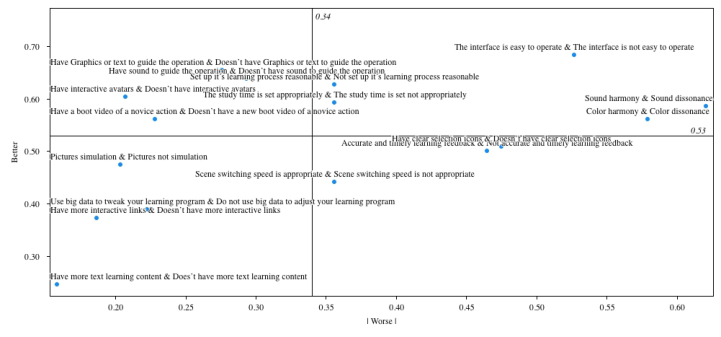
In addition, the SPSSAU platform automatically calculates the Better (sati- sfying influence) and Worse (unsatisfying influence) coefficients based on the uploaded data, using the following formula: Better coefficient=(A+O)/(A+O+M+I) Worse coefficient=–1*(O+M)/(A+O+M+I) Better and Worse are both used to determine how sensitive users are to changes in requirements levels. The Better metric is between 0 and 1, with a higher value indicating greater sensitivity and higher priority (Table 4 shows). At the same time, the SPSSAU platform will distribute the absolute values of the Better and Worse coefficients corresponding to the vertical and hori- zontal coordinates respectively, and calculate and generate the Better-Worse coefficient graph. The Better-Worse coefficient graph shows the coordinates
The Design Guide and Scenario of Virtual Reality Education APP 801
of each function/service. The horizontal coordinate is a Worse absolute value, and the vertical coordinate is a Better value, which visually shows what the requirements attribute looks like.
The Better-Worse coefficient clearly shows the impact on user satisfaction when a requirement is met or not met (Chu et al. 2022). Better is the satisfa- ction of the user when it meets a requirement, and Worse is the dissatisfaction of the user when it does not meet a requirement.
RESULT
According to the results of Kano’s model analysis, (Table 5 shows) the user’s level of demand for the virtual reality education App’s functions is obtai- ned. It is divided into 4 attribute of charm, 3 attribute of expectation, 9 Attribute of Indifference, 0 attribute of requirement or backward attri- bute. ‘Have a boot video of a novice action’, ‘have graphics or text to guide the operation’, ‘have sound to guide the operation’ and ‘have intera- ctive avatars’ belongs to the attribute of charm. If these attributes are met, user satisfaction will increase significantly and they are the key to impro- ving the competitiveness of the virtual reality education App. ‘The interface is easy to operate’ and ‘Color harmony and sound harmony’ belongs to the attribute of expectation. Meeting these attributes can lead to a signi- ficant increase in customer satisfaction, but when such needs are not met or performed poorly, customer dissatisfaction can also increase significantly. Therefore, the designer of such products, should take a priority to meet the attitude.
After analyzing the demand attribute of each influencing factor, we got a better-worse coefficient graph (Figure 1). As the graph shows, the user shows great interest in the new boot video, picture boot, sound boot, interface visu- alization, and icon highlighting properties. Most of the respondents wanted a virtual reality education App that would provide a video guide for begin- ners and would be easy to use, with clear icons for the screen and sound. Secondly, as an educational App, users show obvious concern for its main function-educational content. As the graph shows, users expect the virtual reality education App to have reasonable settings for learning content and time. Finally, unlike traditional educational applications, virtual reality edu- cational applications are more interactive (Schapiro, 2014), a feature that users like.
It is worth noting that although some attributes are classified as indif- ference in the Kano model analysis results, they behave unusually in the better-worse coefficient graph. Like ‘have more text learning content’, ‘have more interactive links’, ‘use big data to tweak your learning program’, both ‘better’ and ‘worse’ show lower values in all three attributes. This means that users are both more negative about positive questions and more skeptical about negative ones. The result is somewhat similar to the backward attribute, so we should handle with caution when designing these attributes.
Table 5. The analysis result of KANO Model.
Table available in the original PDF paper.
Better Worse
Function/Service Analysis Result
56.14% −22.81%
Attribute of Charm
Have a boot video of a novice action & Doesn’t have a new boot video of a novice action
68.42% −52.63%
The interface is easy to operate & The interface is not easy to operate
Attribute of Expectation 65.52% −27.59% Attribute of Charm Have Graphics or text to guide the operation & Doesn’t have Graphics or text to guide the operation
63.79% −29.31%
Attribute of Charm
Have sound to guide the operation & Doesn’t have sound to guide the operation
38.89% −22.22%
Attribute of Indifference
Use big data to tweak your learning program & Do not use big data to adjust your learning program
50.00% −46.43%
Attribute of Indifference
Accurate and timely learning feedback & Not accurate and timely learning feedback
60.34% −20.69%
Have interactive avatars & Doesn’t have interactive avatars
Attribute of Charm 62.71% −35.59% Attribute of Indifference Set up it’s learning process reasonable & Not set up it’s learning process reasonable
24.56% −15.79%
Have more text learning content & Doesn’t have more text learning content
Attribute of Indifference 37.29% −18.64% Have more interactive links & Doesn’t have more interactive links Attribute of Indifference
56.14% −57.89%
Color harmony & Color dissonance Attribute of Expectation
58.62% −62.07%
Sound harmony & Sound dissonance Attribute of Expectation
44.07% −35.59%
Scene switching speed is appropriate & Scene switching speed is not appropriate
Attribute of Indifference 59.32% −35.59% The study time is set appropriately & The study time is set not appropriately Attribute of Indifference
47.46% −20.34%
Pictures simulation & Pictures not simulation
Attribute of Indifference 50.85% −47.46%
Have clear selection icons & Doesn’t have clear selection icons
Attribute of Indifference
A: Attribute of Charm, O: Attribute of Expectation, M: Attribute of Requirement, I: Attribute of Indifference, R: Backward Attribute, Q: Doubtful attribute.
DISCUSSION
Requirements Assessment of Virtual Reality Education App Design Essentials In the App design process, its usability, friendliness, stability is worth thin- king (Norman, 2010) when designing the virtual reality education App, we should focus on the sound and color. At the same time, we should focus on
The Design Guide and Scenario of Virtual Reality Education APP 803
Figure 1: Better-Worse coefficient graph.
the harmonious matching of sound and picture, and integrate the cognitive psychology and virtual technology to slow down the delay and enhance the interaction. Within the scope of App operation design, using novice guide video and sound, picture to assist in learning. It is convenient for the user to be familiar with the interactive application of the virtual reality education App in a short time, so as to integrate into the App as soon as possible.
In the process of designing the virtual reality education App, we should keep the effective integration of the related design elements and the virtual reality technology when we match the specific requirements. In the process of matching different design requirements, we use a variety of integrated factor analysis method to classify and compare the different design requirements, so as to produce and analyze the design requirements.
The Design Scenario of Virtual Reality Education App The design scenario of the virtual reality App focuses on the priority design of the novice operation guidance video, the graphic and text operation, and the sound operation habits. It should aim at the novice user, the intermedi- ate user’s demand carries on the design scene consummation. In the different design scene, the user model and the interface scene are effectively matched with the technical realization scene, and the design scene representation and expression. In the design scene, the virtual reality technology should be used to reproduce the reality, it is effectively constructed in the process of user’s using.
In the process of designing virtual reality education App, the design of App scene should realize the balance of requirement-technology-design. By combing the interactive behavior logic of graphics, text and sound, the real- time information transmission and feedback of users in different scenes are realized. For example, Elastic Desktop Service, developed by Alibaba Group, could serve as an easy-to-use, secure and efficient cloud desktop service (Song, 2020). Under the premise of user-centered design, virtual reality education App can use artificial intelligence and big data methods to carry out technical operation and system maintenance, and realize multiple guarantees of user’s use stability and usability.
CONCLUSION
The main points of the design of the virtual reality education App mainly focus on the video, sound and picture of the novice guide, and the interaction between the application and technology of the App. In different application scenarios, it is necessary to adopt different design strategies and specifications to guide the design practice and application. In the selection and matching of design elements, the consideration of virtual role, interactive feedback and design style still need to be further discussed and refined.
In order to carry out the idea of life-long education, in the design and development of the virtual reality education App, we should consider the characteristics of the different users of its learners, and construct appropri- ate user portraits. In the face of different types of learners in the design of applications, we should adopt different design strategies and styles to adapt. Through the virtual reality education App to achieve online and offline edu- cation model, to compatible and open form of sharing to break the possibility of data separation and isolated island. In this way, the smooth flow of infor- mation will be achieved, so as to achieve the original purpose of wisdom education.
ACKNOWLEDGMENT
The authors would like to gratefully acknowledge the reviewers’ comments. This work was supported jointly by National Social Science Foundation of China (No. 2021AC05295), Shanghai Philosophy and Social Fund Project (No. 2019EWY010), Shanghai Business School Curriculum Ideological and Political Construction Project (No. SBS-2021-XJKCSZ-06) and Shanghai Business College Education and Teaching Reform Research Key Project (No. SBS-2022-XJJG-07).
REFERENCES
Chu, Y., Wang, P., Li, J., Li, Y. (2022). “Kano Model Analysis of Patent Information Service Platform Function”. Information and Documentation Services. 2022. 43(05). pp. 71–80 Langer, S. K.(1977). Feeling and Form. Prentice Hall. Liu, R. X & Ren, Y. Q. (2019). “Research on Effects of Flow Experience and Empathy
in Immersive Virtual Environment”. E-Education Research. 40. pp. 99–105. NORMAN D A, NIELSEN J. Gestural interfaces: A step backward in usability [J].
Interactions, 2010, 17(5): 46–49. Rasheed, F., Onkar,P. and Narula, M. (2015). “Immersive Virtual Reality to Enhance the Spatial Awareness of Students”. In Proceedings of the 7th Internati- onal Conference Human Computer Interaction, Guwahati – India HCI 2015. pp. 154–160 Tsolakidis, C., Zouboula, N., Fokides, E., & Vratsalis, C. (2008). “Virtual Reality
and Museum: An Educational Application for Museum Education”. Int. J. Emerg. Technol. Learn. (IJET). 3. pp. 89–95. Schapiro (2014). Embodied cognition. Nanjing: Huaxia Publishing House. Song, J (2020). “A big bet on CIPU, Alibaba Cloud to define the next generation of cloud”. The Electronic Information Industry Network:http://www.cena.com.cn/
LISTED IN THE AHFE DIGITAL BOOKSTORE CATALOGUE
Explore the complete digital volume
Intelligent Human Systems Integration (IHSI 2023): Integrating People and Intelligent Systems
Read this individual research paper free through the original publisher, or explore the full digital proceedings book.
ISBN 978-1-958651-45-2
Explore this ISBN in the AHFE Bookstore ↗Listed in the July 2026 bookstore catalogue; search by ISBN to confirm current availability · Digital book purchase optional