Donglin Wang, Yuning Qian, Jiong Fu, Hongli Jia (2022). Designing and Evaluating of an iPad-based Reading Mode for Enhancing the Efficiency of Non-native Immersive Reading. In: Intelligent Human Systems Integration (IHSI 2022): Integrating People and Intelligent Systems. AHFE Open Access, vol. 22. https://doi.org/10.54941/ahfe100934
With the development of the Internet and electronic devices, it has become easier for us to acquire knowledge, but the concentration of reading has decreased. Nowadays, many tasks must rely on various electronic devices, and within them there is still a large demand for immersive reading in front of electronic screens. However, due to the particularity of electronic devices, the concentration of text reading is not high enough, resulting in low reading efficiency, especially for non-native language reading. Many studies have focused on the effects of static elements (such as labeling, background color, etc.) on reading efficiency and fatigue, however, few studies on the effect of dynamic text display form on reading concentration.Considering that iPad is often selected as the immersive reading tool, due to its function of annotating with pencils, this study aims to propose an iPad-based dynamic reading mode to help users with immersive reading demands read more effectively with electronic devices. In order to clarify the direction of design, we conducted a pre-experiment on the several existing reading modes designed for reading concentration available through eye-tracking evaluation and user interviews. Three participants wore eye trackers to experience several reading modes and put forward their design suggestions. Based on the eye-tracking data and interview results, an iPad-based reading mode of paragraph highlight was proposed based on the improvement of the existing reading mode. This reading mode can dynamically highlight the paragraphs of the article following the drag of the page, helping users to concentrate on the paragraphs they want to read intensively, without being interfered by other elements on the page.In order to evaluate the function of this reading mode, a multi-dimension verification experiment was conducted on the reading efficiency and concentration of non-native language reading with this reading mode and its user preference. The experiment was conducted by reading articles in different reading modes and answering questions about articles, and filling out subjective evaluation scales. A total of 24 university students were invited, all of whom are non-native speakers of English, and their English level is comparable. The English articles used were all TOEFL reading articles of the same difficulty, in order to balance the difficulty of the questions after the articles. Each participant experienced three reading modes in the experiment, which are reading modes of line highlight, paragraph highlight, and normal (no highlight). The order of the three modes and the combination of articles have been balanced. After each article, there were three questions about the articles and several subjective evaluation scales about concentration, preference, and difficulty.The results show that the reading mode of paragraph highlight received the highest correct rate of question-answer and reading concentration of subjective evaluation significantly. Moreover, its user preference is also significantly higher than the other two reading modes. In conclusion, it shows that the reading mode of paragraph highlight proposed in this research may improve the efficiency and concentration of non-native language reading on the iPad. In the future, relevant web reading plug-ins or reading apps in the iPad based on this reading mode can be developed, which may provide more possibilities for users who use iPad for immersive reading.
Intelligent Human Systems Integration (IHSI 2022): Integrating People and Intelligent Systems https://openaccess.cms-conferences.org/#/publications/book/978-1-7923-8988-7
Efficiency
INTRODUCTION
With the development of Internet technology, more and more products and services become digital. Many jobs need to rely on various electronic devices, and the reading based on electronic screen is gradually rising. Compared with paper reading, it is easier to obtain information, but the time for immersive reading is decreasing (Liu, 2005). Users are easily distracted when reading on the screen, especially for non-native materials. This is due to the complexity of electronic equipment, the interference of massive information and the lack of physical contact with users. Therefore, how to design reading assistance to enable users to focus on the text content on the screen and improve reading efficiency has become particularly important.
RELATED WORK
As we mentioned earlier that immersive reading at the macro level is very helpful, but not sufficient, we now review some micro level strategies in further detail to improve the reading efficiency of an individual document.
Reading and comprehension D Kingery and R Furuta found that font typeface, font size, screen resolution and display size have impacts on the legibility of screen text reading (1997). Luo Wei believes that immersion to the text is an important state for the reader when reading. With the rise of electronic reading, reading tools on the electronic devices that meet users' immersive reading needs become more and more important. Most interfaces of reading tools have too many interference elements, which may easily interrupt reading and then hinder readers from entering the immersion state (2013). Hirohito Shibata et al. found that interaction with text is an important factor affecting reading performance. When the user's interaction with the text is limited, the reading efficiency may be reduced (2013). These results show that the dynamically focused reading mode based on the iPad can improve reading concentration.
Reading assistance Terje Hillesund proposed that users need the least interference from technical factors of electronic devices to achieve the immersive reading mode, so as to make the interference factors transparent (2010). Matthew K. Hong et al. found that readers showed visual tracking activities in reading process. They usually use thin objects (such as pens) or fingers as the instantaneous focus to guide visual attention and mark position. Based on this discovery, they proposed a desktop design scheme to strengthen reading behavior. Particularly, the text area will be temporarily highlighted following reader’s visual tracking
Intelligent Human Systems Integration (IHSI 2022): Integrating People and Intelligent Systems https://openaccess.cms-conferences.org/#/publications/book/978-1-7923-8988-7
(2012). The Microsoft edge browser has an immersive reading tool that simplifies the layout of web page and eliminates irrelevant information. Readers can open the "line-focused" mode to read focused on one line, three lines or five lines at a time. This is consistent with our research direction, but we will further explore the impact of focused text areas and operation mode on reading experience.
REQUIREMENT AND DESIGN Pre-design Analysis
In order to better understand the impact of reading mode on electronic reading performance, we collected the data of three graduate students (aged 22-24 years) reading non-native texts with an eye tracker (Tobii lab high precision head mounted eye tracker). The research aims to understand the user experience of the current immersion reading tools on the browser, so as to provide information for the further design. Participants successively experienced and evaluated three reading modes: Jane Yue reading plug-in (paragraph-focused reading mode), the immersion reading mode of Microsoft edge browser (line-focused reading mode) and ordinary web page text reading.
Our researchers conducted a detailed analysis of participants' eye movement data. Through analysis, it is found that the pupil diameter of the three participants is the smallest when using paragraph-focused reading mode, which may be due to the less fatigue of readers in this reading mode. Furthermore, three participants all thought that they tend to be more immersive when using the first two focused reading modes than the ordinary reading mode.
Reading Mode of Paragraph Highlight In order to help readers read more effectively, one of the important tasks is immersive reading, which needs to help users focus on the text. Furthermore, it needs to restore the natural reading state as much as possible, which is ignored by the existing reading modes. Therefore, based on the existing web page reading mode, we propose a dynamically focused reading mode based on iPad. This reading mode can highlight the article paragraphs one by one following the drag of the page by the finger, helping users to concentrate on the paragraphs they want to read intensively, and avoiding the interference of other elements in the interface.
EVALUATION STUDY
METHODS
In order to evaluate the impact of this iPad-based reading mode on non-native reading efficiency, concentration and user preferences, our research conducted a multi-dimensional verification study.
Intelligent Human Systems Integration (IHSI 2022): Integrating People and Intelligent Systems https://openaccess.cms-conferences.org/#/publications/book/978-1-7923-8988-7
Participants. 24 non-native speakers who are proficient in English participated in the study (M(age)= 23.67, 12male, 12female). The participants are college students of Shanghai Jiao Tong University, with different majors. In the recruitment stage, participants completed the English vocabulary test (provided by Scallop Words), and students with a vocabulary of 8000-12000 were invited to participate in the study.
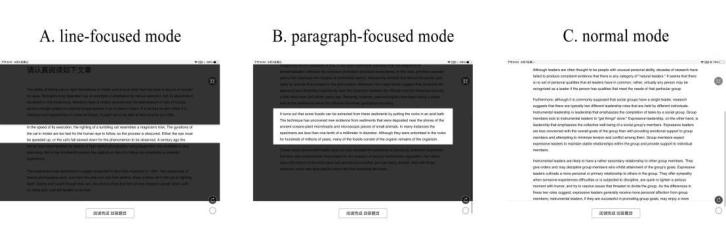
Materials. All participants need to use iPad mini 5 to experience three reading modes (Figure 1) in the experimental environment (quiet and empty room with standard sitting posture). The three reading modes are line-focused (similar to the reading mode on Microsoft edge browser), paragraph-focused (design mode) and normal mode. In order to balance the difficulty of articles and questions, the English articles we use are TOEFL reading articles with the same difficulty, and three questions (theme question, detail question and reasoning question) are selected for each article. The three articles are: A Result of a Research about Leaders (372 words), Newton's laws of motion (358 words), The Music of Films (353 words), and their Lexile Text Measures are 1210L to 1400L.
Figure 1. Three reading modes were used in the experiment.
Procedure. The study was evaluated by reading articles and answering questions in different reading modes, and filling in a subjective evaluation scale. Before the reading experience, the experimenters briefly introduced the use methods of the three reading modes and the process of the whole experiment. Then, participants read three articles in three reading modes. After reading each article, they need to complete the corresponding three reading answers and subjective evaluation questions. The combination of the reading modes and articles, and the order of the reading modes are balanced. After experiencing the three reading modes, participants chose their favorite reading mode. The subjective evaluation question evaluates the user's subjective concentration when using the reading mode and the subjective difficulty of the reading tasks, including: 1) How focused do I think I am in the above reading mode? 2) How difficult do I think the above reading tasks are? 7-point Likert Scales are used for both questions.
Intelligent Human Systems Integration (IHSI 2022): Integrating People and Intelligent Systems https://openaccess.cms-conferences.org/#/publications/book/978-1-7923-8988-7
ANALYSIS One-way within subject ANOVA with three groups and post hoc test (LSD) were used to analyze the question answer scores, subjective evaluation of concentration, user preference and subjective evaluation of reading difficulty under the three reading modes.
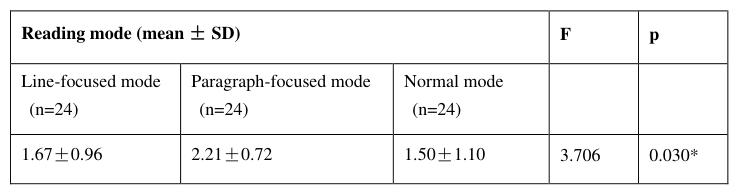
FINDINGS Accuracy of question answer. Under different reading modes, the total scores of question answer shows significant difference (F = 3.706, p = 0.030) in Table 1. It is found that the total scores of paragraph-focused mode (designed mode) is significantly higher than that of normal mode (p = 0.011) and slightly higher than that of line-focused reading mode (p = 0.050). This shows that the designed mode can significantly improve the reading accuracy, which implies that users can more accurately grasp the content of the article and be more concentrated when using the designed reading mode.
Table 1: Analysis of users’ question answers score Reading mode (mean ± SD) F p
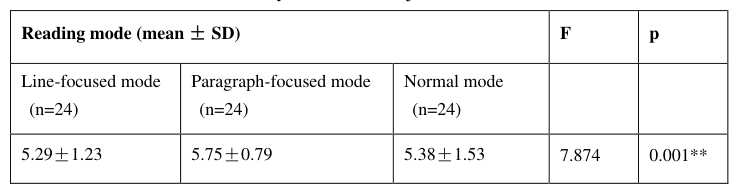
Subjective concentration. There was a significant difference (F = 7.874, p = 0.001) in subjective evaluation of concentration scores under different reading modes in Table 2. It was found that the subjective concentration scores of paragraph-focused mode and line- focused mode were significantly higher than those of normal mode. Therefore, the reading mode with functions helping focusing will make users feel more concentrated in reading, especially the designed dynamically paragraph-focused mode.
Table 2: Analysis of users’ subjective concentration Reading mode (mean ± SD) F p
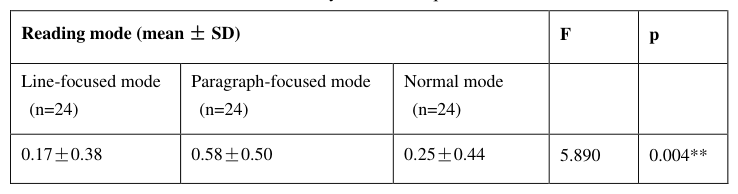
User preference. The user preference shows significant difference (F = 5.890, p = 0.004)
Intelligent Human Systems Integration (IHSI 2022): Integrating People and Intelligent Systems https://openaccess.cms-conferences.org/#/publications/book/978-1-7923-8988-7 in Table 3, and the scores of the designed mode is the highest (p < 0.05), which reflects that the usability and effectiveness of the designed reading mode has been recognized by users.
Table 3: Analysis of users’ preference Reading mode (mean ± SD) F p
Subjective difficulty. There is no significant difference in subjective evaluation of task difficulty under different reading modes, which means that the effects of different reading modes on task difficulty are consistent.
Therefore, the results of the evaluation study shows that the paragraph-focused mode proposed in this research can improve the efficiency and concentration of non-native language reading on the iPad. Users are willing to use this mode for reading and show high preference. At the same time, this reading mode does not increase the difficulty of reading. The above analysis confirms the effectiveness and usability of the dynamically paragraph- focused mode.
CONCLUSIONS
Based on the needs of immersive reading on the screen in the information age, we proposed an iPad-based reading mode of dynamically focused on text paragraphs, which finds the possibility to improve the reading concentration on tablet computers. However, at present, the interaction of this reading mode depends on dragging on the screen, which is far from the visual tracking when reading traditional print text. Further researches can be applied to mobile devices with floating touch technology to get closer to the interaction mode of natural reading. Additionally, the evaluation method is limited to reading non-native short article and it may be evaluated in more detail in further researches. In the future, we hope to apply this reading mode to develop relevant reading application software, so as to provide more choices for users who use electronic devices for immersive reading.
ACKNOWLEDGMENTS
We owe gratitude to the college students of Shanghai Jiao Tong University, who
Intelligent Human Systems Integration (IHSI 2022): Integrating People and Intelligent Systems https://openaccess.cms-conferences.org/#/publications/book/978-1-7923-8988-7 volunteered to take part in this study. At the same time, we also thank the school of design of Shanghai Jiao Tong University for providing us with eye tracker and other experimental equipment.
REFERENCES
Liu, Z. (2005). Reading behavior in the digital environment: Changes in reading behavior over the past ten years. Journal of documentation.
Kingery, D. and Furuta, R. (1997). Skimming electronic newspaper headlines: A study of typeface, point size, screen resolution, and monitor size. Information Processing & Management, 33(5), pp.685-696
Wei, L.U.O. (2013). The Levels of Reading Experience and the “Immersive” Reading Experience. Art and Design. p.06 Shibata, H., Takano, K. and Omura, K. (2013). Invited Paper: Impact of the Use of a
Touch-based Digital Reading Device in Immersive Reading, in: SID Symposium Digest of Technical Papers. pp. 45-48 Hillesund, T. (2010). Digital reading spaces: How expert readers handle books, the Web and electronic paper.
Hong, M., Piper, A.M., Weibel, N., Olberding, S. and Hollan, J. (2012). Microanalysis of active reading behavior to inform design of interactive desktop workspaces. In Proceedings of the 2012 ACM international conference on Interactive tabletops and surfaces. pp. 215-224
Intelligent Human Systems Integration (IHSI 2022): Integrating People and Intelligent Systems https://openaccess.cms-conferences.org/#/publications/book/978-1-7923-8988-7
LISTED IN THE AHFE DIGITAL BOOKSTORE CATALOGUE
Explore the complete digital volume
Intelligent Human Systems Integration (IHSI 2022): Integrating People and Intelligent Systems
Read this individual research paper free through the original publisher, or explore the full digital proceedings book.
ISBN 978-1-7923-8988-7
Explore this ISBN in the AHFE Bookstore ↗Listed in the July 2026 bookstore catalogue; search by ISBN to confirm current availability · Digital book purchase optional