Miguel Cobos, Daniel Ripalda (2022). Production of educational videogame from the design document. In: Intelligent Human Systems Integration (IHSI 2022): Integrating People and Intelligent Systems. AHFE Open Access, vol. 22. https://doi.org/10.54941/ahfe100996
This work aims to promote environmental awareness in children, as a philosophy of life, to promote a culture of care for the ecosystem in their family and social environment. From the field of video games, we wanted to achieve the proposed objective, for this we started from the design document, based on Rogers' model. Prototypes were developed, levels were designed, resources were placed in the scenario, physics and mechanics were tested. The agile Scrum methodology and the Unity video game engine with C# scripts were considered for the development. The video game consists of a superhero of nature with three levels, was generated in its initial phase to be tested with the target audience. The results obtained from a control group of children from 7 to 10 years old are presented. A user experience evaluation method was applied by inspection to obtain results related to usability heuristics, Gestalt principles, interactions, and perception of aesthetics.
Intelligent Human Systems Integration (IHSI 2022): Integrating People and Intelligent Systems https://openaccess.cms-conferences.org/#/publications/book/978-1-7923-8988-7
INTRODUCTION
Environmental conservation One of the concerns facing humanity is related to actions to conserve the environment through proper resource and waste management. (Arokiaraj et al. 2019) states that global waste will increase from 1.3 billion tons in 2018 to 27 billion tons in 2050. (Banerjee et al. 2019) analyzed the types of waste generated in the urban sector, in- cluding biodegradable, recyclable materials, inert waste, hazardous waste, toxic waste, etc. These wastes are causing serious problems to our health and the environ- ment. The recommendation is to prevent through proper waste management and pub- lic awareness. The government of Ecuador has a manual for the use of municipal organic waste (Ministerio del Ambiente y Agua del Ecuador 2020), which is aimed at companies that use municipal solid waste, but it does not describe any actions aimed at the public to classify waste.
Educational video games Video games have been with us for several decades, they have been used for many purposes, from entertainment to therapeutic, educational, simulations and whatever application we want to give them. Serious video games are used for educational pur- poses, focused on promoting active learning (Menendez-Ferreira et al. 2020).
A team of researchers and developers generated an application, in line with the objective of promoting environmental awareness in children, being this the starting point to generate a culture of environmental conservation. This work shows the production process of an educational video game oriented to children between 7 and 10 years old, starting from the design document, subjected to usability, interaction, and aesthetic perception metrics.
RELATED WORK
There is some research related to the topic, using didactic material, gamification, and multimedia. Local applications and around the world aim to make the population aware of the care of our environment. (Torres-Toukoumidis et al. 2020) present a video game oriented to the public, whose mission is to collect organic and inorganic garbage. (Robalino 2016) aims to teach children between 8 and 13 years of age to determine which garbage can be recycled, is also analyzed. On the other hand, there are applications that have been developed for a certain region or for specific interest.
METHODOLOGY
This section describes the methods used in the current work. Starting from the game design document, the construction of physical and software prototypes, the validation
Intelligent Human Systems Integration (IHSI 2022): Integrating People and Intelligent Systems https://openaccess.cms-conferences.org/#/publications/book/978-1-7923-8988-7 of the mechanics, generation of the first version of the video game, finally the vali- dation of parameters to determine the validity of the product.
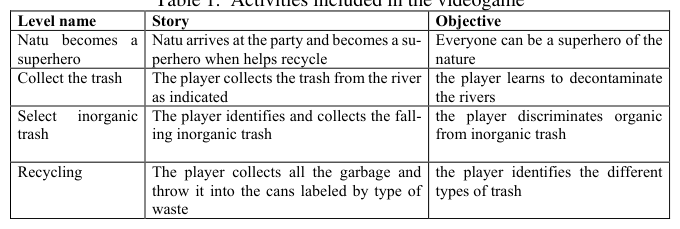
Project structure The project is proposed in two parts, an audiobook with the narration of the story, and the game, where the proposed activities are developed to reinforce children's awareness of environmental conservation. Table 1 shows the levels that will be built in the video game with their respective story and objective.
Table 1. Activities included in the videogame Level name Story Objective Natu becomes a superhero
Waterfall methodology The development process of a video game is like software development, following the waterfall methodology, it is divided into three stages (Atmaja and Siahaan 2016): pre-production, production, and post-production. For the development of this project, we start from a previous work of the same research team, where we wrote the game design document, for which we followed the methodology of (Rogers 2014) and the recommendations of (Schell 2019), in this way the pre-production stage is complete, and the work is concentrated on the production phase
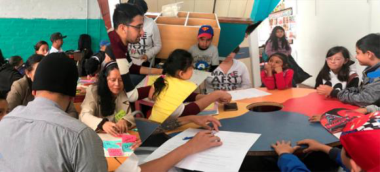
Prototyping Physical prototypes were made with cardboard, paper, toys and other elements to build the scenario, then test the physical mechanics and determine if the playability is adequate, (Adams and Dormans 2012) recommend doing this to refine the project, this was done using the participatory design work methodology (Asaro 2000), where all participants were involved including the target audience. A physical prototype is shown in Figure 1.
Intelligent Human Systems Integration (IHSI 2022): Integrating People and Intelligent Systems https://openaccess.cms-conferences.org/#/publications/book/978-1-7923-8988-7
Figure 1. Physical prototype Figure 2. Gameplay and game mechanics testing Video game development
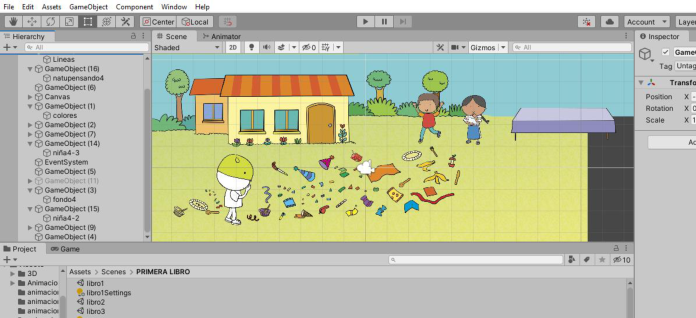
On the physical prototype, the mechanics were validated, a group of students tested this scenario and described their experience. The playability with the main character, physical mechanics such as jumping, walking, and flying and the interaction with the other characters and the environment were measured. Figure 2 shows the validation of gameplay parameters by the target group. After analyzing the data, adjustments were made to make the software prototype, the levels were built using the Unity video game engine (Camargo and Sáenz 2021), sup- ported by the agile development methodology SCRUM (Saputra et al. 2021), writing scripts in c#, thus achieving a first software prototype where it is possible to interact with the physical mechanics, internal economy, and progression. Figure 3 shows a first prototype where most of its elements are tested.
Figure 3. Software prototyping
RESULTS
The production process of this work generates an application with several immersed activities, all associated with the narrative of this project: a boy who becomes a su- perhero of nature, when he teaches his group of friends to collect and classify waste.
Intelligent Human Systems Integration (IHSI 2022): Integrating People and Intelligent Systems https://openaccess.cms-conferences.org/#/publications/book/978-1-7923-8988-7
The application is called The Adventures of Super Natu, in honor of its main charac- ter, and is intended to run as an application on Windows and Mac computers, as well as to be available in the main mobile application stores.
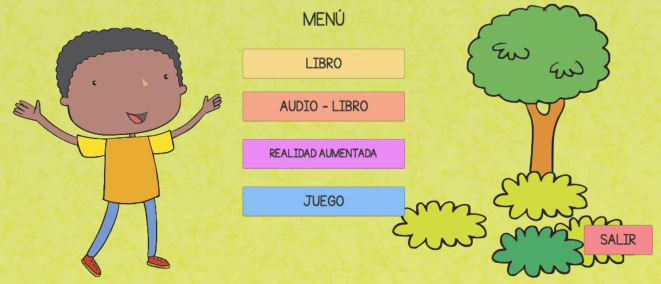
When the application is started, a navigation menu is presented, where users can choose the different activities. This interface is shown in Figure 4.
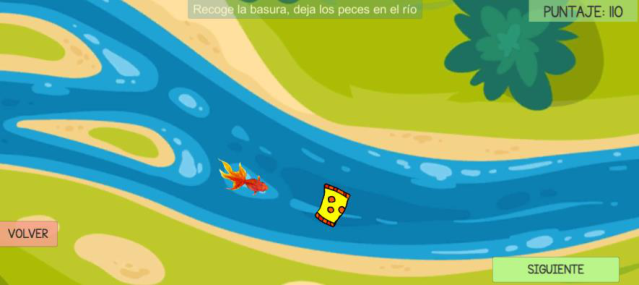
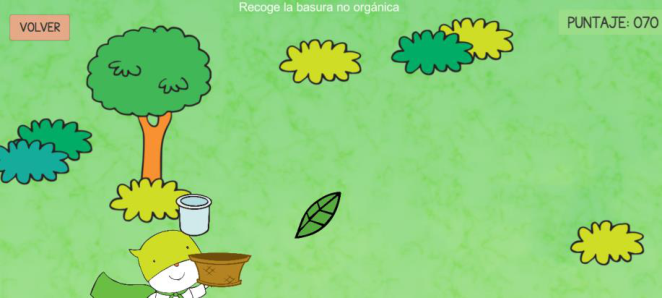
Figure 4. Access interface to the application's activities Having selected the game option, the first level is displayed, to pass it, at least a score of one hundred points must be reached, then the next option is enabled to pass to the next level. This level (Figure 5 shows an example) consists of collecting the waste from the river, to do so, just select it with the mouse or with the finger in mobile devices, avoiding selecting the fish to avoid reducing the score, the objective of this level is to guide the children in keeping the rivers clean and preserving the existing life in them.Figure 5. Game level 1: collecting garbage from the river Once the previous challenge has been overcome, level two is enabled (as shown in Figure 6), here the player is oriented to discriminate organic waste from inorganic
Intelligent Human Systems Integration (IHSI 2022): Integrating People and Intelligent Systems https://openaccess.cms-conferences.org/#/publications/book/978-1-7923-8988-7 waste, to achieve this, he must move Super Natu horizontally to catch the falling non- organic objects. Avoid selecting the leaves so as not to decrease your score.
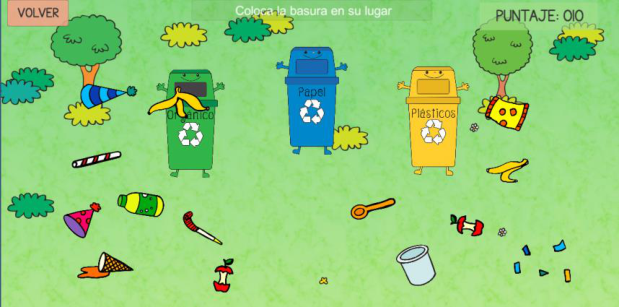
Figure 6. Game level 2: collecting inorganic garbage The next level is enabled once the previous ones have been passed, the objective is to drag the garbage and place it in the bins as appropriate, when you bring a waste close to the correct bin, it will open the lid to allow you to throw it there, in case it does not correspond, you will get an alert indicating that the garbage does not correspond. As shown in Figure 7.Figure 7. Game level 3: place the garbage in each garbage can as appropriate The game is a practice activity, reinforcing the story narrated in the audiobook, where Super Natu sensitizes the children not to litter and to help pick up garbage, discrimi- nating according to the type of container. Once the video game is finished, according to the design document and tuning, it is subjected to usability, perception, and aesthetics tests. Using the Gestalt prototyping
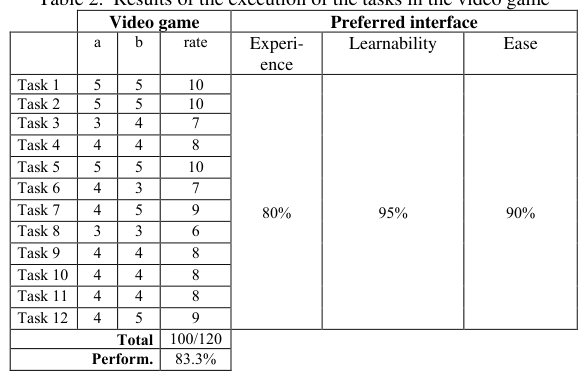
Intelligent Human Systems Integration (IHSI 2022): Integrating People and Intelligent Systems https://openaccess.cms-conferences.org/#/publications/book/978-1-7923-8988-7 framework (Ripalda et al. 2020), where Nielsen heuristics and Gestalt principles are linked. Tests were conducted with 152 children between 7 and 10 years of age from a school in northwestern Quito. The instrument used employed 48 interactions and 12 tasks carried out in different periods of time. After each task, participants scored their experience on a Likert scale (Hornbæk 2006). The following activities were graded: Task 1: "Launch the video game and go to the home screen"; Task 2: "From the home screen select the Audiobook option"; Task 3: "Advance to the section where Natu becomes Super Natu"; Task 4: "From the audio- book, return to the home screen"; Task 5: "From the home screen select the Game option", Task 6: "In the first level, collect all the trash in the river until you exceed 100 points"; Task 7: "Choose the Next option to advance to the next level"; Task 8: "On level 2, use the basket held by Super Natu to collect the inorganic trash, pass 100 points to advance to the next level"; Task 9: "Positioned on level 3, collect an organic waste and drag it to the green trash can"; Task 10; "Stay on level 3, collect a paper waste and place it in the blue trash can"; Task 11: "Staying at level 3, picking up a plastic waste and placing it in the yellow trash can"; Task 12: "Staying at level 3, picking up all the trash from the site by placing it in the respective container according to type". Parameters such as speed (a), ease of use (b), and interface parameters (ex- perience, learnability, ease) were measured. Table 2 shows the results obtained.
Table 2. Results of the execution of the tasks in the video game Video game Preferred interface a b rate Experi-
CONCLUSIONS AND FUTURE WORK Using a video game as a resource to make students aware of the importance of caring for nature was a valid and motivating idea to get them interested and to reach the objective of this project. Developing a video game from the design document streamlines the production pro- cess. This has made it possible to proceed directly to developing prototypes, testing
Intelligent Human Systems Integration (IHSI 2022): Integrating People and Intelligent Systems https://openaccess.cms-conferences.org/#/publications/book/978-1-7923-8988-7 mechanics and gameplay. On the other hand, involving the target audience in the tests before having a first prototype of the videogame, has allowed refining the project to bring it closer to the medium for which it was intended. Selecting a relatively easy-to-use game engine, such as Unity, speeds up the devel- opment process, allowing the proposed levels to be generated quickly. The team, with prior knowledge of the game engine, was familiar with using it for development in- stead of looking for other alternatives. The usability test shown in the results made it possible to determine the difficulties in the development of the activities and to propose changes. It is expected to use the video game in educational institutions, validate again its usability and determine the fulfillment of its objective.
REFERENCES Adams, E. and Dormans, J. (2012). Game mechanics: advanced game design. Berkeley, CA: New Riders. Arokiaraj, D., Yamuna, T. and Ramanarayan, S. (2019). Recover, Recycle and Reuse,
An Efficient Way to Reduce the Waste. International Journal of Mechanical and Production Engineering Research and Development, 9(3), pp.31–42. Asaro, P.M. (2000). Transforming society by transforming technology: the science and politics of participatory designଝ. , 2000, p.34. Atmaja, P.W. and Siahaan, D.O. (2016). Game Design Document Format For Video
Games With Passive Dynamic Difficulty Adjustment. , 2016, p.12. Banerjee, P., Hazra, A., Ghosh, P., Ganguly, A., Murmu, N.C. and Chatterjee, P.K.
(2019). Solid Waste Management in India: A Brief Review. In: Ghosh, S. K., ed. Waste Management and Resource Efficiency. Singapore: Springer Singapore, pp.1027–1049. Available from: http://link.springer.com/10.1007/978-981-10- 7290-1_86 [accessed 17 January 2022]. Camargo, J.E. and Sáenz, R. (2021). Evaluating the impact of curriculum learning on the training process for an intelligent agent in a video game. Inteligencia Artifi- cial, 24(68), pp.1–20. Hornbæk, K. (2006). Current practice in measuring usability: Challenges to usability
studies and research. International Journal of Human-Computer Studies, 64(2), pp.79–102. Menendez-Ferreira, R., Torregrosa, J., Panizo-Lledot, A., Gonzalez-Pardo, A. and Camacho, D. (2020). Improving Youngsters’ Resilience Through Video Game- Based Interventions. Vietnam Journal of Computer Science, 07(03), pp.263–279. Ministerio del Ambiente y Agua del Ecuador. (2020). Manual de aprovechamiento
de residuos orgánicos municipales. Primera edición. Quito: CENTRO DE AR- TES GRÁFICAS “EL FUEGO Y LA PALABRA. Ripalda, D., Guevara, C. and Garrido, A. (2020). Framework Based on Gestalt Principles to Design Mobile Interfaces for a Better User Experience. In: Ahram, T. and Falcão, C., eds. Advances in Usability, User Experience, Wearable and As- sistive Technology. Advances in Intelligent Systems and Computing. Cham: Springer International Publishing, pp.158–165. Available from:
Intelligent Human Systems Integration (IHSI 2022): Integrating People and Intelligent Systems https://openaccess.cms-conferences.org/#/publications/book/978-1-7923-8988-7 http://link.springer.com/10.1007/978-3-030-51828-8_21 [accessed 17 January 2022]. Robalino, F. (2016). Diseño de un videojuego para dispositivos móviles que fomente el reciclaje en los niños y niñas. , 2016. Rogers, S. (2014). Level up! the guide to great video game design. 2nd ed. Chichester:
Wiley. Saputra, N., Tentua, M.N. and Sari, R.P. (2021). The Development of Web-Based Correspondence Information Systems in University Using Scrum. Journal of Physics: Conference Series, 1823(1), p.012058. Schell, J. (2019). The art of game design: a book of lenses. Third edition. Boca Raton:
Taylor & Francis, a CRC title, part of the Taylor & Francis imprint, a member of the Taylor & Francis Group, the academic division of T&F Informa, plc. Torres-Toukoumidis, A., Robles-Bykbaev, V. and Cajamarca, M. (2020). Recycling process through 3D videogame technologies for web platforms in Latin-Ameri- can context. In: 2020 IEEE International Symposium on Technology and Society (ISTAS). 2020 IEEE International Symposium on Technology and Society (IS- TAS). Tempe, AZ, USA: IEEE, pp.350–353. Available from: https://ieeex- plore.ieee.org/document/9462179/ [accessed 17 January 2022].
Intelligent Human Systems Integration (IHSI 2022): Integrating People and Intelligent Systems https://openaccess.cms-conferences.org/#/publications/book/978-1-7923-8988-7
LISTED IN THE AHFE DIGITAL BOOKSTORE CATALOGUE
Explore the complete digital volume
Intelligent Human Systems Integration (IHSI 2022): Integrating People and Intelligent Systems
Read this individual research paper free through the original publisher, or explore the full digital proceedings book.
ISBN 978-1-7923-8988-7
Explore this ISBN in the AHFE Bookstore ↗Listed in the July 2026 bookstore catalogue; search by ISBN to confirm current availability · Digital book purchase optional