Daniel Ripalda, Miguel Cobos, Yamirlis Gallar Perez, Mario Piedra (2022). Design of interfaces for Dyslexia and Dyscalculia Applications. In: Intelligent Human Systems Integration (IHSI 2022): Integrating People and Intelligent Systems. AHFE Open Access, vol. 22. https://doi.org/10.54941/ahfe1001020
In the field of Human-Computer interaction, one of the decisive factors is the graphical interface; especially in applications in which the user has specific conditions that limit its operation and performance. This is the case of the Gabarato application, which facilitates the treatment of children diagnosed with dyslexia and dyscalculia who are cared for by Sinsoluka Center in Ecuador.During the development phase of the application, it was determined that there is a complexity to achieve specific usability interactions such as “ease of use”, “memorability” and “effectiveness”, especially with users who do not have the ability to operate peripherals of the application. computer and who present physical or cognitive difficulties to manipulate a conventional interface.Although in the preliminary studies the methodologies, standards, and protocols were met in the prototype tests; it was evident that the metrics used might not be effective; For this reason, the present work presents a proposal to measure usability interactions in children who present specific conditions; With these results, new versions of interfaces oriented to mobile devices were made.In this work, comparative data are analyzed that establish differences between the usability metrics with conventional users and users who present specific conditions or disabilities; Additionally, a discussion is offered regarding the elements that make up the interfaces and their relationship with usability heuristics and the fundamentals of human perception.
Intelligent Human Systems Integration (IHSI 2022): Integrating People and Intelligent Systems https://openaccess.cms-conferences.org/#/publications/book/978-1-7923-8988-7
INTRODUCTION
Dyslexia is classified as one of the specific learning difficulties and is known as a basic disorder that involves oral and written comprehension of language; it is mainly defined around the deficit of phonological, auditory, or visual language processing. People who manifest this disorder, especially in school stages, present difficulties with both precision and speed in understanding the language (Galaburda, A. M., & Cestnick, L., 2003) On the other hand, according to different authors, dyscalculia can manifest itself as a difficulty in the ability to perform calculations or operations that involve numbers; Among other difficulties in the basic training stage, students may have difficulties to use the language, use graphs or understand problems that involve geometry or arithmetic operations (Andalusian Dyslexia Association, 2010) Contemporary educational systems, developing countries, have significant limitations at the budget level to acquire technological tools that effectively contribute to the learning of children with conditions such as dyslexia and dyscalculia; these problems that in developed countries have adequate protocols and instruments for treatment and diagnosis; In countries like Ecuador, they have become a cause for school dropouts, because added to the lack of tools, there is a low level of application and control regarding the educational adaptations that children require in the different stages of cognitive development in basic education.
THERAPIES USING MOBILE APP Several experts have pointed out that one of the alternatives to face these learning difficulties would be the use of specialized applications that can be used as a complement to specific therapies. Applications such as For Dyslexia, Children’s day map, ABC Kit Letters, Newsela, Rave-o and Detective, present interesting functions that range from exercises that allow identifying if a child has dyslexia to specific exercises that use didactic strategies that range from the use of questions, guided readings and small games that can be used during the school stage (Quishpe, Bernal, & Gilva, 2017).
Gabarato The Gabarato application, designed and produced by students and teachers of the Indoamérica University of Ecuador (Cobos & Piedra, 2019). Gabarato was tested in a group of students receiving therapy at the Sinsoluka Foundation, which welcomes children of different ages who are in a condition of poverty, neglect, or with special educational needs, who for various reasons do not receive state benefits for their treatments. For its production, we worked with psychologists, speech therapists, and experts in psycho rehabilitation, who participated as consultants during the Project.
Intelligent Human Systems Integration (IHSI 2022): Integrating People and Intelligent Systems https://openaccess.cms-conferences.org/#/publications/book/978-1-7923-8988-7
It consists of two clearly defined sections, the first is oriented as support material for the treatment of dyslexia, provides reinforcement regarding the acquisition of skills to understand written language, and through audible support, facilitates the reading process from the decoding of graphemes and phonemes that make up words. For Dyscalculia, the development team chose to facilitate the recognition of mathematical signs and propose operations based on mathematical logical reasoning.
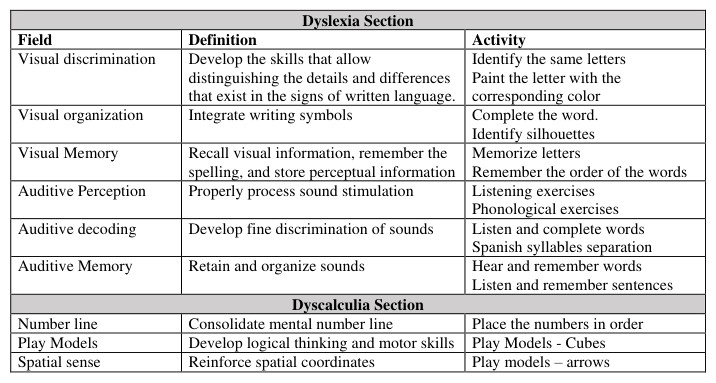
Table 1: Activities included in las primeras pruebas de UX Dyslexia Section Field Definition Activity Visual discrimination Develop the skills that allow distinguishing the details and differences that exist in the signs of written language.
New questions arise in User Experience UX testing The application user experience tests during the validation phase included tests of usability interactions related to experience, learnability, and ease. Although the tests, in general, obtained a 77% performance on average, it was found that not all the main users, who are children with different educational needs or physical disabilities, could complete the tests satisfactorily. For this reason, the development team opted for a more in-depth study that revealed details about the skills that children with disabilities require to use the teaching materials correctly. This new study was carried out individually with the children, under the supervision of the psycho-rehabilitation specialist and the Project specialist; Several of the user
Intelligent Human Systems Integration (IHSI 2022): Integrating People and Intelligent Systems https://openaccess.cms-conferences.org/#/publications/book/978-1-7923-8988-7 experience tests that were carried out during the first phase were repeated, but for this group, time was considered as one of the crucial factors. The experiment was recorded on video, which was reviewed for details such as concentration, stress level, precision, and fatigue. The tests were initially planned for a single day, however not all the evaluations could be completed due to the level of stress they generated. It was necessary to increase the number of participants and the sessions; finally, reliable user experience data were obtained from only 15 children between 8 and 12 years old. The results were not as expected
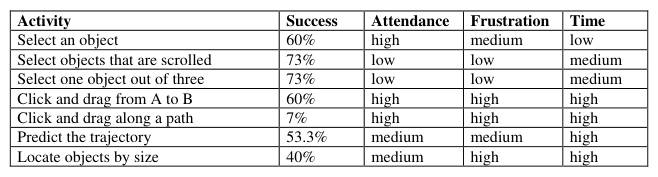
In the user tests carried out with children with a lower degree of physical disability, it was not possible to demonstrate in the first round of tests that there were problems when moving around the main interface; This was detected in users with a greater range of disability who had a 60% effectiveness in operating the sliding components, 33.3% presented serious inconveniences to perform the task. Another of the proposed actions consisted of extracting an object that was between two other objects, in this case, 20% had difficulties and 7% could not complete it. As the tests became more difficult, such as dragging an object to raise or lower it on the interface, some users even used both hands, affecting their posture and the performance of the application. Another of the activities that attracted attention had to do with coloring an image, in which they must select the color and place it in a section of the image where the spaces are not regular, in this case, 46.7% presented difficulties while 13 % gave up the task. Table 2 summarizes the study considering the level of success or effectiveness of the participants, the level of intervention or assistance from the specialist that was required, an estimate of the level of frustration, and the perception of speed in which they developed the activity.
Table 2: UX Test – Users with more severe physical or cognitive disabilities Activity Success Attendance Frustration Time Select an object 60% high medium low Select objects that are scrolled 73% low low medium Select one object out of three 73% low low medium Click and drag from A to B 60% high high high Click and drag along a path 7% high high high Predict the trajectory 53.3% medium medium high Locate objects by size 40% medium high high The 66.7% of the users developed the tasks considering themselves "slow" while on average 13% of the participants did not complete one or more activities. The level of frustration is high, for the users of the application with higher levels of disability, especially those who present physical or cognitive problems in which their attention span is compromised. These inconveniences are not necessarily connected to the problem of dyslexia or dyscalculia; however, it is a factor that must be considered when making improvements to the application, from the main interface to how the activities are presented and evaluated.
Intelligent Human Systems Integration (IHSI 2022): Integrating People and Intelligent Systems https://openaccess.cms-conferences.org/#/publications/book/978-1-7923-8988-7
IMPROVING INTERFACES Concepts used
As a complementary concept for the visual aspect, the User Experience Design UXD was used, defined as a set of methods applied to the design of interactive experiences (Lewis, J. R., & Sauro, J., 2021) it is the ability to synchronize the elements that favor the experience of the different senses of the user, to influence their perceptions and behaviors.
For the gameplay concepts, we worked around the Interaction Design (Oulasvirta, A., Kristensson, P., 2018), which is responsible for generating a response to the specific actions of the user, which can be simple or complex. There are four principles to facilitate the interaction process between the person and the device, raised by Donald Norman, who explained that all objects must be well designed with elements that are easy to interpret and that guarantee better operation for users.
For functional and aesthetic improvements, concepts such as the User Interface Design were used (Bødker, S., 2021), understood from how the user can communicate with the device, which allows user interaction through visual means and graphic objects that provide information and actions available in the interface, allowing the use of the device to be easy to use and learn. As an approach to aesthetics, the constructive model of the Gestalt Prototyping Framework (Ripalda, D., Guevara, C., & Garrido, A., 2021) effectively links the basic notions of the Nielsen Heuristics with Gestalt principles, providing theoretical and visual references to understand how these models are integrated during the development of a GUI. Usability experts, designers, and developers of mobile applications have used these concepts to adapt, improve, or correct the prototypes of interfaces in projects, without interfering with the development methodology they have decided to use. RESULTS Based on the evaluation of the user experience carried out on children with more severe disabilities, the team decided to make improvements in the content presentation dynamics of the Gabarato mobile application, through modifications in the visual components of the interface. The components that were modified were related to the parameters established in the Gestalt Prototyping Framework. Reducing frustration
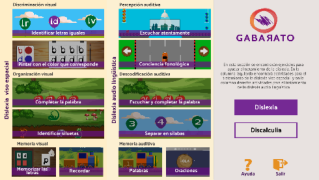
One of the main problems detected was the precision of the participants, which affects the time they spend to develop an action and is the determining factor to increase the levels of frustration of the users, in the face of this reality, as can be seen in Figure 1, some interfaces had a significant amount of information, which was removed
Intelligent Human Systems Integration (IHSI 2022): Integrating People and Intelligent Systems https://openaccess.cms-conferences.org/#/publications/book/978-1-7923-8988-7 depending on the user profile of the application; for example, it was proposed that the text blocks containing explanations of the exercises would only be available to therapists, while for the child interfaces, simplified versions of the instructions would be available (Dix, A, Finlay, J., Abowd, G. D., and Beale, R., 2004).
Figure 1. Interfaces of the first version of the Gabarato application During user experience testing it was determined that one of the most frustrating factors was the operation of some controls that had to be selected and dragged across the interface; To increase the precision, it was proposed that this type of activators be larger, and the displacement distances are reduced. To further reduce the level of frustration, it was decided to modify the visual, auditory, and haptic feedback, for more constant and pleasant reinforcements and stimuli; For example, the elimination of the sound of alerts in the event of failures was proposed and it was replaced by interpretive messages with random phrases with a low level of repetition. Require less assistance and provide more autonomy
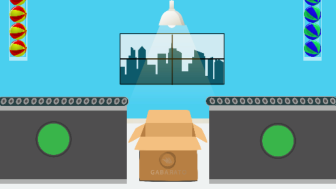
The team posits that for therapy to be more effective, children should feel progressively fewer interventions from the therapist; To achieve this, some settings must be removed from the interfaces that can generate unexpected exits and regressions, the button to "request help" will only appear after the user has repeated a certain number of failures. Increasing autonomy means that children with more severe disabilities can work with the application on their own, this forces the System to improve the prediction to adjust the level of complexity of activity; In other words, the most difficult levels for a child with good motor skills must be available for users with more severe physical or cognitive conditions, but they must have adjustments and complexity selectors adaptable to their condition. This is effectively achieved by reducing the number of repetitions or interactions. For example, in the game of painting a figure, dragging the colors, which turned out to be one of the games that generated the most assistance, time, and frustration in users with severe disabilities, in the difficulty selector there is the option to reduce the color palette from 8 to 2 options and that the illustrations show spaces that appear previously colored. As can be seen in Figure 2, the difficulty selector must also be placed in the child's interface so that they can adjust the complexity of the activity by themselves according to their progress and level of motivation.
Intelligent Human Systems Integration (IHSI 2022): Integrating People and Intelligent Systems https://openaccess.cms-conferences.org/#/publications/book/978-1-7923-8988-7
Figure 2. Interfaces related to the selection of difficulty Gabarato App Improving speed
According to the conceptual framework, there are different factors to increase the speed in the development of therapeutic activities; the first factor arises precisely from the Usability Heuristics (Nielsen, 1992), which determine the need to modify the interactions that facilitate the memorization of the dynamics of using an interface. To achieve this, the user is required to have an induction on the location and operation of the basic mechanisms. The second factor that must be considered is that the speed in the development of a task in the Gabarato application is a relative result and depends closely on the perception of ease of use, ease of learning, and the ability of each user to complete it effectively (Baker, S., Au, F., Dobbie, G., & Warren, I., 2008). Unlike operational and commercial applications, a therapeutic application such as Gabarato will not be evaluated as fast by the speed with which it processes information, but by the effectiveness with which a user completes a task; that is, if a child completes an activity with lower levels of frustration and with less intervention from the therapist, he will not only evaluate the application as fast but will also perceive himself as fast. It is precisely this factor that specialists in the treatment of these learning conditions consider necessary, that the person being treated can perceive that they are improving, that they can stay in therapy all the time, that they perceive it as easy, and feel that they are making effective (Ljilja & Sanfod, 2017).
CONCLUSIONS AND FUTURE WORK From the review of the results of the user experience tests, the link with people who have severe physical disabilities, the review of the videos, and the in-depth evaluation of the results by different experts and professionals who made up the development team It was seen that experience tests and prototypes can quite easily give us "false positives", causing us experts in user experience to fall into the fallacy of underestimating the results of real user tests. The metrics and instruments to determine usability factors, due to social responsibility, must meet the standards and cover the particularities of the focus groups, especially in products that focus on sensitive issues such as therapy, since within a group that requires attention, people who require special attention or specific adjustments could be involuntarily left out of the tests. The Gabarato development team is currently making the functional and
Intelligent Human Systems Integration (IHSI 2022): Integrating People and Intelligent Systems https://openaccess.cms-conferences.org/#/publications/book/978-1-7923-8988-7 visual modifications that are required to address the treatment of dyslexia and dyscalculia more effectively, the next step is to carry out comparative tests with similar applications so that improvements can be determined. at the level of content, procedures, and management of results. In parallel, work is being done to measure the progress that the children of the Sinsoluka Foundation are making from the use of the application.
REFERENCES
Andalusian Dyslexia Association. (2010). General Guide on Dyslexia. Recuperado el 01 de 12 de 2021, de https://d1wqtxts1xzle7.cloudfront.net/56622353/guia-general-sobre- dislexia-with-cover-page- v2.pdf?Expires=1641833299&Signature=f9WAGm0~o13mxEzTgchUQY MYu9zQZaihQWz4eBtkRwSDPAJa7B~DB42WDlj56YUy1LJPAxSBZU GGfhlWFmTxn5CzfZf~ZiXOwbw-stTcDBTLaEwmvVVG-r4H8pRxvi2N Baek, Y. M., & Bae, D. H. (2016). Automated model-based Android GUI testing
using multi-level GUI comparison criteria. Proceedings of the 31st IEEE/ACM International Conference on Automated Software Engineering. Baker, S., Au, F., Dobbie, G., & Warren, I. (2008). Automated Usability Testing Using HUI Analyzer. 19th Australian Conference on Software Engineering (answer 2008). Bødker, S. (2021). Through the interface: A human activity approach to user
interface design. CRC Press. Cobos , M., & Piedra, M. (2019). MULTIMEDIA TOOLS AS SUPPORT IN THE TREATMENT OF SPECIFIC LEARNING DISORDERS. Quito: Universidad Tecnológica Indoamérica. Obtenido de http://repositorio.uti.edu.ec//handle/123456789/1222 Dix, A, Finlay, J., Abowd, G. D., and Beale, R. (2004). HumanComputer
Interaction (3 ed.). Harlow, England: Prentice Hall. Galaburda, A. M., & Cestnick, L. (2003). Dislexia del desarrollo. Revista de neurología, 3-9. Lewis, J. R., & Sauro, J. (2021). Usability and user experience: Design and
evaluation. Handbook of Human Factors and Ergonomics. Ljilja, R., & Sanfod, J. (2017). Universal Design Mobile Interface Guidelines. In Mobile e-Health, 17-37. Nielsen. (1992). Finding Usability Problems Through Heuristic. Monterrey,
California: In proceedings of the SIGCHI conference on Human factors in computing systems. Oulasvirta, A., Kristensson, P. (2018). Computational interaction. Oxford University Press. Quishpe, A., Bernal, C., & Gilva, S. (2017). Use of educational mobile apps for
children. Lima: Universidad de San Martín de Porres. Ripalda, D., Guevara, C., & Garrido, A. (2021). Gestalt Prototyping Framework- Evaluation Tool. International Conference on Intelligent Human Systems Integration, 747-752.
Intelligent Human Systems Integration (IHSI 2022): Integrating People and Intelligent Systems https://openaccess.cms-conferences.org/#/publications/book/978-1-7923-8988-7
Intelligent Human Systems Integration (IHSI 2022): Integrating People and Intelligent Systems https://openaccess.cms-conferences.org/#/publications/book/978-1-7923-8988-7
LISTED IN THE AHFE DIGITAL BOOKSTORE CATALOGUE
Explore the complete digital volume
Intelligent Human Systems Integration (IHSI 2022): Integrating People and Intelligent Systems
Read this individual research paper free through the original publisher, or explore the full digital proceedings book.
ISBN 978-1-7923-8988-7
Explore this ISBN in the AHFE Bookstore ↗Listed in the July 2026 bookstore catalogue; search by ISBN to confirm current availability · Digital book purchase optional