Tengfei Xian (2022). An exploration on stimulating game developers' engagement using sandbox game development environment in higher education design courses. In: Intelligent Human Systems Integration (IHSI 2022): Integrating People and Intelligent Systems. AHFE Open Access, vol. 22. https://doi.org/10.54941/ahfe1001001
The motivation to stimulate college students to learn and participate in game development courses can be found from the following facts: learning itself is not always motivated. This paper presents a user experience method of creating game courses on sandbox game development platform. The core idea is that by making college students feel involved in creating games, they can stimulate their interest in game development. It is assumed that this method can improve college students' participation in game development and promote their understanding of learning perception. In order to test this hypothesis, this paper describes the experience of 71 college students' game development courses with ages between 19 and 21 years old. The results show that college student's satisfaction is significantly improved in this process. It can be concluded that the sandbox game development platform has the interest and motivation to stimulate the participation of college students or game developers.
This work aims to contribute to the study of the potential benefits of sandbox games for the teaching and learning process in the context of higher education. In particular, the research is related to game production and creation studies.We present a dual experience, analyzing the impact of sandbox game-based learning experiences on students' motivation and satisfaction using Roblox, as well as on game design research.The impact of the sandbox game-based learning experience on student motivation and satisfaction, as well as on the final achieved learning outcomes, was analyzed. According to Villagrasa et al. (2014), the main purpose of gamification is to increase commitment and motivation. (Gamification has been widely and successfully used in marketing, Zichermann and Cunningham, 2011). In the field of education, gamification techniques transfer the mechanics of play into educational settings with the aim of improving motivation and thus the teaching and learning process (Lee and Hammer, 2011; De-Marcos et al., 2017). The aim is to encourage interaction between teachers and students in order to increase student motivation and thus improve the ability of students to absorb knowledge and acquire it.
PURPOSE AND RESEARCH QUESTIONS In an empirical study of second-year college students, we hypothesized that students who utilized sandbox game development in their game design classes would show higher achievement in game creation than those who took a normal game design class without a sandbox game intervention.Game-based interventions. In addition, we hypothesized that students who played computer games during class would show greater motivation to learn. Students who utilize sandbox game development in class will show greater motivation to learn game creation than students who do not use sandbox game development.To test our hypothesis, we introduced the Roblox sandbox game development platform for this purpose.
PARTICIPANTS Four full classes of 71 seventh graders (37 female and 34 male) from a university in Guangdong participated in this study.These students were randomly assigned to either a sandbox game making competition group or a non-competition group. Prior to the study, participants were informed They were informed that their participation was voluntary. They had the freedom to stop participating at any time, and that participation or non-participation would not affect their performance. Both groups in this study had comparable prior knowledge of the target scientific content between the two groups.
Intelligent Human Systems Integration (IHSI 2022): Integrating People and Intelligent Systems https://openaccess.cms-conferences.org/#/publications/book/978-1-7923-8988-7
CHARACTERISTICS OF SANDBOX GAME CREATION A central part of this study is a sandbox platform called Roblox. Roblox offers a free, multi- functional development tool that allows students to build 3D worlds, script their work, and even publish their work online. By learning the stand-alone module content, you can quickly master using these stand-alone techniques and try to practice exporting them individually or as large project pieces.This is a game development platform based on sandbox game building, creating simple obstacle courses to develop basic skills such as manipulating components and creating scripts. Once these skills are mastered, students will be able to code adventure games in later courses.
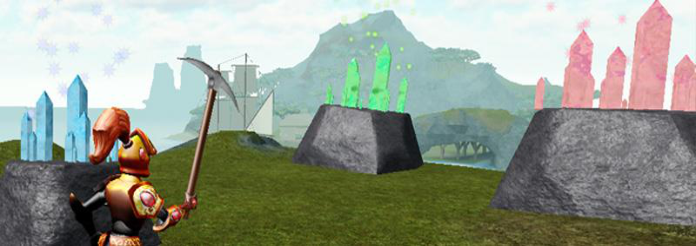
Figure 1. Roblox game interface
Coding Basics Explore coding concepts for functions, loops, and if/then statements using small projects such as color-changing platforms and traps that can be added to the game.Adventure Games Part 1 After learning the basics of using Roblox Studio and creating scripts, participants further develop their skills by working on more complex projects, known as adventure games. They will plan various game elements, create virtual worlds, and set up basic game components, such as tracking player items.Adventure Games Part 2 Participants continue to develop adventure games. They will create scripts for using tools, selling items, and upgrading spaces.Adventure Games Part 3 Spend time catching up on previous lessons and preparing adventure games for others to play. Participants should evaluate whether their game meets the goal of being fun, challenging, and error-free; redesign or refine their game as needed.
ENGAGEMENT In this study, we measured students' engagement in terms of the number of attempts they made to develop the game using the sandbox. In particular, the number of attempts made by each student was tracked and recorded throughout the game development process. More attempts inferred higher levels of engagement.
Intelligent Human Systems Integration (IHSI 2022): Integrating People and Intelligent Systems https://openaccess.cms-conferences.org/#/publications/book/978-1-7923-8988-7
STUDY PROCEDURE At the beginning of the study, all participants took a 30 -minute content test knowledge. After the pretest, students were assigned to either a sandbox game group or a non-sandbox production group based on their complete class. Within these two groups, students were taught a 4-week, 120-minute weekly session.
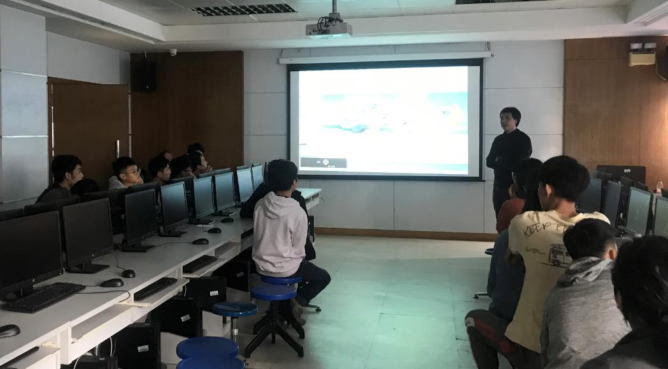
Figure 2. Roblox learning course in Guangdong university of finance and economics The survey is a snapshot of a larger number (71) of people who participated. Each person answered four levels of agree or disagree questions.The survey results showed that participants' self-confidence increased after the introduction of the sandbox game platform, and students reported that the Roblox game development platform enabled them to learn course material in a more informal setting.
There was a positive association between the game development platform and standardized mastery of the course material, as the majority of students who used the platform felt they learned the material more thoroughly. A four-point Likert scale was used to collect responses (1=never, 2=sometimes, 3=often, 4=don't know).sometimes, 3=often, and 4=always). The results were expressed as mean, SD. The Cronbach's Alpha coefficients obtained by analyzing the questionnaires completed by the university students were acceptable, and the reliability coefficients of the question numbers as follows: (Alpha>0.65): reasonable; satisfactory (Alpha<0.65); unacceptable (Alpha<0.5). Q1: Did you read the materials related to the course topic before each session? Q2: Sandbox game creation is an effective way to learn about game making.Histology. Q3: Sandbox game creation motivated me to learn more about game design and production.
Intelligent Human Systems Integration (IHSI 2022): Integrating People and Intelligent Systems https://openaccess.cms-conferences.org/#/publications/book/978-1-7923-8988-7
Q4: The ability to collaborate with the teacher by discussing the results of game creation in lab classes is important. Q5: Roblox has enhanced my understanding of game design . Q6: Gamification helps retain my knowledge. Q7: The discussion in the online game session improved my understanding of the skills. Q8: Sandbox game creation is an effective way to correct my misconceptions about content. Q9: If I play online games in class, I get nervous. Q10: Roblox is a better platform than other online sandbox creation platforms. Q11: I feel relaxed if I play online creative sandbox games in class. Q12: I am more engaged with feedback through online sandbox game. Table 1.Summary of voluntary and anonymous responses on the student feedback forms Q1 Q2 Q3 Q4 Q5 Q6 Q7 Q8 Q9 Q10 Q11 Q12
QUESTIONNAIRE RESULTS No imputation strategy for missing data was used, so the final sample size included 71 respondents. The questions listed in Figure 2 will be referred to as Q1, Q2,etc. to simplify further reading of the text. More than 74% of the participants expressed satisfaction with this method of histological education. Internal consistency was assessed using Cronbach's Alpha and was 0.436 for all 12 survey questions.
The internal consistency of the 12 survey questions was 0.436. The elimination process was used to group questions based on their consistency, i.e., how closely a group of questions fit together as a group. How closely a group of questions is related as a group .
After eliminating Q1, the Cronbach's alpha level was satisfactory. level (0.547). Further exclusion of Q5, Q7, Q9, Q10, Q11, and Q12 increased the consistency of the remaining questions. q11 and q12, brought the consistency of the remaining questions to a reasonable level (Cronbach's alpha > 0.650). Thus, Q2, Q3, Q4, Q6, and Q8 can be considered a reliable set of questions. 85% of students indicated that the platform created a more accessible environment relative to traditional learning. Over 78% of students indicated that Roblox may help create an easier way to learn the basics of how to make games.
The survey results also show that approximately 80% of students regularly use this approach during the histology instruction process regularly during the histology instruction process. Participants identified using Roblox as their favorite environment for learning how
Intelligent Human Systems Integration (IHSI 2022): Integrating People and Intelligent Systems https://openaccess.cms-conferences.org/#/publications/book/978-1-7923-8988-7 to make games for development, and in addition, over 80% of students were pleased with the opportunity to receive constructive feedback from their instructors in a friendly atmosphere.
In response to a question about sandbox gamification, students responded that the sandbox game system was a useful medium for building game logic and content that allowed them to interact with histological content. And that Roblox was a useful learning tool that allowed them to interact with the histology content and also to ask questions in the forum about the difficult aspects of learning.
DISCUSSION
This pilot study explored the impact of a sandbox gaming platform on learning and enjoyment in a design course for college students.The data from this study suggest that there are some positive benefits to incorporating sandbox games into the curriculum.This is because students perceive the additional competition component of the course as adding a complementary educational value, thus confirming that gamification may have practical implications in college. Our survey showed that students preferred creating games in groups or teams as opposed to making games individually.When Roblox was done in teams, students were more relaxed according to their self-assessment. In other words, the production was done as a group rather than as an individual. In terms of team-based management, the impact and development of team interaction is important for the students' future academic and professional development.
The results suggest that other materials of the game making course may be partially or completely forgotten by some students during the teaching and learning process.If students are quizzed during instruction, they may be more likely to recall small amounts of information, but more frequently, as was the case with the gamification intervention utilized in this study.
In this survey, 67% of students felt that sandbox gamification helped to increase their knowledge of basic game design science.84% of survey participants reported having a better understanding of game design content. The results suggest that timely feedback from Roblox Software facilitated team discussions and encouraged peer-to-peer learning. Our findings suggest that the use of sandbox gamification as part of a group active learning approach improves game design science education.
Sandbox gamification enhances the formation of an active learning community in which knowledge is accessible and readily available.Sandbox gamification creations enhance the formation of an active learning community where knowledge is convenient and easily accessible. Our findings are consistent with previous studies that have found that the sandbox game Roblox motivates group learning and problem solving skills. In addition, the data provided as part of this investigation suggest that team-based sandbox gamification supports peer-to-peer and group learning among students.Student-to-student group learning. Timely and well-timed qualitative and quantitative feedback among team members can keep students
Intelligent Human Systems Integration (IHSI 2022): Integrating People and Intelligent Systems https://openaccess.cms-conferences.org/#/publications/book/978-1-7923-8988-7 engaged.in a class or group of students and may have a positive impact on their learning outcomes. The survey also revealed that readiness to learn after gamification was highly correlated with readiness. In other words, the more prepared students were for their topic, the more accurately and actively they were able to participate in the sandbox game making discussions.
The Roblox platform engages with game design topics through gamification and the use of other materials to enhance learning.By gamifying and leveraging other materials, for example, the Roblox platform provides a tiered learning model that offers multiple types of instructional media to scaffold the curriculum. This approach is consistent with the redesigned histology curriculum. The latter provides students with timely opportunities for formative assessment based on weekly learning objectives. Further gamification programs stimulated deeper student understanding of the material.
CONCLUSIONS
This study provides some insight for educators who plan to use sandbox platforms in their game design and production education.For games that do not include competition, teachers should monitor learners' engagement in the game as an important indicator of learning. For games that offer opportunities for competition, teachers should keep in mind that competition has its limits and that high levels of participation do not necessarily mean good performance. As learners progress through the game design process, teachers should pay special attention to helping learners establish learning goals beyond just winning a game.
REFERENCES
Cӑlinoiu, N. (2019). Learning enhancement through video games. ELearning & Software for Education, 1, 68. Retrieved from https://search.ebscohost.com.proxy- bloomu.klnpa.org/login.aspx?direc t=true&db=edb&AN=135939613&site=eds-live&scope=site Sun, C.-Y., Kuo, C.-Y., Hou, H.-T., & Lin, Y.-Y. (2017). Exploring learners’ sequential
behavioral patterns, flow experience, and learning performance in an anti-phishing educational game. Educational Technology & Society, 20(1), 45–60. Fredricks, J. A., Filsecker, J., & Lawson, M. A. (2016a). Student engagement, context, and adjustment: Addressing defnitional, measurement, and methodological issues. Learning and Instruction, 43, All, A., Castellar, E., & Van Looy, J. (2016). Assessing the efectiveness of digital game-
based learning: Best practices. Computers and Education, 92, 90–103. Ke, F. (2016). Designing and integrating purposeful learning in game play: A systematic review. Educational Technology Research and Development, 64(2), 219–244. https://doi.org/10.1007/s11423-015-9418-1 Barzilai, S., & Blau, I. (2014). Scafolding game-based learning: Impact on learning
achievements, perceived learning, and game experiences. Computers & Education, 70, 65–79. https://doi.org/10.1016/j.compedu.2013.08.003.
Intelligent Human Systems Integration (IHSI 2022): Integrating People and Intelligent Systems https://openaccess.cms-conferences.org/#/publications/book/978-1-7923-8988-7
Hwang, G. J., Wu, P.-H., & Chen, C.-C. (2012). An online game approach for improving students’ learning performance in web-based problem-solving activities. Computers & Education, 59, 1246–1256. Papastergiou, M. (2009). Digital game-based learning in high school computer science
education: Impact on educational efectiveness and student motivation. Computers & Education, 52(1), 1–12. https://doi.org/10.1016/j.compedu.2008.06.004. Addy, T. M., Dube, D., Croft, C., Nardolilli, J. O., Paynter, O. C., Hutchings, M. L., et al.
(2018). Integrating a serious game into case-based learning. Simulation and Gaming, 49(4), 378–400. https://doi.org/10.1177/1046878118779416. Abdual Jabbar, I. A., & Felicia, P. (2015). Gameplay engagement and learning in gam-based learning: A systematic review. Review of Educational Research, 85(4), 740–779. https://doi.org/10.3102/0034654315577210. Hoffman, B., & Nadelson, L. (2010). Motivational engagement and video gaming: A mixed
methods study. Educational Technology Research and Development, 58(3), 245–270. doi:10.1007/s11423-009-9134-9 Rebetez, C., & Betrancourt, M. (2007). Video game research in cognitive and educational sciences. CogniŃie, Creier, Comportament/Cognition, Brain Behaviour. Romanian Association for Cognitive Science, 11(1), 131–142. Eck, R. V. (2006). Digital game-based learning: It’s not just the digital natives who are
restless. EDUCAUSE Review, 41(2), 16–30.
Intelligent Human Systems Integration (IHSI 2022): Integrating People and Intelligent Systems https://openaccess.cms-conferences.org/#/publications/book/978-1-7923-8988-7
LISTED IN THE AHFE DIGITAL BOOKSTORE CATALOGUE
Explore the complete digital volume
Intelligent Human Systems Integration (IHSI 2022): Integrating People and Intelligent Systems
Read this individual research paper free through the original publisher, or explore the full digital proceedings book.
ISBN 978-1-7923-8988-7
Explore this ISBN in the AHFE Bookstore ↗Listed in the July 2026 bookstore catalogue; search by ISBN to confirm current availability · Digital book purchase optional