Biyao Li, Fang Liu (2025). Game-Based Learning for AI Education: Systematic Review. In: Training, Education, and Learning Sciences. AHFE Open Access, vol. 193, pp. 190–199. https://doi.org/10.54941/ahfe1006660
The rapid development of artificial intelligence (AI) globally has pushed educational systems to focus on AI literacy in K-12 curricula. However, teaching AI at this level presents challenges due to the abstract and complex nature of AI concepts, which can be difficult for younger students to understand. Game-based learning (GBL) offers an effective solution, providing interactive and immersive experiences that can boost student engagement and help them better understand these complex concepts. This paper explores how to integrate GBL into K-12 AI education, focusing on key design elements, game mechanics that improve engagement and learning outcomes, and the challenges of implementation. Based on a review of relevant literature from 2019 to 2024, the study proposes several design principles and practical recommendations. The findings highlight the importance of selecting suitable game types for different grade levels and learning goals, using game mechanics that encourage both competition and cooperation, and structuring learning in phases to improve engagement and learning results. At the same time, the shortage of resources and the integration of games and curriculum objectives are still the main obstacles to the implementation of GBL.
Artificial intelligence (AI) is rapidly changing the global landscape, impacting industries, education, and daily life (Long and Magerko, 2020; Yang, 2022). Recognizing the critical role of AI, countries around the world have incorporated AI education into their strategic plans, aiming to foster AI literacy and train future innovators (UNESCO, 2022; Kong et al., 2021). However, K-12 AI education faces significant challenges. The abstraction and complexity of AI concepts such as algorithms, machine learning, and ethics can often overwhelm young learners (Chiu, 2021). In addition, the lack of a standardized curriculum further exacerbates these difficulties, resulting in ineffective teaching methods and limited student engagement (Chiu, 2021).
GBL has emerged as a promising pedagogical approach to address these challenges (Bado, 2022). By leveraging interactive and immersive features, GBL can increase student motivation and promote understanding of complex and abstract concepts (Margoudi et al., 2016). Empirical studies have shown its potential to improve programming skills and promote conceptual understanding, making it an effective tool for introducing AI concepts
Game-Based Learning for AI Education: Systematic Review 191
to younger students. However, the GBL’s success largely depends on its design. Alignment between play elements, educational goals, and student development needs is critical to achieving meaningful learning outcomes (Deterding et al., 2011; Kim et al., 2019). On the other hand, poorly designed GBL experiences can be distracting or fail to achieve instructional goals, ultimately hampering student progress (Leitner et al., 2023).
Given the transformative potential of GBL and the urgent need for effective K-12 AI education, this review aims to systematically examine the current application of GBL in this field. It seeks to explore how GBL can be integrated with specific AI learning content, investigate design principles to maximize student engagement and learning outcomes, and analyze the challenges and opportunities of incorporating GBL into K-12 AI education. By synthesizing existing research, this review provides actionable insights for educators, researchers, and policymakers, contributing to the advancement of AI education in the K-12 environment.
RELATED WORK
Educational games are widely recognized for their ability to promote excitement, engagement, and deep learning in a variety of situations (Steinkuehler and Squire, 2014). By providing tangible and interactive experiences, these games can help learners grasp abstract concepts more effectively (Margoudi et al., 2016). For young learners, game-based approaches show particular promise in simplifying complex subjects and supporting cognitive development.
In the field of AI education, many studies have explored the potential of GBL. For example, the MIT Media Lab (2019) developed a program that utilizes social robots as learning partners and programmable tools to effectively help young children understand basic AI concepts. Guei et al. (2018) implemented a game similar to 2048 to teach reinforcement learning and game algorithms, demonstrating its ability to improve student motivation and educational outcomes. Similarly, Gupta (2024) designed PRIMARYAI, a GBL platform that engages students in science-based inquiry adventures that explore technologies such as image recognition and semi-automatic navigation. Most recently, Maxyn Leitner (2023) launched ARIN-561, a game that helps high school students learn artificial intelligence concepts, applied math skills, and build computational thinking.
Although gamification is popular and in high demand, most games have yet to achieve the desired outcomes (Gomes). This may be attributed to several factors, including the complexity of the educational content itself. The field of AI encompasses a vast and intricate body of knowledge, covering areas such as machine learning, deep learning, natural language processing, and other specialized domains. This complexity makes it necessary for designers to have deep knowledge of educational psychology and accurate comprehension of AI content in gamification design, so as to accurately find the balance between education and entertainment in the process of game construction (Dominguez et al., 2013; Leitner et al., 2023; Donovan et al., 2013). This means that game content should not focus solely on
192 Li and Liu
superficial fun at the expense of its core educational value. Instead, it is crucial to carefully refine aspects such as game mechanics, level design, and reward systems to stimulate students’ intrinsic motivation and encourage their continued engagement in the gamified learning process (Deterding et al., 2011; Kim et al., 2019). Although there are relevant literatures that provide certain theoretical basis and ideas for gamification design (Mora et al., 2017). However, there is still a research gap in K-12 AI teaching. The cognitive level, learning ability and interest points of students in K-12 stage are significantly different from those in other stages. They are in the critical period of knowledge system construction and thinking mode formation, and they need a more gradual and lively way to accept and understand AI knowledge.
METHOD
Searches were conducted in multiple digital libraries, including ACM Digital Library, Google Scholar, Web of Science, and Scopus, which are widely acclaimed for their coverage of educational technology and AI-related research. This article focuses on identifying research that employs gamified learning to enhance AI education at the K-12 level, with a particular emphasis on 20 empirical studies published between 2019 and 2024, along with key relevant reviews to capture the latest developments in the field. The primary search terms include “game-based learning” “AI education” “K-12,” and “AI education games” Secondary keywords, such as “AI algorithms,” “AI ethics,” “AI literacy,” and “K-12 game design,” are used to expand the search.
RESULTS
RQ1: What Are the Key Design Considerations for Integrating GBL With AI Learning in K-12 Education?
According to existing research (Shahid et al., 2019), the design of games must take into account the level of cognitive development of students, especially in the lower grades (K-5), to avoid the cognitive burden of overly complex technical content. Younger students can be guided to understand basic AI concepts through figurative and screenless forms of play, such as board games and physical programming blocks (Kim et al., 2019; Li et al., 2023). For older students (grades 6-12), the depth of AI learning can be progressively increased, and games should be designed to lead students to think about complex issues such as AI ethics, social implications, and decision logic, thereby introducing more abstract concepts such as neural networks and data bias (Priya et al., 2024).
Additionally, selecting appropriate game types to correspond with AI learning content is crucial. Different types of games must be aligned with AI educational objectives to effectively promote the understanding of knowledge and the development of skills (Zhan et al., 2022). According to existing research, games can be divided into five categories: simulation games (Si), role playing games (Rp), reasoning strategy games (RS), puzzle games (Pu), and robot games (Ro). Simulation games, such as ArtBot, allow students to make decisions using AI in a virtual environment, effectively teaching the
Game-Based Learning for AI Education: Systematic Review 193
application of AI in areas like resource management, system optimization, and data analysis. Through interactive experiences, these games help students understand the practical value of AI in the real world (Leitner et al., 2023; Voulgari et al., 2021; Microsoft Corporation, 2019). Role-playing games such as ML-Quest and PRIMARYAI provide students with an immersive environment to help them understand and explore the application of AI technology, and are suitable for guiding students to understand higher-order applications of AI, such as ethical decision-making, situational adaptation, and complex system simulation (Priya et al., 2024; Gupta, et al., 2024; Henry et al., 2021; Kajiwara et al., 2023; McGinley, 2024). Robot games, such as IRobotQ3D, help students understand the principles of robots through practical activities (Zhan et al., 2022; Williams et al., 2019). Reasoning strategy games such as Color Conquest help students understand how to solve problems by reasoning and choosing optimal strategies, and then master the reasoning mechanism and algorithmic logic in AI (Kim et al., 2019; Su et al., 2024; Nautiyal et al., 2024; Ng et al., 2024). Games like Treasure Island, Guess Whose Face, and other puzzle games are well-suited for teaching basic AI concepts, especially for beginners in K-12 education, thanks to their intuitive interfaces and flexible design. These games provide a relaxed and engaging environment that helps students grasp fundamental algorithms and programming concepts (Goslen et al., 2024; Ali et al., 2023; Lee et al., 2021b; Leitner et al., 2023; Nautiyal et al., 2024). Ensuring a close match between game mechanics and AI knowledge points helps students to deeply understand AI concepts and skills, thus promoting the effective implementation of AI education.
RQ2: Which Game Mechanisms Maximize Engagement and Learning Outcomes in K-12 AI Education?
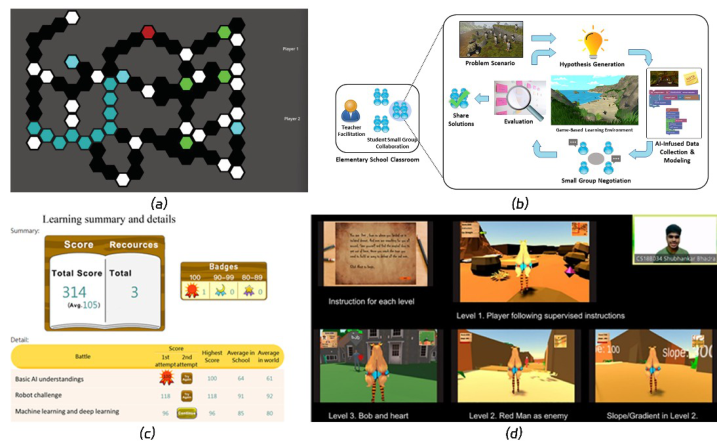
In order to increase K-12 students’ engagement and learning outcomes in AI education, competition, cooperation and reward mechanisms in the game are integral elements of the design (Zainuddin et al., 2020; Zhan et al., 2022). Meanwhile, phased learning is suitable for students to learn complex AI knowledge (Van Roy & Zaman, 2018). Competition mechanism can enhance students’ motivation and participation by stimulating their competitive spirit (Du et al., 2023; Ali et al., 2023; Lim et al., 2024; McGinley, 2024; Nautiyal et al., 2024). The cooperation mechanism fosters students’ understanding of complex AI concepts through teamwork and interaction, enhancing knowledge sharing and collective problem-solving skills. By collaborating to solve AI-related tasks, students deepen their understanding of AI content (Williams et al., 2019; Zhang et al., 2023; Gupta, et al., 2024; Lim et al., 2024). Reward mechanisms (such as scores, leaderboards, etc.) can enhance students’ sense of achievement and get feedback on task completion, thus deepening their understanding of the concept of AI (Voulgari et al., 2021; Kim et al., 2019; Du et al., 2023; Goslen et al., 2024; Ng et al., 2024). Phased learning can effectively reduce the cognitive burden that students may face in the process of mastering complex AI concepts, and gradually build a deep understanding of AI knowledge by breaking learning content into small
194 Li and Liu
stages that are easy to understand and digest (Lee et al., 2021b; Voulgari et al., 2021; Priya et al., 2024; Su et al., 2023; Kajiwara et al., 2023; Zammit et al., 2021). In conclusion, game design should ensure an organic alignment with AI educational objectives. Through the combination of competition and cooperation mechanisms, students can stimulate higher learning interest in challenge and collaboration, and improve their learning effect in AI courses through personalized rewards. However, these mechanisms also need to be moderate and truly integrated into phased learning to help students better grasp knowledge and improve their overall participation in AI education and long-term effects.
Figure 1: Example of competition mechanism (a) cooperation mechanism (b) reward mechanism (c) and phased learning mechanism (d) (Du et al., 2023; Lee et al., 2021b; Ng et al., 2024; Priya et al., 2024).
RQ3: What Are the Major Design Challenges in Implementing GBL for K-12 AI Education?
While GBL shows great potential in K-12 AI education, its design and implementation still face several challenges. First, insufficient resources are a major obstacle. The design and development of high-quality AI educational games require professional teams, adequate funding and technical support (Dominguez et al., 2013; O’Donovan et al., 2013; Zhan et al., 2024). However, many schools, especially those in rural areas and with limited funding, often face tight budgets and inadequate technical facilities, making it more difficult to develop and apply AI educational games on a large scale (Goslen et al., 2024; Shahid et al., 2019). To solve this problem, exploring low-cost development solutions, utilizing open source platforms, or through cross-school collaboration may be an effective strategy.
Game-Based Learning for AI Education: Systematic Review 195
Moreover, the integration of the game with the course objectives is another complex challenge. Compared to traditional disciplines, AI education is not yet widespread, and many existing games have not been adequately tested and evaluated in the classroom (Goslen et al., 2024; McGinley, 2024). When designing games, it is important to ensure that they are not only entertaining, but also effective in connecting with the objectives of the course and stimulating students to think deeply and understand the concepts of AI. However, the balance between entertainment and education is often difficult to grasp. Too much emphasis on entertainment may lead students to neglect the deep understanding of AI knowledge (Bayliss, 2012; Graesser et al., 2016; Leitner et al., 2023). If the game design is monotonous or time consuming, it may reduce student engagement and thus affect learning outcomes (Zammit et al., 2021). As a result, designing games that engage students without causing excessive cognitive burden remains an urgent challenge. To ensure the educational effectiveness of games, designers should work closely with educational experts (Gupta et al., 2024) to ensure that the difficulty and content of games progressively lead students to master and apply AI concepts, rather than just complete tasks.
CONCLUSION
This study provides a comprehensive examination of the application of game-based learning (GBL) in K-12 AI education. Through a comprehensive analysis of existing research, it has significant findings on three key research questions.
In terms of design considerations for the effective integration of GBL with specific AI learning content, it is clear that games need to be designed according to the level of cognitive development of students, lower grade students use concrete, screenless game forms to understand basic AI concepts, and higher grade students can gradually learn abstract concepts. Additionally, for different types of AI knowledge, selecting the most suitable game types is essential. For example, simulation games can be used to teach AI applications in areas such as resource management, and role-playing games help students understand advanced AI applications, thus promoting a deeper understanding of AI concepts and skills.
When it comes to game mechanics that promote engagement and learning outcomes in K-12 AI education, competition, cooperation, reward mechanisms, and phased learning play an important role. Competition mechanism stimulates students’ competitive spirit, cooperation mechanism promotes knowledge sharing and problem solving, reward mechanism enhances sense of achievement, and phased learning reduces cognitive burden. Combining these mechanisms with AI teaching goals can significantly improve students’ participation and learning effect in AI education.
Although GBL has great potential in K-12 AI education, there are still many challenges in the design and implementation process. AI knowledge is complex, and designing educational games requires significant resources and costs, which limits the development and application of high-quality AI education games. Additionally, the integration of games with curriculum
196 Li and Liu
objectives is challenging, including the lack of feedback on the game’s use in formal classrooms, as well as the difficulty in balancing entertainment with education. These factors hinder the effective promotion of GBL in K-12 AI education.
Overall, the findings of this study provide guidance for educators in applying GBL in classroom practice, offer direction for further research in this field, and serve as a strong foundation for policymakers in developing relevant policies. It is hoped that this research will contribute to fostering more AI-literate and future-ready learners in the future.
ACKNOWLEDGMENT
This work is supported by The National Key Research and Development Program of China [2019YFB1405702].
REFERENCES
Ali S, Kumar V, Breazeal C (2023). Ai audit: A card game to reflect on everyday ai systems. arXiv preprint arXiv:230517910. Bado N (2022). Game-based learning pedagogy: A review of the literature. Interactive Learning Environments, 30(5):936–948. Bayliss, J. D. (2012, September). Teaching game AI through Minecraft mods. In 2012
IEEE International Games Innovation Conference (pp. 1–4). IEEE. Chiu TK (2021). A holistic approach to the design of artificial intelligence (ai) education for k-12 schools. TechTrends, 65(5):796–807. Cui, S., Liu, F., Li, B., & Yuan, X. (2024). Sharing instead of being infringed: How
to build a responsible community for online artwork sharing?. Cui, S., Liu, F., Zhou, T., & Zhang, M. (2022, October). Understanding and identifying artwork plagiarism with the wisdom of designers: A case study on poster artworks. In Proceedings of the 30th ACM International Conference on Multimedia (pp. 1117–1127). Cui, S., Liu, Z., Liu, F., Ye, Y., & Zhang, M. (2025). Integrating conceptual
and visual representations with domain expertise for scalable visual plagiarism detection. Expert Systems with Applications, 267, 125974. Dehghanzadeh, H., Farrokhnia, M., Dehghanzadeh, H., Taghipour, K., & Noroozi, O. (2024). Using gamification to support learning in K-12 education: A systematic literature review. British Journal of Educational Technology, 55(1), 34–70. Deterding, S., Dixon, D., Khaled, R., & Nacke, L. (2011, September). From game
design elements to gamefulness: defining” gamification”. In Proceedings of the 15th international academic MindTrek conference: Envisioning future media environments (pp. 9–15). Domínguez, A., Saenz-de-Navarrete, J., De-Marcos, L., Fernández-Sanz, L., Pagés, C., & Martínez-Herráiz, J. J. (2013). Gamifying learning experiences: Practical implications and outcomes. Computers & education, 63, 380–392. Du, X., & Wang, X. (2023). Play by Design: Developing Artificial Intelligence
Literacy through Game-based Learning. Journal of Computer Science Research, 5(4), 1–12. Goslen, A., Gupta, A., Muthukrishnan, S., Midgett, R., Min, W., Vandenberg, J., ... & Mott, B. (2024, March). Engaging Students from Rural Communities in AI Education with Game-Based Learning. In Proceedings of the 55th ACM Technical Symposium on Computer Science Education V. 2 (pp. 1660–1661).
Game-Based Learning for AI Education: Systematic Review 197
Gomes, T. C. S., Falcão, T. P., & Tedesco, P. C. D. A. R. (2018). Exploring an approach based on digital games for teaching programming concepts to young children. International journal of child-computer interaction, 16, 77–84. Graesser, A. C., Hu, X., Nye, B. D., & Sottilare, R. A. (2016). Intelligent
tutoring systems, serious games, and the Generalized Intelligent Framework for Tutoring (GIFT). In Using Games and Simulations for Teaching and Assessment (pp. 58–79). Routledge. Greenwald E, Leitner M, Wang N (2021). Learning artificial intelligence: insights into how youth encounter and build understanding of ai concepts. In: Proceedings of the AAAI Conference on Artificial Intelligence, pp. 15526–15533. Gupta, A., Lee, S., Mott, B., Chakraburty, S., Glazewski, K., Ottenbreit-
Leftwich, A.,... & Lester, J. (2024, March). Supporting Upper Elementary Students in Learning AI Concepts with Story-Driven Game-Based Learning. In Proceedings of the AAAI Conference on Artificial Intelligence (Vol. 38, No. 21, pp. 23092–23100). Guei H, Wei TH, Wu I, et al. (2018). Using 2048-like games as a pedagogical tool for reinforcement learning. ICGA Journal, 40(3):281–293. Henry, J., Hernalesteen, A., & Collard, A. S. (2021). Teaching Artificial Intelligence
to K-12 Through a Role-Playing Game Questioning the Intelligence Concept. KI- Künstliche Intelligenz, 35(2), 171–179. Hooshyar, D., Lim, H., Pedaste, M., Yang, K., Fathi, M., & Yang, Y. (2019). AutoThinking: An adaptive computational thinking game. In Innovative Technologies and Learning: Second International Conference, ICITL 2019, Tromsø, Norway, December 2–5, 2019, Proceedings 2 (pp. 381–391). Springer International Publishing. Hooshyar, D., Pedaste, M., Yang, Y., Malva, L., Hwang, G. J., Wang, M.,...
& Delev, D. (2021). From gaming to computational thinking: An adaptive educational computer game-based learning approach. Journal of Educational Computing Research, 59(3), 383–409. Kajiwara, Y., Matsuoka, A., & Shinbo, F. (2023). Machine learning role playing game: Instructional design of AI education for age-appropriate in K-12 and beyond. Computers and Education: Artificial Intelligence, 5, 100162. Kong SC, Cheung WMY, Zhang G (2021) Evaluation of an artificial intelligence
literacy course for university students with diverse study backgrounds. Computers and Education: Artificial Intelligence 2:100026 Kim, J., & Park, N. (2019). Development of a board game-based gamification learning model for training on the principles of artificial intelligence learning in elementary courses. Journal of The Korean Association of Information Education, 23(3), 229–235. Lee S, Mott B, Ottenbreit-Leftwich A, Scribner A, Taylor S, Park K, Rowe J,
Glazewski K, Hmelo-Silver CE, Lester J (2021b). Ai-infused collaborative inquiry in upper elementary school: A game-based learning approach. In: Proceedings of the AAAI conference on artificial intelligence, pp. 15591–15599. Lee, I., Ali, S., Zhang, H., DiPaola, D., Breazeal, C. (2021a). Developing middle school students’ ai literacy. In: Proceedings of the 52nd ACM technical symposium on computer science education, pp. 191–197. Leitner M, Greenwald E, Wang N, Montgomery R, Merchant C (2023). Designing
game-based learning for high school artificial intelligence education. International Journal of Artificial Intelligence in Education, pp. 1–15.
198 Li and Liu
Li, Q., Jiang, Q., Liang, J. C., Xiong, W., Liang, Y., & Zhao, W. (2023). Effects of interactive unplugged programming activities on computational thinking skills and student engagement in elementary education. Education and Information Technologies, 28(9), 12293–12318. Lim, H., Min, W., Vandenberg, J., Cateté, V., & Mott, B. (2024, March).
Unplugged K-12 AI Learning: Exploring Representation and Reasoning with a Facial Recognition Game. In Proceedings of the AAAI Conference on Artificial Intelligence (Vol. 38, No. 21, pp. 23285–23293). Liu, F., Zhang, M., Zheng, B., Cui, S., Ma, W., & Liu, Z. (2023). Feature fusion via multi-target learning for ancient artwork captioning. Information Fusion, 97, 101811. Liu, F., Lv, J., Cui, S., Luan, Z., Wu, K., & Zhou, T. (2024). Smart”Error”! Exploring
Imperfect AI to Support Creative Ideation. Proceedings of the ACM on Human- Computer Interaction, 8(CSCW1), 1–28. Long D, Magerko B (2020). What is ai literacy? competencies and design considerations. In: Proceedings of the 2020 CHI conference on human factors in computing systems, pp. 1–16. Margoudi M, Oliveira M, Waddell G (2016) Game-based learning of musical in struments: A review and recommendations. In: European Conference on Games Based Learning, Academic Conferences International Limited, p. 426 McGinley, T. (2024). Designing Game-Based Machine Learning Education for Dutch
High School Students (Doctoral dissertation). Miao, F., & Shiohira, K. (2022). K-12 AI curricula. A mapping of governmentendorsed AI curricula. UNESCO Publishing, URL https://unesdoc.unesco. org/ark:/48223/pf0000380602, 3, 1144399. Microsoft Corporation (2019) “Minecraft. https://education.minecraft.net/hour-of-
code Hour of Code: AI for Good”, [online]. Mora, A., Riera, D., González, C., & Arnedo-Moreno, J. (2017). Gamification: a systematic review of design frameworks. Journal of Computing in Higher Education, 29, 516–548. Nautiyal, V. V., Silverio, S. A., & Salvador, E. E. P. (2024, September). Let’s get on-
board: a practical framework for designing and implementing educational board games in K-12 classrooms. In Frontiers in Education (Vol. 9, p. 1420515). Ng, D. T. K., Xinyu, C., Leung, J. K. L., & Chu, S. K. W. (2024). Fostering students’ AI literacy development through educational games: AI knowledge, affective and cognitive engagement. Journal of Computer Assisted Learning. O’Donovan, S., Gain, J., & Marais, P. (2013, October). A case study in the
gamification of a university-level games development course. In Proceedings of the South African Institute for Computer Scientists and Information Technologists Conference (pp. 242–251). Priya, S., Bhadra, S., Chimalakonda, S., & Venigalla, A. S. M. (2024). ML-Quest: a game for introducing machine learning concepts to K-12 students. Interactive Learning Environments, 32(1), 229–244. Shamir, G., & Levin, I. (2022). Teaching machine learning in elementary school.
International Journal of Child-Computer Interaction, 31, 100415. Shahid, M., Wajid, A., Haq, K. U., Saleem, I., & Shujja, A. H. (2019, November).
A review of gamification for learning programming fundamental. In 2019 International Conference on Innovative Computing (ICIC) (pp. 1–8). IEEE. Steinkuehler C, Squire K (2014). Videogames and learning, Cambridge University Press, pp. 377–394. DOI: 10.1017/CBO9781139519526.023.
Game-Based Learning for AI Education: Systematic Review 199
Su, J., & Yang, W. (2024). Artificial Intelligence (AI) literacy in early childhood education: An intervention study in Hong Kong. Interactive Learning Environments, 32(9), 5494–5508. Su J, Guo K, Chen X, Chu SKW (2023). Teaching artificial intelligence in k–12 classrooms: a scoping review. Interactive Learning Environments, pp. 1–20. Van Roy, R., & Zaman, B. (2018). Need-supporting gamification in education:
An assessment of motivational effects over time. Computers & Education, 127, 283–297. Voulgari, I., Zammit, M., Stouraitis, E., Liapis, A., & Yannakakis, G. (2021, June).
Learn to machine learn: Designing a game based approach for teaching machine learning to primary and secondary education students. In Proceedings of the 20th Annual ACM Interaction Design and Children Conference (pp. 593–598). Wang, Z., Liu, F., Liu, Z., Ran, C., & Zhang, M. (2024). Intelligent-paint: a Chinese painting process generation method based on vision transformer. Multimedia Systems, 30(2), 112. Wang, Z., Liu, F., Ran, C., & Zhang, M. (2023). AI Promotes the Inheritance and
Dissemination of Chinese Boneless Painting—Research on Design Practice from Interdisciplinary Collaboration. Williams, R., Park, H. W., & Breazeal, C. (2019, May). A is for artificial intelligence: the impact of artificial intelligence activities on young children’s perceptions of robots. In Proceedings of the 2019 CHI conference on human factors in computing systems (pp. 1–11). Williams R, Park HW, Oh L, Breazeal C (2019). Popbots: Designing an artificial
intelligence curriculum for early Zhan, Z., Zhong, B., Shi, X., Si, Q., & Zheng, J. (2022). The design and application of IRobotQ3D for simulating robotics experiments in K-12 education. Computer Applications in Engineering Education, 30(2), 532–549. Zhang, M., Liu, F., Li, B., Liu, Z., Ma, W., & Ran, C. (2024). CrePoster:
Leveraging multi-level features for cultural relic poster generation via attention- based framework. Expert Systems with Applications, 245, 123136.
LISTED IN THE AHFE DIGITAL BOOKSTORE CATALOGUE
Explore the complete digital volume
Training, Education, and Learning Sciences
Read this individual research paper free through the original publisher, or explore the full digital proceedings book.
ISBN 978-1-964867-69-4
Explore this ISBN in the AHFE Bookstore ↗Listed in the July 2026 bookstore catalogue; search by ISBN to confirm current availability · Digital book purchase optional