Shuichi Fukuda (2022). Instinct-Driven Engineering. In: Intelligent Human Systems Integration (IHSI 2022): Integrating People and Intelligent Systems. AHFE Open Access, vol. 22. https://doi.org/10.54941/ahfe1001010
Current Information engineering is focused on artificial world in engineering, in information processing, etc. But as the Real World is getting more and more complicated and complex, and the environments and situations come to change frequently, extensively and in an unpredictable manner, it becomes increasingly difficult to cope with such problems of large dimensions. As the curse of dimension tells us if the number f dimensions become too large, we cannot process the problem mathematically. But we can manage to cope with such changing Real World, although it becomes more and more difficult. Why can we manage to cope with such drastically changin Real World? It is because our instinct can process a tremendously large amount of data. So, instead to sticking to processing everything mathematically, we should think to use our instinct, when it becomes difficult to process mathematically. But even when we use instinct, it becomes more and more difficult to cope with the changes of the Real World. So, this paper proposes to develop a tool to support instinct to reduce its burden. Mahalanobis Distance-Pattern (MDP) approach is proposed as a tool in that direction. MDP is based on ordinal approach based Mahalanobis Distance and combine it with pattern. Thus, it enables instinct to make the most of qualitative evaluation, while the current engineering is primarily based on cardinal approach and only provide quantitative evaluation.
Intelligent Human Systems Integration (IHSI 2022): Integrating People and Intelligent Systems https://openaccess.cms-conferences.org/#/publications/book/978-1-7923-8988-7
THE REAL WORLD YESTERDAY AND TODAY
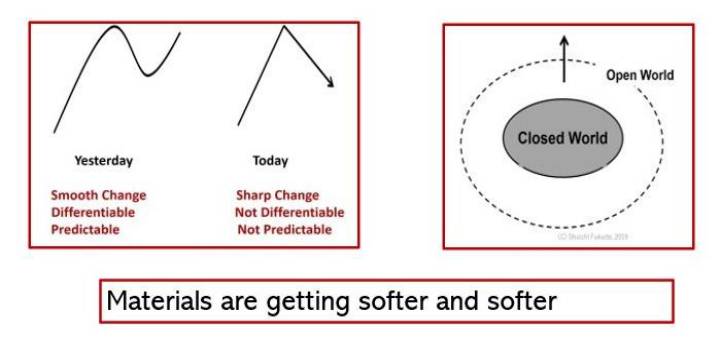
Figure 1 shows the change of the Real World from yesterday to today. Yesterday, changes were smooth, so we could differentiate them and predict the future. But today, they change sharply. Therefore, we cannot predict the future. And our world was closed with boundary yesterday, but it is expanding rapidly, and the boundary disappeared. Now it is an open world without boundary. Another great change is materials are getting softer and softer with the remarkable progress of material engineering.
Figure 1. Real world is changing Up to now, we could easily understand how to handle objects with our eyes alone, even from a distance. But as materials are getting soft, we need to directly interact with them. In other words, object handling has been tactical up to now. In other words, it was a problem of how. But with soft materials, we need to introduce a pragmatic approach. We need to find out what we should do by trial or error. Sensing and Actuation
This is the problem of sensing and actuation and VAK plays an important role. The softer materials become, the more we need directly interaction to understand how we should handle them. In other words, we need to perceive the situation through our movements.
Visual means eyes. They have played a very important role until now. But now we need additional sensing and actuation functions. Auditory does not mean only regular function of ears. What is more important is three semicircular canals. They help us to perceive the environment and situation through movement. They work for sensing the position of our body and for balancing them. Kinesthetics are movements.
Intelligent Human Systems Integration (IHSI 2022): Integrating People and Intelligent Systems https://openaccess.cms-conferences.org/#/publications/book/978-1-7923-8988-7
HUMAN MOVEMENTS Human movements are divided into two. One is Motion, which can be observed from outside. The other is Motor, which is movements inside of our body, such as muscles, etc.
Nikolai Bernstein clarified Motion (Bernstein.1967). At the early stage, our trajectories vary widely. This is because we coordinate many body parts and balance our body to adapt to the environment and the situation. But when we get close to the target object, our muscles harden, and they move together with our skeleton, forming a musculoskeletal system. So, we can easily identify parameters and apply mathematical approaches. Traditional engineering has focused on this stage. And control was our main focus.
But now the Real World is changing frequently, extensively, and unpredictably. So, it becomes more and more important how we coordinate many elements. This holds true not only with human movements, but also with many issues today, when environments and situations change frequently, extensively, and unpredictable.
EUCLIDEAN SPACE AND NON-EUCLIDEAN SPACE Traditional computing processes numbers, based on 0 or 1 framework. Data was represented as numbers. This Euclidean approach requires its datasets to be orthonormal and interval-based distance with units. But as the world becomes increasingly complex and complicated, datasets come to be composed of a wide variety of elements. So, they do not satisfy these requirements anymore. Therefore, we need to develop non-Euclidean approach.
Our information processing has been problem solving. But today, goal finding becomes our major task. We need to find our goals by trial and error and prioritize our strategic plan.
P. C. Mahalanobis proposed Mahalanobis Distance (MD) (Mahalanobis. 1936). to remove outliers. Although his datasets are Euclidean, MD itself is non-Euclidean. It is ordinal. Therefore, if we ignore the relationship between datasets, and regard MD just how far away the point P is from the mean of an individual dataset, we can utilize it for developing a non-Euclidean approach.
In other words, MD provides us with a qualitative performance indicator. Most of the current performance indicators are quantitative. But as datasets today are composed of a wide variety of elements, MD provides us with a very appropriate tool to cope with the frequently, extensively, and unpredictably changing environments and
Intelligent Human Systems Integration (IHSI 2022): Integrating People and Intelligent Systems https://openaccess.cms-conferences.org/#/publications/book/978-1-7923-8988-7 situations.
MIND-BODY-BRAIN It is our body that directly interacts with the outside world. Brain collects information from Body, and it accumulates them and structures them into knowledge. When changes were smooth and the future was predictable, Knowledge helped us to realize adequate plan. Brain played a crucial role. We should remember Mind accommodates both of Body and Brain. Currently, brain science is getting wide attention, but Brain cannot react immediately. We should pay attention to Body which reacts in real time. In fact, we say “Make up your Mind”. We do not say “Make up your Brain”. And Blood supports Body. But we should remember Blood is analog. We should harmonize digital and analog processing. The octopuses teach us how important Instinct is. They die immediately after their babies are born. So, they do not inherit knowledge from their previous generation. They have no other way than to live on their Instinct alone. But they are known as the expert of escape. They can escape even from a screwed container. But they need to repeat many trials and errors. If a appropriate performance indicator will be provided, how much it will reduce their burden.
PATTERN MD provides us with the ordinal based selection tool, but it deals with only one dataset. As datasets come to include a wide variety of data, i.e., information, we need to perceive the whole picture how they are related. Fukuda and his group used to study on detecting emotion from face. After many trials, Fukuda suddenly realized that we can easily detect emotions from characters in a cartoon. So, we developed a cartoon face model, and succeeded to detect emotions in a very short time (Kostov et al. 2001). We learned patterns play a very important role for nonverbal communication.
MAHALANOBIS DISTANCE-PATTERN (MDP): AN INSTINCT SUPPORT TOOL To cope with the drastically changing Real World today. MDP is proposed to assist Instinct (Fukuda. 2021).
Intelligent Human Systems Integration (IHSI 2022): Integrating People and Intelligent Systems https://openaccess.cms-conferences.org/#/publications/book/978-1-7923-8988-7
Dynamic data processing is easily done by introducing Recurrent Neural Network (RNN). But RNN assigns weights to inks randomly. So, it is a black box. To solve this problem, we can introduce Reservoir Computing (RC). Then, we can adjust at the output (Figure. 2).
Figure 2. Reservoir Computing Reservoir Computing (RC) has many benefits, in addition to providing us with the system manipulation function. Another great advantage is it enables us to introduce micro technologies. So, we can make sensors and actuators extremely small and make them part of our body. It realizes Things Team in IoT and realizes Human Enhancement. Besides, this enables robots, if they work separately from us to sense the situations and lead them to respond to the desired actions.
Figure available in the original PDF paper.
REFERENCES
Bernstein, N. (1967). The Co-ordination and Regulation of Movements, Oxford, Pergamon Press. Fukuda, S. (2021). PDSA Computing, Computing Conference (2021). Kostov, V., Fukuda, S., Johansson, M. (2001). Method for Simple Extraction of
Paralinguistic Features in Human Face, Image & Visual Computing, 30 (2), 111-125. Mahalanobis, P. C. (1936). On the Generalized Distance in Statistics, Proceedings of the National Institute of Science of India, 2 (1), 49-55.
Intelligent Human Systems Integration (IHSI 2022): Integrating People and Intelligent Systems https://openaccess.cms-conferences.org/#/publications/book/978-1-7923-8988-7
LISTED IN THE AHFE DIGITAL BOOKSTORE CATALOGUE
Explore the complete digital volume
Intelligent Human Systems Integration (IHSI 2022): Integrating People and Intelligent Systems
Read this individual research paper free through the original publisher, or explore the full digital proceedings book.
ISBN 978-1-7923-8988-7
Explore this ISBN in the AHFE Bookstore ↗Listed in the July 2026 bookstore catalogue; search by ISBN to confirm current availability · Digital book purchase optional