Niccolò Casiddu, Francesco Burlando, Claudia Porfirione, Annapaola Vacanti (2022). SiRobotics – an assistive experimental robot. In: Intelligent Human Systems Integration (IHSI 2022): Integrating People and Intelligent Systems. AHFE Open Access, vol. 22. https://doi.org/10.54941/ahfe1001025
SiRobotics is a European-funded project that involves 17 partners among companies and universities, which worked together to design and develop novel solutions of collaborative assistive ICT robotics with advanced capabilities to support caregivers, users and families in healthcare services, while act-ing with a socially acceptable behavior. The aim of the project is to support weak users in their daily activities, whether they live in home environments or elder care facilities; assessing the progress of their physical and cognitive decline, i.e. cognitive frailty, dementia, mild cognitive impairment, etc., will enable early diagnosis, objective assessment, therapy control and rehabilitation. Si-Robotics system will be used within the context of elder care facilities or home environments, characterized by the presence of frail people requiring gentle and dedicated attention and interaction, assisted by professional and/or in-formal caregivers and medical operators, working with very scheduled and demanding tasks; a first prototype developed in all its physical and interac-tional features is being tested in a simulation with real end users. The paper will describe our design process and the following choices, involving the shape and aesthetics of the robot.
Intelligent Human Systems Integration (IHSI 2022): Integrating People and Intelligent Systems https://openaccess.cms-conferences.org/#/publications/book/978-1-7923-8988-7
1. INTRODUCTION
Si-Robotics is a European-funded project that intends to develop novel collaborative assistive ICT robotics solutions that can support humans in healthcare services. This need comes from severe socio-economic issues that Western society is facing nowadays, caused by the large amount of people ageing out of their working life (Vermesan and Bacquet, 2017). The implementation of technological solutions in the lives of weak users will allow to support them in their daily activities and to assess the progress of their physical and cognitive decline, i.e. cognitive frailty, dementia, mild cognitive impairment, etc., thus enabling specific challenges for early diagnosis, objective assessment, therapy control and rehabilitation. Si-Robotics solution will operate within the context of elder care facilities and home environments, which are characterized by the presence of frail people requiring gentle and dedicated attention and interaction, assisted by caregivers and medical operators, working with very scheduled and demanding tasks. At this scope, the Architecture and Design Department of the University of Genoa has been cooperating with several partners in order to design radically new concepts and solutions in which humans, IoT de-vices and AI- powered social robots will harmoniously exist as a “cognitive agent” capable of anticipating needs and providing assistance to the users (Casiddu et al., 2020). Previous publications on this research activity discussed our design approach (Casiddu et al., 2020) and in particular the design of facial expressions as feedback on the robot face and the im-portance of visual interaction in the relationship between our users and the platform. In fact, the face represents the most important human-human interface for social activities and emotion recognition, as more than 60% of human interaction with individuals of the same species is conducted non- verbally (Ekman and Rosenberg, 1998), by using facial expressions and gestures. For a robot which has the ultimate goal of being a social agent in the lives of frial users being able to engage in this kind of interaction with humans is a massive step forward, towards a full acceptance and the creation of an emotional bond with users. As mentioned, these themes are widely discussed in previous papers (Casiddu et al., 2020). Here we will go in depth with describing and analyzing the design choices we made for the physical structure of the robot and its body features, which have been developed by taking into consideration human dimensions in order to optimize support and interaction.
Intelligent Human Systems Integration (IHSI 2022): Integrating People and Intelligent Systems https://openaccess.cms-conferences.org/#/publications/book/978-1-7923-8988-7
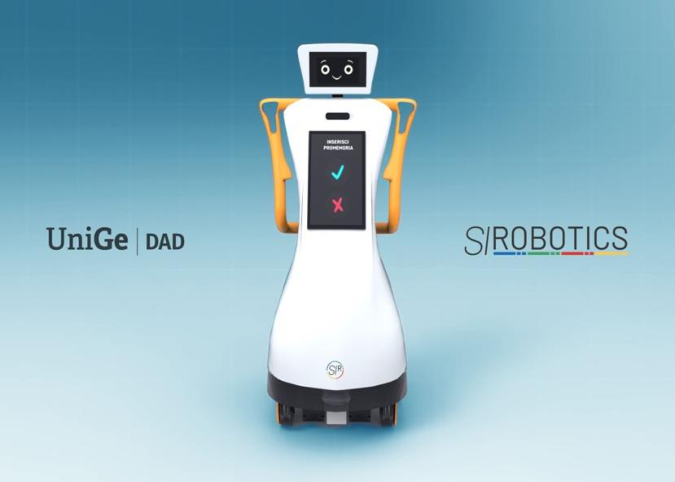
Figure 1. A photorealistic rendering of the final model.
2. DESIGN FOR HRI
As part of the project, UniGe team was involved in the design of aesthetic and functional features. We approached the project with a particular focus on the principles of user-centered design methods (Abras et al., 2004). The first phase consisted in some activities with twenty target users: elderly people without specific and serious diseases. The activities started with a brief about SiRobotics project and a summary introduction to robotics to give to the users a basic knowledge about the topic. Right after, users were asked to play a card sorting activity in which they had to create a robot’s body by glue together some cards depicting basic shapes as rectangle, circle and so on. Then they could equip the robot with some add on as tablet or webcam. The result should have been the robot that they expected to carry out the scenarios that we presented to them before. Later, a sociologist of the team leads a focus group in which the choices of the previous activity have been analysed by the users themselves. At the end of the activity, the team summarized the main concepts that were highlighted by the users and an illustrator produced some sketches of what the robot would looks like. In a second activity with the same sample of users, the team showed them the sketches and, according on their comments, the illustrator performs a live-drawing operation to modify the aesthetic of the robot. The sketches were projected on a wall in a 1:1 scale so that the activity of brainstorming with the users would be more accurate (Porfirione, 2020).
At the end of those activities, the team summarized the main concepts that had emerged and,
Intelligent Human Systems Integration (IHSI 2022): Integrating People and Intelligent Systems https://openaccess.cms-conferences.org/#/publications/book/978-1-7923-8988-7 cross-referencing the latter with the output of a bibliographic research, started to approach the phase of shaping the robot with the features that are given below.
3. DESIGN DETAILS
The main goal for the aesthetic was to design a humanoid robot with a low degree of anthropomorphism but at the same time with a comfortable aspect and a very strong practical value. Starting with the constraints given by the mechanical basis we designed a sort of skirt which gradually turns into a human-like upper body. A 17 inches touch screen monitor was placed on the chest in order to ensure a great interaction experience and to ensure a good readability of the content by elderly users. The design of the back started by a winding construction line from which we extruded a very flat surface to give an idea of a straight spine. Since the base was longer than the upper body, we included a tray in the lower part of the back. The latter can be useful as port objects or support base for other add-ons. One of the main components is the handlebar: a pipe that start from the shoulders, descends along the sides and wraps the lower back as if the robot kept the hands behind his back recalling a popular figure of the Italian culture: men of retirement age who spend their time watching construction sites, called Umarell. Such pipe is shaped in order to obtain a multi-points handold taking inspiration from public transport handlebars. Therefore, the “shoulders” have been holed and a bump has been modelled so that a person can stay alongside the robot walking arm-in-arm. The handlebar turns around the shoulder’s axis becoming an handrail when it is in horizontal position. Moreover, when it is completely revolved so that the “arms” are in horizontal position in front of the chest, a tray – shaped to fit together with the pipe – can be placed on it so that the robot can bring several objects. We decided to design an animated face that is displayed in a 9 inches monitor located in the head. Several tests with users were carried out also for the design of the face, which starts from basic emotions associated with colours based on the research on the literature. Bibliographic research, and research about robots on the market and robots from sci-fi movies, is the foundation of the colour choice. Evidence suggested that light blue and orange convey peacefulness and suggest friendliness.
4. ENGINEERING PROCESS AND THERMOFORMING PRODUCTION
As required by the contents of the ORs of UniGe competence, the covers for the robotic platform were designed. Our team of researchers developed the concept following an approach dictated by the briefing activities with the partners and by the needs that emerged in the co-design phase carried out with the end-users.
To start the production of the first robot prototype, contact was made with Carpiplast company, which specializes in thermoforming of plastic materials. After consulting with the company, it proves necessary to consult an expert to engineer the CAD model developed by our team, relying on Modeltek company which actively collaborates with Carpiplast (in the
Intelligent Human Systems Integration (IHSI 2022): Integrating People and Intelligent Systems https://openaccess.cms-conferences.org/#/publications/book/978-1-7923-8988-7 person of Dr. Massimiliano Salvarani). The technical consultancy carried out by Modeltek is aimed at engineering the CAD file to make it suitable for production.
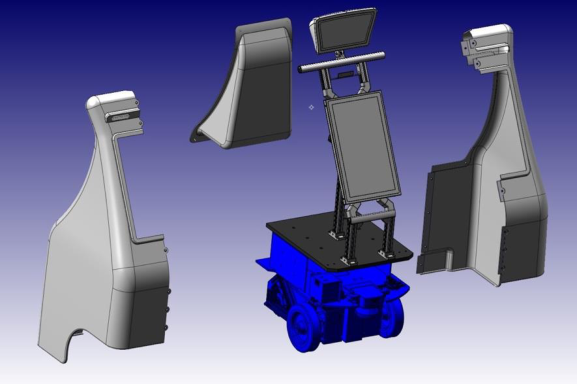
The experience in the sector and the quality of the necessary results in terms of details and surface finishes required a joint work phase with Carpiplast and Modeltek, aimed at identifying the most suitable production method in terms of materials for the molds. In light of the choices made, an engineering intervention by Modeltek makes the necessary changes to the CAD to make it suitable for the specific technical needs of thermoform-ing: in particular it was decided to divide the "body" of the robot into two side parts plus a rear part and some curves have been slightly modified to allow the removal of the final pieces from the mold. Finally, the method of joining the various parts was defined by means of metal rods and a lower support plate in which rivet fixings were inserted. Finally, the area in which the holes to access the control panel will be inserted has been defined, the template of which is then made with plastic cut from a sheet. The breakdown of the surfaces also considered the technical and mechanical requirements: assembly and disassembly of the robot body and inspection if necessary. The team decides that the remaining components such as the head and handle will be 3D printed. The results of the changes to the CAD file can be seen in the following image.
Figure 2. The CAD model ready for production.
The thermoforming of plastic is a hot working technique that allows you to model plates of plastic material on specific molds through heat, with pressure or suction. It is generally applied on various types of materials and, thanks to the precision achieved, it allows to obtain exclusive creations with attention to the smallest details. For the realization of the robot we start from a semi-finished product, consisting of a flat plate in 6 mm thick Acronitrile butadiene styrene (ABS); once thermoformed, the piece must then be freed from the scraps through subsequent manual processing.
Intelligent Human Systems Integration (IHSI 2022): Integrating People and Intelligent Systems https://openaccess.cms-conferences.org/#/publications/book/978-1-7923-8988-7
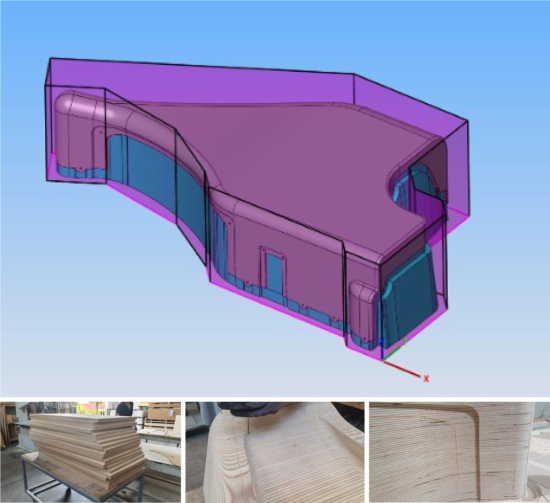
The molds used are in uniface birch wood, i.e. modeling with a single surface, male (posi- tive) while it is decided that the shaping of the sheet must take place under vacuum (for thermoforming sometimes female molds and pressure can be used). The semi-finished product (slab) is then preheated in the oven and with the vacuum it leads to coupling with the mold.
Figure 3. Design and production of the molds.
5. CONCLUSION
The paper has briefly described the whole design process of a social robot, starting from the conceptualization of its features, carried out by investigating users’ perception, needs and expectations regarding assistive robotics, and ending with the engineering production. In general, it is possible to affirm that the prototype presents a very good degree of precision and is consistent to the design we developed. The prototype produced through the hereby described process will be used during several tests carried out with end users as part of the project. Results in term of acceptance, easiness of use and interaction and general perception of the robot will be described in detail in further publications and will activate a new iterative phase of perfectioning of our design.
Intelligent Human Systems Integration (IHSI 2022): Integrating People and Intelligent Systems https://openaccess.cms-conferences.org/#/publications/book/978-1-7923-8988-7
ACKNOWLEDGEMENTS
Si-Robotics is a project funded by the National Operational Program "Research and Innovation" 2014-2020 (PON "R&I" 2014-2020 - Decree of admission to financing n. 3203 of 03/12/2018). It has been carried out by our research group together with several partners among companies and universities: Università Politecnica delle Marche – Dip. Ingegneria elettronica, Università degli studi di Milano – Laboratorio di Sistemi Intelligenti Applicati, Fondazione Neurone Onlus, Fondazione religione e di culto “Casa Sollievo della Sofferenza” – Opera di San Pio da Pietralcina, Fondazione Bruno Kessler, Consiglio Nazionale delle Ricerche – ISTC Roma, INRCA Istituto Nazionale Riposo e Cura Anziani di Ancona, l'Istituto di BioRobotica della Scuola Sant'Anna di Pisa, Exprivia, Item Oxigen srl, R2M Solution srl, Grifo Multimedia srl , Next2U srl , Cupersafety srl Università degli studi di Roma “La Sapienza” . Istituto Internazionale per gli Alti Studi Scientifici “Eduardo R. Caianiello”.
REFERENCES
Abras, C., Maloney-Krichmar, D., & Preece, J. (2004). User-centered design. Bainbridge, W. Encyclopedia of Human-Computer Interaction. Thousand Oaks: Sage Publications, 37(4), 445-456. Casiddu, N., Burlando, F., Porfirione, C., & Vacanti, A. (2020, July). Humanoid Robotics:
A UCD Review. In International Conference on Applied Human Factors and Ergonomics (pp. 87-93). Springer, Cham. Casiddu, N., Burlando, F., Porfirione, C., & Vacanti, A. (2020, July). Visual elements for the design of a Robotic Head in Si-Robotics project. In International Conference on Applied Human Factors and Ergonomics (pp. 231-237). Springer, Cham. Casiddu, N., Burlando, F., Porfirione, C., & Vacanti, A. (2020, September). Designing
synthetic emotions of a robotic system. In International Conference on Human Systems Engineering and Design: Future Trends and Applications (pp. 148-155). Springer, Cham. Ekman, P., Rosenberg, E. L. (1998) What the Face Reveals. Oxford University Press. Porfirione, C. (2020). Silver design: progettare ambienti e dispositivi capacitanti al tempo della silver economy. Silver design, 1-168. Vermesan, O., & Bacquet, J. (Eds.). (2017). Cognitive Hyperconnected Digital
Transformation: Internet of Things Intelligence Evolution. River Publishers.
Intelligent Human Systems Integration (IHSI 2022): Integrating People and Intelligent Systems https://openaccess.cms-conferences.org/#/publications/book/978-1-7923-8988-7
LISTED IN THE AHFE DIGITAL BOOKSTORE CATALOGUE
Explore the complete digital volume
Intelligent Human Systems Integration (IHSI 2022): Integrating People and Intelligent Systems
Read this individual research paper free through the original publisher, or explore the full digital proceedings book.
ISBN 978-1-7923-8988-7
Explore this ISBN in the AHFE Bookstore ↗Listed in the July 2026 bookstore catalogue; search by ISBN to confirm current availability · Digital book purchase optional