Middle-aged women in China face health risks from prolonged IUD use, often beyond recommended durations, with postmenopausal women at higher risk. Current healthcare services lack proactive support, particularly for removal. Daughters, motivated to help, face barriers like trust gaps and limited knowledge. To address this, we developed the Daughter-led IUD Care app, which raises awareness, reduces surgical fears, and offers professional guidance. The app features four modules: Community Sharing, Workshop Reservations, Knowledge Learning, and Hospital Reservations. Evaluation shows the app improved mothers' willingness to remove IUDs and enhanced daughters' support. By leveraging family bonds, it fills gaps in healthcare programs and offers a model for integrating familial support into public health strategies.
In China, many middle-aged women use intrauterine devices (IUDs) beyond their recommended lifespan, leading to risks like unintended pregnancies or displacement. While IUDs typically last 5–8 years, many women use them for an average of 20.96 years, with the longest case being 41 years (Wang, 2021). Post-menopausal women are especially at risk, as uterine changes make IUDs unsuitable, and removal success declines after two years post-menopause. Surveys show 24% of women retain IUDs within five years of menopause (Yin and Zhou, 2021). IUD use in China has been widespread since the 1980s family planning policy, with around 540 million women using metal IUDs by 2017 (Shu et al., 2015). Despite recent increases in removals, many from the family planning era continue prolonged use due to a lack of health education, conservative views on sexuality, and personal reasons like fear of pain or ignorance of removal needs. Surveys show 39% delay removal due to pain, 31.7% are indifferent to risks, and 11.1% forget or neglect removal plans (Wu and Zou, 2009).
Current government-led initiatives have been largely ineffective, often due to lack of proactive implementation and poor outreach. Our approach focuses on intergenerational communication, utilizing daughters’ empathy Received February 1, 2026; Revised April 7, 2026; Accepted April 22, 2026; Available online July 20, 2026
Daughter-Led Intergenerational Collaboration: Human-Computer Interaction 43 and concern for their mothers’ health to bridge information gaps and promote IUD removal. However, daughters face challenges in persuading their mothers, including distrust or reluctance to engage, fear of medical professionals’attitudes, and lack of professional support.We developed the IUD Care app to support IUD removal, featuring Community Sharing, Workshop Booking, Knowledge Learning, and Hospital Booking and Monitoring.
A user questionnaire study with 20 participants compared IUD Care to government interventions and spontaneous actions by daughters. Through a controlled trial and user surveys, we explored three key research questions:
RQ1: Can IUD Care help daughters persuade their mothers to remove the IUD?
RQ2: Can IUD Care assist daughters in providing support and
reassurance?
RQ3: Can IUD Care improve the pre- and post-surgery experience?
Our proposed IUD Care application overcomes the implementation limitations of government-led programmes by leveraging the bond between mothers and daughters to safeguard the health of middle-aged women:Promoting IUD-related knowledge raises awareness of the risks of prolonged use and the need for removal, while encouraging younger generations to care for their mothers’ health;Offering valuable insights for similar health promotion initiatives, highlighting the potential of using familial bonds to tackle health challenges.
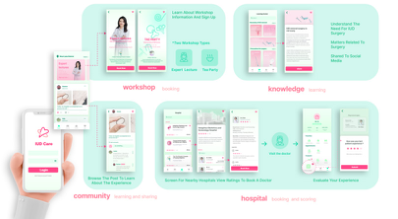
DESIGN The IUD Care app consists of four modules, each addressing specific user needs: (1) The community learning section fosters interaction between daughters and mothers, raising awareness of IUD removal and alleviating anxiety through community support. (2) The workshop booking section offers expert lectures and peer gatherings, combining professional input with relatable experiences to educate users, enhanced by push notifications and easy booking. (3) The Knowledge Learning section provides accessible content on IUD removal and post-procedure care, helping daughters support their mothers. (4) The hospital booking and scoring section partners with medical institutions to improve the healthcare process, ensuring user-friendly services and promoting professional standards.
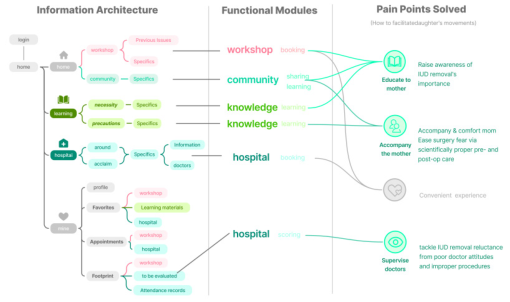
Figure 1: The high-fidelity of IUD Care APP four core functional modules, including: The Community Sharing and Communication Module,The Workshop Reservation Module, The Knowledge Learning Module ,The Hospital Reservation and Supervision Module.Figure 2: Information architecture of the IUD Care APP and its corresponding functional modules and pain point solutions.
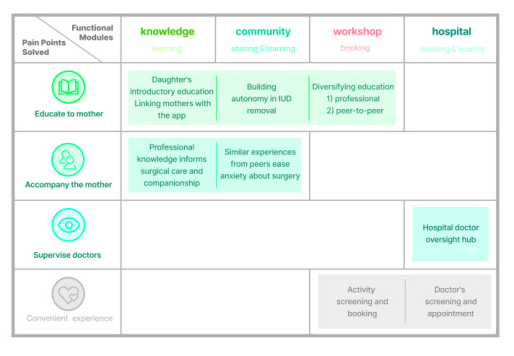
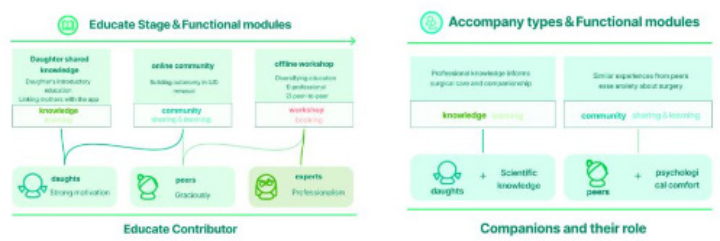
Different functional modules address pain points at varying levels and perspectives: To tackle the challenge of science communication and raise awareness of IUD removal, the three modules correspond to progressive stages. Daughters initiate science communication through emotional empathy, connecting their mothers to the app. Users with removal experience offer psychological support in online communities and offline workshops. Experts provide personalized answers to procedure-specific questions, with general scientific rationale available in the knowledge module.
Companionship and reassurance operate in parallel, supporting users when deciding to undergo IUD removal and throughout pre- and post-operative care. The knowledge section offers accessible guidance on perioperative care, supported by the daughter’s assistance. The community section provides psychological comfort, allowing flexible discussions with others who share similar experiences.
Figure 3: The specific aspects and levels of the pain points corresponding to each functional module of the IUD Care APP.Figure 4: Different participants and various functional module stages and levels corresponding to the pain point solutions of ‘Educate to mother’ & ‘Accompany to mother’.
Functional Module Analysis (1) The Community Learning and Sharing Model
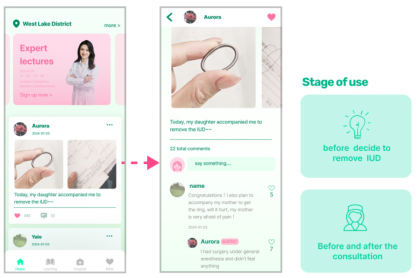
This section, located in the lower half of the “Home” tab, allows users to browse shared experiences and insights on IUD removal and post queries or share their own stories.
It addresses two key pain points: First, during the awareness phase, the platform fosters intergenerational collaboration by encouraging interaction between daughters and mothers, raising awareness of IUD removal and strengthening health consciousness across generations. It promotes user autonomy, shifting from passive information reception to active participation, cultivating proactive health habits through browsing and discussions. It also creates a space for mothers to engage with peers, where authentic experiences encourage empathy and prompt IUD removal.Second, in the pre- and post- operative phases, forum posts provide companionship and reassurance, alleviating anxiety about the procedure. They also help daughters prepare for their mothers’ surgery, offering practical advice on pre-operative preparations and post-operative care. These shared experiences fill information gaps, offering emotional support and reassurance that mothers are supported by a community.
Figure 5: The community sharing and communication module.
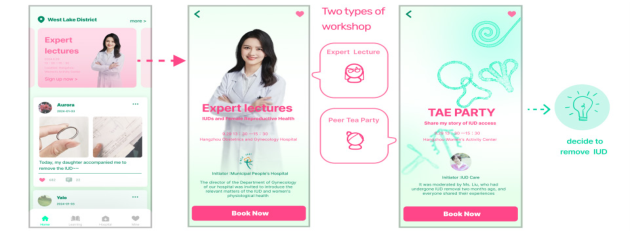
This section, located in the upper part of the “Home” tab, displays nearby workshops with details and booking options accessible by tapping.
The workshops, including expert lectures and peer-led tea gatherings, address the science communication gap for middle-aged women who find their daughters’ explanations unconvincing or feel uncomfortable discussing sexuality. This section offers trusted science communicators, advancing outreach through tangible, activity-based formats.
Expert lectures provide systematic knowledge, building authority and persuasiveness through direct interaction with specialists, enabling more flexible, detailed learning than the knowledge section. Peer tea gatherings, led by women with firsthand IUD experience, involve participants who have either not had an IUD or have had theirs removed. These gatherings foster relatability, using shared experiences to build trust. In-person interactions strengthen connections more than online discussions.
Push notifications and booking functions enhance usability. Workshops are promoted based on the user’s location, with swiping allowing easy access to event details and comparisons. Direct in-app booking streamlines the process, improving user experience.
Figure 6: The workshop reservation module.
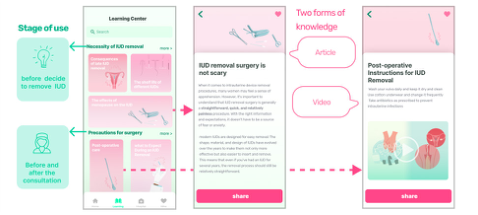
(3) The Knowledge Learning Module This The “Learning” tab in the app consists of two main sections: the upper portion covers the necessity of IUD removal, while the lower section provides surgical preparation information. Users can explore topics in detail and share content via social media platforms like WeChat.
The “necessity of IUD removal” content is shared by daughters during early public awareness campaigns, serving as the primary means of app dissemination. Delivered through images, text, or videos, it targets middle- aged users and serves as the foundation for IUD removal awareness, offering a more systematic and recordable format compared to other educational content. Its usability ensures easy access for repeated consultation.
The “Pre- and Post-operative Care and Preparation” section offers accessible, evidence-based guidance, helping daughters support their mothers through the surgical process. It covers pre-operative checks and post-operative recovery, empowering daughters to assist with practical care.
Daughter-Led Intergenerational Collaboration: Human-Computer Interaction 47 Unlike the community sections that provide emotional support, this section delivers structured, practical knowledge to ensure comprehensive support, addressing both emotional and functional needs.
Figure 7: The knowledge learning module. (4) The Hospital Booking and Scoring Module
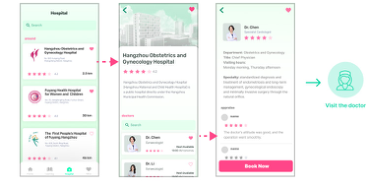
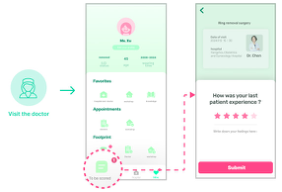
This section has two stages: ‘Hospital Booking’ and ‘Hospital Oversight’. It helps users find hospitals while also recording ratings, serving as a supervisory mechanism for hospitals and doctors. This reduces users’ concerns about regulatory standards in healthcare.
Figure 8: The hospital booking module.
The booking stage is found under the ‘hospital’ tab, where the app suggests nearby hospitals with ratings. Clicking on a hospital shows detailed info, including physician profiles (ratings and specializations). Selecting a physician brings up their profile with reviews and allows direct appointment booking. This streamlined process improves the consultation experience, while ratings and reviews help reduce user concerns. Actions here also lay the groundwork for future rating contributions. The daughter can assist the mother in exploring and selecting suitable healthcare providers, creating an intergenerational collaborative decision-making process.
Figure 9: The hospital scoring module.
48 Chen After the visit, users can rate their experience under ‘Footprints – Pending Rating’ in the ‘mine’ section. This monitoring of doctors and hospitals encourages professional standards and regulatory compliance, easing user concerns. Jointly reviewing and evaluating the medical journey fosters communication, trust, and mutual understanding, blending emotional and functional design for better healthcare oversight.
User Journey In terms of the chronological sequence of intergenerational collaboration, the IUD Care user journey is primarily divided into three phases. The first two phases are more significant, forming the core of intergenerational collaboration:
Figure 10: The mother and daughter’s journey whilst using the app. (1) Before Surgery
The daughter leads information transfer and health education. She introduces the app to her mother, using the younger generation’s advantage in gathering information. Health education occurs in three stages: early education through the “Essential Knowledge” section, mid-stage education via the community sharing section, where peer experiences encourage IUD removal, and late- stage offline education via workshop bookings that address specific concerns.
(2) Around Surgery This phase supports the decision to remove the IUD. The hospital booking section helps manage the appointment process, using doctor ratings and reviews to reduce anxiety. Pre- and post-operative care is provided through the knowledge learning section, which equips daughters with practical, professional guidance to support their mothers before and after the procedure.
(3) After Surgery This phase focuses on physician monitoring and user-led knowledge dissemination. Post-surgery, users rate their doctors and provide feedback, ensuring oversight of medical practices. Experienced users also contribute to community knowledge sharing and lead peer workshops, offering reassurance and scientific support to others, thus completing the knowledge dissemination loop.
EVALUATION This study used a mixed-methods approach to evaluate the app’s usability and value. A usability evaluation with the questionnaire (n = 20) assessed
Daughter-Led Intergenerational Collaboration: Human-Computer Interaction 49 user and daughter acceptance, comparing it with the existing companion app Xiaoju Peizhen. Additionally, semi-structured interviews explored whether the prototype helped daughters persuade their mothers to remove the IUD, provide emotional support, and improve the overall experience before and after the procedure.
Participants This study recruited 20 participants for app testing, including 10 mothers and 10 daughters, all from Hangzhou, Zhejiang Province, China. None had significant medical conditions, and all were first-time users of the app. Mothers, aged 45–56 years (mean age: 50.5), had varying educational backgrounds (primary to senior secondary school) and prior IUD experience. Six mothers had used IUDs beyond the recommended duration, and four retained theirs postmenopause. Daughters, aged 18–25 years (mean age: 21.5), all had at least senior secondary education, were university students or recent graduates, and were proficient in using smartphones and health apps.
Assessment Process All 20 participants completed the full evaluation process, which included an introduction (covering the test objectives, app tasks, and goals), a 10-minute app experience and questionnaire completion for both the control and experimental groups, followed by a post-test interview. Prior to testing, the researchers provided a brief overview of IUDs, the current context, the app’s usage and goals, and offered guidance on navigating the app.
The specific testing process was as follows: (1) The participants were informed of the test purpose, method, and
objectives. (2) Control Group Test: ① The tester guided participants through the control group’s companion app. ② Participants used the app to simulate a companion-assisted medical experience. ③ After the simulation, they completed an evaluation questionnaire. (3) Experimental Group Test: ① The tester guided participants through
the IUD Care app. ② Participants used the IUD Care app to simulate a companion-assisted medical experience. ③ After the simulation, they completed an evaluation questionnaire. (4) A semi-structured interview was conducted to gather participants’ subjective impressions.
To assess the acceptance of the app developed in this study among users, the questionnaire was employed, which has become a widely recognized measurement tool across various fields. Semi-structured interviews were conducted to explore whether IUD Care could facilitate the process of IUD removal and engage users in discussion about this aspect.
Data Collection and Analysis For quantitative data collection, an online survey via Wenjuanxing platform yielded 20 valid responses. The survey aimed to assess participants’
50 Chen preferences for medical apps, acceptance of the IUD Care prototype, and future usage intent. Descriptive statistics were used to analyze key variables. The questionnaire employed a 7-point Likert scale (1 = strongly disagree, 7 = strongly agree), with odd-numbered items positively worded and even- numbered negatively worded. Odd items were scored by subtracting 1 from the participant’s rating, and even items by subtracting the rating from 5. The total score was calculated by summing individual scores and multiplying by 2.5. The experimental group (IUD Care) had an average score of 73.5, while the control group (Xiaoju Companion) scored 58.2, showing a significant 15.3-point difference. For qualitative data collection and analysis, semi-structured interviews were employed. The interview process was transcribed in real-time through speech-to-text technology, and all interviews were audio-recorded with the informed consent of the participants. All data were anonymized to protect participants’ privacy. Thematic analysis was used to analyze the qualitative data, which involved open coding, axial coding, and selective coding to systematically organize and categorize the interview texts.
Feedback from mothers included: (1) “This app allows my daughter to help us understand issues like IUD removal that we might otherwise miss.” (2) “One of the best features is that IUD Care also considers the appointment scheduling process with doctors, which is incredibly convenient for someone like me who often faces difficulties in visiting hospitals.” (3) “Compared to other channels, my daughter’s presence significantly alleviates my anxiety and fear about the procedure.” (4) “I think the app’s community and workshop booking features are excellent. If I only listened to my daughter, I wouldn’t have accepted the importance of IUD removal so quickly. This definitely facilitated communication between my generation and my daughter’s.”
Feedback from daughters about the app included: (1) “When I communicate with my mother, she often expresses a lack of trust in younger people, but this app offers many convenient and professional resources that strengthen my ability to persuade her about IUD removal.” (2) “The app has helped me focus more on my mother’s health.” (3) “What I find particularly thoughtful is the practical instructions provided for post-surgical care.” (4) “I’m happy to use this app because I recently came across a lot of information online about IUDs and really wanted to learn more about my mother’s situation.”
Result
Quantitative results indicate that participants preferred IUD Care over other healthcare apps, showing higher acceptance of the prototype and a willingness to continue using intergenerational collaboration apps. In the usability evaluation involving 20 participants, the experimental group using IUD Care achieved an average score of 73.5, which was significantly higher than the 58.2 score recorded by the control group using the Xiaoju Companion app, representing a substantial 15.3-point difference. This quantitative advantage highlights that specialized features, such as the intergenerational knowledge loop and peer-led workshops, provide a more tailored and persuasive experience than general medical companion services. Qualitative findings suggest the app enhanced middle-aged women’s willingness to remove their
Daughter-Led Intergenerational Collaboration: Human-Computer Interaction 51 IUDs and improved daughters’ experience in persuading their mothers. It effectively supported daughters in encouraging IUD removal by fostering intergenerational communication, helping daughters better monitor their mothers’ health during the procedure, and alleviating their mothers’ anxiety and fear through companionship. Mothers noted that their daughters’ involvement significantly reduced their fear of the procedure and that the streamlined appointment process was highly efficient. Similarly, daughters reported that the professional resources and postoperative care guides provided by the app bolstered their confidence and enabled them to focus more effectively on their mothers’ well-being.
CONCLUSION
This research introduces IUD Care, an innovative application that leverages the emotional bond between mothers and daughters to address the health risks associated with prolonged IUD use among middle-aged Chinese women. By integrating four core modules including community sharing, workshop reservations, knowledge learning, and hospital reservations, the app overcomes the limitations of traditional top-down healthcare programs and transforms a private medical task into a collaborative family journey. The results demonstrate that this daughter-led intergenerational model not only increases mothers’ health awareness and willingness to seek medical care but also provides a viable design model for public health strategies dealing with sensitive family health issues. By combining professional guidance with familial emotional support, IUD Care fills a critical gap in current healthcare services and provides a powerful tool for improving the quality of life for aging female populations.
LIMITATION Despite these positive outcomes, this study has several limitations. The sample size was relatively small and geographically limited to Hangzhou, which may not fully represent the diverse socioeconomic backgrounds and digital literacy levels of middle-aged women across China.
REFERENCES
Ai, L. E. (2021). A new outlet: The creative methodology of the new generation of female installation art—Taking the 5th Women’s Art Biennale “Whole Nest Project 2021” as an example. Art Panorama, (09), 12–17. https://doi.org/ CNKI:SUN:MSDG.0.2021-09-003 Bai, S. (2024). Medical discourse and disease metaphors in Zhou Wenjing’s artistic
works. Medicine & Philosophy, 45(04), 43–47. Branaghan, R.J., O’Brian, J.S., Hildebrand, E.A., Bryant Foster, L.: Usability evaluation.In: Branaghan, R.J., O’Brian, J.S., Hildebrand, E.A., Bryant Foster, L. (eds.) Humanizing Healthcare – Human Factors for Medical Device Design, pp. 69–96. Springer, Cham (2021).https://doi.org/10.1007/978-3-030-64433-8_4 China Health Statistical Yearbook 2020 (2021-12-06) [2025-08-23]. http://www.nhc.
Shaanxi University of Science & Technology). Li, L., & Yang, N. N. (2024). Middle-aged and elderly women should not forget the IUDs in their bodies. Food and Health, 36(12), 6–7. Liang Liling, Zhao Li, Deng Juan & Ye Xuchun. (2019). Chinese Version and
Reliability and Validity Test of the NASA-TLX Scale. Nursing Research, 33 (05), 734–737. Liu, Y. (2002). Usability evaluation and methods of human-computer interaction interfaces. Chinese Journal of Ergonomics, (02), 35–38. Liu, Z. W., & Liu, J. (2025). Intergenerational knowledge feedback and artificial
supplementation in health knowledge communication: A study based on the health knowledge feedback practice of “taking mothers to have IUDs removed”. Journalism & Writing, (02), 96–109. Lou, S. T. (2018). A study on persuasive design for App interaction interfaces (Master’s thesis, Jiangnan University). Ma, L. (2021). The forgotten “intrauterine device”. Family Medicine (Second Half
of the Month), (09), 24–25. Shen, J., Cui, S., & Chen, S. Y. (2025). Adapting to “presence” and taking initiative in “presence”: Women’s bodily practices toward a pro-natal friendly society. Journal of Social Development, 12(01), 187-205+246. Shu, X. Y., Sun, X. M., Zong, Z. H., & Mao, J. S. (2015). Research on the current
status and development strategies of reproductive health services for rural perimenopausal women. Population and Development, 21(03), 61–66. Su, Z. Y. (2024). A study on service design of community “intergenerational care behavior” based on community collaboration (Master’s thesis, Wuhan Institute of Technology). The State Council of the People’s Republic of China. (2023). National Basic Public
Service Standards (2023 Edition).[EB/OL]. [2025-08-23] https://www.gov.cn/ zhengce/zhengceku/202308/P020230810416348836015.pdf Wang, Q. (2021). Do not let intrauterine devices “overstay their service period”. Jiangsu Health Care, (10), 35. What are the dangers of leaving an expired IUD in the uterus, which has grown
‘fishhooks’? [EB/OL].(2019-8-15) [2025-08-23] https://m.thepaper.cn/ newsDetail_forward_4185776 Wu, S. C., & Zou, Y. (2009). Current status and research progress in the application of intrauterine devices. Chinese Journal of Practical Gynecology and Obstetrics, 25(10), 795–797. Yang, H. (2013). A study on interface design of smartphone mobile Internet
applications (Doctoral dissertation, Wuhan University of Technology). Yin, J., & Zhou, Y. (2021). Resident’s Handbook of Obstetrics and Gynecology, Peking Union Medical College Hospital. People’s Medical Publishing House. Zhuang, N. Y. (2024). A study on multi-modal interaction design of intelligent
washing machines in the context of intergenerational integration (Master’s thesis, Jiangnan University).
Read this individual research paper free through the original publisher, or explore the full digital proceedings book.
ISBN 979-8-950676-09-3
Explore this ISBN in the AHFE Bookstore ↗Listed in the July 2026 bookstore catalogue; search by ISBN to confirm current availability · Digital book purchase optional