Radhika Joglekar, Gail Hopkins (2025). Exploring and Understanding Neurodiverse Sensory Experiences and Management Through Digital Intervention. In: Human Interaction and Emerging Technologies (IHIET 2025). AHFE Open Access, vol. 197, pp. 21–34. https://doi.org/10.54941/ahfe1006696
Sensory processing and regulation have garnered particular focus by professionals when recommending interventions to help neurodivergent individuals. However, little research has been done into the extent that neurodiverse individuals (the general population) understand sensory management, specifically: sensory seeking; sensory avoiding; and the concept of sensory diets, despite the potential value of this to their wellbeing. This study used a mixed-methods approach to explore sensory awareness and preferences in adult respondents and to understand their sensory experiences, including sensory triggers and their management of these. The overall aim of this study was to understand whether and how a mobile application could be designed to build a user’s awareness of their own sensory needs through sensory self-assessment; and recommend a personalised sensory diet to support their sensory regulation.Twenty-seven people completed a survey asking about their understanding of sensory processing and management. Survey data highlighted a lack of participant awareness of vestibular, proprioceptive and interoceptive senses; and the use of sensory diets to help manage sensory processing and maintain an optimal sensory experience. Findings informed the design of a low-fidelity app for further evaluation. Qualitative interviews were then conducted with 14 people. The purpose of these were two-fold: to gain richer data on individuals’ sensory perceptions and experiences; and to evaluate the concept of the sensory awareness prototype. Data from the interviews were thematically analysed and affinity mapping was used to analyse the prototype concept testing, capturing participants’ views on the potential usefulness of the app. Analysis of interview data highlighted how participant experiences consisted of sensory preferences – innate or learned inclinations toward specific sensory stimuli – and sensory triggers; stimuli that cause a strong response within the individual. Behavioural responses to preferences and triggers were categorised as seeking, avoiding, or employing no structured strategy. Seeking and avoiding behaviours were classified as either a premeditated strategy to prevent stress or a coping mechanism to try and alleviate stress. The selection of these depended upon environmental opportunities or on the intensity/impact of a trigger. Participant descriptions included instances of a cycle of sensory response, leading to physical response, leading to emotional response and a consequential reduction in sensory tolerance which further impacted physical wellbeing. In cases where no proactive strategy was in place, individuals often relied on instinctive “fight or flight” reactions.A high-fidelity prototype app, “SenseHarmony”, was developed which incorporated sensory screening and mood-logging features and provided sensory diet recommendations. This was tested with a further five participants through task-based usability analysis and interviews. This evaluation suggested that digital tools can be of value as an educational resource and to help equip people with a better awareness of, and strategies for, managing their own sensory needs. Through this study, we have sought to highlight how individuals interact with and manage their day-to-day sensory experiences and the potential benefits of a mobile app to enable this. We suggest that a tool to help individuals predict and manage their sensory responses can promote a shift from coping mechanisms to strategies, and support wellbeing.
Sensory perception in humans is multi-faceted, incorporating both exteroception, or the detection of external cues (such as visual, auditory, tactile) and interoception, or the detection of internal cues (such as feelings of hunger). Additionally, humans process the position of their body in space (proprioception) and information from their vestibular system to enable and maintain balance (Harrison et al., 2019).
Sensory processing refers to how individuals interpret and respond to sensory stimuli (Soler et al., 2023). Effective sensory regulation enables individuals to manage sensory input and adapt their behaviour, influencing focus, task performance, and emotional stability (Armstrong, 2019). Difficulties in sensory processing can disrupt daily functioning and emotional well-being (Brown et al., 2001) and sensory regulation has been widely studied in neurodivergent individuals as a means to support them. However, there is a lack of research investigating sensory processing variations in the neurodiverse population. In this paper we argue that a better awareness of sensory regulation differences in every one of us could promote better coping mechanisms, enable better understanding of others and benefit general wellbeing. This research therefore aims to address this gap by investigating the sensory experiences of adults; their coping strategies; the impact of sensory regulation on daily life; and how this might be supported through digital intervention. Specifically, four research questions were formulated: RQ1: What awareness do adults have of their different senses and what do they understand by the terms sensory regulation and sensory diet?
RQ2: What types of sensory regulation activities (seeking/avoiding) are most commonly used in the general population?
RQ3: What are the most common sensory triggers and processing challenges adults in the general population face and how do these impact their daily lives?
RQ4: How can a mobile application be designed to assess adult sensory perception and recommend a personalised sensory diet for regulating their sensory needs?
LITERATURE REVIEW
Sensory processing and regulation are integral to our understanding of and communication within our environment (Soler et al., 2023). Our capacity to interact with others and our tolerance of our environment are affected by the way in which we process and regulate our sensory input (Gulla & Golonka, 2021). It is, therefore, unsurprising that our sensory processing ability can directly impact our quality of life (Costa-López et al., 2021).
Ayres Sensory Integration® (ASI) is a theoretical framework of principles describing how our central nervous systems process and act on sensory information (Ayres, 1979). A core concept of this, praxis, involves ideation (conceptualising actions), motor planning and motor execution. Our sensory systems develop from an early age and link together or integrate. Deficits in their development can impair integration, causing difficulties, e.g., impairments in links between visual perception, conceptualisation and motor planning can lead to motor coordination problems such as Developmental Coordination Disorder (Lane et al., 2019).
Sensory modulation is the process of regulating response to sensory input and it relies on the brain’s ability to detect and understand sensory information. Each of us has different neurological thresholds for our senses; impacting our modulation, and hence our behaviour; such as withdrawal in sensory-avoiding individuals or active exploration in sensory-seeking
Exploring and Understanding Neurodiverse Sensory Experiences and Management 23
individuals. Dunn mapped the interaction between neurological threshold and self-regulation to a Model of Sensory Processing, categorising sensory processing into four quadrants: low registration; sensory seeking; sensory avoiding; and sensory sensitivity (Dunn, 1997).
Problems with sensory modulation can lead to exaggerated behaviours and disrupt engagement with daily activities. Behaviours can be hyper-reactive, e.g. hyperactivity, distractibility and heightened sensory sensitivity, which can lead to distress and anxiety, or they can be hypo-reactive, e.g. poor sensory registration, which can cause failure to notice sensory input (Lane et al., 2019). Professionals, such as Occupational Therapists (OTs), use assessment tools to identify sensory processing difficulties, informing interventions. Numerous assessment tools exist including the Sensory Integration and Praxis Tests (Ayres, 1996), the Sensory Profile 2 (Dunn & Westman, 1997) and the Evaluation in Ayres Sensory Integration® (EASI) (Mailloux et al., 2018). Assessments have also been designed specifically for adults (e.g. Gomez & Medallon, 2022).
The literature on sensory-based interventions (SBI) however, predominantly focus on young neurodivergent people (Watt et al., 2024) with ASI being one of the most frequently used interventions in autism (Watling & Hauer, 2015). Identifying sensory difficulties can lead to recommendations including a sensory diet (Wilbarger & Wilbarger, 2002). This is the design of a tailored programme of regular, guided, sensorimotor activities, providing a child with the necessary sensory stimuli to help them to regulate their senses and participate in daily activities. Sensory diets are tailored for individuals in terms of type, timing, duration and intensity of sensory stimuli with the intention of promoting changes in the brain, enabling ongoing adaptive behaviours (Lane et al., 2019).
Despite the pervasiveness of mobile phones, few studies have looked in detail at their use in supporting neurodivergent people. Examples include Augmented and Virtual Reality (Ghasemi et al., 2024; Rossi et al., 2019), wearable technology (Bermudez, 2021) and sensory diet recommendations for children through a smart phone app (Khanahmadi et al., 2023). Most target individuals with known sensory difficulties with few aimed at adults. Likewise, apps available on the market are mostly aimed at neurodivergent children and so require links with an OT. They also have limited customisability (SensoryTreat, 2025), free features (Sensational Brain, 2025) and consistent user experience (Sensory App House, 2025). Sensory processing differences are, however, evident in the general neurodiverse population and differences continue throughout adulthood. Studies have highlighted the impact of sensory processing difficulties on stress, anxiety, depression and quality of life (e.g. Costa-López et al., 2024; Harrold et al., 2024; Wu et al., 2021), which is further exacerbated by social media use (Przybylski and Weinstein, 2017) and prolonged screen exposure causing mental fatigue and stress (Scott et al., 2019). Studies have also identified a potential link between early exposure to digital media and atypical sensory processing (Fabio & Suriano, 2024; Heffler et al., 2024; Kim et al., 2021). However, given the ubiquity of technology, we propose
24 Joglekar and Hopkins
the right technological approach could support sensory needs in adults. This study looked at how to design a mobile app as an educational and therapeutic tool, to enable the user to gain a deeper understanding of their own sensory needs.
METHODOLOGY
An iterative user-centred design process was followed (Figure 1). Full ethics approval was gained in advance through the authors’ institution.
Figure 1: Flowchart of methods used.
Figure available in the original PDF paper.
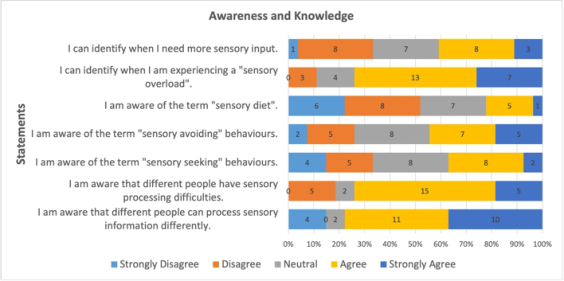
Survey We designed a 16-item survey to collect insights into adults’ sensory perception, regulation awareness and coping strategies. We collected demographic data (Q1-5) and then explored participants’ general awareness of sensory domains (Q6 & 7); experience of sensory sensitivities (Q8 & 9) and ratings of their sensitivities on a five-point Likert scale ranging from “Not at all sensitive” to “Extremely sensitive” (Q10). Participants were then asked to rate seven statements on a five-point Likert scale (strongly agree to strongly disagree) (Q11) on their awareness of sensory: difficulties, differences, seeking and avoiding in others; their awareness of the term sensory diet; and their ability to identify their own sensory overload and seeking. Knowledge of coping strategies (Q12) and their strategies for sensory regulation and the effectiveness of these (Q14 & 15) were also asked. Question 16 asked about their interest in using a mobile application for managing sensory needs. We analysed these data using descriptive statistics and frequency analysis.
Prototyping We developed low and high fidelity prototypes using Figma which were concept and task-based usability tested, respectively. We used Affinity Mapping to categorise feedback (Lucero, 2015) and, for the high fidelity prototype, used a Theme-Based Prioritisation framework (Righi et al., 2013).
Interviews Our semi-structured interviews involved 13 participants (eight females, five males) aged 20-35, from seven countries, who were recruited using purposeful sampling to ensure a demographic mix. Informed consent was taken at the start of the sessions and we provided explanations of all terms. Interviews were audio recorded, lasted around one hour each and explored participants’ understanding of sensory processing and their own sensory sensitivities, preferences, challenges and coping mechanisms. Using Reflexive
Exploring and Understanding Neurodiverse Sensory Experiences and Management 25
Thematic Analysis (Braun and Clarke, 2019) we engaged in an iterative cycle of data familiarisation, digitally transcribing the audio data and first deductively coding it to ensure we were not overlooking important aspects, then inductively coding it based on RQ1-RQ3. We reflexively refined codes and combined them into themes.
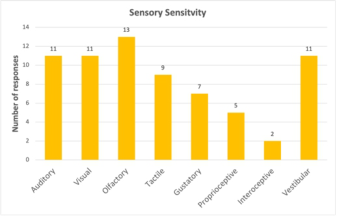
SURVEY RESULTS Participants’ sensitivities were particularly dominated by their olfactory and visual senses, with auditory, tactile and vestibular senses also reported as significant (Figure 2). Their awareness and knowledge of sensory processing in others and ability to recognise sensory overload in themselves was good. However, fewer than half could identify their own need for sensory input or were aware of the terms sensory seeking, sensory avoiding and sensory diet (Figure 3).
Figure 2: Sensory sensitivity among neurodiverse adults.Figure 3: Awareness of sensory behaviours (including own) in neurodiverse adults.
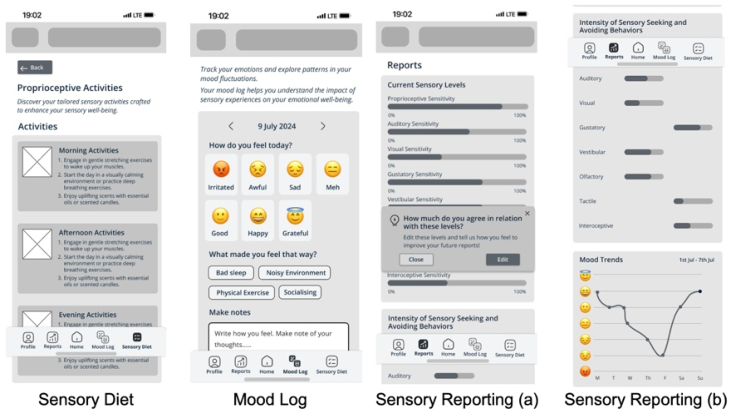
LOW FIDELITY PROTOTYPING We designed a wireframe prototype with the aim of prioritising intuitive navigation, clear information architecture, and minimal cognitive load (Figure 4). Our concept testing with users identified a number of improvements including the need for clearer icons and guidance; onboarding tutorials; an information icon for complex terminology and improved mood logging through customisable triggers.
26 Joglekar and Hopkins
Figure 4: Wireframe prototype.
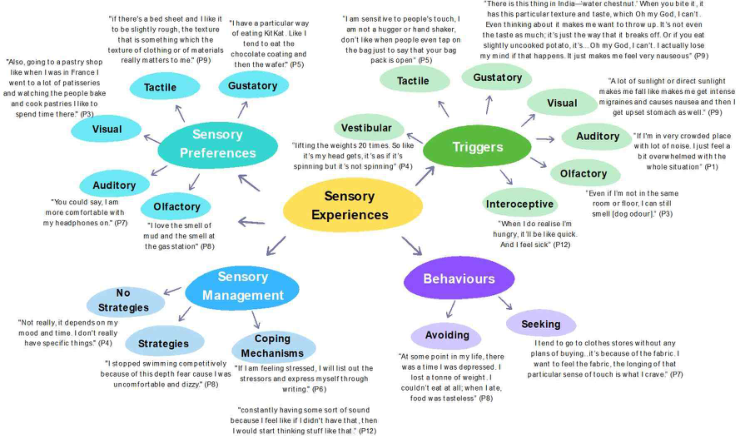
SEMI-STRUCTURED INTERVIEWS The interviews highlighted that the term “sensory diet” was completely new to all participants. Only two demonstrated some knowledge of their range of sensory modalities (RQ1). We identified four themes from the thematic analysis: Sensory Preferences (RQ2), Triggers (RQ3), Sensory Management (RQ2) and Behaviours (RQ2). These themes and codes are shown in Figure 5 and discussed below.
Figure 5: Mind map of thematic analysis.
Exploring and Understanding Neurodiverse Sensory Experiences and Management 27
Theme 1 – Triggers Auditory and visual triggers were most commonly reported. No proprioceptive triggers were reported. The most triggering experiences described were related to gustatory and tactile events: “There is a certain packaging texture which I can’t touch; it makes me uncomfortable” (P12). Gustatory triggers from strong flavours seemed unremarkable, but linked to tactile sensations, prompted particularly strong reactions: “Anything which makes a lot of... I don’t know how to say it, [ ] makes an impact when you’re biting it or breaking it off makes me feel very uncomfortable” (P9);”Like when you grate your teeth against the wooden spoon. That one triggers me massively. I just hate it” (P12).
For many individuals, sensitivity to smells could elicit strong reactions, causing headaches, nausea and feelings of sensory overload. Such was the sensitivity of one participant that they reported being able to smell dog excrement from another floor of the building after it had been removed and the floor cleaned.
Cyclical patterns emerged around interoceptive triggers of hunger, sleep deprivation, stress, and temperature sensitivity, which compounded one another increasing cognitive, emotional and physical discomfort. Physical and emotional changes were reported to then influence interoception, e.g., stress affected eating habits and hunger leading to overeating and eating “junk” food or, in some, a reduced appetite, with consequences for participants’ physical states: “I don’t like the feeling of being too full. I feel lethargic and tired” (P8); or mood: “A lot of stress could also affect my appetite and it gets me really, I’m really irritable” (P6).
Theme 2 – Behaviours Sensory seeking through touch was strong in some, including a “craving” for handling fabrics (P6), and: “I like to feel different ingredients especially while cutting ingredients” (P2). P3 reflected on how their cultural background fostered a preference for physical touch: “[ ] we are more touchy people like hugging and handshaking. [ ] if I see a chair in a museum, I would like to touch it.”
Participants were strongly inclined towards seeking auditory input such as white noise or music for comfort. Seeking smells was also significant: “I like the smell of new books [I] really like and not even new books, any book, stationery” (P9).
Participants shared a range of experiences related to avoiding behaviours. For example, P9 described an intense aversion to specific textures and tastes, saying, “There is this thing in India, ‘water chestnut’... when you bite it, it has this particular texture and taste, which, oh my God, I can’t.”
P5 described their avoidance of physical interactions, particularly hugging: “The physical interactions might affect my relationships, and many people are very much into hugging and I absolutely hate it.” P6 described the discomfort of crowded places: “It gets so claustrophobic and irritating.”
28 Joglekar and Hopkins
Theme 3 – Sensory Management Coping mechanisms for sensory overload ranged from environmental adjustments to specific actions and clearly linked to a need to regain control and create a sense of comfort or safety. Some used sound as a distraction. One avoided using noise-cancelling headphones, saying: “I like to know what’s going on outside.” Others described physical discomfort, needing to shower or bath due to strong smells.
Particular routines or structured activities were reported by several people for stress or sensory management, such as diarising emotional triggers and physical states: “I try to find the root cause to avoid these triggers” (P2); “If I am feeling stressed, I will list out the stressors and express myself through writing” (P6).
Many participants shared detailed coping mechanisms but several acknowledged a lack of consistent strategies or routines for managing sensory challenges. Instead, their responses tended to be situational and for physical or environmental triggers, avoidance emerged as the primary response.
Theme 4 – Sensory Preferences A range of sensory preferences played a significant role in participants’ everyday lives, contributing to their emotional well-being and overall comfort. P3 described: “going to a pastry shop [ ] and watching the people bake and cook pastries I like to spend time there.” Other preferences were more unusual: “I love the smell of mud and the smell at the gas station” (P8). P9 relayed their preferences for bed sheets: “I like it to be slightly rough, the texture [ ] the texture of clothing or of materials really matters to me.” Other preferences included a meticulously ordered approach to packing or taking vitamins (P5) and a preference for specific seating arrangements when travelling (P8).
Summary Whilst several of the sensory experiences and preferences did not appear unusual, some reported interesting, distinct sensory seeking and avoiding behaviours. Participants described different feelings such as a “longing” for the feeling of a fabric; the dread of specific textures in food; the inability to touch certain objects; feeling frantic about certain smells or needing to wash; a lack of noise feeling “weird” and the need to quickly get out of environments due to fear or sensory overload. Contrasting sensory sensitivities were highlighted through one participant feeling nauseous from the smell of leather through to another who liked the smell at gas stations. Some experiences impacted the ability to interact socially and, for some, led to a cycle of sensory-physical-emotional-sensory impact.
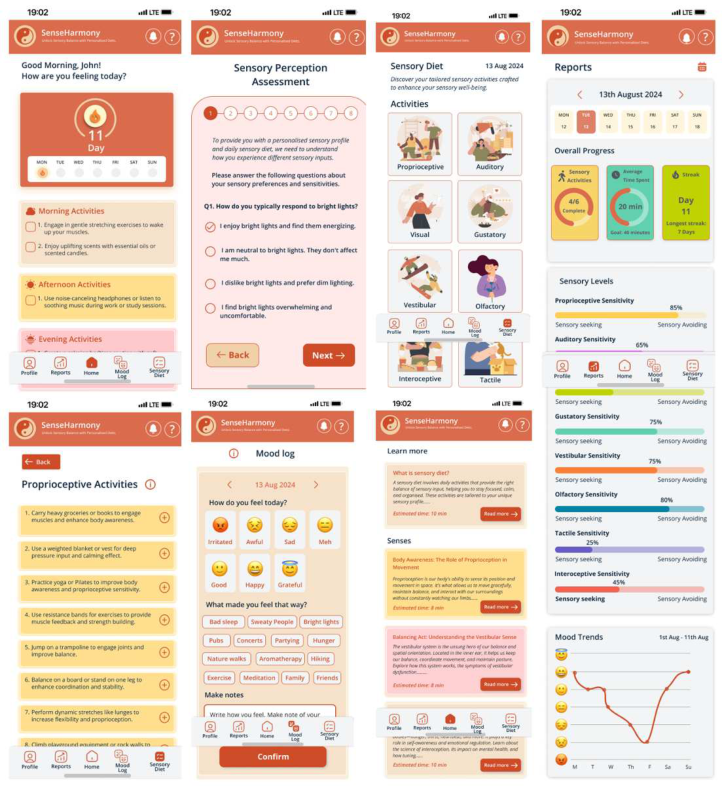
HIGH FIDELITY PROTOTYPING We incorporated feedback from the wireframe prototype to create a high- fidelity prototype (Figure 6). Five people (two male, three female) confirmed, through task-based usability testing, that, with some minor changes (larger interface elements and clarification of some terminologies), the app would provide value to them.
Exploring and Understanding Neurodiverse Sensory Experiences and Management 29
Figure 6: High-fidelity prototype.
DISCUSSION AND CONCLUSION This was a limited study, in that participant numbers were low and there were no selection criteria, so we cannot rule out having neurodivergent people in our study. However, our own experiences and subjectivity enabled us to gain a deeper understanding of participants’ perspectives. We were open about our positionality as insiders throughout the study which, we feel, helped participants to be open about their experiences.
Survey and interview data revealed only a basic awareness of different senses and little to no knowledge of sensory regulation or sensory diets (RQ1). However, a range of seeking and avoiding behaviours were evident from the interviews (RQ2). Common triggers were auditory and visual, but these did not necessarily invoke the greatest response, which were related to gustatory and tactile triggers (RQ3). In terms of processing challenges and
30 Joglekar and Hopkins
their impacts (RQ3), our interview findings revealed a cyclical and layered nature of sensory perception in our participants. They reflected not only a linear journey from perceiving a sensory stimuli to the behavioural response, but also the recursive nature of an ongoing negotiation that individuals go through while navigating their sensory experiences.
In reflecting on these findings and our own day-to-day experiences, we could see how preferences and triggers can lead to sensory seeking or avoiding. Some sensory triggers were not necessarily unusual. Instead, they often appeared to be ordinary experiences, such as textured clothing, overlapping voices or certain smells which in turn evoked strong physical reactions and emotional responses. These responses were invariably individualised and unpredictable. For example, tactile discomfort intersected with personal boundaries and social norms, leading to heightened self- consciousness. There was a subjective intensity of some things that might otherwise be considered neutral stimuli. Unlike conventional stimuli- response models, this study demonstrates that sensory experiences are shaped by a collection of interdependent factors – internal, external, as well as contextual.
The behaviours that followed triggers were scarcely fixed or unidirectional. Instead both seeking and avoiding coexisted within an individual, often in relation to different sensory modalities or even within the same modality, depending on the environment. This contrast reinforces Dunn’s (1997) model, which suggests that behaviour is influenced by individual neurological thresholds and self-regulation strategies. Participants shifted between seeking and avoiding behaviours depending on internal states and external environments. As one participant stated, “It’s related to my moods, so it’s not really regular”.
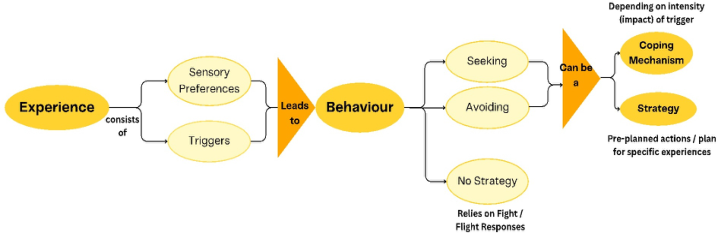
Behaviours were used either as a coping mechanism or a strategy depending on the intensity or unexpected nature of the trigger. When the response was immediate and reactive, such as covering one’s ears or withdrawing from overwhelming environments, it functioned as a coping mechanism. In contrast, when the actions became more pre-emptive, such as using noise-cancelling headphones or heated eye masks they operated as strategies. However, in some cases, the responses were neither strategic nor conscious but rather relied on an individual’s fight or flight responses. Figure 6 provides a visual representation of this process.
People with sensory dysregulation have highly individualised needs (Watt et al., 2024), and tools that are effective in measuring symptoms of sensory need are vital for understanding support needed by neurodivergent people (Soler et al., 2023). However, we argue that understanding sensory needs and regulatory mechanisms are important for everyone to function effectively and maintain their wellbeing. This study identified some surprising sensory triggers and responses from the interview data. Participants used emotive words and expressions: “I absolutely hate it”; “claustrophobic”; “it drives me crazy”; “spinning in the head”; “I don’t feel safe” and “you just want to get out”. Sensory sensitivity even led to feeling physically unwell. There was a clear unmet need for sensory regulation.
Exploring and Understanding Neurodiverse Sensory Experiences and Management 31
Figure 7: Flowchart showing researcher reflections from interview data.
Studies have directly linked sensory sensitivities to mental health challenges (Costa-López et al., 2024; Harrold et al., 2024; Wu et al., 2021), and it has been argued that sensory sensitivities might be more widespread than previously acknowledged, with a potential spectrum of sensory traits across populations (Doyle, 2021). Researchers have acknowledged distinct differences between individuals in terms of their sensory sensitivities and responses to these (Costa-López et al., 2024) but also a spectrum of various traits has been proposed, including sensory sensitivity, attention and anxiety which are impacted by each other and the external environment (Hopkins, 2025). We witnessed several descriptions of strong sensory sensitivities and reactions in our participants that differed between participants and across sensory domains and led to a cycle of impact in terms of anxiety, tolerance and physical symptoms. Such is the impact of sensory processing on mental health that researchers have put forward recommendations for inclusion of sensory functioning in frameworks used to understand mental health disorders (Harrison et al., 2019).
However, limitations of specialist resources and practitioners make the provision of sensory-focussed therapy a challenge even for those with known sensory processing difficulties, making the likelihood of offering support to adults without any formally identified difficulty very low. Technological interventions are limited, even for neurodivergent children, with very little that focuses on adults.
Miller et al. (2023) conducted a qualitative analysis with adolescents and adults who had received sensory-focussed OT, to understand the impact of that therapy on their daily lives. They highlighted four core themes from the client-therapist relationship: the therapeutic alliance; the importance of education and knowledge; the provision of strategies, tools and resources; and follow-up with additional support after therapy. They concluded that education of lived experiences with sensory integration and processing challenges will help improve therapeutic tools and that further research is needed for sensory-based interventions.
Our study found sensory differences and need in a group of adults that were not selected for based on any criteria. These adults indicated that the app could provide a valuable educational tool and promote their sensory regulation (RQ4). The advantage of such an app is that its support would
32 Joglekar and Hopkins
not be time-constrained and need could be monitored enabling a sensory diet to be modified over time. However, effectiveness of any intervention is dependent not just on tailoring but also on the therapeutic alliance, or relationship with the therapist (Schoen et al., 2019). This may necessitate the integration of AI to foster a para-social relationship between the AI agent and the user (Namburi & Hopkins, 2023) with dynamic tailoring of interventions, which would be the next stage of this work.
ACKNOWLEDGMENT
The authors extend their thanks to all participants who took part in this study.
REFERENCES
Armstrong, S. (2019). Sensory Processing in Children and Adults with Learning Difficulties. PhD. University of Sheffield (United Kingdom). Ayres, A. J. (1996). Sensory integration and praxis tests (SIPT). Los Angeles, CA:
Western Psychological Services. Ayres, J. A., (1979). Sensory integration and the child. Western Psychological Services. Bermudez, M. (2021). Wearable Technology: The Future in Sensory Processing
Disorder Intervention. Braun, V., & Clarke, V. (2019). Reflecting on reflexive thematic analysis. Qualitative research in sport, exercise and health, 11(4), 589–597. Brown, C. et al. (2001). The adult sensory profile: Measuring patterns of sensory
processing, The American journal of occupational therapy, 55(1), pp. 75–82. Costa-López, B., Ferrer-Cascales, R., Ruiz-Robledillo, N., Albaladejo-Blázquez, N., & Baryła-Matejczuk, M. (2021). Relationship between sensory processing and quality of life: A systematic review. Journal of clinical medicine, 10(17), 3961. Costa-López, B., Ruiz-Robledillo, N., Moreno, O., Albaladejo-Blázquez, N.,
Hernandez, C., Baryła-Matejczuk, M., & Ferrer-Cascales, R. (2024). Sensory processing sensitivity as a predictor of health-related quality of life outcomes via stress and sleep quality. Scientific Reports, 14(1), 22707. Doyle, N., (January 16, 2021). Is everyone a little autistic? Forbes Website: https:// www.forbes.com/sites/drnancydoyle/2021/01/16/is-everyone-a-little-autistic/?sh= 1e42d9a95666. Dunn, W. (1997). The impact of sensory processing abilities on the daily lives
of young children and their families: A conceptual model, Infants and young children, 9(4), pp. 23–35. Dunn, W., & Westman, K. (1997). The sensory profile: the performance of a national sample of children without disabilities. The American journal of occupational therapy, 51(1), 25–34. Fabio, R. A., & Suriano, R. (2024). The Role of Smartphone Use in Sensory Processing: Differences Between Adolescents with ADHD and Typical Development. International Journal of Environmental Research and Public Health, 21(12), 1705. Ghasemi, S., Behravan, M., Ubur, S. D., & Graˇcanin, D. (2024). Attention
and sensory processing in augmented reality: Empowering ADHD population. In International Conference on Human-Computer Interaction, Switzerland, pp. 301–320.
Exploring and Understanding Neurodiverse Sensory Experiences and Management 33
Gomez, I. N., & Medallon, K. G. (2022). Assessing sensory processing in adults.
Current Developmental Disorders Reports, 9(3), pp. 63–67. Gulla, B., & Golonka, K. (2021). Exploring protective factors in wellbeing: How sensory processing sensitivity and attention awareness interact with resilience. Frontiers in psychology, 12, 751679. Harrison, L. A., Kats, A., Williams, M. E., & Aziz-Zadeh, L. (2019). The importance
of sensory processing in mental health: A proposed addition to the research domain criteria (RDoC) and suggestions for RDoC 2.0. Frontiers in psychology, 10, 103. Harrold, A., Keating, K., Larkin, F. and Setti, A. (2024). The association between sensory processing and stress in the adult population: A systematic review. Applied Psychology: Health and Well-Being, pp. 1–31. Heffler, K. F., Acharya, B., Subedi, K., & Bennett, D. S. (2024). Early-life digital media
experiences and development of atypical sensory processing. JAMA pediatrics, 178(3), pp. 266–273. Hopkins, G. T. (2025). “The human spectrum: a position paper”, Journal of Applied Research in Higher Education, Vol. 17, No. 1, pp. 6–22. Khanahmadi, S., Sourtiji, H., Khanahmadi, Z., & Sheikhtaheri, A. (2023). Effect of
a sensory diet smartphone application on the symptoms of children with attention deficit hyperactivity disorder (ADHD): A feasibility study. Heliyon, 9(8). Kim, C. H., Kim, K. M., Chang, M. Y., & Jung, H. (2021). Relationship between Smartphone Addiction and Sensory Processing Ability of Preschool Children. The Journal of Korean Academy of Sensory Integration, 19(2), 1–11. Lane, S. J., Mailloux, Z., Schoen, S., Bundy, A., May-Benson, T. A., Parham, L. D.,
Smith Roley, S., & Schaaf, R. C. (2019). Neural Foundations of Ayres Sensory Integration®. Brain Sciences, 9(7), 153. Lucero, A. (2015) Using affinity diagrams to evaluate interactive prototypes, Lecture Notes in Computer Science, 9297, pp. 231–248. Mailloux, Z., Parham, L. D., Roley, S. S., Ruzzano, L., & Schaaf, R. C. (2018).
Introduction to the evaluation in ayres sensory integration® (EASI). The American Journal of Occupational Therapy, 72(1), 7201195030p1-7201195030p7. Miller, D. C., Schoen, S. A., Schmitt, C. M., & Porter, L. M. (2023). Adolescents’ and adults’ perceptions of sensory-based interventions: A qualitative analysis. The American Journal of Occupational Therapy, 77(5), 7705205160. Namburi, S., & Hopkins, G. (2023). Meraki: Encouraging Language Learning
in Real-World Simulations through AI Para-Social Relationship Building. In European Conference on Games Based Learning (ECGBL23), Vol. 17, No. 1, pp. 807–816. Przybylski, A. K. and Weinstein, N. (2017). A large-scale test of the Goldilocks hypothesis: Quantifying the relations between digital-screen use and the mental well-being of adolescents. Psychological Science, 28(2), pp. 204–215. Rossi, H., Prates, R., Santos, S., & Ferreira, R. (2019). Development of a
virtual reality-based game approach for supporting sensory processing disorders treatment. Information, 10(5), 177. Schoen, S. A., Lane, S. J., Mailloux, Z., May-Benson, T., Parham, L. D., Smith Roley, S., & Schaaf, R. C. (2019). A systematic review of ayres sensory integration intervention for children with autism. Autism Research, 12(1), 6–19. Scott, H., Biello, S. M. and Woods, H. C., (2019). Social media use and adolescent
sleep patterns: Cross-sectional findings from the UK Millennium Cohort Study. BMJ Open, 9(9), p. e031161. Sensational Brain (2025). https://sensationalbrain.com/brainworks/, accessed 2/4/25.
34 Joglekar and Hopkins
Sensory App House (2025). https://www.sensoryapphouse.com, accessed 2/4/25. SensoryTreat (2025). https://sensorytreat.com, accessed 2/4/25. Soler, N., Cordier, R., Perkes, I. E., Dale, R. C. and Bray, P., (2023). Proxyreported sensory measures for children and adolescents with neurodevelopmental disorders: A systematic review. Developmental Medicine & Child Neurology, 65(2), pp. 185–199. Watling, R., & Hauer, S. (2015). Effectiveness of Ayres sensory integration®
and sensory-based interventions for people with autism spectrum disorder: A systematic review. American Journal of Occupational Therapy, 69(5), 6905180030p1-6905180030p12. Watt, H. M., Cox, G., DeHerrera, M., Podgorny, S., Fortuna, J., & Cantwell-Jurkovic, L. (2024). Sensory-Based Interventions in School-Based Occupational Therapy: A Scoping Review. Occupational Therapy, Schools, & Early Intervention, 17(3), 731–754. Wilbarger, J., & Wilbarger, P. (2002). Clinical application of the sensory diet. In A. C.
Bundy, S. J. Lane, & E. A. Murray (Eds.), Sensory integration: Theory and practice (339-341). Philadelphia, PA: FA Davis. Wu, X., Zhang, R., Li, X., Feng, T. and Yan, N., (2021). The moderating role of sensory processing sensitivity in the link between stress and depression: A VBM study. Neuropsychologia, 150, 107704.
LISTED IN THE AHFE DIGITAL BOOKSTORE CATALOGUE
Explore the complete digital volume
Human Interaction and Emerging Technologies (IHIET 2025)
Read this individual research paper free through the original publisher, or explore the full digital proceedings book.
ISBN 978-1-964867-73-1
Explore this ISBN in the AHFE Bookstore ↗Listed in the July 2026 bookstore catalogue; search by ISBN to confirm current availability · Digital book purchase optional