Tong Wu, Lu Yao Wang (2022). Learning Design of Intelligent TV Interactive Interface for Aging Population Based on Kano Model. In: Human Interaction & Emerging Technologies (IHIET-AI 2022): Artificial Intelligence & Future Applications. AHFE Open Access, vol. 23. https://doi.org/10.54941/ahfe100857
With the deepening of population aging trend, the demand for population aging has also increased significantly.More and more elderly people are being popularized and occupied in their daily life by intelligent products and the Internet to a large extent. Intelligent TV is an indispensable entertainment electronic network environment and family entertainment center for the elderly, but the cognitive and learning ability of the elderly has been ignored.In this paper, with the aim of intelligent television aging design as the research object, investigate the use of television, learning and cognitive characteristics, physiological function based on the Kano model theory of interface design, at the heart of the smart TV 55-75 elderly users request has carried on the investigation and interview, through qualitative and quantitative research to determine the use of smart TV demands for the elderly,Translate into requirements items.Combined with the theoretical model of intelligent interface interaction design, cognitive psychology and interface design methods, the design process of elderly intelligent TV interface was explored and its feasibility was evaluated.In order to help the elderly improve their ability of self-learning intelligent products and intelligent information in the digital era, and improve the interactive experience of the elderly smart TV, it provides some reference value for the interactive interface design of intelligent products for the elderly.
Backgroud Since the topic of intelligent information age and age-appropriate interaction design was proposed,Academic and designers are closely focused on the transformation and development of urban aging design. Due to the different ability of physical perception and cognitive habits, the elderly adapted to today's intelligent information environment, which has triggered a lot of life. (Liu et al. 2020) The struggle of the outward and psychological, many intelligent products and platform interactive interfaces rarely consider the needs of the elderly group, in summarizing the interactive interface of the modern smart TV lacks humanistic care for the elderly, so that the elderly group is difficult Integrate the demand for modern intelligent life, then a digital ditch is formed.
Research Significance The increasing number of the elderly group causes the attention to the spiritual life of the elderly. But in today's digital information age, the current has a lot of smart interactive product on the market and the network platform, rarely pay attention to the elderly group for the demand of intelligent interactive platform and interface design, the Kano model is applied to the elderly in the study of smart TV interactive interface, to guide the elderly autonomous learning smart TV interaction, It solves the discomfort and derailment of the elderly in the modern digital age, excavates the cognitive and learning characteristics of the elderly, summarizes the supporting system design strategy, provides a new perspective for the interface design of smart TV for aging, and complies with the development trend of the future aging country.
KANO MODEL Kano Model Principle
Originated in the 80 s, kano model put forward by Japanese professor Noriaki Kano and his colleagues, is different from the traditional idea of system design at the time, improve the product or any kind of system attributes can improve user satisfaction,
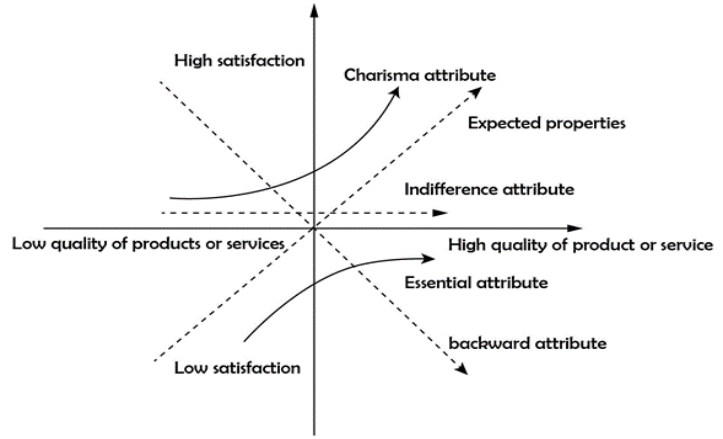
Human Interaction & Emerging Technologies (IHIET-AI 2022) Artificial Intelligence & Future Applications https://openaccess.cms-conferences.org/#/publications/book/978-1-7923-8989-4 but Noriaki Kano thought in the use of user experience ascension is not all of the index and properties are equal, Some attributes can improve user experience, satisfaction and user stickiness more efficiently and directly, and their theories are sorted out and named as Carnot model, as shown (see Figure 1). The model is used to analyze the relationship between user demand and satisfaction degree of all kinds of indicators, establish the bi-dimensional curve and nonlinear model of product quality attribute and product satisfaction degree, and help point out the direction of developers to evaluate and optimize products. (Materla et al. 2019)
Figure 1. The relation table of five quality attributes in Kano model .(The author since the draw) Evolutionary Improvement of Kano Model
As this research method can only be used for qualitative analysis and lacks quantitative identification data, Berger proposed the formula calculation method of user satisfaction coefficient, and predicate the value of the coefficient determine the classification of functional attributes. The formula is shown follow.When the product provides this function, the better coefficient calculation method is shown in the formula: Better (Si) =(A+O)/(A+O+M+I). (1)
When the product does not provide this function, the Worse coefficient can be calculated as follows: Worse (Di) =(M+O)/(A+O+M+I). (2)
A, O, M, and I represent the numbers of categories A, O, M, and I, respectively.
Research on Elderly Users With the growth of age and the evolution of social identity, the physical function and psychological state of the elderly have changed, and the lifestyle, cognitive habits and cultural background of the group are also significantly different. At the same time, the connection between the group and the intelligent TV and network environment can not be ignored.
Physiological Cognitive Characteristics For research on user 55-75 years old this part of the old people, between the ages of 55-65, the body is relatively active and healthy, daily time is enough, the entertainment demand is also very rich, after age 66 will be relative decline, cognitive behavior more slowly and straightforward, visual information need to be more clear, such as interactive steps more easy to understand, Ease of learning needs to be improved to the greatest extent. Some actions of the elderly in this part have been inconvenient to a certain extent, so they need to improve their entertainment on TV, and they are more dependent on interaction for aging. (Costa et al. 2017)
Psychological Needs Analysis 55-75 years old of this kind of old people are often more psychological should be accompanied by relatives, often feel lonely, at the same time to now tell the development of the social environment and intelligent expansion s often feel anxiety and emotional, psychological often appear atrophy of bad condition, even to the emergence of new things and study show the inferiority and resist, so need to fully consider the psychological state, Make soothing designs that encourage healthier and happier learning.
Overview of smart TV operation journey For most of the elderly, the living environment and time of living alone at home dominate their lives. The intelligent TV interactive interface on the market has many operation steps, with excessive page information and strict text arrangement. The
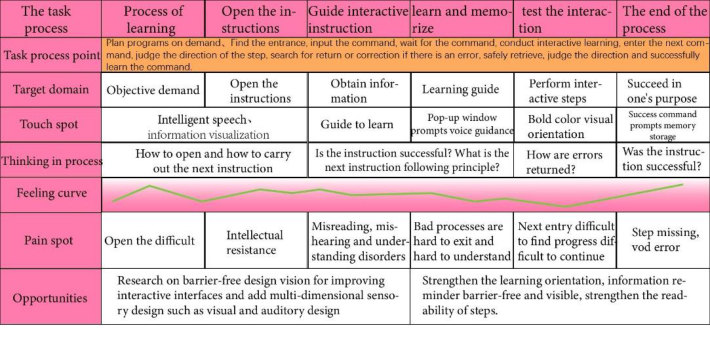
Human Interaction & Emerging Technologies (IHIET-AI 2022) Artificial Intelligence & Future Applications https://openaccess.cms-conferences.org/#/publications/book/978-1-7923-8989-4 main operation information is buried, and the unfamiliar operating environment makes them feel uneasy and irritable. Demand: Watching smart TV is the longest entertainment mode for the elderly users every day. In the process of learning the interface operation of smart TV, the elderly have the highest dependence on step guidance and guided learning, and they often get lost in the complex information and pictures on the interface and too many steps.(Mladenovic, 2020) Supplier: In most TV interfaces, elderly people's fear of intelligent products and digital networks cannot be eliminated. In addition, there are too many unnecessary screen information and text contents in the interface. Popups and steps make it difficult for elderly users to quickly capture accurate navigation and information, and the sense of interactive experience makes it difficult for the elderly to operate and learn. Learning for the elderly requires multiple operations and familiarity with the logic behind, but the existing interactive interface lacks multiple tutorials and links to guide learning. By means of interview, observation, questionnaire and literature research, the author starts from the activity logic of time operation to study the elderly users. The user journey map focuses on the elderly's operational cognition and learning behavior preference, captures the electric shock and interaction points of the interactive interface and environment between people and smart TV in the process of learning interaction, and establishes the ecological chain of operation steps and learning behavior chain of the elderly users of smart TV. (see Figure 2).
Figure 2. The elderly learn to operate user journey maps. (The author since the draw)
Data Analysis and Conclusion of Kano Model Questionnaire components
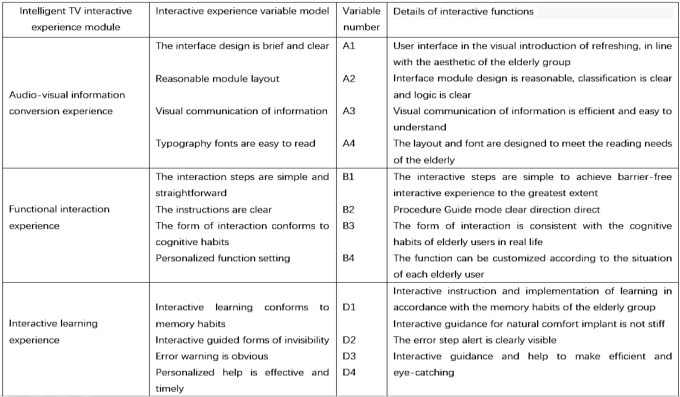
The Kano questionnaire contains the following two parts: A. Basic information of interviewees.This survey mainly targets smart TV users aged 55-75, who have high utilization rate of smart TV and have better acceptance and cooperation. A total of 150 questionnaires were issued, and 110 valid samples were sorted out after data screening. (Shi and Wang 2021).About 54% of the sample respondents are female and 46% are male. About 60% of the elderly take TV programs as their main form of entertainment every day, and about 85% of the users need to open and operate multiple interactive interfaces of smart TV many times every day.B. Demand items for Kano model construction, namely satisfaction questionnaire for various design project variables, this model is constructed mainly from three dimensions, namely audio-visual information conversion experience, functional interaction experience and interactive learnability experience.The questionnaire contains questions in both positive and negative directions, asking users' attitudes towards certain functional attributes. (see Figure 3).
Figure 3. Construction of Kano model for learnability interaction function of smart TV.(The author since the draw)
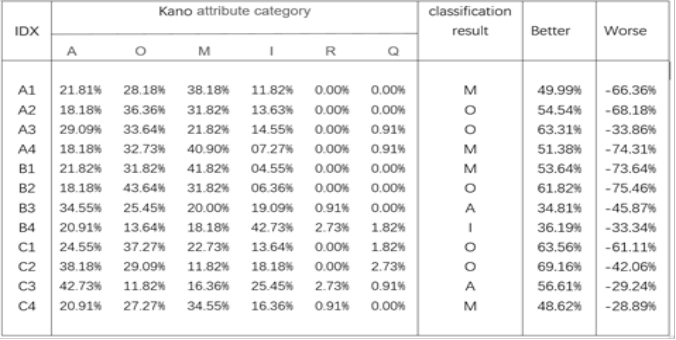
Analysis of Data and Conclusion According to the six attributes of Kano model: essential attribute M, expected attribute O, charm attribute A, indifference attribute I reverse attribute R and suspicious result Q, the order of functional variables and satisfaction satisfaction is defined as M > O > A > I > R. Kano model is used to further study the satisfaction degree of each function. According to the calculation formula introduced in the second section, the difference of learning satisfaction degree of different interactive functions is calculated to determine the priority ranking of interactive functions and learning-ability functions of the interactive interface of the smart TV for theelderly. (see Figure 4) .The data are summarized in the following. (García Vázquez et al. 2012).
Figure 4. Summary table of Kano model analysis results.(The author since the draw) Interactive System Architecture
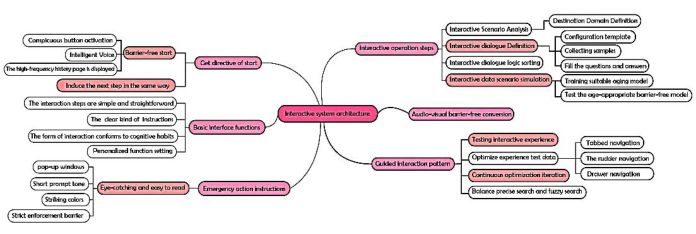
The ranking results and interactive system architecture design drawing based on Kano model are as follows. (see Figure 5).
Figure 5. Interactive system architecture.(The author since the draw)
CONCLUSIONS
In today's aging era, the learning and intelligent interaction of smart TV is an important subject to comply with The Times. In this paper, Kano model is used to conduct in-depth research, exploration and optimization of user needs, and in-depth discussion of the interaction needs, learning orientation needs and emotional compensation of the elderly on smart TV interactive interface.According to the data of the model, the interactive framework and design strategy are proposed, and a set of intelligent TV interactive interface design prototype which is suitable for the elderly and easy to learn is formed.It provides the basis for future intelligent interactive interface.
ACKNOWLEDGMENTS
The authors would like to acknowledge the professionals to help the project.High tribute shall be paid to teachers,Special thanks should go to the friends who have put considerable time and effort into their comments on the draft.Finally,the authors are indebted to the parents for their continuous support and encouragement.
REFERENCES
Costa, C. R., Anido-Rifon, L. E. and Fernandez-Iglesias, M. J. (2017) An Open Architecture to Support Social and Health Services in a Smart TV Environment. IEEE J Biomed Health Inform, 21(2), pp. 549-560. García Vázquez, C., Moreno Martínez, E., Valero Duboy, M. and Gómez Oliva, A.
(2012) Distributed system for cognitive stimulation over interactive TV. IEEE Trans Inf Technol Biomed, 16(6), pp. 1115-21.
Liu, B., Chen, Y. and Xiao, M. (2020) The Social Utility and Health Benefits for Older Adults of Amenity Buildings in China's Urban Parks: A Nanjing Case Study. Int J Environ Res Public Health, 17(20). Materla, T., Cudney, E. A. and Hopen, D. (2019) Evaluating factors affecting
patient satisfaction using the Kano model. Int J Health Care Qual Assur, 32(1), pp. 137-151. Mladenovic, J. (2020) Standardization of protocol design for user training in EEGbased Brain-Computer Interface. J Neural Eng. Shi, B. and Wang, T. (2021) Analysis of Entrepreneurial Motivation on
Entrepreneurial Psychology in the Context of Transition Economy. Front Psychol, 12, pp. 680296.
Read this individual research paper free through the original publisher, or explore the full digital proceedings book.
ISBN 978-1-7923-8989-4
Explore this ISBN in the AHFE Bookstore ↗Listed in the July 2026 bookstore catalogue; search by ISBN to confirm current availability · Digital book purchase optional