Zihan Xu, Wuzhong Zhou (2022). Metro Public Art from the Perspective of Semiotics. In: Human Factors in Architecture, Sustainable Urban Planning and Infrastructure. AHFE Open Access, vol. 58, pp. 58–63. https://doi.org/10.54941/ahfe1002333
With the prosperity and development of China's subway construction, subway space has become an important functional node in the city. Public art first intervened in the subway space interface as a decorative role, and later developed to assume more and more functions. However, the public art design of many subway spaces now only attaches importance to function and form, but ignores the needs of the subject of use. There are many problems such as restricting passenger behavior, ignoring passenger psychology, and not allowing passengers to understand the works. Nowadays, "people-oriented" works of art have become the mainstream, and public art should also change from "aesthetic decoration type" to "humanistic function type". This study attempts to introduce "symbol coding system" from the perspective of semiotics, and analyze and summarize the symbolic semantic communication process of subway space public art. Through literature method, field research method, case analysis method, questionnaire survey method and experimental method, this paper focuses on the diversified and sustainable design thinking in the new era, hoping to provide new solutions and directions for the problems faced by the current subway public art design.
The development of semiotic theory in the 20th century has greatly influ- enced human cognition of the world. The originally complex world has become a huge symbolic system with a sense of order. Symbols are bridges and links for people to understand things, and they are also the medium for conveying information and carrying culture. Semiotic theory has been used in the field of aesthetic research since its emergence, and now it has been widely used in the research of language communication, mythology, film and drama, and art design. The use of semiotic theory in design to construct arti- stic symbol system can provide a more efficient method for design. In the existing research, semiotic theory has been applied to architectural design, product design, graphic design, etc. in the design field, but there is still a gap in the public art design of subway space interface, which needs to be further explored.
Metro Public Art from the Perspective of Semiotics 59
RESEARCH ON THE CONCEPT OF PUBLIC ART OF SUBWAY STATION INTERFACE Space Interface Concept of Metro Station
The interface is the basic element of the building. The enclosure of the inter- face constitutes the space. At the same time, it has the function of dividing the architectural space. The way of dividing the interface determines the appearance of the space.
The closed space is enclosed by six interfaces: facade, top and ground. The public space inside the subway mainly includes walls, cylinders, ground, top, stairs, ramps and escalators.
Current Status of Interface Public Art at Home and Abroad The design of foreign subway public spaces is mostly carried out in an integra- ted manner, with designers, architects, artists, craftsmen and other divisions of labor cooperating and carrying out at the same time, so the degree of public art involvement is high. In the inner space of subway stations, public art covers a wide range of interfaces, including walls, top surfaces, ground, steps, cylinders, screen doors, skylights, domes, etc., plus rich expression tech- niques, matching lighting, diverse The material is very infectious and artistic. The public art of the subway interface in China is mostly installed on the walls, cylinders and top surfaces of the station hall. It is a little isolated and single in terms of location, but it has gradually developed vigorously in recent years. In addition to traditional elements, there are also many new forms, sty- les, The intervention of materials provides more possibilities for the shaping of space.
SEMIOTIC STUDIES Semiotic Theory
Semiotics is a general theoretical discipline that studies symbols. It studies the nature of symbols, the meaning of symbols and the law of development of symbols, and reveals the relationship between symbols and symbols, between symbols and human activities, and between symbols and the objective world. various connections (Feng Gang, 2013). In the 20th century, semiotic theory entered the public eye and developed significantly. The world changed from a complex and chaotic state to an ordered body composed of symbols (Navy, 2004). Throughout the development history of semiotics, there are some sch- olars and their theories. Contributed outstanding strength, summarized as follows: (1) Saussure — the Linguistic Dimension Swiss linguist Saussure is the father of modern linguistics and one of the founders of modern semiotics. In his linguistics lecture “General Lingui- stics Course”, he proposed the concept of language and speech from the perspective of linguistics. It has a social nature, with certain regularity and potentiality, just like an instruction code; speech is more private in nature and
60 Xu and Zhou
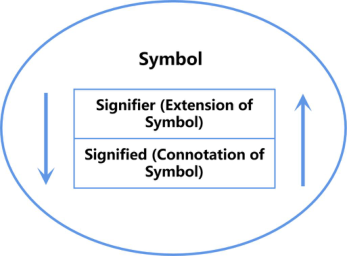
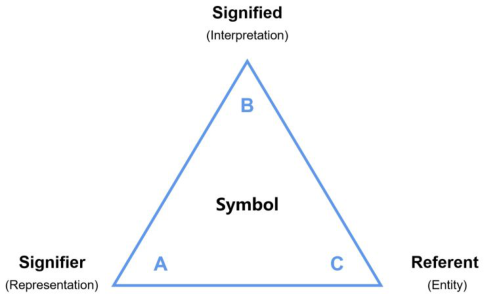
Figure 1: Saussure’s “binary unity” symbolic model. (From the author’s own painting).Figure 2: Pierce’s symbolic triangle model. (From the author’s own painting).
is an individual’s language behavior, intended to convey information (Saus- sure and Gao Mingkai, 1980). He decomposes the concept of symbols into two parts: “signifier” and “signified”. “Signifier” refers to a medium, sound or image that refers to or represents a thing, that is, the extension of a thing, “signified” refers to or refers to. Involving the concept or meaning of things, that is, the connotation of things, there is a conventional relationship betw- een the two, and only the combination of the two is a complete symbol (see Figure 1).
(2) Pierce — the Dimension of Logic Pierce’s semiotic theory has the characteristics of pragmatism philosophy. His most significant scholarly contribution is the trichotomy of symbols, namely design, object and interpretation, which also represents the three aspects of human cognition, namely process, method and result. According to the relationship between “symbolic representation” and “object”, Peirce divides symbols into image symbols, identification symbols, and symbolic symbols, whose meanings are constituted by the explanatory items of symbols (Lu Jingtong, 2011). The semiotic theory proposed by him is called “generalized semiotics”, which is applicable to many fields such as linguistics, architecture, literature and art, and aesthetics (see Figure 2).
Metro Public Art from the Perspective of Semiotics 61
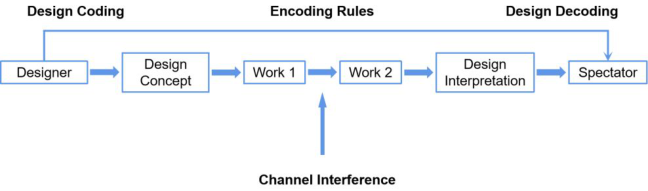
Figure 3: Encoding and decoding process. (From the author’s own painting).
(3) American philosopher Morris developed Peirce’s theory, and on this basis, semiotics is divided into semiotics (semantics), semiotics (seman- tics), and semiotics (pragmatics). Semiotics mainly studies the compo- sition of symbols; Semiotics studies the representational meaning of symbols; Semiotics studies the origin, use and expressive functions of symbols. (4) In architectural semiotics, Morris’s semiotic trichotomy is usually used to analyze the structure of architecture. At the semantic level, it mainly studies the combination and rules between single or complex symbols and symbols that constitute a building; at the semantic level, it mainly studies the way symbols convey meaning; pragmatics is the analysis of symbolic information. Reception effect — the user’s perception of a series of architectural symbols.
The Process of Conveying Symbols In the public art of the subway interface, the designer (the sender) organizes the ideas, emotions and meanings (information 1) that he wants to express, and uses the visual design symbols as the carrier to organize the design works (the letter 1) according to the design rules. The design process from sketches to finished products may be restricted by related factors such as environment, construction, technology (interference factors in the channel), and the cultu- ral background and aesthetic level of the viewer (receiver) itself. The work (Letter 2) may be slightly different from what the designer wants to express, so the viewer has his own understanding of the work (Information 2). When the content decoded by the viewer is consistent with the concept that the designer originally wanted to convey, the ideal communication purpose is achieved (see Figure 3).
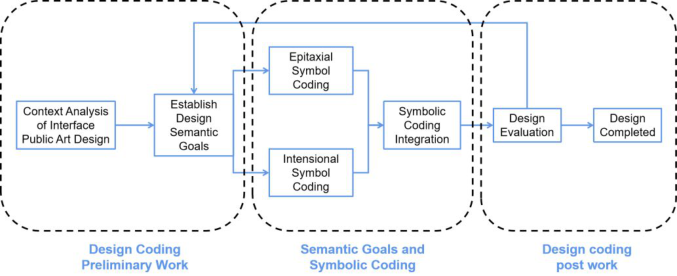
Coder Model (1) Analyze the context of the design work by investigating the site’s regional environment and historical culture. (2) Establish the connotation and denotative semantic goals of the work based on background analysis. (3) Convert connotative and denotative semantic goals into symbolic elements. (4) Combine and encode the symbols. (5) Formation and evaluation of symbolic coding works (see Figure 4).
62 Xu and Zhou
Figure 4: Coder model. (From the author’s own painting).
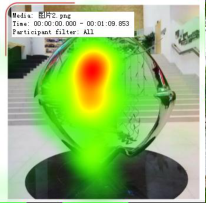
EXPERIMENTAL DESIGN In order to verify the practicability of the above coding model, the following experiments are designed, which are divided into two parts: questionnaire survey and eye movement experiment. The effect of design specification on decoding is mainly studied. Design description is one of the key factors to assist the observer in decoding. This experiment mainly examines the auxi- liary effect of design description on decoding and the impact on memory points.One picture of each of the two public art works in colleges and uni- versities, “Symmetrical” and “Sudden Power”, which were selected by the media.
Experimental design: This experiment is a four-factor mixed experimental design of 2 (gender: male, female) * 2 (extension coding layer) * 2 (inten- sion coding layer) * 2 (design description). The gender is the between-subject design and the picture material is the within-subject design.
Experimental Hypothesis: The design specification helps the observer to interpret the code better, and its auxiliary effect on the connotative coding layer is greater than the extensional coding layer.
The first stage: The subjects carefully observed the two works provided on the screen, and the eye tracker recorded the subjects’ eye movements and answered the following questions.
1. Can you understand the theme that the work is trying to express? (1-5 Very incomprehensible-very understand) 2. Can you judge the material of the work? (1-5 not at all - totally able) 3. Can you judge the size of the work? (1-5 not at all - totally able) The second stage: After the subjects answered the questions, the researcher gave the design instructions to the subjects to read, and observed the works on the screen again. The eye tracker recorded the subjects’ eye movements, and then continued to answer the following questions.
1. Can you understand the meaning of the work after reading the design description? (1-5 not at all - totally able) 2. Does the work give you a positive or negative impression? (1-5 very negative - very positive)
Metro Public Art from the Perspective of Semiotics 63
Figure 5: Eye movement test results. (From the author’s own painting).
3. Do you think the placement of these two works is appropriate? (1-5 very inappropriate - very suitable).
CONCLUSION
Combined with the screen recording of the eye movement path, before recei- ving the text description, the subjects’ gaze was more evenly distributed and the path was more random. After providing a text description, the subjects consciously chose to stay in some specific areas for a longer time. This is the process of receiving encoded information and decoding it again. At the same time, according to the questions answered by the subjects, the above hypo- thesis is verified: the design description helps the observer to better interpret the coding, and its auxiliary effect on the connotative coding layer is greater than the extensional coding layer (see Figure 5).
To sum up the above two experiments, the conclusion is drawn: from the perspective of semiotics, public art needs the help of design instructions to allow viewers to better interpret and form certain memory points by coding in the connotative and epitaxial layers. At the same time, the form of online media can also better assist the decoding process. Therefore, designers need to consider how to better integrate online and offline when designing public art.
ACKNOWLEDGMENT
The authors would like to acknowledge the postgraduate advisor Zhou Wuzhong for his help.
REFERENCES
Chen Shenren. (2005). Design Morphological Semantics. Beijing: Chemical Industry Press. Feng Gang. (2013). Art Semiotics. Shanghai: Donghua University Press. Lu Jingtong, ed. (2011). Formal Language and Design Semiotics. Beijing: Machinery
Industry Press. Navy. (2004). Semiotics of Graphic Design. Tsinghua University. Saussure, translated by Gao Mingkai (1980). A Course in General Linguistics.
Beijing: Commercial Press. Yu Jihong. (2009). Research on Furniture Morphology Based on Semiotic Theory.
Nanjing Forestry University.
LISTED IN THE AHFE DIGITAL BOOKSTORE CATALOGUE
Explore the complete digital volume
Human Factors in Architecture, Sustainable Urban Planning and Infrastructure
Read this individual research paper free through the original publisher, or explore the full digital proceedings book.
ISBN 978-1-958651-34-6
Explore this ISBN in the AHFE Bookstore ↗Listed in the July 2026 bookstore catalogue; search by ISBN to confirm current availability · Digital book purchase optional