Driving involves a variety of events and activities that stimulate emotional experiences. The aim of this investigation was to examine automobile experiences and to identify affective themes. 245 UK-based participants were recruited using a purposive sampling strategy. One study consisted of an online questionnaire which inquired about the automotive experiences which proved most emotionally intense. The second consisted of a simulator based immersive driving experience, followed afterwards by a questionnaire which inquired about the automotive experiences which proved most emotionally intense. Questionnaire responses were clustered into themes using a content analysis method. The study identified 13 major themes and 44 sub-themes. The findings provide guidance regarding the triggers of emotional responses which designers can use to better understand and to improve automotive experiences.
The automotive industry is facing a period of significant transformation with new digital technologies that have redefined the automobile. No longer simply a means for transporting individuals from point A to B, contemporary automobiles are multi- purpose spaces which provide entertainment and facilities that are used for both business and pleasure. These new spaces have resulted in a more complex driving environment and have expanded the ways in which drivers or passengers experience automobiles. Ultimately, it is important for designers to understand what now shapes customer experiences and to focus on what shapes emotionally engaging experiences given the role of the human emotions in road safety, driving pleasure, customer satisfaction and brand loyalty.
Highly emotional experiences lead to vivid and durable recollections of the events which occurred (Reisberg & Hertel, 2004). It is thus helpful to focus on what triggers strongly positive or strongly negative emotions. And the situational contexts involved have often been noted (Weber et al. 2018) to be a major factor which shapes the intensity and the valence of the stimulated emotion. Since a focus on emotions is beneficial, and the stimulated emotions depend on the context and activities performed, design scenarios which specifically describe the emotions and which specifically capture the contexts may prove helpful.
A Design Scenario is a description of a sequence of events and activities which occurs within a specific context, and which can involve other agents such as intelligent technologies, animals and people. Current automotive scenarios are usually technical task-based journey descriptions which are useful for evaluating the impact of functional design alternatives or the impact of external conditions such as traffic, weather and road type (Gkouskos et al. 2014, Burnett, 2009). Few current automotive design scenarios reflect trends in digital connectivity or in automation (Miller et al. 2015). And none consider the emotions involved or the effects of those emotional responses on task performance. Additional scenarios which better reflect current realities would thus appear beneficial, particularly if the additional scenarios capture situations which would be expected to lead to intense positive or negative emotions. Such scenarios might prove helpful towards improving road safety (Giacomin & Ramm, 2013) and towards understanding people’s satisfaction and opinions about the automobile and about the automobile brand.
But which situations trigger intense emotions in automobiles? To answer this question the real-life experiences of people were investigated. This paper starts by discussing how the affective experiences were defined and how they were investigated with people. The paper then describes how the studies were conducted, how the data was gathered and how the data was analysed. Finally, a set of affective themes and sub-themes are described and their possible use in automotive design is discussed.
RESEARCH METHODOLOGY ‘Study 1’ investigated the participant’s stories about their emotional reactions to automobiles and to the driving contexts they had personally encountered previously. The information of ‘Study 1’ was gathered using an uncontrolled online setting. ‘Study 2’ gathered instead additional information which hopefully filled some gaps about emotional experiences with automobiles which may have been present in the data which was collected via ‘Study 1’. ‘Study 2’ investigated participant’s emotional stories with automobiles by means of a combination of a controlled driving simulator experience and an online survey. A driving simulator was used for reasons of safety and convenience, and due to having been suggested adequate for inducing affective states (Jeon, 2012) and for evaluating driver responses (Chrysler et al. 2015). The use of a carefully controlled route in the simulator guaranteed the exposure of each participant to a range of driving stimuli which are known to elicit strong human emotions, and which hopefully also stimulate memories about past experiences.
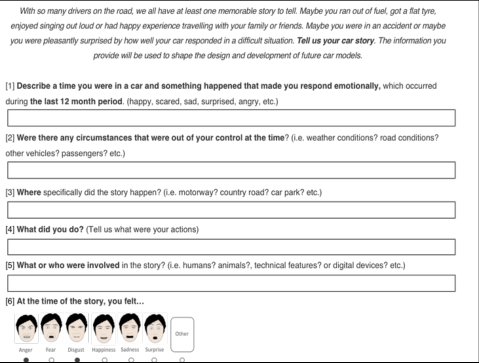
The questionnaire shown in Figure 1 below was used in both ‘Study 1’ and ‘Study 2’. It consisted of six open-ended questions including visual icons of six basic emotions (McCloud, 2006). The six basic human emotions which were first defined by Ekman and Friesen (Ekman & Friesen, 1971) were adopted for purposes of emotion identification in this study due to being both uncontroversial and widely deployed in design practice, allowing possible future comparisons to datasets from other design applications.
Figure 1. Questionnaire used in both ‘Study 1’ and ‘Study 2’.
Data Collection Study 1 –Exploring Affective Themes in an Uncontrolled Online Setting
The study’s sample size was determined using criteria for both quantitative and qualitative research. The UK’s population and the number of registered cars in the UK were used to establish that a target population of 384 (assuming a standard error of .05) was sufficient for statistical credibility (Krejcie & Morgan, 1970) and to avoid data saturation (Johnson & Christensen, 2012). The survey of six questions was distributed online to potential participants via the university website, via the distribution lists of several professional social networking services of relevance to automotive designers, and via a small number of academic research websites. The gathered responses totalled 211 fully completed automotive stories (n=211). Study 2 – Exploring Affective Themes by Prompting Memory in a Driving Simulator Setting An “XPI DS2 Full Car Simulator” based on a BMW Mini body shell and control room was used to stimulate real-time driving emotions and possible memories of past automobile affective experiences. The simulator’s visual stimuli were projected by five WUX4000 projectors onto a 2m wrap-around projection screen giving a 270° view. Two driving contexts were simulated by controlling four individual characteristics: road type, weather condition, traffic density and one-off events.
The first driving context was intended to stimulate mostly positive emotions while the second was intended to stimulate mostly negative ones. Specific one-off factors including music playing, emergency overtaking, navigation alerts, accident alerts, car horn honks and ambulance sirens were inserted at specific points in the drives as part of the sensory stimulation. Iterative pilot testing of both driving contexts was performed with three individuals to optimise the frequency and diversity of the elicited participant responses. The driving experience in each context lasted approximately 10 minutes so as to maximise task engagement, minimise boredom and fatigue (Saxby et al. 2013) and avoid simulator sickness. After completing the driving experience, the participants were asked to describe their emotions while still in the simulator. Participants accessed the online survey form on the researcher’s laptop computer and responded to the six survey questions.
Participant selection criteria including possession of a full driving license and at least 12 months of driving experience. Based on standard sample size recommendations for exploratory qualitative studies (Nastasi, n.d.) a minimum of 25 participants was established for the study. The data saturation guidelines which are commonly adhered to in qualitative studies (Miles & Hubermann, 1994) were also considered, and also confirmed the adequacy of 25 participants. Eventually, a total 34 fully completed automotive stories (n=34) were collected.
Data Analysis and Intercoder Reliability Check The participant responses from each study were separately deconstructed by means of content analysis (Downe-Wamboldt, 1992). In Step 1 of the process the participant responses were organised into a database according to the nature of the experience. In Step 2 the specific places and agents were identified at an intermediate level of
Human Interaction & Emerging Technologies (IHIET-AI 2022) Artificial Intelligence & Future Applications https://openaccess.cms-conferences.org/#/publications/book/978-1-7923-8989-4 abstraction. In Step 3 selected individual words or complete sentences from the previous steps were assigned as codes. In Step 4 the individual codes were collated into subcategories. And, finally, in Step 5 the subcategories were assigned into one or more main categories of automotive experience.
In the case of ‘Study 1’ the 211 completed automotive stories produced 56 codes which were collated into 36 subcategories which lead to 14 main categories (themes). In the case of ‘Study 2’ the 34 completed automotive stories produced 34 codes which were collated into 25 subcategories which led to 11 main categories (themes).
Reliability checks were performed by three independent reviewers to ensure the validity of the results. Each independent reviewer checked three different measures of intercoder reliability: the per cent agreement, Fleiss's Kappa (Fleiss, 1971) and Cohen's Kappa (Cohen, 1960). In the case of ‘Study 1’ the checks suggested that 12 of the 14 themes could be considered reliable. Six of them met the target minimum reliability rate of 61% (substantial agreement) while the other six had a reliability rate of 81% (almost perfect agreement). In the case of ‘Study 2’ the checks suggested that all 11 themes could be considered reliable. Seven met the target minimum reliability rate of 61% (substantial agreement) while the other four had a reliability rate of 81% (almost perfect agreement).
RESULTS
Themes The reliable categories from ‘Study 1’ and ‘Study 2’ were consolidated into the single set of themes which is presented in Table 1 below. The consolidation was achieved by merging together those categories from the two studies which contained a large number of nouns and verbs which were identical, or strongly similar semantically.
The set of themes of Table 1 includes several issues which are traditional in automotive design such as the road violations, infotainment issues and the usability of the vehicle’s components and subsystems. A few of these have been noted to stimulate negative human emotion (Jeon & Walker, 2011) and have been incorporated into past simulator studies which investigated safety, and into past driving training courses.
Several other themes of Table 1 are instead not usually discussed in traditional automotive design processes. It is noteworthy that most of the themes of Table 1 which might be expected to stimulate positive emotions are currently not considered during design, or considered to be issues which are external to the automobile. For example, the presence of loved ones is not usually considered and the possible interactions with the landscape are not fully evaluated despite the obvious opportunities for design interventions aimed at improving safety and customer satisfaction. Inspection of sub-themes suggests that most of them exhibit evidence of obvious contexts and specific replicable actions. Most of the sub-themes thus appear to be candidates for development into detailed design scenarios.
Table 1: 13 identified themes and 44 identified sub-themes Main Themes Sub-themes
Table available in the original PDF paper.
Warning alerts, breakdowns, partial system malfunction
1. Road violations Overtaking, insulting behaviour, being forced to give way, arguments, tailgating 2. Car accident Bumping into another car or obstacle, being hit by another car, witnessing an accident, recalling a memory of a previous accident, witnessing a dog's death 3. External environment conditions Heavy traffic, road infrastructure, other road users, parking space, unfamiliar road, weather 4. Infotainment Music on the radio, news from the radio / calls 5. Car hardware system malfunction and alerts
6. Abrupt manoeuvring of driver Sudden road entry, sudden stop, sudden turn, sudden lane changing, sudden reversing 7. Lack of awareness in driving Mistakes/confusion, first time driving in conditions, slow driving, lack of confidence of driver 8. Driving with a loved one Driving with family, driving with friends
9. Generous driving behaviour on the road Getting help, giving way, helping others
10. Driver's in-car experience Experience with car features, feeling relaxed, hearing familiar sound of the engine 11. Car software system malfunction
12. Driving landscape Seeing beautiful scenery, Night driving with stars 13. Usability Adjusting mirror angles Basic Emotions
Table 2 below presents the basic human emotions which were most frequently encountered in the datasets of ‘Study 1’ and ‘Study 2’. When recalling the emotions from memory via the online investigation of ‘Study 1’ the responses of the participants suggested that the majority of the negative emotions were caused by road violations. When instead the ‘Study 2’ participants responded after the short real-time driving experience in the simulator the leading cause of negative emotions was found to be hardware system malfunction. The results shown in Table 2 suggest possible differences between the thoughts and opinions of people which are gathered in real- time, within context, and those which are instead retrieved from long term memory.
Fear was the most commonly encountered basic emotion in both ‘Study 1’ and ‘Study 2’ and represented a similar percentage of the total in both datasets. 28.5% of the emotions indicted by the participants in ‘Study 1’ were fear compared to 27.9% in ‘Study 2’. The observation that fear was the most commonly expressed of the human basic emotions aligns with previous research (Sheller, 2004) of similar nature.
Table 2: Themes which were associated with the most frequently cited basic emotions in
Table available in the original PDF paper.
‘Study 1’ and ‘Study 2’ Study 1 Study 2
n Most Associated Theme n Most Associated Theme Fear 26 Road violations 5 Car hardware system malfunction and alerts Surprise 16 Car accident 4 Car accident Anger 29 Road violations 2 Abrupt manoeuvring of driver Happiness 6 Infotainment 6 Driving with a loved one Sadness 10 Road violations 3 Car accident Disgust 11 Road violations 1 Car accident The prevalence of fear in the current data does not however match the statistics gathered by other investigators by means of real-time facial emotion analysis (Weber et al. 2018). Real-time, within context driving of an actual vehicle equipped with a facial emotion analysis system found that the positive basic emotion of joy was the most prevalent and that the negative emotion of fear was rarely encountered (Weber et al. 2018). Whether such differences can be attributed to the differing stimuli of the road circuits involved, or instead to the mediating effects of language usage, is an open question which is worthy of further investigation.
DISCUSSION
Detailed design scenarios can assist automotive designers and researchers in understanding: (1) which automotive components and systems people interact with most frequently; (2) the issues which people encounter most frequently in automobiles and (3) the opportunities for improving the safety, comfort, interactions and experiences of automobiles.
The research described here investigated the real-life emotional experiences of people with respect to automobiles. One part of the investigation gathered information by means of a questionnaire distributed, and responded to, in an uncontrolled online setting. The other part of the investigation gathered information instead by means of a controlled driving simulator experience followed by the immediate deployment of the questionnaire. The first part gathered data which was presumably retrieved from human long-term memory and which was presumably based on years of past automotive experiences. The second part gathered data which instead was presumably the result of thoughts and emotions which were stimulated specifically by the driving simulator experience in the moments prior to the deployment of the questionnaire. In the second case the simulated driving involved a range of sensory stimuli and driving conditions which hopefully helped to probe the participant’s thoughts and emotions beyond the most common and stereotypical responses.
The six basic human emotions which were first defined by Ekman and Friesen (1971) were used in the questionnaire. The adoption of the Ekman and Friesen definitions allowed the separation of the participant responses into emotion categories, and, importantly, separated them into those of positive valence and those of negative valence. From the participant responses it was noted that the majority of the emotions elicited in the current investigation were negative in valence.
The questionnaire also contained six open-ended questions which were intended to probe people’s experiences of automobiles and of the emotions involved. The statements provided by the participants in response to the six questions were deconstructed by means of content analysis, and when the results of ‘Study 1’ and ‘Study 2’ were combined into as single database it produced 13 major themes and 44 sub-themes. Of the 13 major themes, 9 of them were strongly characterised by the widespread expression of emotions which were negative in valence. And inspection of the group of 44 sub-themes suggests that most of them exhibited evidence of obvious contexts and specific replicable actions, thus most of them appear to be candidates for development into detailed design scenarios.
The results of the current detailed investigation provide information which can be used to define a first set of automotive design scenarios which specifically target human emotions. Such scenarios might be termed “affective design scenarios” and a suitable working definition for describing them might be: “An Affective Design Scenario is a Design Scenario which is expected to produce in the individual a noticeable physiological response which can be described in terms of one or more of the basic emotions of anger, disgust, fear, happiness, sadness and surprise.”
Designers could possibly use such scenarios as a starting point and guide during the ideation stage of the automotive design process. If deployed, such design scenarios would naturally stimulate questions about ways to reduce the negative emotions and ways to increase the positive emotions which are encountered in each specific scenario.
ACKNOWLEDGMENTS
This research was supported and funded by Jaguar Land Rover as part of project Automotive Habitat Laboratory (AutoHablab).
REFERENCES
Burnett, G. (2009), “On-the-Move and In Your Car.” International Journal of Mobile Human Computer Interaction, 1(1), 60–78. Chrysler, S., Ahmad, O. and Schwarz, C. (2015), “Creating Pedestrian Crash
Scenarios in a Driving Simulator Environment.” Traffic Injury Prevention. 16(sup1), S12-S17.
Cohen, J. (1960), “A Coefficient of Agreement for Nominal Scales.” Educational and Psychological Measurement, 20(1), 37–46. Downe- Wamboldt, B. (1992), “Content analysis: Method, Applications, and
Issues.” Health Care for Women International, 13(3), 313–321. Ekman, P. and Friesen, W. (1971), “Constants Across Cultures in the Face and Emotion.” Journal of Personality and Social Psychology, 17(2), 124–129. Fleiss, J. (1971), “Measuring Nominal Scale Agreement among Many raters.”
Psychological Bulletin, 76(5), 378–382. Giacomin, J. and Ramm, S. (2013), “There's More to Safe Driving than Information and Decisions.” Fleet Safety Conference & Awards, St John’s Hotel, Solihull, UK. 13-14 June. Gkouskos, D., Normark, C. and Lundgren, S. (2014), “What Drivers Really Want:
Investigating Dimensions in Automobile User Needs.” International Journal of Design, 8(1), 59–71. Jeon, M. (2012), “Effects of Affective States on Driver Situation Awareness and Adaptive Mitigation Interfaces: Focused on anger.” Ph.D. Georgia Institute of Technology. Jeon, M. and Walker, B. (2011), “What to Detect?: Analyzing Factor Structures of
Affect in Driving Contexts for an Emotion Detection and Regulation System.” The Human Factors and Ergonomics Society Annual Meeting, 55(1), 1889– 1893. Johnson, R. and Christensen, L. (2012), Educational Research: Quantitative, Qualitative, and Mixed Approaches. Los Angeles: Sage. Krejcie, R. and Morgan, D. (1970), “Determining Sample Size for Research
Activities.” Educational and Psychological Measurement, 30(3), 607–610. McCloud, S. (2006), Making Comics: Storytelling Secrets of Comics, Manga and Graphic Novels. New York: Harper Collins. Miles, M. and Hubermann, A. (1994), Qualitative Data Analysis: An Expanded
Sourcebook. Calif: Sage. Miller, D., Sun, A., Johns, M., Ive, H., Sirkin, D., Aich, S. and Ju, W. (2015), “Distraction Becomes Engagement in Automated Driving.” 59th Human Factors and Ergonomics Society Annual Meeting, 59 (1), 1676—1680. Nastasi, B. (n.d.), Qualitative Research: Sampling & Sample Size Considerations.
https://pdfcoffee.com/research-19-pdf-free.html Reisberg, D. and Hertel, P. (2004), Memory and Emotion. Oxford: Oxford University Press. Saxby, D., Matthews, G., Warm, J., Hitchcock, E. and Neubauer, C. (2013), “Active
and Passive Fatigue in Simulated Driving: Discriminating Styles of Workload Regulation and Their Safety Impacts.” Journal of Experimental Psychology Applied, 19(4), 287–300. Sheller, M. (2004), “Automotive Emotions.” Theory, Culture & Society, 21(4-5), 221–242. Weber, M., Giacomin, J., Gkatzidou, V., Malizia, A. and Skrypchuk, L. (2018),
“Automotive Emotions: An Investigation of Their Natures Frequencies of Occurrence and Causes.” International Scholarly and Scientific Research & Innovation, 12(9), 714–721.
Read this individual research paper free through the original publisher, or explore the full digital proceedings book.
ISBN 978-1-7923-8989-4
Explore this ISBN in the AHFE Bookstore ↗Listed in the July 2026 bookstore catalogue; search by ISBN to confirm current availability · Digital book purchase optional