Aline Teixeira Souza Silva, Fernando Moreira Da Silva (2022). Facilitating Materials Learning into Design Education through Visual Representations. In: Human Dynamics and Design for the Development of Contemporary Societies. AHFE Open Access, vol. 25, pp. 195–201. https://doi.org/10.54941/ahfe1001389
Typically, the teaching-learning process about materials and manufacturing processes for design include a range of tasks: knowledge restricted to industries; designers’ responsibilities; functional requirements; and subjective values. For instance, materials knowledge is fundamental for designers. Considering this mix of competences and additionally the quantity and complexity of the subject, the process of teaching-learning about materials is challenging. This paper discusses the visual representations as strategy for materials and manufacturing processes learning into design education. We argue that traditional sources as demonstrations and reports are important to classes, but visualizations have the causal effect. To demonstrate the proposition, we present an experience report.
Materials in Design Education Knowledge of materials is fundamental for designers. The way artifacts are made determines relevant aspects of professional practices such as: novel and originality of creations, innovative solutions, anticipation of problems, indu- strial resolutions, etc. It is consensus to scholars that some aspects should be pondered about materials and design education:
(1) Knowledge restricted to industries. Lefteri (2007) cites the manufactu- red objects “hidden story” when it comes to industrial processes, since knowledge on the subject is reserved for companies and publications; when they diffuse it, they tend to present it from a technical perspective and in a complex language. (2) Responsibilities. Designers have a relevant role in the choice and appli- cation of materials, even knowing that most of the times they will not be involved with the origin or end of these materials, when the products’ life cycle ends. Within their scope of competence, professionals would provide low environmental impact alternatives (Kandachar, 2014).
(3) Functional requirements. Ashby and Johnson (2022) state that mate- rials must enable the product to meet functional requirements, such as acceptable costs, constructive feasibility, strength, quality, safety, among others. (4) Subjective values. Ashby and Johnson (2002) consider that materials, when introduced into the design process, must create aesthetic appeal and perceived value. Karana (2009) concludes that materials evoke emotional meanings for people.
However, considering this mix of competences and additionally the quan- tity and complexity of the issue, the process of teaching-learning about materials is challenging. Lima (2007) underlines while it is hard for the teacher to transmit the content, it is also difficult for the student to learn effectively in short time.
Furthermore, publications about materials focused on design issues are totally recent and rare. So, publications from other fields, major of them from engineering, are used to design classes (Lefteri, 2007). It is a problem because design process should consider also aesthetics, empathic and emoti- onal aspects of materials and these mentioned publications don’t approach these themes (Ashby & Johnson, 2022).
In an attempt to propose alternatives for these challenges, some strategies have been tested by scholars. These alternatives intend to seek more assertive solutions on effective comprehension by students and more involvement of them with the topic.
Within this context, we underline the following practices: (1) “Educating designers through materials club” (Ayala-Garcia, Rognoli, & Zhou, 2018), which consists in a system made to support design students connecting dif- ferent resources (fab labs) and facilities to deal with materials. The intention of the project is to engage students on the creation of materials for their pro- jects. (2) “Design and materials selection lab” (LDSM, 2022) is a research lab which keeps a website since 1998 with 3D animation of manufacturing processes. The content is free and didactic and allow users to understand industrial processes.
Exploring Visual Representations Within this context, our motivation for this topic was to explore possible principles and guidelines for material and manufacturing learning. Therefore, we put ourselves a research question (RQ): how to facilitate the teaching- learning process into materials and design classes? This paper discusses the visual representations as a strategy for material and process learning in design education.
Our proposition is based on cognitive fit theory, which explains visual representations can be used as a strategy to articulate and communicate pro- cess, once they create a link between information and decision performance (Meyer, 2000; Speier, 2006; Teets, 2010).
The concept of visual representations helps to understand complex notions and conceptions, mainly if they are abstract, mental or new. Traditional sou- rces as demonstrations and reports are important to explore during classes,
Facilitating Materials Learning into Design Education through Visual Representations 197
but visualizations have an immediate and causal effect. Creating diagrams have already been part of design and creative practices for some time: desi- gners convert information into visual systems to facilitate the communication of concepts, ideas and strategies. Building a visual mapping into a visualiza- tion process to learn new concepts helps reducing complexity and offers full pictures (Kalbach, 2016).
Visual representations are valuable to learn new concepts. According to Smiciklas (2012) people use four primary learning styles to process infor- mation: visual (charts, maps and diagrams); auditory (listening to spoken words); read/write (words); kinesthetic (experience/ by doing). Within this context, learning benefits associated to infographics includes: “improved comprehension of information, ideas, and concepts; enhanced ability to think critically and organize ideas; improve retention and recall information” (Smiciklas, 2012).
METHODOLOGY
In order to answer our RQ, we adopt experience report as methodology once this type of knowledge production describes academic practices and their implications (Mussi, Flores, & Almeida, 2021). Experience reports contribu- tes to improve academic formation and consequently to social transformation (Córdula & Nascimento, 2018). We used referenced literature to plan and elaborate the study. Graphic visual registration of work process was made. The structure of experience report includes: experience characterization, objective, theorical field, pilot exercise and results.
Technology class: Case study The experiment consisted in an applied exercise into the undergraduate course named Technology II, part of the Design degree of the Federal Univer- sity of Uberlândia. One of the aims of this third period course is to familiarize students with the universe of ceramics and glasses materials. The course syl- labus content includes: physical chemical properties, general characteristics, applications, manufacturing techniques, possibilities and limitations of these materials on design practices.
In addition to technical aspects of contents, this course approaches socio- cultural, environmental, aesthetic, empathic, emotional and economic aspe- cts. The main didactic resource is expositive and dialogued lessons. When the manufacturing techniques were discussed, we demonstrate them step-by-step using draws. Our central concern was for the student to absorb the dynamic behind the processes. Finally, for each manufacturing technique we presen- ted a video made in real context, with machines and equipment working in industry.
Experience Characterization The experience related on this article refers to one of the course exercises we’ve called pilot exercise. To conclude the pilot exercise, students were asked to create visual representations of glass manufacturing processes. The processes studied were: glass pressing, glass blowing, float process and glass
198 Souza Silva and Moreira da Silva
bending. Each process should be represented in a single visual representation, as synthetized as possible. Diagrams, visual maps, sketches, infographics, charts, etc., were accepted. We didn’t teach them how to develop the visual representations, in this period of the degree, because students had already taken visual communication classes before.
Pilot Exercise The aim of the pilot exercise was to allow students to comprehend the dyna- mic of manufacturing processes studied. Attending the course syllabus and considering our R.Q. we elaborated the exercise considering the concept of graphic visualizations.
After theoretical classes, we suggested support bibliography (Lefteri, 2007; Lima, 2008) and recommended students to research by themselves more details about processes. Then, they started preliminary sketches and mood boards with key elements. It is important to underline that the students were unrestricted to project their visual representations according to what they wanted, once this allows them to really understand and fixate the contents being presented and taught.
We asked them to create visual representations considering they would have to plan out a presentation of this content. They also were free to choose representation materials, techniques and resources (hand drawing or draw with software support).
Results
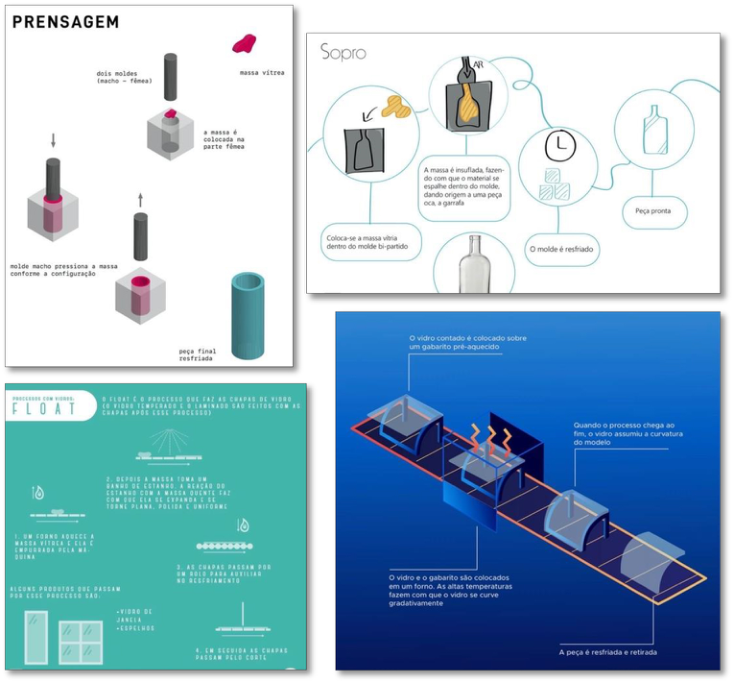
The delivery of exercise starts with the main elements: (1) visual representa- tions of four glass manufacturing techniques (glass pressing, glass blowing, float process and glass bending); (2) key processes concepts and phases; (3) basic resources (materials, machines, instruments, etc.). It is important to underline that learning the basic dynamic of each process import the most because machines and other resources can be variable. Some results can be seen at figure 1.
After concluding the exercise, students were invited to answer a question- naire about the experience. We underline some answers: “The visual representations helped me to absorb the content. I consider I am a visual and rational person; so, seeing information with images, step- by-step arrangements and colors is an efficient way to remember it after a while. Now, remembering the content I don’t see exactly the steps I drew and colored.” (Student 1)
“My experience with the creation of infographics was excellent. First, we were in touch with content by watching videos and theorical classes, then we registered the process by writing, and finally, we created the infographic. For me, this final part helped me the most to understand if I really absorbed how the manufacturing process worked, once we had to “explain” it. This part of learning process was the most effective and helped me to fine attach the subject”. (Student 2) “I liked a lot the exercise because even we note the content, we forget some details and parts. The visual representations made us absorb the content; now
Facilitating Materials Learning into Design Education through Visual Representations 199
Figure 1: Visual representations created by students during the pilot experiment
I feel that I have really learned it. To elaborate the infographic representation, I had to search for the way I would arrange the information; then we fully practice design process. This combination was very nice”. (Student 3)
DISCUSSION
As also seen in theory, we see the process of teaching-learning about mate- rials and manufacturing methods as a complex one. We observed that the main reasons are: the lack of familiarity with the content; the insufficiency of specialized and more didactic publications about the theme; the quantity of new and technical information with new title that students have not listen before.
We observed that using visual representations to absorb the content is a valuable strategy once design students are familiarized with the communica- tion of visual information. Moreover, they stay active during the process of learning; other important aspect is the creative field in which they take part.
Considering the absorption of didactic content, we saw the creative pro- cess of the visual representations is as important as the ready images, or even
200 Souza Silva and Moreira da Silva
more. To create them, students have to research, to read, to select and to synthetize information. They cannot do the visual representation if they do not understand the content. Therefore, this process involves all four pri- mary learning styles to process information as cited by Smiciklas (2012): auditory (classes and videos); read/write (personal annotations); kinesthetic (experience/ by doing); visual (exercise result).
CONCLUSION
We conclude this experience underlining the relevance of seeking alternatives for design education. Considering the creative and practical aspects of the design field, it is vital to use experimental and applied exercises that really stimulate and engage students. Besides being a resource used to asses students’ performance, syllabus activities should contribute to their effective learning. In this context, we consider that the aim of our pilot exercise was reached.
One common reaction from students we would like to underline is their engagement with the exercise. We observed their behavior being more focu- sed on the class score and compliance with mandatory requirements when they were doing other class activities. They were not as excited about those exercises. In the case of visual representations, they felt more comfortable since it was a free creation exercise.
We tried to let students to be as free and autonomous as possible to create their visual representation. However, although working freely is fine to be creative, some works were delivered without any essential information. Then, we observed, the process could maybe be improved with a guideline. In our next study, we intend to formulate a template with minimal requirements.
We think that if we organize this framework, works could be replied or shared to help other students and professionals. As mentioned in this paper, the design field lacks didactic, visual, simple and focused publicati- ons about materials and manufacturing methods. Thus, with this type of information we could contribute to more accessible didactic instruments for design education.
ACKNOWLEDGMENT
The authors would like to acknowledge CIAUD, Research Centre for Archi- tecture, urbanism and Design of the Lisbon School of Architecture, Universi- dade de Lisboa, and FCT, Foundation for Science and Technology, Portugal, for the institutional support, as well as the Design undergraduate students from Federal University of Uberlândia who took part in this course exercise.
REFERENCES
Ayala-Garcia, C., Rognoli, V., & Zhou, Z. (2018) Educating designers through materials club. 4th International Conference on Higher Education Advances (HEAd’18). Valencia. Ashby, M., & Johnson, K. (2022) Materials and Design: the art and science of
material selection in product design. Oxford: Butterworth-Heinemann.
Facilitating Materials Learning into Design Education through Visual Representations 201
Córdula, E., & Nascimento, G. (2018) A produção do conhecimento na construção do saber sociocultural e científico. Revista Educação Pública, v. 18, p. 1-10. Kalbach, J. (2016) Mapping experience: a guide to creating value through journeys,
blueprints, and diagrams. London: O’ Reilly Media. Kandachar, P. (2014) Materials and Social Sustainability. In E. P. Karana, Materials experience: fundamentals of materials and design (pp. 91-101). Oxford: Butterworth-Heinemann. Karana, E. (2009) Meaning of materials, Ph.D Thesis. Delft : TU Delft . LDSM. (2022) Laboratório de design e seleção de materiais. Retrieved from
https://www.ufrgs.br/ldsm/ Lefteri, C. (2007) Making it: manufacturing techniques for product design. London: Laurence King Publishing Ltd. Lima, M. A. (2007) Introdução aos materiais e processos para designers. Rio de
Janeiro: Ciência Moderna. Meyer, J. (2000) Performance with tables and graphs: Effects of training and a visual search model. Ergonomics, 43(11), pp. 1840–1865. Mussi, R., Flores, F., & Almeida, C. (2021) Pressupostos para elaboração de relato de
experiência como conhecimento científico. Revista Práxis Educacional, pp. 60–77. Smiciklas, M. (2012) The power of infographics: using pictures to communicate and connect with your audience. Indianapolis: Pearson. Speier, C. (2006) The influence of information presentation formats on complex task
decision-making performance. International Journal of Human Computer Studies, 64(11), pp. 1115–1131. Teets, J. M. (2010) Using cognitive fit theory to evaluate the effectiveness of information visualizations: An example using quality assurance data. IEEE Transactions on Visualization and Computer Graphics, 16(5), pp. 841–853.
LISTED IN THE AHFE DIGITAL BOOKSTORE CATALOGUE
Explore the complete digital volume
Human Dynamics and Design for the Development of Contemporary Societies
Read this individual research paper free through the original publisher, or explore the full digital proceedings book.
ISBN 978-1-958651-01-8
Explore this ISBN in the AHFE Bookstore ↗Listed in the July 2026 bookstore catalogue; search by ISBN to confirm current availability · Digital book purchase optional