Elga Ferreira, Eliana Penedos-Santiago, Constança Rocha, Daniela Marques, Estêvão Soares-dos-Santos, Sara Dias (2022). Cohort Study Good Practices: Design Communication and Capacitation Processes. In: Human Dynamics and Design for the Development of Contemporary Societies. AHFE Open Access, vol. 25, pp. 339–345. https://doi.org/10.54941/ahfe1001406
In the county of Leiria, Portugal, part of the population is known to have morbidity diagnoses (metabolic illnesses and more) and poor health habits on a big enough scale to bring the idea of how low health literacy can affect people's lives and health services, such as a flood of the emergency systems caused by people attending the emergency room with minor issues. To address it, institutions in Leiria such as the City Hall and Polytechnic of Leiria decided to conduct a longitudinal and prospective cohort study, where a sample of the population will be followed throughout time to understand if their choices regarding health and sustainable habits are indeed affected by their health literacy levels.This project will contribute to the initial stage of this cohort study, by developing a recognizable brand, whose identity can be maintained throughout all its communication and dissemination media, so that the population can identify, without equivocation, the cohort study to which it refers, and awaken their curiosity to participate. This stage also includes the presentation and dissemination of the cohort study itself to the population under study, followed by a randomized inquiry done by pre-selected interviewers.This project relies on Service Design and Participatory Design methodologies to streamline the development of the study’s elements and to solve common cohort issues, such as: 1) gathering a suitable number of participants that can represent the population; 2) follow-up maintenance of participants; 3) keeping the interviewers and participants engaged with the study, after the first contact. Informal interviews and user group definition will help the comprehension of the study and allow to create personas to characterize the interviewers of the cohort study. These aforementioned methodologies will be supported by the workshop methodology under Participatory Design, acting as a testing ground for the previously developed processes, preparing interviewers to adapt their communication when facing people from different generations, education, and social backgrounds.By carrying out this project simultaneously with the cohort study, it’s possible to evaluate, over time, how the design methodologies can empower and facilitate communication and intervene, changing tactics in case it’s needed. The creation of a replicable experience is proposed allowing the betterment of the overall health of the population. Additionally, assuming the lack of information on how the preparatory phases of cohort studies are designed, it’s also envisaged the creation of guidelines and a good practice manual. It is also of great importance to point out the bridge established between the health and design fields, where design becomes the interface between science and the public.
During an interview conducted on 10 November 2021, Prof Sara Dias stated that public health doctors from the ACES Pinhal Litoral found that a large number of citizens were attending the Hospital of Leiria instead of the Heal- thcare Centers, causing an overload in the emergency systems. Besides this, in a report from (ACES Pinhal Litoral, 2019), there is also evidence that a part of the population of Leiria suffers from metabolic illnesses or comorbidities. Which lead to the idea of creating a Cohort Study in the county of Leiria that could reflect the population levels of health literacy.
“Cohort Studies involve following groups of subjects over time” (Hulley et al., 2007), and they can be seen as prospective or retrospective studies. In this case, the chosen observational method is a longitudinal prospective study, where the adult population of Leiria will be followed over a period of 10 years, with follow-ups every 2 years. The first contact with the population will be held by pre-selected interviewers, using a digital health literacy survey. The main goal of this study is to monitor the lifestyle habits connecting them to the levels of health literacy, in order to capacitate the population towards healthier habits. To achieve these outcomes, the CML (City Hall of Leiria) requested the help of researchers and doctors, from ciTechCare (Center for Innovative Care and Health Technology) and ACES Pinhal Litoral (Regional Primary Care Unit Headquarters) and designers from the Master in Design for Health and Wellbeing (School of Arts and Design - Caldas da Rainha) supported by LIDA - Research Laboratory in Design and Arts.
The present project arises from a combination of these factors, resul- ting first in “What can a designer for health and wellbeing do within an observational study?”, and then, “What are the Cohort Study issues and needs in which design methodologies can contribute to the multidisciplinary team?”. To answer these questions, and after some meetings with the stakeh- olders (multidisciplinary team), the designers elaborated a list of issues to be addressed and created a design structure through the application of Service Design and Participatory Design methodologies. Concurrently, the designers acknowledged the need of communicating the LISA Cohort Study (Estudo Longitudinal de Literacia em Saúde no concelho de Leiria) to the population (with different ages, education, social background, and geographic place- ment), to improve the communication effectiveness, possibly both through advertisement and the capacitation of the interviewers.
Throughout this article we will explain the entire process behind the design structure of this project, above mentioned, and the role a designer can have in this kind of observational study, namely the LISA Cohort Study.
THE ROLE OF DESIGN IN THE LISA COHORT STUDY The role of a designer in a study of this nature is yet to be established in Portugal, since the designers are mainly requested for the development of the study’s brand. The role of the designers in this cohort will be fundamental to its development, from the communication model definition to the iden- tification of adequate and suitable interviewers. We propose to follow and use multiple design methodologies, such as Service Design and Participatory
Cohort Study Good Practices: Design Communication and Capacitation Processes 341
Design (Kumar, 2013, p. 2). From the umbrella term of Service Design, we chose the following methodologies: (i) informal interviews (Moeller et al., 1980, p. 2; Martin and Hanington, 2012, p. 102), (ii) user groups defini- tion (Kumar, 2013, p. 176) and (iii) personas (Martin and Hanington, 2012, p. 132; Stickdorn et al., 2018, p. 246). When it comes to Participatory Design, workshops were considered the most adequate procedure since they allow the identification of opportunities, assisting in the design of a consensus strategy plan (with stakeholders and interviewers) for the way the communication with the population is done (Martin and Hanington, 2012, p. 62; Kumar, 2013, p. 300; Stickdorn et al., 2018, p. 714). Currently, the project is in the Service Design phase, where the informal interviews are being transcribed. Thereafter, the methodologies of personas and workshops are yet to be applied, not being addressed in this article. The connection of these tools will allow the multidisciplinary team to understand what are the study expectations, how the study should identify its sam- ple population, who should play the part of the interviewers, and how to communicate the study to the population.
The contribution of Communication Design in a Cohort Study Communication Design plays a very important role because it helps us under- stand how to better reach the population (the target of the study). Being transversal to multiple areas, design contributes to observational studies, through the use of different communication supports and strategies, such as speech refinement and communication engagement with the target’s literacy level (Maibach and Parrott, 1995, p. 105). Service design methodologies are one of the strategies used in this Cohort Study that will assist and complement the communication process.
During this phase, and based on Graphic Design expertise, we developed a brand for the LISA Study, through graphic communication tools (Maibach and Parrott, 1995, p. 105) that best represent the connection between a lon- gitudinal study, the county where it takes place, and the main objective of transmitting information to the population.
Design Methodologies Assisting a Cohort Study Preparatory Phase As mentioned before, Service Design (Design Council and Technology Stra- tegy Board: Driving Innovation, 2015) will be embedded into the pro- ject through the use of informal interviews (Moeller et al., 1980, p. 2; Martin and Hanington, 2012, p. 102). These interviews featured cohort experts from Portugal (Table1) and a small sample of the population sele- cted according to their representation of age, education, and/or geographic placement (if they live in the city, in the outskirts, or in a rural area). At this point the objective was to find if there were commonly identified issues in cohorts, carried out in Portugal, and what were the population expectations. Table 1 presents the experts in cohort studies that were interviewed and their affiliations. Table 2 presents sociodemographic characteristics of the sample interviewed.
342 Ferreira
Table 1. Interviewed experts.
Table available in the original PDF paper.
Expert Affiliation Sara Dias School of Health Sciences, Polytechnic of Leiria, Leiria, Portugal Center for Innovative Care and Health Technology (ciTechCare), Polytechnic of Leiria, Leiria, Portugal Carla Lopes Epidemiology Research Unit (EPIUnit), Medical School of University of Porto Helena Canhão EpiDoC Unit, CEDOC - Center for Chronic Disease Studies
NOVA Medical School / Faculty of Medical Sciences CHRC Comprehensive Health Research Center Ana Rodrigues EpiDoC Unit, CEDOC - Center for Chronic Disease Studies NOVA Medical School / Faculty of Medical Sciences CHRC Comprehensive Health Research Center
Table 2. Interviewed sample of the population.
Table available in the original PDF paper.
Gender Age (years) Geographic Placement Education Level Female 24 City Masters Degree Female 62 Village 6th Grade Female 43 Outskirts 12th Grade Female 55 City 12th Grade Female 78 Village 4th Grade Male 24 Outskirts TESP (professional higher technical courses) Male 22 Village Bachelor’s Degree Male 41 City PhD
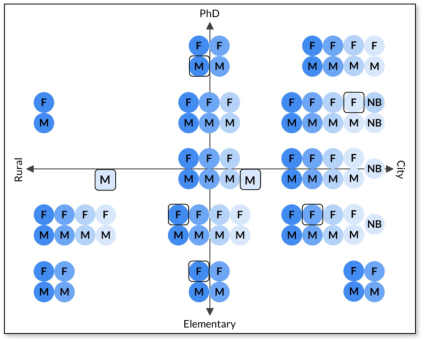
At the same time, through user groups definition (Kumar, 2013, p. 176) map was designed with the assumptions of what the population distribution by age, education, and geographical placement were. Since both methodolo- gies are used at the same time, the expectation is that the information from the informal interviews validates our assumptions in the mapping of the popu- lation. These represent the first steps towards the future definition of the interviewers’ profile, by analyzing what was said in the interviews a pattern of what is expected is starting to appear.
PRELIMINARY OUTCOMES Development of the LISA Brand
The main outcome, achieved through our communication strategies, was the logo of the study (Figure 1 and 2). It was created by first collecting logos from similar studies throughout the world and comparing them. Then a similar process was carried out for logos of the county of Leiria. Followed by a search for the county’s iconic elements, the arches of the city’s castle were selected as well as the ceilings of the city’s cathedral and the floor patterns of the central square. These elements were chosen for their potential to establish a connection with the population since they represent the region.
Cohort Study Good Practices: Design Communication and Capacitation Processes 343
Figure 1,2: Brand Identity of the Cohort Study LISA. (left- vertical logo; right - horizontal logo with tagline)
Figure 3: User groups definition validated by the interviewees.
Mapping the Population The conception of a map (Figure 3), result of the user groups definition, allows a simplified view of the expected population distribution by age, education, and geographic placement. Because this step was occurring at the same time as the informal interviews it was possible to confirm if our assumptions were correct.
List of Issues This list was achieved through informal interviews with experts and a small sample of the population, representing the target group of the Lisa Cohort Study. The interviews with the experts allowed us to perceive that one of the bigger challenges was to collect a sample sufficiently representative and available until the end of the study. This challenge is followed by holding the sample and the interviewers’ motivation and the medium/long duration of the study, highlighting the absolute necessity to capacitate the interview- ers, since they will be the interface between the study and the sample. The interviews with individuals from the population sample allowed us to con- firm how important the announcement and communication (dissemination) of the study is.
344 Ferreira
FINAL CONSIDERATIONS Completed the project’s first phase, presented in this article, we aim to deve- lop the personas and workshops methodologies. The resulting data will feed the creation of guidelines for cohort studies and a good practice handbook for the interviewers of LISA. Aligned with this ultimate goal is the design of communication supports that will assist in the dissemination of the LISA Cohort Study, as mentioned above.
It is fundamental to understand the role of a designer in this kind of observational study, and how their presence over the preliminary stage is determinant to assist the methodologies definition for the development of the said study, thus bringing new perspectives to light. We can draw some conclusions from this first phase, concerning the position achieved by the designers as part of the multidisciplinary team, thus creating a balance and assisting in the communication’s capacitation in health.
In the future, we propose to further explain the evolution of this pro- ject and of the LISA Cohort Study, clarifying the still to be developed methodologies, and presenting the findings to be validated.
ACKNOWLEDGMENT
The authors would like to acknowledge that the present article is part of two master’s thesis being developed to obtain a master’s degree in Design for Health and Well-being, conducted in the School of Arts and Design - Caldas da Rainha, Polytechnic of Leiria. These master’s thesis constitute an integral part of a Cohort Study taking place in the county of Leiria that involves CML, ciTechCare, ACES Pinhal Litoral, and LIDA.
Also, the authors would like to acknowledge the assistance and financing from Fundação para a Ciência e a Tecnologia (FCT) (UIDB/05468/2020) and Laboratório de Investigação em Design e Artes (LIDA) that made the participation in the event possible.
REFERENCES
ACES Pinhal Litoral (2019) Plano Local de Saúde do ACES Pinhal Litoral 2018-
2020. Leiria. Design Council and Technology Strategy Board: Driving Innovation (2015) Design methods for developing services : an Introduction to Service Design and a Selection of Service Design Tools. Design Council. Hulley, S. B. et al. (2007) Designing Clinical Research. 3rd edn, Retina. 3rd edn. Edi-
ted by S. Seigafuse and N. Winter. Philadelphia: Lippincott Williams & Wilkins. doi: 10.1097/00006982-199010000-00024. Kumar, V. (2013) 101 Design Methods - A Structured Approach for Driving Innovation in Your Organization. New Jersey: John Wiley & Sons, Inc. Maibach, E. and Parrott, R. L. (eds) (1995) Designing Health Messages: Approa-
ches from Communication Theory and Public Health Practice. 1st edn. California: SAGE Publications, Inc. Available at: https://sk.sagepub.com/books/designing- health-messages. Martin, B. and Hanington, B. (2012) Universal methods of design: 100 ways to research complex problems, Rockport Publishers. Beverly, MA: Rockport Publishers.
Cohort Study Good Practices: Design Communication and Capacitation Processes 345
Moeller, G. H. et al. (1980) ‘The Informal Interview as a Technique for Recreation Research’, Journal of Leisure Research, 12(2), pp. 174–182. doi: 10.1080/00222216.1980.11969436. Stickdorn, M. et al. (2018) This is Service Design Doing : Applying Service Design Thinking in the Real World : a practitioner’s handbook. 4th edn. Edited by M. Treseler et al. Sebastopol, CA: O’Reilly Media, Inc.
LISTED IN THE AHFE DIGITAL BOOKSTORE CATALOGUE
Explore the complete digital volume
Human Dynamics and Design for the Development of Contemporary Societies
Read this individual research paper free through the original publisher, or explore the full digital proceedings book.
ISBN 978-1-958651-01-8
Explore this ISBN in the AHFE Bookstore ↗Listed in the July 2026 bookstore catalogue; search by ISBN to confirm current availability · Digital book purchase optional