José Silveira Dias (2022). Symbiosis Design: An Interdisciplinary Methodology. In: Human Dynamics and Design for the Development of Contemporary Societies. AHFE Open Access, vol. 25, pp. 45–52. https://doi.org/10.54941/ahfe1001370
Thinking conceptually on what is tangible results in ideas that feed cycles of thought. This incremental continuum gives rise to a reflection on the current crisis of temporal dispersion.Creativity can be continuously stimulated through life-long learning. When exploring societal active methodologies within teaching and learning processes, Design is an interdisciplinary subject aided by: Artificial Intelligence in rethinking the positioning that humans conquered as conscious beings, but which underestimates nature and fails to recognize its dependency on other species; User-centered Psychotherapy and Spatial Interaction towards strategies for emotions and mind impulses which correspond to societal behaviors; Social Sciences in the context of Landscapes and Territorial Dynamics; Bionics and Mimetics reformulating technology through Nature as a model; Human Factors Engineering in the investigation of the cognitive system in the adequacy of physical and digital agents. It is projected consolidate the design of the procedural spiral in the design orientation of a methodology for the Design that leads the memory in anticipation to the retroactive effect of the knowledge that will operationalize responsible creative contents, aiming at the expansion of a remembrance against the forgetfulness of the human being to care Mother Earth.The intention to develop and validate this societal active methodology started from a model (4Xself) elaborated in the context of the PhD that, with the guidance of the respective Practical Assignments Guide, intends to guide a Symbiosis Proto-Methodology. This model was applied in 2019/20 and 2020/21 with students, and preliminary conclusions have already been reached in the scope of SPIRAL project. This project aligns with the 4th SDG on education, specifically target goal 4.7, as we aim to contribute to the SDGs defined by the UN in a transversal way with the methodology. We aspire to achieve acceptance of concepts and practices that integrate the research questions: How to create and implement a Symbiosis methodology that promotes interdisciplinary, sustainable, and ethically committed design processes? How can this methodology consolidate its meaning as a catalyst and aggregator system for acting in the Design process, guaranteeing the benefit of the agents involved?The expected outcomes of this project result from exploring different media channels to disseminate and implement Symbiosis’s proto-methodology whose expertise promote the crossing of knowledge in the respective areas and interactive practices in education, training in companies, in entrepreneurship and professionalization, ensuring the following principles: be transversal to the values and mission of the methodology for a more qualitative strategy in teaching; supporting a transition to information glocalization; reflect on Education as a learning channel for all; encourage a shared responsibility among everyone involved in the design process guaranteeing code of conduct; develop an operational methodology with and for society through Co-design and Participatory Design to better qualify individuals in society and this as a social collectively; improving training methodologies in education through interdisciplinarity and participatory learning; be enrolled in the ECO triangulation in which the Social, Economic and Ecological aspects are marked out between the poles Perception/Production and Nature/Culture in the domains of Design, Art, Science and Engineering
Thinking in the abstract about the concrete always allows us to infer results that serve as raw material to return to the abstract again, updating it and, thus, successively design. This continuous and incremental change is a pretext for a reflection on the current crisis of temporal dispersion (Han, 2017).
Creativity can be continuously stimulated through life-long learning. When exploring sustainable active methodologies within teaching and lear- ning processes, Design is an interdisciplinary subject aided by: (i) artificial intelligence in rethinking the positioning that humans conquered as conscious beings, but which underestimates nature and fails to recognize its depende- ncy on other species; (ii) User-centered Psychotherapy and spatial interaction towards strategies for emotions and mind impulses which correspond to sustainable behaviours (Silveira Dias & Almendra, 2022); (iii) in the con- text of Landscapes and Territorial Dynamics supported by Social Sciences; (iv) in the ways of reformulating technology through Nature as a model by Bionics and Mimetics; (v) and in the investigation of the cognitive system in the adequacy of physical and digital agents by Human Factors Engineering.
In this way, we aim to consolidate the design of a procedural spiral (Hegel, 2003) in a methodological orientation in Environmental Design. This meth- odology intends to project the effect from the evocation of memory, leading to experimentation and responsible operationalization. Absence of the expe- rience of the Place leads to the lack of responsibility of our actions towards the environment. This will guarantee a critical and expansive reflection of the processes whose fundamental action is to ethically preserve our Nature (Love, 1998).
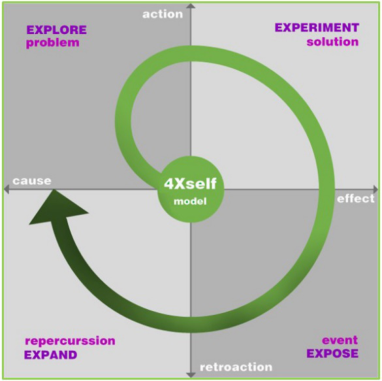
The intention to develop and validate this active sustainable methodology started from a model 4Xself (fig. 1) elaborated in the context of the PhD that, with the guidance of the respective Practical Assignments Guide, intends to guide Proto Methodology.
The 4Xself model (Silveira Dias, 2019) was applied in 2019/20, 2020/21, 2021/22 with students, and preliminary conclusions have already been reached.
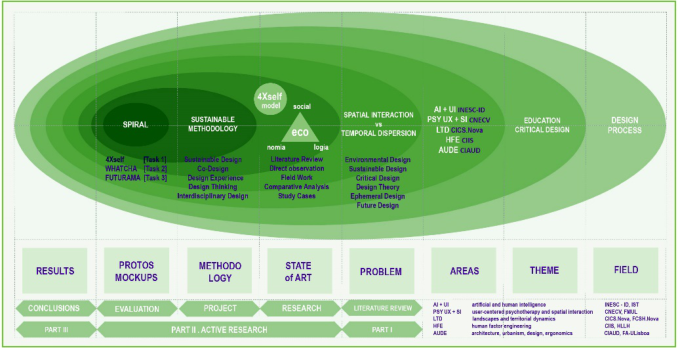
The SPIRAL (Symbiosis Project into Redesigning Atmospheres and Land- scapes) aligns with the 4th SDG on education, specifically target goal 4.7, as we aim to contribute to the SDGs defined by the UN in a transversal way with the methodology. The State of Art deals with the areas of study identi- fied (fig. 2) and integrates the theorists considered relevant in the acceptance of concepts and practices that integrate the research questions: Q1 - How to create and implement an active sustainable SPIRAL methodo- logy that promotes interdisciplinary, sustainable development, and ethically committed design processes (Love, 1998)?
Q2 - How can this methodology consolidate its meaning as a catalyst and aggregator system for acting in the Design process?
We then present the information considered relevant to support and delimit the strategic action of the 4Xself model for the Active Sustainable Methodo- logy, as well as for the prototyping of the Methodology within the scope of Critical Design Education.
Symbiosis Design: An Interdisciplinary Methodology 47
Figure 1: 4Xself model (author, 2019).
Theorizing about Environments Design (atmospheres and landscapes) is organized according to the 4 quadrants of the 4Xself model (fig. 1) that identifies four distinct and successive moments: (i) through the forms and characteristics of the object of study, within the scope to EXPLORE; (ii) through the emergence of the problem in urban territory and contempo- rary cultures, in the field to EXPERIMENT, promoting ACTION, completing cycles that develop from the cause, projecting the effect. In the continu- ation of this movement, which is intended to be incremental, (iii) it is also reflected on the modes of manifestation of the object for EXPOSE, and (iv) through ways of acting and applying recognized systematization models to EXPAND the knowledge for the Design Process, establishing the RETROACTION.
SPIRAL’s team includes specialists whose expertise promote the crossing of knowledge in the respective areas (fig. 2) and interventionist practices in edu- cation, training in companies, in entrepreneurship and professionalization, ensuring the following principles: (i) be transversal to the values and mission of the SPIRAL methodology for a more qualitative strategy in teaching; supporting a transition to information glocalization: virtual learning communities; reflect on Education as a learning channel for all; “Learning Action” in context, recursive and optimized for sustainable development; guarantee code of conduct; (ii) develop an operational methodology with and for society through Co- design and Participatory Design to better qualify individuals in society and this as a social collectively); (iii) be enrolled in the ECO triangulation (fig. 2) in which the Social, Econo- mic and Ecological aspects are marked out between the poles Nature and Technology, Natural and Artificial, Authenticity and Simulation (Papanek, 1995).
48 Silveira Dias
Figure 2: Design Research Organogram (author, 2021).
OBJECTIVES The main goal of this research is to establish a sustainable active methodo- logy in higher education, which can: G1 - Encourage a shared responsibility among everyone involved in the design process; G2 - Promote the ephemeral nature of the design process as a way of expanding creativity and imagination in Design, supported by participatory strategies and collaboration.
In effect, it will be about; G3 - Establishing the systematization of interdi- sciplinary and participatory knowledge in the social domain, among others, through the application of a conceptual model in the practice of proces- ses, namely in the project in Design; G4 - Developing critical thinking: co-responsibility, ethics, and the will to determine (free will); G5 - Impro- ving training methodologies in education through interdisciplinarity and participatory learning.
SCIENTIFIC RELEVANCE FOR DESIGN _ The nature of the proposed methodology exposes Design as an area advisor, aiming to find a common language that is made possible by it;
_ It is assumed that Design is an interdisciplinary discipline as a procedural discipline in all areas of knowledge; _ Inferences the need to constitute a more robust doctrine in a design philosophy;
_ Confirms design as a design process in guaranteeing identity, human nature and ethics, as essential qualities in the creative process based on critical thinking; _ Redirect’s humanist thinking, emphasizing the potential and entrepre- neurship of human beings, individually and socially.
_ Methodologically, it defends a casuistic and universalist dialectic based on Hegel’s dialectic (2003) in which: an idea comes out of itself (thesis); to be something else (antithesis); then it returns to its identity, becoming more concrete (synthesis).
Symbiosis Design: An Interdisciplinary Methodology 49
RESEARCH PLANS AND TASKS SPIRAL proto methodology for Design education is based on the model deve- loped by the IR at the doctoral level, whose methodology is being developed within the IR’s post-doctoral project (due in September 2023). This proto methodology will guide the process dynamics, in a spiral growing manner.
Four main tasks will be carried in order to test different supports for the methodology to be developed: TASK 1 - To develop 4Xself, a conceptual model that will be implemented in the methodological process. It will be guided by the following goals: (i) to improve the process representation comprehension by Human being; (ii) to design efficient visual information about the process among the stakeh- olders, in order to become a collaboration tool; (iii) To become referential and inspirational for the process and as a way of documenting for future reference.
This model is in the base of SPIRAL (Proto Methodology), and aims to: (i) develop new sustainable dynamics through participatory and collaborative practices, for the awakening of the communitary sense; (ii) reinvent human, material and immaterial resources to enterprise new business models, beyond consumption; (iii) reinterpret the shape and function of goods and services for renovating the production systems; (iv) understand Objects Life Cycle benefiting a co responsible behaviour on processes; (v) defend the exception within the quotidian through the processes constant updating; (vi) lead to the understanding of material ephemerality and immaterial non ephemerality, to revive material and immaterial human inheritage.
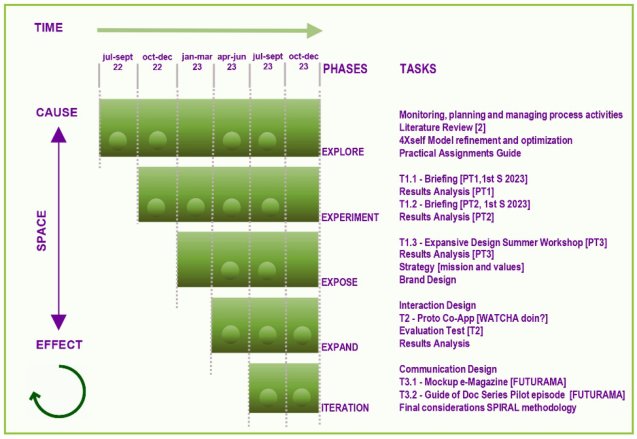
SPIRAL testing will be carried through according to the timetable (fig. 3). PROTO TESTS 1 and 2: Project briefs will be delivered to degree stu- dents on the subject classes of Interior Design, Product Design, Ephemeral Architectures, Design IV and Design V.
PROTO TEST 3 EXD (Expansive Design Summer Workshop) and TED talks FUTURE DESIGN about: the Methodology application; collabora- tion (on problem solving) and participatory sessions with users; Critical Design Education, Spiral Thinking Design (Silveira Dias & Almendra, 2022), Environments Design (atmospheres and landscapes).
These three Proto Tests will allow us to assess and optimize the Methodo- logy in order to apply it. Demonstration through a model’s practice can, on one hand, illustrate its use, and on the other hand assess its methodological adequacy in social, economic, and ecological terms, being the key issue, the practice of participatory collaboration of stakeholders in the process.
The methodological tests must have dissemination supporting tools. In a first moment we will operate in High Education contexts using it as a lab to test and optimize so replication can be done through an expansion to social territory: TASK 2 – WHATCHA doin’? - what are you doing for Earth? (pilot app) Development of a collaborative PROTO APPLICATION to support SPI- RAL methodology as a way of: (i) inquiring and registering of individual and group contributions towards an improved future LIFE on Earth; (ii) crossing and sharing experiences, models, case-studies in a scientific research context;
50 Silveira Dias
Figure 3: Timeline (author, 2021).
(iii) giving global visibility to projects (critical reflexion and/or experimen- tal practice); (iv) optimizing the platform as a search engine and one that activates hyperlinks among and with projects, communities; research and researchers; (v) hosting an experience and experimentation e-library and an archive of creative estate; TASK 3 - FUTURAMA – e-magazine, recycle paper-magazine (mockup) and documentary series (script of pilot episode).
Futurama (magazine and documentary series) is inspired in this humanistic ideology that aims to ally technology with their own principles; Both propo- sals will establish the interface so with other knowledge areas one can confirm the application of the design process since design is an interdisciplinary discipline.
With these 2 dissemination modes we ensure a more transversal impact, and we have the possibility of having more focus group reaching and parti- cipating in it. Thus, it will be possible to develop an intelligible and common language among the audience. The two dissemination formats target disti- nct groups (from analogic to digital generations that together form the entertainment Era, the Era of emotional consumerism T3.1- biannual e-magazine; recycled paper magazine Mockup T3.2- documentary series (8 chapters of 30’) > about Future Design.
EXPECTED ECONOMICS AND SOCIAL IMPACT SPIRAL’s expected economic and social impact resides in two main areas: (i) directly in Design education by applying SPIRAL’s methodology in the creative process and in the training of responsible professionals; (ii) which, in turn, will integrate the labor market with skills focused on sustainability principles, contributing to a more equitable economy.
Symbiosis Design: An Interdisciplinary Methodology 51
This way, the impacts will be related to the change of mindset in which time regains its value. In the medium and long term, it could constitute a management and strategy tool that, when applied, economically optimizes the design and production processes in a more sustainable and responsible critical manner (Papanek, 1995).
It is expected to impact society, as it aims to support strategies to slow down our current pace and value the time to reflect on our actions/processes. SPIRAL will encourage the repositioning of human beings as part of Nature, respecting the rhythm of natural regeneration cycles, defending nature as a model for analyzing and learning.
EXPECTED SCIENTIFIC RESULTS SPIRAL’s expected economic and social impact resides in two main areas: (i) directly in Design education by applying SPIRAL’s methodology in the creative process and in the training of responsible professionals; (ii) which, in turn, will integrate the labor market with skills focused on sustainability principles, contributing to a more equitable economy.
This way, the impacts will be related to the change of mindset in which time regains its value. In the medium and long term, it could constitute a management and strategy tool that, when applied, economically optimizes the design and production processes in a more sustainable and responsible critical manner (Papanek, 1995).
It is expected to impact society, as it aims to support strategies to slow down our current pace and value the time to reflect on our actions/processes. SPIRAL will encourage the repositioning of human beings as part of Nature, respecting the rhythm of natural regeneration cycles, defending nature as a model for analyzing and learning.
ACKNOWLEDGMENT
The author would like to acknowledge: CIAUD, Research Centre for Archite- cture, Urbanism and Design, Lisbon School of Architecture; FCT - Fundação para a Ciência e a Tecnologia, I.P., UIDB/04008/2020; CICS.NOVA, Interdi- sciplinary Centre of Social Sciences; CNECV, National Council of Ethics for the Life Sciences; CIIS, Interdisciplinary Health Research Center; INESC.ID, Institute of Systems and Computers Engineering.
REFERENCES
Han, B. (2017). Psychopolitics: Neoliberalism and New Technologies of Power.
London & New York: Verso Books. Hegel, G. 2003. Fenomenologia do Espírito. 2a ed. Petrópolis: Vozes. Love, T. (1998). Social, environmental, and ethical factors in engineering design theory: a post-positivist approach. PhD Thesis. University of Western Australia: Department of Mechanical and Materials Engineering. Papanek, V. (1995). The Green Imperative – Ecology and Ethics in Design and
Architecture. London: Thames & Hudson.
52 Silveira Dias
Silveira Dias, J. (2019). POPPING UP. Desenhando um modelo conceptual para o Processo em Design ou A Efemeridade em busca do seu desígnio. PhD Thesis. Universidade de Lisboa: Faculdade de Arquitetura. Silveira Dias, J. & Almendra, R. (2022), “Designing minds with designed emotions.
Spiral thinking design” in Kong, M. & Monteiro, M. (Eds.), Creating through Mind and Emotions, CRC Press, Taylor & Francis Group, Boca Raton, United States (accepted for publication).
LISTED IN THE AHFE DIGITAL BOOKSTORE CATALOGUE
Explore the complete digital volume
Human Dynamics and Design for the Development of Contemporary Societies
Read this individual research paper free through the original publisher, or explore the full digital proceedings book.
ISBN 978-1-958651-01-8
Explore this ISBN in the AHFE Bookstore ↗Listed in the July 2026 bookstore catalogue; search by ISBN to confirm current availability · Digital book purchase optional