Xiuxiu Wu, Kin Wai Michael Siu, Joern Buehring (2022). Barriers affecting incremental innovation in design-led SMEs in China's Greater Bay Area. In: Creativity, Innovation and Entrepreneurship. AHFE Open Access, vol. 31, pp. 177–184. https://doi.org/10.54941/ahfe1001520
In this study, we review and explore the critical barriers affecting design-led small and medium-sized enterprises (SMEs) in the Greater Bay Area (GBA) of China. Eight in-depth interviews are conducted with key decision-makers in the innovation process, representing a range of SMEs. The results show that collectivism, hierarchy, and market factors are unique barriers to SMEs in the GBA. Collectivist culture is the fundamental and macro factor that hinders innovation. It results in employers possessing most of the decision-making power in firms, whereas employees at lower levels can only provide basic skills to accomplish tasks without the motivation to innovate. The middle-level leaders in these enterprises are essential for internal knowledge creation and smoothing the information flow between members, thereby stimulating innovation. Moreover, under collectivism and hierarchy, design has become a rigid process linked to achieving key performance indicators (KPIs) instead of acting as a creative endeavor for designers. Instead of motivating employees to work creatively, KPIs force them to achieve only minimal goals at work. In addition, collectivism leads to a more extreme design strategy in which employers and designers tend to imitate existing products on the market, rather than taking risks to develop novel products and services that generally require a large amount of time to generate any commercial value.
Small and medium-sized enterprises (SMEs) have always been a crucial part of the economy, accounting for 99.8% of companies in the Chinese market (National Bureau of Statistics, 2019). In this study, we assess design-led SMEs with 10≤X<100 employees following the standard Chinese classification of large, medium, small, and micro-enterprises (2017). Unlike large firms, whose innovation are more significant than those of small firms, SMEs tend to be gradual and invisible. A variety of studies have explored the factors that drive incremental innovation and deter innovation in manufacturing industry. For example, Arza and Lopez (2021) noted that cost, knowledge, institu- tional, and market factors were the main barriers to innovation for SMEs in Argentina manufacturing sector. Furthermore, Du (2021) posited that internal knowledge heterogeneity and knowledge depth affected incremental
innovation in China manufacturing firms. D’Este (2012), whose study took place in the U.K., concluded that there were two types of barriers affe- cting SME innovation: revealing barriers and deterring barriers. Revealing barriers refer to learning experiences that occur throughout the innovation process, whereas deterring barriers prevent firms from engaging in innova- tion. Although numerous studies have analyzed the barriers that affect SMEs, we suggest that these barriers affect design-led SMEs differently in the Chi- nese context. Firms that engage in innovation need to overcome a series of barriers, particularly in developing countries. To create policies that assist SMEs in removing these barriers, we need to identify which barriers result in innovation failure. The methodology and concepts developed from previous studies offer clear guidance on accurately addressing this objective.
We used data from the Greater Bay Area (GBA), a Chinese megalopolis that was created in 2017. Innovation is a crucial part of the GBA’s mission, in particular boosting SMEs’ innovation capacities. The China Merchants Bank (2020) reported that 90.3% of companies have fewer than 50 emplo- yees in Shenzhen, the central city of GBA. Given the prevalence of SMEs in the GBA, we suggest that increasing these enterprises’ innovation capa- city may benefit the region’s economy. If firms could identify and anticipate barriers to innovation, and manage them in advance, they would have a bet- ter chance of finding solutions and overcoming those barriers (Hueske and Guenther, 2015). This discussion leads to the main research question: what are the barriers that affect SMEs’ incremental innovation? We offer first-hand information about the barriers in design-led SMEs in the GBA.
METHODS
We used purposeful sampling to identify design-led SMEs in three GBA cities: Shenzhen, Guangzhou, and Hong Kong. Our sample included Internet service providers, software companies, design consultancies, and consu- mer electronics companies. The eight interviewees who participated in our study were either part of a company’s innovation team or a company CEO. Multiple methods and sources were used to gather data, including eight semi-structured interviews, documents, company websites, and images. We
Design consultancy 2016 26 CEO Shenzhen Design consultancy 2018 12 CEO Shenzhen Software 2008 55 Design director Shenzhen Fintech 2016 52 Product director Shenzhen Media company 2019 25 Content designer Shenzhen Software 2020 11 Graphic designer Hong Kong Consumer electronics 2020 23 User experience designer Guangzhou Internet service 2022 15 User experience designer
Barriers Affecting Incremental Innovation in Design-Led SMEs in China’s Greater Bay Area 179
increased the validity of our results using data triangulation. We developed interview questions based on previous studies that illustrated the ways in which innovation culture, knowledge, cost, and the market were primary barriers to innovation for SMEs (Arza and López, 2021; Du, 2021). Through our questions, we sought to ascertain how to better understand and encou- rage incremental innovation in SMEs, manage design teams, and overcome challenges. The interview was 90 minutes long.
RESULTS
Barriers Affecting Incremental Innovation Six significant barriers emerged as critical in terms of their influence on incre- mental innovation. We list the barriers in order of importance: collectivism, hierarchy, the Chinese market, the use of key performance indicators (KPIs), the lack of customized and unstandardized expertise, and the lack of internal knowledge creation.
Collectivism We observed that the employees of GBA SMEs operate based on a colle- ctivist cultural background. As SMEs usually follow established industry practices, these enterprises normally take on low-risk endeavors. This tende- ncy provides these enterprises with a sense of security but hinders successful innovation. As such, the CEOs of SMEs are often risk-averse. As the pur- pose of innovation is to reference existing, similar products, innovation often results in criteria for evaluating design outcomes that must consider existing products on the market. Furthermore, we noted that a collectivist culture shapes employee behavior and leads to psychological models that prioritize the opinions of leaders. Decision-making power requires significant effort and involves controlling resources and taking on additional responsibilities. Employees therefore tend to accept company decision-makers’ instructions instead of expressing their own opinions, resulting in a passive form of collaboration.
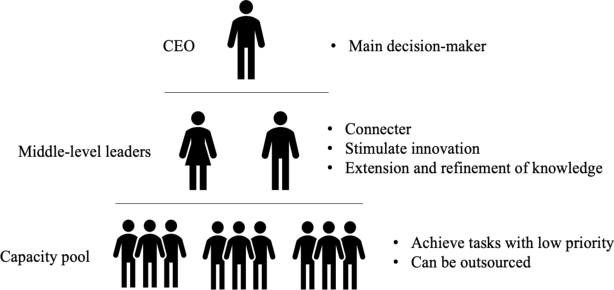
Hierarchy SMEs adopt a pyramid structure for management (see figure 1). The top layer is the CEO, and the lower level is a capability pool that includes the primary human resources (e.g., interaction designers, graphic designers, and program- mers). The middle level represents project managers or directors acting as connectors between the upper and lower levels.
In SMEs, the CEO is the gatekeeper, the primary decision-maker, and the promoter of innovation. When middle-level leaders and employees in the capacity pool engage in innovation activities, their superiors are likely to be the utmost of enterprise innovation and the industry experts who control all enterprise resources.
Middle-level leaders significantly influence employees’ decision-making, and these leaders’ creativity and ability to innovate determine the company’s
Figure 1: SMEs organizational structure.
innovation trajectory. Middle-level leaders need to process and organize kno- wledge and experiences, which are then transmitted upward to leaders and downward to subordinates. The accumulation of knowledge from past expe- riences acts as a foundation to connect current innovation with previous experiences. The constancy of middle-level leaders is essential for SMEs, and the ideas, exchanges, communication, and support of middle-level leaders are essential for innovation because of these leaders’ unique roles in SMEs.
Employees at the lowest level of the pyramid are responsible for achi- eving the concrete tasks assigned by employees in the upper levels. Indi- viduals in the capacity pool can be easily replaced or even outsourced to other companies, effectively decreasing costs for enterprises. Most emplo- yees at this level perform tedious, energy-consuming tasks, and have no sense of purpose or achievement compared to middle and senior emplo- yees. Even when they have innovative ideas, as primary employees, they struggle to think comprehensively. More specifically, these employees would question whether an idea would be acceptable or meaningful for the company.
Chinese Market Given the extensive nature of China’s market, SMEs struggle to distribute innovative products in a timely manner, allowing latecomers to develop and distribute similar products. In contrast to China, European countries have relatively small populations, and SMEs often launch products in Europe that can seize the market quickly, providing a foundation for future development. Conversely, in China, new products often occupy regional markets, allowing competitors to place their products in other regions. Thereby, SMEs’ chance of survival depends on who has the most significant advantage and strength in the market. Indeed, 80% of the SMEs in our study were unwilling to invest capital in developing new products and preferred to follow or make incre- mental innovations to occupy the market. In other words, these enterprises generally opted to make only minor changes to existing products to entice customers to pay for the newer and adapted products. Even SMEs invested
Barriers Affecting Incremental Innovation in Design-Led SMEs in China’s Greater Bay Area 181
resources in developing products, large companies could merge SMEs dire- ctly and take over the market. However, large markets provide opportunities for SMEs, as it takes a relatively long time for a company to have a mono- poly over the entire market, thereby allowing SMEs to pursue incremental innovation.
Trying to Encourage and Measure Innovation Through KPIs KPIs mainly encourage quantitative output rather than quality, resulting in invisible psychological pressure on employees. Constantly emphasizing the quantity of work carried out causes employees to fall into self-repetition and consumes energy in a way that is void of knowledge and input. When the sense of achievement in the workplace slowly decreases, as there are no opportunities to learn anything new, these employees prefer to work in a different environment to relieve the pressures associated with KPIs. One con- tent designer in our study noted, “KPIs make me pay less attention to creative content. I just fulfill the minimum requirement to get a salary.” Faced with KPI pressure, this employee noted the ways in which design became a rigid process with the sole goal of achieving KPIs, instead of acting as a creative practice.
Lack of Customized and Unstandardized Expertise SMEs’ organizational dynamics are unique and characterized by a speci- fic purpose. Despite the existence of a large number of professionals in the job market, it is challenging for SMEs to find appropriate candidates to fill the various positions. This phenomenon likely occurs because other types of organizations with differing business models shaped their emplo- yees, making it challenging for SMEs to find employees who can match their desired specifications. This lack of suitable employees is particularly harmful when SMEs need to expand to scale. Indeed, we observed that the majority of the SMEs in our study preferred to hire fresh graduates, who would likely be more flexible than experienced candidates in their training.
Lack of Internal Knowledge Creation The accumulation of internal knowledge management requires additional human resources. SMEs with few employees could quickly reach a consen- sus based on the needs of users and the market, as in this situation there would be no need to summarize the innovative experience and refine it into tools or modules. These organizations prefer to focus on the present or future to increase profit. The lack of internal knowledge creation in SMEs weakens the connection between existing knowledge and new knowledge, forcing firms to indulge in their knowledge framework. SMEs that focus on one area are more likely than other SMEs to become circumstanced by knowledge and experience in the industry, resulting in challenges for these SMEs in achieving innovation while self-reinforcing their organizational rigidity.
DISCUSSION
Theoretical implications Whereas in Western countries the organization structure of SMEs is more transparent and decentralized, the collectivist culture prevalent in China results in centralization and hierarchy in SMEs. Collectivist culture also prompts mangers to follow established trends and employees to follow their superiors’ orders. In countries that feature an individualistic cultural background, the advantage of innovation in SMEs is that it decentrali- zes their decisions and encourages employees’ involvement (Scherer, 1988; Szostak and Gay, 2019). China is more collectivist, as the country’s cultural positioning is rooted in Confucianism. Although management styles in the country are not entirely systematic and structured, employers still possess large amounts of authority in the workplace and are considered role models (Chen et al., 2018). Tang and Sun (2021) noted that when leaders made light of their own mistakes, employees considered this a sign of weakness, lea- ding to lower employee creativity levels. This finding aligns with the work of Paramitha and Indarti (2014), who noted that the perceived work environ- ment (both organizational and cultural) affected innovation and employee creativity in firms.
Hierarchies in design-led firms are particularly harmful. Design is an ite- rative and repetitive process that involves reviewing problems and creating solutions. Designers need to repeatedly discuss tasks with colleagues to under- stand the requirements and reach a consensus. Hierarchy makes information synchronization difficult and thereby delays firms’ final output. Hierarchy also silences employees’ opinions and eventually leads to disharmony within the company. Reducing hierarchy levels in SMEs can reduce the power dista- nce between employees and employers, strengthen team connections, and allow employees to speak freely without worrying about the consequences of their mistakes. Hierarchy renders design a rigid process with the express purpose of achieving KPIs, rather than acting as a creative motivator for designers. Firms that prioritize their KPI measurements will miss out on measuring and capturing the knowledge and soft skills generated inside the company, where the internal knowledge creation is valuable for SMEs due to these companies’ unique and highly characterized knowledge generation pra- ctices that cannot be learned or repeated from outside (Forés and Camisón, 2016).
Managerial implications First, employers possess the higheest levels of decision-making power in firms, whereas employees in the capacity pool can only provide basic skills to accomplish tasks without the motivation to innovate. As such, middle-level employees are responsible for internal knowledge creation and for smooth- ing over the information flow between members to drive innovation. These employees work as a connector by collecting their subordinates’ firsthand information to report to the CEO. This process is known as knowledge management, which covers the explicit and implicit knowledge that can enhance innovation in SMEs (Byukusenge and Munene, 2017). The precise
Barriers Affecting Incremental Innovation in Design-Led SMEs in China’s Greater Bay Area 183
ways in which middle-level employees manage this knowledge and process and export it to other employees is crucial for innovation. SMEs should therefore focus on training middle-level employees with knowledge mana- gement skills. Second, mangers should provide employees with a sense of achievement at work by providing feedback and by allowing these emplo- yees to make changes within the scope of their existing responsibilities. A harmonious relationship between colleagues can create a dynamic working environment by quickly understanding each other’s expressions. This type of working environment gives employees a sense of security, as they will likely feel less concerned about making mistakes. This more relaxed atmo- sphere could in turn help dissolve the hierarchy and therefore encourage more innovative ideas.
CONCLUSION
In this study, we explore the barriers affecting incremental innovation in design-led SMEs in China’s GBA. Six barriers were identified as influencing incremental innovation: collectivism, hierarchy, the Chinese market, the use of KPIs, the lack of customized and unstandardized expertise, and the lack of internal knowledge creation. Of these, collectivism, hierarchy, and market factors presented unique barriers to SMEs in the GBA, where a collectivist culture was the fundamental and macro factor that hindered innovation. We posit that KPIs manage design resources but deter employee creativity. KPIs stifle employee motivation by rendering their work a tedious process of sim- ply achieving the minimum requirements. Individuals who need to achieve KPIs become tools in the capacity pool instead of creative resources.
ACKNOWLEDGMENT
We would like to express our gratitude to the School of Design and RISUD of The Hong Kong Polytechnic University (PolyU). We acknowledge the support of the Eric C. Yim Endowed Professorship. We also thank Zhangrui, Huang Jie, Li Yan, Liang Danling, Danni for their support during the data collection.
REFERENCES
Arza, V., & López, E. (2021). Obstacles affecting innovation in small and medium enterprises: Quantitative analysis of the Argentinean manufacturing sector. Rese- arch Policy, 50(9), 104324. Byukusenge, E., & Munene, J. C. (2017). Knowledge management and business
performance: Does innovation matter?. Cogent Business & Management, 4(1), 1368434. Chen, Y., Zhou, X., & Klyver, K. (2019). Collective efficacy: Linking paternalistic leadership to organizational commitment. Journal of Business Ethics, 159(2), 587–603. China Merchants Bank Small and Micro Enterprises Research Report: Focus on
the Greater Bay Area. (2020). China Merchants Bank. [Online] Available from: https://finance.sina.cn/zl/2020-06-24/zl- iircuyvk0198902.d.html?vt=4
Chinese classification of large, medium, small and micro enterprises approach.
(2019). National Bureau of Statistics. [Online] Available from: http://www.stat s.gov.cn/tjsj/tjbz/201801/t20180103_1569357.html D’Este, P., Iammarino, S., Savona, M., & von Tunzelmann, N. (2012). What hampers innovation? Revealed barriers versus deterring barriers. Research policy, 41(2), 482–488. Du, L. (2021). How knowledge affects incremental innovation in SMEs: Know-
ledge base and knowledge heterogeneity. Journal of General Management, 46(2), 91–102. Forés, B., & Camisón, C. (2016). Does incremental and radical innovation performance depend on different types of knowledge accumulation capabilities and organizational size?. Journal of business research, 69(2), 831–848. Hueske, A. K., & Guenther, E. (2015). What hampers innovation? External stakeh-
olders, the organization, groups and individuals: a systematic review of empirical barrier research. Management Review Quarterly, 65(2), 113–148. National Bureau of Statistics. (2019). National Bureau of Statistics. [Online] Available from: http://www.stats.gov.cn/tjsj/zxfb/201912/t20191218_1718313.html Paramitha, A., & Indarti, N. (2014). Impact of the environment support on crea-
tivity: Assessing the mediating role of intrinsic motivation. Procedia-Social and Behavioral Sciences, 115, 102–114. Scherer, F. M. (1986). Innovation and growth: Schumpeterian perspectives. MIT.
Press Books, 1. Szostak, B. L., Gay, C. (2019). Innovation and creativity in SMEs: Challenges, evolutions and prospects. John Wiley & Sons. Available from: https: https://www.or eilly.com/library/view/innovation-and-creativity/9781786303172/ Tang, L., & Sun, S. (2021). How does leader self-deprecating humor affect crea-
tive performance? The role of creative self-efficacy and power distance. Finance Research Letters, 42, 102344.
LISTED IN THE AHFE DIGITAL BOOKSTORE CATALOGUE
Explore the complete digital volume
Creativity, Innovation and Entrepreneurship
Read this individual research paper free through the original publisher, or explore the full digital proceedings book.
ISBN 978-1-958651-07-0
Explore this ISBN in the AHFE Bookstore ↗Listed in the July 2026 bookstore catalogue; search by ISBN to confirm current availability · Digital book purchase optional