Parth Shah, Tejeswar Yarlagadda, Ameersing Luximon, Dong An, Yan Luximon (2022). An evaluation of material customized modular protective helmets. In: Creativity, Innovation and Entrepreneurship. AHFE Open Access, vol. 31, pp. 48–55. https://doi.org/10.54941/ahfe1001506
Helmets are often recommended as primary safety equipment for protecting the head. Several studies have been conducted to test the effectiveness of different impact-absorbing liner materials and their response to high impact loading. The standard helmets have an impact-absorbing liner of a single material, which may not be the best design approach. Hence, the possibility of modular helmet liner design with two different materials has been explored in this study. The chapter presents a preliminary Finite element analysis (FEA) study to evaluate the performance of hard foam, soft foam and a combination of both the foams as impact-absorbing liners for helmets. The results suggest that the hard foam liner showed better performance for high impact loads, while the soft foam liner was more effective for low impact loads. The results also indicated that the modular design-based helmet liners developed using both the hard and soft foam performed better than single foam liners.
The head is the most delicate and susceptible part of the human body(Shah and Luximon, 2021). A high-impact blunt trauma injury in the skull area or an accidental injury caused while working in hazardous work environments, driving, or playing sports can lead to brain haemorrhage and severe injuries (Shah and Luximon, 2018). Therefore, helmets are often recommended as a primary tool to ensure the safety of the head region. A helmet often comprises three crucial parts, (a) a rigid external shell for protection, (b) an impact- absorbing liner and (c) comfortable inner padding. The rigid outer shell helps resist penetration while the inner liner absorbs the energy and spreads the impact force over a larger surface area to reduce the impact on the guarding region. It is also known that the effect of impending impact on the head may vary significantly due to variation in the anatomy and biomechanical properties of the soft tissues. However, the impact-absorbing liner material is often the same throughout the helmet despite the impact’s nature and lacks
An Evaluation of Material Customized Modular Protective Helmets 49
the impact-oriented design. Several studies (Shuaeib et al., 2007, Mills et al., 2009, McIntosh et al., 2012, Mills and Gilchrist, 2006, Mustafa et al., 2015, Mustafa et al., 2019, Aare and Kleiven, 2007) have been conducted to explore the influence of materials on helmet performance; however, the effectiveness of modular designed helmets with multiple materials has not been explored.
Some previous studies (Chang et al., 2000, Walsh et al., 2011, Beckwith et al., 2012, Bland et al., 2018, Mills et al., 2009) conducted for hel- met evaluation have used human head forms. Usage of such head forms can only help provide a brief idea about the helmet performance and may not pro- vide detailed information about the impact on the skull or brain. Some recent studies (Yang et al., 2021, Cai et al., 2019, Dai et al., 2011) have develo- ped multiple-part/layer based anatomical head models replicating the human head anatomy. However, these studies have adopted uniform layer thickness for different parts instead of considering the actual thickness for simplicity in modelling. Hence, there is a need for a detailed human head finite element model to better mimic the actual head anatomy for more accurate simulation results.
Hence in this study, the modular design of the helmet’s impact-absorbing liner has been evaluated using a detailed human head finite element model to understand the relative difference in the performance of hard foam, soft foam and their combinations.
MATERIAL AND METHOD Development of Human Head and Helmet Finite Element Models
Computed Tomography (CT) data of a male adult Indian subject (age = 31 years) was used to develop a detailed anatomical head model. Separate models for soft tissue, skull, Mandible and brain were developed from CT data of the participants using Materialise MIMICS Research 20.0.0691 sof- tware. Cerebrospinal fluid (CSF) and meninges were not modelled separately and were combined with the brain model to reduce the complexity of the analysis. The developed models were imported into Geomagic Wrap 2021.0.0 software to simplify the mesh structure using smoothening operations and to remove existing defects.
The skull region and Mandible were connected by adding ligaments on both sides of the jaw using the sketch tool in SolidWorks (Version: 29.3.0.0059) software. After which, the Boolean operation was used on the skull and the outer surface of the head to get a model of the soft tissue of the head. A similar process was repeated for ligaments and brain models as well. This was done to avoid any gaps or discontinuities amongst different parts. Finally, the soft tissue, skull, Mandible and brain were assembled to form a Parasolid file of the human head finite element model.
A standard helmet 3D model was developed comprising an external shell of 2.75mm thickness and the inner impact-absorbing liner of 25mm thickness. The boolean operation was performed between the outer surface of the deve- loped head model and the helmet model’s inner surface to avoid gaps for ease of analysis. Inner comfort padding of the helmet was not considered in this study.
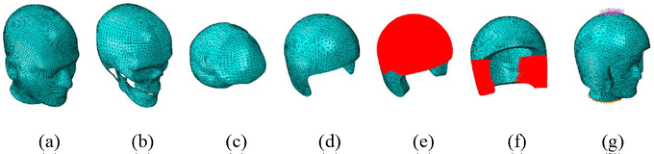
Figure 1: Processed meshes for FEA.
FINITE ELEMENT ANALYSIS ABAQUS 6.14, a finite element simulation tool, was used for this study. Before the analysis, the developed models were preprocessed in the software to remove sharp gradients at the boundaries and achieve converging discre- tization. Various mesh seedings were performed to avoid element distortion and negative element volumes. Based on the results, a global seeding of 5 mm was used, and all the parts were discretized with linear four-noded tetrahedral unstructured element meshes, especially the brain with hybrid formulation elements, as shown in Figure 1 (a-d).
Material and Interface Properties Based on the literature (Yang et al., 2021, Salimi Jazi et al., 2014), soft tis- sue, bones, and the helmet’s external shell were modelled as elastic materials. The ligaments were assigned the same properties as the bones for ease of modelling. The brain was assigned viscoelastic material properties defined using the Prony series, and the respective parameters were estimated from the Maxwell material model adopted in the study conducted by Salimi Jazi et al. (2014). The hard and soft foam material parameters were identified to replicate the respective stress-strain models presented in the study conducted by Zhang et al. (2013). The soft foam was defined as crushable foam, having a volumetric hardening behaviour. While testing for the modular design, the liner was divided into two material regions (1) top (head scalp region) and (2) both sides (Temporomandibular region) as shown in Figure 1(e) and (f), respectively. The material properties of different parts have been summarized in Table 1. A surface to surface tie constraint was applied between soft tissue, skull, ligaments and brain, as done in a previous study conducted by Cai et al. (2019) and also between the soft tissue and helmet liner.
Impact Force Structural analysis was performed in ABAQUS to test the difference in the performances of hard foam, soft foam and their combination used in the modular impact-absorbing liner design. A surface load of 4 MPa was applied over 50 × 50 mm2 on the head vertex as shown in Figure 1(g), which sums up to a total of 10 kN. The head model was fixed at the bottom (neck region), as shown in Figure 1(g). A simulation of the direct application of load on the head vertex was also performed to understand the impact on different parts without a helmet.
An Evaluation of Material Customized Modular Protective Helmets 51
Table 1. Material properties for different parts used in this study.
Table available in the original PDF paper.
E (MPa) υ Material TypeRemarks Elements Element
Part ρ ×10-8 (kg/mm3)
type 193.5 4096.8 0.22 Elastic 55,767 C3D4 Soft tissue 140 0.7 0.45 Elastic 183,897 C3D4 Bones and ligament
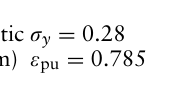
k = 1.933; kt = 1.0 σc0 = 0.045; p0 = 0.03 R = 0.136 σc = σc0 + P0ε 1−ε−R Note: ρ - density; E - elastic modulus; υ - poison ratio; giProny, kiProny, τ iProny - Prony series parameters; σ y - yield stress; εpu - ultimate plastic strain; k - compression yield stress ratio; kt - hydrostatic stress ratio; σ c - compressive stress; ε - strain; σ c0 - initial yield stress; p0– effective gas pressure; R - relative foam density.
RESULTS AND DISCUSSION
The results of the current studies have been summarized in Table 2. Case C0 represents the impact of 95% of total load on soft tissue, skull and the brain when no helmet was used. Cases C1, C2 and Cases C3, C4 present the results for 25% and 95% of total loading on single material foam liners made up of hard foam and soft foam, respectively. Cases C5 and C6 present results for 95% of total loading for modular liners, with C5 having the top region com- prising of hard foam and side region comprising of soft foam, whereas C6 had the soft foam in the top region and hard foam in the side region. This study aimed to identify the performance difference between the single-material and modular designed foam; hence, relative differences in the results have been compared, and preliminary inferences have been presented. However, a detai- led experimental study in the future needs to be conducted to acquire a more holistic understanding of the actual difference in the performance For Case C0, it is evident that there is a large amount of stress at the vertex region of the head, which is transferred internally to the skull and the brain. Due to the application of fixed constraint in the neck region, there is signi- ficant stress in the neck and mandibular region, which is further transmitted up to the ear region. For evaluation of other cases, the results of C0 has been taken as a relative reference.
For single-material impact-absorbing liner (Cases C1-C4), it can be seen that at lower load (25% of total loading), the amount of load transmitted on the soft tissue, skull and brain is more for hard foam (Case C1) compared to soft foam (Case C3). Also, the stress is more distributed for soft foam liner
Table 2. FEA results.
Table available in the original PDF paper.
Cases Soft tissue Skull Brain Load Level Helmet Top Liner Side Liner
C0 95% No
C1 25% Hard Foam
C2 95% Hard Foam
C3 25% Soft Foam
C4 95% Soft Foam
C5 95% Hard Foam Soft Foam
C6 95% Soft Foam Hard Foam
Legend
than concentric stress observed for the hard form. Whereas at a higher load (95% of total loading), the amount of load transmitted was much higher and concentrated for the soft foam (Case C4) compared to hard foam (Case C2). This could be caused due to the bounce-back effect making the impact more severe in the case of soft foams.
While considering modular design approach-based liners (Cases C5 and C6). The results for C5, when compared with C2, suggest that the perfor- mance of the multiple-material liner was better than the single-material liner. For both C2 and C5, the amount of loading on the top region is quite similar;
An Evaluation of Material Customized Modular Protective Helmets 53
however, due to soft foam material in the side region, the stress transmitted in the ear and mandibular region is significantly lesser in C5 compared to C2. It is also observed that the stress distribution in C5 is comparatively better than C2 for soft tissue skull and the brain.
While comparing Cases C4 and C6 having soft foam in the vertex region where the load is applied, it can be seen that the overall load distribution is significantly better in the scalp region for C6 compared to C4, where the amount of stress is more. However, the stress is transmitted more on the ear and mandibular region where there is hard foam in C6, which is much higher than C4 for the soft tissue. For the brain and the bone region, it was observed that the stress imparted was lesser and more distributed in C6 than in C4.
Most helmets used at construction sites/ mines have uniform hard foam lining material, whereas ordinary bicycle and motorcycle helmets generally have a single layer of crushable foams like Expanded PolyStyrene (EPS), and most sports helmets have rubbery foam liners. However, with the adoption of the modular design approach, a large variety of application-specific helmets can be developed, which can exhibit higher performance and provide better protection than single-material liners.
Compared to the previous study, the current study tried to use a detai- led human head finite element model; however, the models assumed the material properties to be homogenous, whereas, in reality, the biomecha- nical properties may vary significantly in different regions of the head and face. In addition, some anatomical parts were merged or not considered for the simplicity of modelling. Also, in the current finite element head model, the material properties of ligaments were considered similar to that of bone; however, to make the model more realistic, the ligaments need to be sepa- rately assigned properties based on their biomechanical properties. Hence further detailed head model needs to be developed in future to achieve more realistic results. The helmet model also needs to be further refined in future studies by adding additional parts like comfort foam liner, chin strap, and shield. Also, the contact modelling between helmet and head needs to be modified to replicate the realistic contact behavior by providing slippage and friction parameters. By adopting a modular design approach in this study, only two types of foams with different properties were evaluated for two dif- ferent regions (top and side). However, in the future, multiple combinations of materials and multiple part liner designs can be tested to develop optimal application-specific designs.
CONCLUSION
The current study presents a preliminary investigation of how helmet per- formance can be enhanced using a modular design approach for impact- absorbing liner design. Finite element analysis was conducted on a detailed human head finite element model with four combinations of the helmet’s impact-absorbing liners (hard foam, soft foam, and their two combinations). The results suggest that the hard foam liner was more effective than soft foam liner for high impact loads, whereas soft foam liner performed better for low impact loads. The results also indicated that the overall response of
liners developed using a modular design approach by using multiple materi- als performed better than single material foam liners. Further experimental verification is required to have a detailed realistic understanding of the per- formance; however, the current study provides the initial inferences, which are very promising. The results from this study can help create a new direction of research in the area of helmet design, where application-specific modular helmet liner designs can be developed based on their functional requirements and the estimated range of intensity of the possible impending impact during the usage.
ACKNOWLEDGMENT
The work described in this paper was supported by a grant from the Resea- rch Grants Council of the Hong Kong SAR., China (Project No. GRF/PolyU 15606321) and a grant from The Hong Kong Polytechnic University (Project No. P0031501).
REFERENCES
Aare, M., Kleiven, S. (2007). Evaluation of head response to ballistic helmet impacts using the finite element method. International journal of impact engineering, 34, 596–608. Beckwith, J. G., Greenwald, R. M. and Chu, J. J. (2012). Measuring head kinematics
in football: correlation between the head impact telemetry system and Hybrid III headform. Annals of biomedical engineering, 40, 237–248. Bland, M. L., Mcnally, C. and Rowson, S. (2018). Headform and neck effects on dynamic response in bicycle helmet oblique impact testing. Proceedings of the IRCOBI Conference. Athens, Greece, 413–423. Cai, Z., Xia, Y., Bao, Z. and Mao, H. (2019). Creating a human head finite ele-
ment model using a multi-block approach for predicting skull response and brain pressure. Computer methods in biomechanics and biomedical engineering, 22, 169–179. Chang, C. H., Chang, L. T., Chang, G. L., Huang, S. C. and Wang, C. H. (2000). Head injury in facial impact—a finite element analysis of helmet chin bar performance. J. Biomech. Eng., 122, 640–646. Dai, J., Yang, J. J. and Zhuang, Z. (2011). Sensitivity analysis of important parame-
ters affecting contact pressure between a respirator and a headform. International Journal of Industrial Ergonomics, 41, 268–279. Mcintosh, A. S., Patton, D. A. and Thai, K. (2012). Impact assessment of jockey helmet liner materials. Proceedings of the Institution of Mechanical Engineers, Part P: Journal of Sports Engineering and Technology, 226, 237–243. Mills, N., Gilchrist, A. (2006). Bicycle helmet design. Proceedings of the Institution
of Mechanical Engineers, Part L: Journal of materials: Design and applications, 220, 167–180. Mills, N. J., Wilkes, S., Derler, S. and Flisch, A. (2009). FEA of oblique impact tests on a motorcycle helmet. International Journal of Impact Engineering, 36, 913–925. Mustafa, H., Pang, T. Y., Ellena, T. and Nasir, S. (2019). Impact attenuation of user-
centred bicycle helmet design with different foam densities. Journal of Physics: Conference Series, IOP Publishing, 012043. Mustafa, H., Pang, T. Y., Perret-Ellena, T. and Subic, A. (2015). Finite element bicycle helmet models development. Procedia Technology, 20, 91–97.
An Evaluation of Material Customized Modular Protective Helmets 55
Salimi Jazi, M., Rezaei, A., Karami, G., Azarmi, F. and Ziejewski, M. (2014). A computational study of influence of helmet padding materials on the human brain under ballistic impacts. Computer methods in biomechanics and biomedical engineering, 17, 1368–1382. Shah, P., Luximon, Y. (2018). Three-dimensional human head modelling: a systema-
tic review. Theoretical issues in ergonomics science, 19, 658-672. Shah, P., Luximon, Y. (2021). Assessment of pressure sensitivity in the head region for Chinese adults. Applied Ergonomics, 2021 Nov;97:103548. doi: 10.1016/j.apergo.2021.103548. Epub 2021 Aug 12. PMID: 34391990. Shuaeib, F., Hamouda, A., Wong, S., Umar, R. R. and Ahmed, M. M. (2007). A
new motorcycle helmet liner material: The finite element simulation and design of experiment optimization. Materials & design, 28, 182–195. Walsh, E. S., Rousseau, P. and Hoshizaki, T. B. (2011). The influence of impact location and angle on the dynamic impact response of a hybrid III headform. Sports Engineering, 13, 135–143. Yang, W., Wang, H. and He, R. (2021). Establishment of a finite element model based
on craniofacial soft tissue thickness measurements and stress analysis of medical goggles. Ergonomics, 1–22. Zhang, L., Makwana, R. and Sharma, S. (2013). Brain response to primary blast wave using validated finite element models of human head and advanced combat helmet. Frontiers in neurology, 4, 88.
LISTED IN THE AHFE DIGITAL BOOKSTORE CATALOGUE
Explore the complete digital volume
Creativity, Innovation and Entrepreneurship
Read this individual research paper free through the original publisher, or explore the full digital proceedings book.
ISBN 978-1-958651-07-0
Explore this ISBN in the AHFE Bookstore ↗Listed in the July 2026 bookstore catalogue; search by ISBN to confirm current availability · Digital book purchase optional