Melissa Ngo, Philippe Rauffet, Siobhan Banks (2022). Exploring Multitasking Performance and Fatigue with the MAT-B II: A Narrative Review. In: Human Error, Reliability, Resilience, and Performance. AHFE Open Access, vol. 33, pp. 22–31. https://doi.org/10.54941/ahfe1001564
Multitasking and switching between tasks is a universal function in many occupations as juggling tasks simultaneously can increase task productivity especially with, factors such as workload that can lead to decrements and impair human performance. Fatigue can refer to the effects or after-effects of exerting mental and or physical effort on a task. Fatigue inducing factors such as high workload and time-on-task can impact task management, optimization and prioritization which can lead to performance decrements. Despite the universality of multitasking, from aviation to driving a car whilst talking simultaneously, it is unclear as to what underlying cognitive processes are affected by induced fatigue. This brief narrative review explores the dynamics of cognitive processes with induced fatigue on individual operator and task contexts. With an interest in cognitive-behavioral models and the Multi-Attribute Task Battery II (MAT-B II), this review aims to provide a conceptual background of the MAT-B II and its diverse use in modelling multitasking environments. By describing and investigating fatigue with multidisciplinary expertise, the development and implementation of countermeasures can enhance performance to mitigate the deleterious effects of workload and time-on-task.
Operating concurrent tasks is highly complex and requires an operator to divide attention across safety-critical tasks in occupations like maritime and air traffic control (Bender et al, 2017). The collaboration between humans and machinery has been integrated as much as possible to mitigate human errors manifested by different types of fatigue. But some risk for error remains as it is well established that fatigue induced by workload and time-on-task can contribute to deleterious effects of task performance (Westbrook et al, 2018; Van Cutstem et al, 2017). As these types of fatigue can contribute to poor performance it is impera- tive to develop and implement countermeasures for multitasking performa- nce. The objective of this novel narrative review is to firstly, investigate the underlying cognitive mechanisms of multitasking whilst also defining and
Exploring Multitasking Performance and Fatigue with the MATB-II 23
exploring fatigue with workload and time-on-task. To assist in reviewing these cognitive mechanisms, several cognitive-behavioral models will be used to provide insight into the external and internal factors of multitasking whilst highlighting the importance of several contexts on operator performance. The final section of this review will provide a conceptual background on the use of multitasking with the Multi-Attribute Test Battery II (MAT-B II). The findings of this review will be used to guide the structure of a multitasking pilot pro- tocol to investigate task-related fatigue with expertise from chronobiology, human factors and ergonomics.
LITERATURE REVIEW
Reviews of the fatigue and human factors literature reveals that underloading or overloading an operator during a task can lead to decrements in perfor- mance (Xie & Salvendy, 2000). This coincides with the notion of ‘active’ and ‘passive’ fatigue. Active fatigue refers to when the operator must manually attend to a task for an extended period (Bernhardt et al., 2019). Whereas passive fatigue refers to periods of underloading, such as monitoring/su- pervising an automated process during the task (e.g., when an aircraft is on autopilot; Bernhardt et al., 2019; Fan & Smith, 2017). This is ‘task- related fatigue’ which is associated with the decrements of the concurrent tasks. Task-related fatigue can result in cognitive and behavioral perfor- mance impairment outcomes including ineffective attention and poor effort allocation on concurrent tasks which can compromise occupational safety (Banks et al., 2019; Gupta et al., 2019). It has been established that fatigue factors such as workload, time-on-task, circadian effects (e.g., factors rela- ted to time-of-day) and sleep-related effects (i.e., being sleep deprived) can exacerbate fatigue with observed performance decrements, particularly when attending to multiple tasks simultaneously (Alhola & Polo-Kantola, 2007; Harrison & Horne, 2000). Multitasking is more complex than just switch- ing between concurrent tasks as this requires the support of several cognitive mechanisms that allows the operator to attend to a task whilst maintaining a level of attention to concurrent tasks (Madore & Wagner, 2019).
As tasks vary in nature, the switching between tasks that are ‘cognitively’ different can further contribute to the preexisting mental strain and fatigue. This suggests that switching itself is facilitated by a cognitive factor that sup- ports simultaneous task performance (Meyer & Kieras, 1997). Identifying these factors has been difficult, as operators across a variety of domains rely on different operational skill sets to effectively complete a task. There may be three ways multitasking is impacted in operational environments: 1) Cognitive processes that can be sensitive to fatigue (e.g., sustained vigi- lance or memory-based processes); 2) External factors that relate to task attributes such as the number and the degree of heterogeneity of the tasks (how different they are to each other), and 3) Internal factors such as per- sonal/operator states (Meyer & Kieras, 1997; Musslick & Cohen, 2021). There are a variety of factors that can contribute to inducing fatigue, yet this paper will refer to fatigue as task-related fatigue which includes workload and time-on-task effects.
Fatigue and Multitasking Investigations of task-related fatigue factors has found that single, deman- ding, long, and monotonous tasks have illustrated a greater number of errors, reduced reaction time (RT), and more variability (Banks et al, 2010; Chua et al, 2014; Fan & Smith, 2017). Despite consistent findings on this, complex tasks including multitasking, decision, and working memory tasks have shown mixed performance decrements (Wickens et al, 2015). It is sugge- sted that a mixture of internal and external attributes, along with preexisting fatigue can amplify poor multitasking.
An observational field study conducted by Westbrook and colleagues (2018) demonstrated that fatigue, poor sleep (i.e., below the average 7-9 hours), interruptions whilst multitasking were associated with greater rates of prescribing errors in a hospital setting. Interestingly, multitasking was significantly associated with legal/procedure errors (e.g., writing the incor- rect metrics of dosage). This suggests that interruptions and multitasking can lead to errors, and perhaps the mode of task performance could determine the type of errors made. However, it has also been found that multitasking may be advantageous to task engagement in certain settings (Meyer & Kieras, 1997; Srna et al, 2018). Additional studies have found an effect of time- of-day when completing and solving task problems. This may suggest that there are other factors of fatigue that can modulate the level of alertness and vigilance (Caldwell & Ramspott, 1998; Wilson et al, 2005). Wilson et al (2005), demonstrated that time-on-task and time-of-day did have a signifi- cant impact on an increase of errors and impaired reaction on the MAT-B II system monitoring task, however, the resource management and tracking task were ‘non-degraded’. Hence, supporting the notion of simpler tasks being more sensitive to fatigue, operators may strategically choose simple tasks as they require less effort and demand to manage workload and fati- gue (Gartenberg et al., 2018). This suggests that a mixture of task modes may contribute to an operator’s strategy to switch tasks. Despite this, very few studies to knowledge have explored the impact of multitasking as most studies have explored cognitive processes in isolation.
The Cognitive Processes Underlying Multitasking Performance Multitasking has been defined as dividing attention amongst two or more tasks that are occurring simultaneously (Spink et al, 2006). Task switching to attend to new information due to an interruption or a distraction is multita- sking (Waller 1997; Westbrook et al., 2018). Literature has suggested that the human brain has limited capacity to operate on two or more tasks concurren- tly, as the brain lacks the cognitive and neural systems (Gosselin et al, 2005). Hence, switching from one task to the other is a strategy used to engage tasks concurrently. But the cognitive costs of switching can be counterproductive in demanding, unfamiliar and/or stress-inducing environments as it can dis- rupt attention on one or all concurrent tasks (Gutzwiller et al, 2018; Madore & Wagner, 2018).
Multitasking has been said to incorporate several functions including memory, decision making, and sustained attention to allocate effort across
Exploring Multitasking Performance and Fatigue with the MATB-II 25
tasks (Harrison & Horne, 1999; Qi et al, 2019). These processes may become constrained with increased task load and increases in fatigue (Ardoin et al, 2014; Stark et al, 2000). Studies have suggested that tasks which are cogni- tively different from each other are more resilient to task-related fatigue as switching between the tasks are engaging and effort is distributed across a combination of cognitive systems (Stark et al, 2000). Cognitive systems such as working memory capacity (WMC), which assist in maintaining and retrie- ving information momentarily, are important for multitasking as individuals higher on WMC are more effective in maintaining information and focus despite unexpected task interruptions (Stelzel et al, 2018). Thus, implicating those cognitive systems such as WMC may be effective predictors of effective multitasking (Westbrooke et al, 2017). Some studies have indicated that diffe- rent aspects of multitasking can be cognitively mapped onto different regions of the brain, it may be possible that multiple regions are engaged in multi- tasking performance as tasks are dynamic and require different uses of the brain (Fairclough et al, 2005; Gartenberg et al, 2018; Stelzel et al, 2018).
Studies looking at multitasking and task-related fatigue such as task demand and workload is limited. Cohen et al (2008) suggest that when individuals engage in up to three or more primary tasks, the cost of mul- titasking was evident as a greater number of errors and decreased perfor- mance was observed following an increase of task demand. Comparatively, Camden et al’s (2015) study of workload demonstrated that an increased number of tasks with the same difficulty had no interaction effects between the number of task numbers and performance. Whereas other studies have suggested that subjective perception of difficulty could also explain lowered performance (Adler & Benbunan-Fich, 2014). However, it remains unclear if undertaking the tasks for a longer period would result in performance differe- nces. These findings suggest that although the capacity to multitask and swi- tch between concurrent tasks is limited, multitasking can occur when keeping within the constraints of task familiarity, expertise and limiting distractibility for productive multitasking (Bender et al, 2017; Camden et al, 2017).
Cognitive-behavioral Models of Multitasking Cognitive-behavioral models have provided insight into the internal (ope- rator) and external (environmental) attributes that influence multitasking. Namely, the Strategic Task Overload Model (STOM), Model of Visual Atten- tion Allocation (SEEV), and Contextual Control Model (COCOM) are used in exploring the dynamics of cognitive control (Wickens et al., 2017; Wickens 2015). In short, STOM is a multi-attributional decision model which attem- pts to predict the switching and periods of task neglect by an operator during an ongoing task and an alternative task (Wickens & Gutzwiller, 2017). External influences include task difficulty, priority, interest, salience, and time-on-task. For example, a task that is a priority is of high interest and salient, it would be an ongoing task as the operator continues to complete the task. Comparatively, a task that is irrelevant, low on interest or engage- ment, difficult, with greater time spent on the task can incline operators to switch (Wickens & Gutziller, 2017).
Correspondingly, the SEEV model, includes 4 attributes that consider the tracking and measuring scanning neglect or attention on a task with eye- tracking and gaze (Bocca & Denise, 2006). This posits that the salience, effort, expectancy, and value (SEEV) contribute to task switching which com- pliments the STOM attributes (Wickens & Gutziller, 2017). In SEEV, salience refers to brightness, flashing and larger stimuli, that requires less effort for the eye to travel to; and where stimuli are easier to detect and predict. Interestin- gly, time-on-task, for SEEV highlights the complexity of task factors. On one hand, longer time spent on a task may decline scanning rates, however, spen- ding more time on gazing and scanning a task may be a tactic that allows the operator to maintain information and notice task changes. Effectively, lon- ger gaze or more scanning may cause resistance to task switching to focus on the one task at hand, allowing the operator to manage their workload with minimal effort (Wickens & Gutziller, 2017).
Similarly, COCOM is highly involved in cognitive control as it is based on the concept of maintaining competence (i.e. the operator’s set of actions that can be applied to during a situation), control (i.e. having the competence to apply an action) and constructs (i.e. having or following the orderliness to perform the task) in addition to 4 strategic modes of control (Hollnagel, 1996; Hollnagel, 1999). These 4 modes of control are determined by the availability of resources, time available, and the number of goals needed for task completion (Hollnagel, 1999). These modes occur based on the environ- ment which alters operator strategies through a 1. Strategic implementation of action when the context of a task is clear and/or predictable; 2. Tacti- cal performance can be implemented when limited context is available but the task follows a known procedure; 3. Opportunistic control is used when there is a lack of competence and when the salient features of task guiding action(s); and finally, 4. Scrambled mode occurs in extreme situations when there is zero control and context, and performance is based on trial-and-error (Rauffet, et al, 2020). Although it may be difficult to observe and characterize the modes these models highlight the complexity of operator strategies.
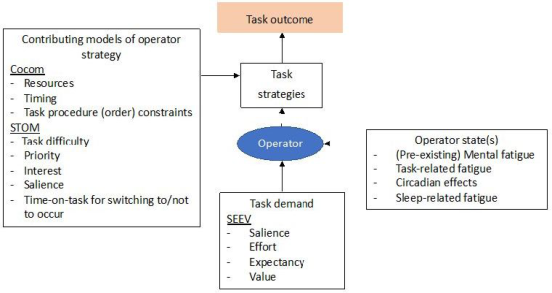
Operator expertise should also be considered in the models as individual differences are present in real-world contexts, including the aspect of task training, seniority and/or expertise to optimize task and resource manage- ment (Bender et al, 2017; Westbrook et al, 2017). These additional factors compliment the STOM attributes of difficulty, as they could be a regulating factor of difficulty and ultimately encourage operators to respond to sali- ent information with increased task familiarity and operator choice (Adler & Benbunan-Fich, 2015; Rill et al, 2018). For example, operators having the freedom (essentially in a scrambled mode according to COCOM) to ope- rate independently or instructed with a pre-determined task order (i.e. either with tactical or opportunistic mode) may be a defining feature of task and resource management (See Figure 1). Multitasking performance in various settings require different modes of control, but the strategic modes may dif- fer depending on the task and the relevance of the strategy (Rauffet et al, 2020). Despite the exploration of cognitive control, implicating and modeling these attributes in a multitasking simulation with physiological measures has shown promising results in predicting maximal or minimal operator effort.
Exploring Multitasking Performance and Fatigue with the MATB-II 27
Figure 1: This figure demonstrates the interplaying dynamics of the different factors that contribute to task outcome at different levels.
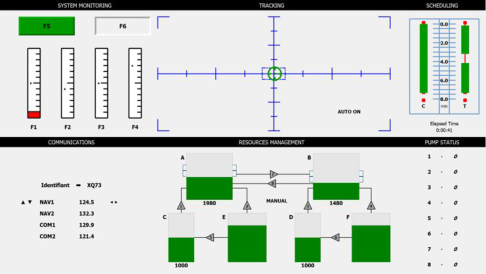
MATB-II AS AN EXPERIMENTAL FRAMEWORK Originally developed by NASA, the MAT-B II has been used to simulate operations in aviation. The MAT-B II tasks consist of system monitoring (SYSMON), tracking (TRACK), communications (COMM), and resource management (RESMAN) with pump-status which can be configured to three difficulty levels (low, medium, and high). These tasks simulate gene- ral piloting tasks which include the detection and response to the ‘aircraft’ system, navigation, over-radio communication, and the management of ‘fuel’ (Stantiago-Espada et al, 2011). A ‘scheduling’ (SCHED) display allows the operator to predict the incoming workload(s) (see Figure 2). The task also includes the NASA Task Load Index (NASA-TLX) as a post-task measure of subjective workload, the configuration for task automation or manualiza- tion, and the manipulation of workload.
Alongside the MAT-B II metrics, eye tracking, various physiological (e.g. electroencephalogram (EEG) and functional magnetic resonance imaging (fMRI)), reaction time, and self-reporting measures have been investigated to predict or detect impaired multitasking. Blink rate and gaze have been utili- zed as tools to demonstrate the allocation of attention and effort, which have been correlated with the management multitasking with SEEV and STOM attributes (Zabala & Gutzwiller, 2021). Aligning with previous workload findings (e.g., Ardoin et al, 2014; Stark et al, 2000), Fairclough et al (2005) explored blink rates and showed that TRACK and RESMAN had performa- nce decrements when task demand was high. However, accuracy on gauge management of RESMAN increased which may be due to the change of dif- ficulty during the task. The reduced mean blink rate found in this study might be due to the high need for visual attention and demands (Veltman & Gillard, 1996). Hence, to optimize visual occlusion, blinking may have decreased. Zabala & Gutzwiller (2014) conducted an eye-tracking study with the MAT- B II that manipulated tracking difficulty with multitasking and found that there was less switching during the ‘difficult’ than in the ‘easy’ task levels when paired respectively with the other tasks (i.e., SYSMON, COMM, and RESMAN) which also supports and compliments findings regarding greater
Figure 2: Displays the MAT-B II operator interface showing all the MAT-B II features. From left (top) SYSMON, TRACK, SCH, COMS, and RESMAN showing pump status.
workload (Stark et al, 2000). Interestingly, mixed findings are observed with eye-tracking used to measure gaze fixation, the effect of task prioriti- zation (e.g., being instructed to prioritize a task), and the number of switches (Zabala & Gutzwiller, 2021). Additionally, blink rate and pupil diameter could be reliable for measuring cognitive load and attention allocation, and perceptual load (Bocca & Denise, 2006; Chen & Epps, 2014).
Heart rate (HR, beats/min), heart rate variability (HRV), EEG, and fMRI studies have shown mixed findings in physiologically quantifying the impa- cts of task-related fatigue during multitasking. Hsu and Colleagues (2015), using the MAT-B II found that EEG of frontal-central areas were appropriate for detecting low-medium and low-high mental workload which was signi- ficantly correlated with the NASA-TLX (Fairclough et al, 2005; Veltman & Gillard, 1996; Wilson et al, 2007). This study also showed that HRV was a sensitive indicator to workload which was correlated with high mental wor- kload. Similar findings have supported this with observations of time-of-day effects and sleep deprivation (Wilson et al, 2007; Kong et al, 2022). These fin- dings demonstrate the reliability of the MAT-B II for simulating multitasking. It would be interesting to examine the self-rated and MAT-B II performance along with training to improve multitasking as it would provide global insight on multitasking and fatigue.
CONCLUSION
It has been well established that task-related fatigue can lead to decrements of task performance, yet this is difficult with multitasking. The findings from this review suggest that multitasking is complex and that the capacity to multitask with pre-existing and additional fatigue is limited. Future studies could simulate microworlds with the MAT-B II for greater durations, and/or investigate the effects of instantaneous overloading and underloading wor- kload to replicate high-tempo switching. These studies would help to better understand the complexities of multitasking, a key aspect of many dynamic environments.
Exploring Multitasking Performance and Fatigue with the MATB-II 29
ACKNOWLEDGEMENT
This paper has been supported by the French Embassy through the Nicolas Baudin Internship Initiative program and in collaboration with the affiliated universities.
REFERENCES
Adler, R.F., and Benbunan-Fich, R. (2014), “The effects of task difficulty and multitasking on performance.” Interacting with Computers, 27, 430–439. Alhola, P., and Polo-Kantola, P. (2007), “Sleep deprivation: Impact on cognitive
performance.” Neuropsychiatric Disease and Treatment, 3(5), 553–567. Ardoin, W.J., Ferris, and T.K. (2014), “Redundancy gain or cost? performance effects of redundantly-encoded tactile displays in multitask Scenarios.” 58th Human Factors and Ergonomics Society Annual Meeting, 57. Banks, S., Landon, L.B., Dorrian, J., Waggoner, L.B., Centofanti, S.A., Roma, P.G.,
and Van Dongen, H.P.A (2019), “Effects of fatigue on teams and their role in 24/7 operations.” Sleep Medicine Reviews, 48, 1–9. Bender, A.D., Filmer, H.L., and Dux, P.E. (2017), “Dynamic continuous multitasking training leads to task specific improvements but does not transfer across action selection tasks.” npj Science of Learning, 14 (376), 1–10. Bernhardt, K.A., Poltavski, D., Petros, T., and Ferraro, R. (2019), “Differentiating
active and passive fatigue with the use of electroencephalography.”Human Factors and Ergonomics Society Annual Meeting, 1285–1289. Bocca, M., and Denise, P. (2006), “Total sleep deprivation effect on disengagement of spatial attention as assessed by saccadic eye movements.” Clinical Neurophysiology, 117, 894–899. Caldwell, J., and Ramspott, S. (1998), “Effects of task duration on sensitivity to sleep
deprivation using the multi-attribute task battery.” Behavior Research Methods, Instruments & Computers, 30, 651–660. Camden, A., Nickles, M., Fendley, M., and Philips, C.A. (2017), “A case for information theory-based modelling of human multitasking performance.” Theoretical Issues in Ergonomics Science, 18 (3), 266–278. Chen, S., and Epps, J. (2014), “Using task-induced pupil diameter and blink rate to
infer cognitive load.” Human-Computer Interaction, 29(4), 390–413. Chua, E.C., Yeo, S., Lee, I.T., Tan, L., Lau, P., Cai, S., Zhang, X., Puvanendran, K., and Gooley, J.J. “Sustained attention performance during sleep deprivation associates with instability in behavior and physiologic measures at baseline.”Sleep, 37(1), 27–39. Drummond, S.P.A., Gillin, C., and Brown, G.G. (2001), “Increased cerebral response
during a divided attention task following sleep deprivation.” Journal of Sleep Research, 10(2), 85–92. Fairclough, S.H., Venables, L., and Tattersall, A. (2005), “The influence of task demand and learning on the psychophysiological response.” International Journal of Psychophysiology, 56(20), 171–184. Fan J., and Smith A.P. (2017), “The impact of workload and fatigue on perfor-
mance.” In: Longo L., and Leva M. (eds.) Human mental workload: models and applications. Communications in Computer and Information Science, 726, 90–105. Gartenberg, D., Gunzelmann, G., Hassanzadeh-Behbaha, S., and Trafton, J. G.
(2018), “Examining the role of task requirements in the magnitude of the vigilance decrement.” Frontiers in Psychology, 9, 1–13.
Gosselin, A., Koninck, J.D., and Campbell, K.B. (2005), “Total sleep deprivation and novelty processing: Implication of frontal lobe functioning.” Clinical Neurophysiology, 116, 211–222. Gupta, C.C., Centofanti, S., Rauffet, R., Banks, S., Coppin, G., and Chauvin, C.
(2019), “Framework and metrics for online fatigue monitoring within subma- rine teams working in 24/7 environments.” International Federation of Automatic Control, 250–264. Gutzwiller, R.S., Wickens, C.D., and Clegg, B.A. (2018), “The role of reward and effort over time in task switching.” Theoretical Issues in Ergonomics Science, 20(2), 196–214. Gutzwiller, R.S., Wickens, C.D., and Clegg, B.A. (2016), “The role of time on task in
multi-task management.” Journal of Applied Research in Memory and Cognition, 5, 176–184. Gutzwiller, R.S., Wickens, C.D., and Clegg, B.A. (2014), “Workload overload modeling: An experiment MATB II to inform a model of task management.” 58th Human Factors and Ergonomics Society Annual Meeting, 849–853. Harrison, H., and Horne, J.A. (1999), “One night of sleep loss impairs innova-
tive thinking and flexible decision making.” Organizational Behavior and Human Decision Processes, 78(2), 128–145. Hollnagel, E. (1996), “Reliability analysis and operator modelling.” Reliability Engineering and Systems Safety, 52(3), 327–337. Hollnagel, E. (1999), “Modelling the controller of process”. Transactions of the
Institute of Measurement and Control, 21(4-5), 163–170. Kong, Y., Posada-Quintero, H.F., Gever, D., Bonacci, L., Chon, K.H., and Bolkhovsky, J. (2008), “Multi-attribute task battery configuration to effectively assess pilot performance deterioration during prolonged wakefulness.” Informa- tics in Medicine Unlocked, 28, 1–11. Madore, K.P., and Wagner, A.D. (2019), “Multicosts of multitasking.” Cerebrum,
4–19. Meyer, D.E., and D.E, Kieras. (1997), “A computational theory of executive cognitive processes and multiple-task performance basic mechanisms.” Psychological Review, 104, 3–65. Musslick, S., and Cohen, J.D. (2021), “Rationalizing constraints on the capacity for
cognitive control.” Trends In Cognitive Sciences, 25(8), 757–775. Qi, P., Ru, H., Gao, L., Zhang, X., Zhou, T., Tian, Y., Thakor, N., Bezerianos, A., Li, J., and Sun, Y. (2019), “Neural mechanisms of mental fatigue revisited: New insights from the brain connectome.” Engineering, 5(2), 276–289. Rauffet, P., Said, F., Laouar, A., Chauvin, C., and Bressolle, M.C. (2020), “Cognitive
control modes and mental workload: An experimental approach.” 4th Internatio- nal Conference on Computer and Human Interaction Research and Applications, 17–26. Rill, R.A., Faragó, K.B., and Lörincz, A. (2018), “Strategic predictors of performance in a divided attention task.” PLoS ONE, 13(4), 1–27. Santiago-Espada, Myer, R.R., Latorella, K.A., and Comstock, J.R. (2011), “The
multi-attribute task battery II (MAT-B II) software for human performance and workload research: A user’s guide.” NASA, Virgina. Saxby, D.J., Matthews, G., Hitchcock, E.M., Warm, J.S., Funke, G.J., and Gantzer, T. (2008). “Effect of active and passive fatigue on performance using a dri- ving simulator”. 52nd Human Factors and Ergonomics Society Annual Meeting, 1751–1755.
Exploring Multitasking Performance and Fatigue with the MATB-II 31
Srna, S., Schrift, R.Y., and Zauberman, G. (2018), “The illusion of multitasking and its positive effect on performance.” Psychological Science, 29(12), 1942–1955. Stark, J.M., Scerbo, M.W., Freeman, F.G., and Mikulka, P.J. (2000). “Mental fati-
gue and workload effort allocation during multiple task performance.” Human Factors and Ergonomics Society Annual Meeting, 863–866. Stelzel, C., Bohle, H., Schauenburg, G., Walter, H., Granacher, U., Rapp, M.A., and Heinzel, S. (2018), “Contribution of the lateral prefrontal cortex to cognitive- postural multitasking.” Frontiers in Psychology, 9, 1–12. Van Cutsem, J., Marcora, S., Pauw, K.D., Bailey, S., Meeusen, R., and Rolelands, B.
(2017), “The effects of mental fatigue on physical performance.” Sports Medicine, 47, 1569–1588. Westbrook, J., Raban, M.Z., Walter, S.R., and Douglas, H. (2018), “Task errors by emergency physicians are associated with interruptions, multitasking, fatigue and working memory capacity: A prospective, direct observation study.” BMJ Quality and Safety, 27(8), 655–663. Wickens, C.D., and Gutzwiller, R.S. (2017), “The status of the strategic task over-
load model (STOM) for predicting multi-task management.” Human Factors and Ergonomics Society Annual Meeting, 757 -761. Wickens, C.D., Gutzwiller, R.S., and Santamaria, A. (2015), “Discrete task switching in overload: A meta-analyses and a model.” International Journal of Human-Computer Studies. 79, 79–84. Wilson, G.F., Caldwell, J.A. and Russell, C.A. (2007), “Performance and psych-
ophysiological measures of fatigue effects on aviation related tasks of varying difficulty.” International Journal of Aviation Psychology, 17(20), 219–247. Xie, B., and Salvendy, G. (2000), “Review and reappraisal of modelling and predicting mental workload in single- and multitask environments.” Work & Stress, 14, 77–99. Zabala, G.M., and Gutzwiller, R.S. (2021), “Validating the strategic task over-
load management (STOM) model using MATB II and eye-tracking.” 65th HFES International Annual Meeting, 700–704.
LISTED IN THE AHFE DIGITAL BOOKSTORE CATALOGUE
Explore the complete digital volume
Human Error, Reliability, Resilience, and Performance
Read this individual research paper free through the original publisher, or explore the full digital proceedings book.
ISBN 978-1-958651-09-4
Explore this ISBN in the AHFE Bookstore ↗Listed in the July 2026 bookstore catalogue; search by ISBN to confirm current availability · Digital book purchase optional