Xia Xia, Deyu Zhou, Haifeng Li (2022). The Effects of Skip Buttons on Brand Recognition in Open-screen Advertising. In: Usability and User Experience. AHFE Open Access, vol. 39, pp. 513–523. https://doi.org/10.54941/ahfe1001749
Open-screen advertising is one kind of popular mobile advertising with the characteristics of full-screen, mandatory, and wide coverage. However, the intrusiveness induced by its sudden appearance reduces users’ experience of mobile applications. Inserting a skip button into the advertisement is a good way to improve users’ experience but may affect the advertising effectiveness. Across two studies, we tried to find a win-win solution that makes users less disgusted with open-screen advertising and has no detrimental effect on the advertising effectiveness concerned by advertisers. We demonstrate the solution that advertisers can force users to view the advertisement for three seconds and then provide the skip button. Implications are provided for advertising on mobile phones and web pages, and theoretical contributions are described.
According to The 47th China Statistical Report on Internet Development (CNNIC 2021), by December 2020, the total number of mobile applications (mobile apps) had reached 3.45 million. Due to the large audience of apps and the use of apps having no geographical restrictions, advertising on mobile apps has become a vital information dissemination carrier between businesses and consumers. Open-screen advertising, also known as flash-screen adver- tising, refers to the full-screen advertising displayed when the mobile app launches, generally lasting for 3-5 seconds (Li 2019). It has the characteri- stics of full-screen, mandatory, and wide coverage. These characteristics make the exposure of open-screen advertising almost the highest among all mobile advertising, creating a solid visual impact on users. Investigation report on the marketing trend of Chinese advertisers in 2019 shows that open-screen adver- tising is one of the most popular types of mobile advertising for advertisers (CTR 2019).
Although the advantages of open-screen advertising are apparent, a pra- ctical dilemma cannot be ignored: it may reduce the user experience of apps. When people launch the apps, they usually have a specific goal to get some information or be entertained. However, open-screen ads will be exposed when the mobile phone loads the apps without warning. Although the sudden
appearance of an open-screen ad captures viewers’ attention and may bene- fit the advertising effectiveness, this kind of mandatory exposure is likely to generate a great sense of dissatisfaction and create a sense of intrusion to users (Cho and Cheon 2004). Several studies have shown that the intrusi- veness of advertising increases users’ frustration and irritation and reduces their user experience of apps (Kim et al. 2019; Logan 2013; Oh et al. 2019;). Ultimately, it may reduce users’ loyalty to the apps (Goodrich et al. 2011).
In addition to the intrusiveness of open-screen advertising, advertising time is another factor that affects users’ experience of apps. Many studies have shown that users are impatient with page loading or mandatory advertising (Jeon et al. 2019; Oshiba et al. 2002). If the exposure time of streaming media advertising is too long, viewers may feel annoying (Oshiba et al. 2002). The longer the ad lasts, the more unpleasantness consumers experience (Jeon et al. 2019). According to Tencent’s mobile page user behavior report in 2016, 74% of users will leave if the page loading time exceeds 5 seconds (Tencent Big Data 2016). Recently, China Internet Association even released a regu- lation that the maximum open-screen advertising time should not exceed 5 seconds (Internet Society of China 2021). Therefore, when it is impossible to avoid viewing advertising, some measures need to be taken to improve the apps’ user experience.
To eliminate the detrimental effect of long advertising time on user expe- rience, inserting a skip button into the ads is a good strategy. Since 2010 YouTube introduced skippable ads, this interactive format has become domi- nant in the industry. A skip button allowed users to skip the ad directly. Compared to non-skippable ads, skippable ads provide users the choice to view the ads or not. This interactive feature lets users gain a sense of control, improving their emotional experiences and increasing their satisfaction with apps (Pashkevich et al. 2012).
The Advertising Effectiveness Affected by Skip Buttons However, advertisers may worry that inserting a skip button into an open- screen ad will greatly affect the advertising effectiveness, especially when the skip button appears synchronously with the ad. This concern is very rea- sonable. According to the filter theory, the nervous system is limited in the capacity to process information (Broadbent 1958). When faced with complex scenes, people can often choose a part of the information for processing and ignore other information. Although the sudden appearance of ads will attract people’s attention, people open apps for information or entertainment. When the open-screen ad and the skip button appear simultaneously, people tend to find the skip button instead of viewing the ad. As a result, they memorize nothing about the contents of the ad. Therefore, is there a win-win solu- tion that makes users less disgusted with open-screen advertising and has no detrimental effect on the advertising effectiveness concerned by advertisers?
The Current Study To find a win-win solution for users and advertisers, we first conducted two experiments to explore how the exposure time (by manipulating the time
The Effects of Skip Buttons on Brand Recognition in Open-Screen Advertising 515
that the skip button appears in the ads) of open-screen ads affected users’ brand recognition. Then, we used the eye-tracker to analyze users’ attention distribution when they viewed the open-screen ads to find the critical eye movement indicators that affected users’ ability to memorize the advertising brands.
STUDY 1: THE SKIP BUTTON APPEARS (THREE SECONDS OR ONE SECOND) AFTER THE ADVERTISEMENT IS EXPOSED Computer-based experiments were designed in study 1(a, b) to investigate the presence of a skip button on the effect of the memory of open-screen advertising. According to the pretest results, the longest tolerance time for the open-screen ads is approximately three seconds. Therefore, we designed two conditions. One is a non-skippable condition during which participants have to view the ad passively. Another is a skippable condition in which a skip button appears after an ad is presented ( for three seconds in Study 1a and one second in Study 1b). According to the filter theory of selective attention (Broadbent 1958), attending to the skip button is detrimental to the proces- sing of the adv content. Thus, we proposed the hypothesis that participants had a higher memory performance under the non-skippable condition than the skippable condition.
We designed Study 1b because the results of Study 1a showed that the skip button had no adverse effect on the memory of the brand names, indicating that participants may fully process the ad within three seconds. We want to explore further whether the skip button impacts brand names’ memory if we shorten the forced exposure time of advertising.
METHOD
Material Twenty-one advertising pictures were made by photoshop. One was used for exercise, and others were used for the formal experiment. The size of the pictures was 369 * 655 pixels with a white background. Each picture contains a product picture, a brand name (two Chinese characters), and an advertising message (eight Chinese characters). The product picture is located at the center of the advertising picture. The brand name is located on the upper left of the product picture. The advertising message appears below the product picture. The sizes of the skip button, brand name, and advertising message were 37 * 75 pixels, 37 * 75 pixels, and 37 * 317 pixels, respectively. This kind of setting is similar to the skip button setting in most open-screen ads in reality. If we set the center coordinate of the picture to (0, 0) (the unit is pixels), then the center coordinate for the skip button is (125, 268), for the brand name is (–95, 153), and for the advertising message was (0, –149).
We searched for 21 categories of product pictures from the internet in the principles of avoiding mainstream brands, celebrity effect, and gender pre- ference. These categories include cup, mouse, towel, glasses, backpack, air conditioner, etc. The brand names were also selected from the internet to avoid familiarity. In addition, we invited 22 participants to rate the familiarity
of the brand names on a 7-point Likert scale ranging from 1 (very unfamiliar) to 7 (very familiar). The result showed that participants were unfamiliar with the brand names. The average score for the brand names was less than 2.0. At last, we chose two brand names with similar familiarity for each product category.
The materials in the two experiments are the same except for the position of the skip button. In Study 1a, the skip button was fixed at the upper right corner of the ad under the skippable condition. In Study 1b, the skip button appears randomly at the four corners of the ad.
Participants Each experiment recruited 60 participants from Fujian Normal University with an average age of 20.38 ± 2.80 years (Study 1a) and 18.97 ± 1.47 years (Study 1b). 50% of them were females. All the participants had normal or corrected-to-normal vision.
Procedure and Design E-prime2.0 was used to present the experimental materials. The experiment consisted of three stages: a learning stage, an interference task, and a recogni- tion task. The learning stage began with a 500 ms fixation in the center of the screen. Then an advertising picture was presented. Participants were asked to view the ad, and they were never told to remember the product, brand name, or advertising message. Under the non-skippable and the skippable condition, the advertising picture was presented for 6 seconds (4 seconds in Study 1b). After 3 seconds of display (1 second in study 1b), a skip button will appear in the upper right corner of the picture under the skippable con- dition. Participants were free to click the skip button to skip the ad or wait for six seconds until it disappeared. Twenty pictures were presented one by one in random order. The mouse pointer was reset to the center of the screen in each trial.
In the interference task, participants were asked to perform a continuous subtraction for one minute. Then they should perform the recognition task during which their memory for the brand names was assessed. Twenty brands were presented in the learning stage as old brands, and 20 were never pre- sented before as new brands. Each participant should rate the 40 brands on a 6-point Likert scale ranging from 1 (very sure to have seen it before) to 6 (very sure not to have seen it before).
These experiments are single-factor between-subjects designs. The inde- pendent variable is the existence of a skip button (the skippable and non- skippable conditions). The dependent variables are the hit rate, false alarm rate, recognition degree function, and response bias for the brand names.
Data Analysis First, we calculated the hit rate and false alarm rate in this study. We classified participants’ responses of ‘1’ to ‘3’ as ‘have seen it before’ and ‘4’ to ‘6’ as ‘not to have seen it before’. Second, we used the Set-Valued Statistics method to
The Effects of Skip Buttons on Brand Recognition in Open-Screen Advertising 517
compute the recognition degree function f(u) to represent an individual’s sen- sitivity, and the β represents individuals’ response bias. Researchers generally calculate the d’ to represent individuals’ sensitivity in the signal detection the- ory. However, the premise of calculating d’ is that participants’ sensations on signal and noise are normally distributed, and their sensitivities are unchan- ged during the experiment. Therefore, to ensure the effectiveness of the data and avoid errors, it is necessary to increase the number of experimental trials to make the data be normally distributed. However, in the actual experiment, increasing experimental trials will increase the difficulty of the experiment and make participants tired, which will affect the reliability and validity of the results. When the total number of trials is relatively low, the method of Set-Valued Statistics is a better method to deal with the data collected by the confidence method because it does not restrict the data to conform to the normal distribution (Meng 1988; Selker et al. 2019). Therefore, we used the Set-Valued Statistics method to calculate the f(u) and β. The f(u) value ran- ges from 0 to 1. ‘0’ indicates participants have no sensitivity, and ‘1’ indicates they have a strong sensitivity or a good recognition ability between target and interference stimuli. If the β is greater than 1, then participants have a strict response bias and tend to make the judgments of ‘no signal’; if the β is less than 1, then participants have a loose response bias and tend to make the judgments of ‘noise’.
RESULTS
In Study 1a, under the skippable condition, 63.50% of the participants clicked the skip button. The data were shown in Table 1. There was no signi- ficant difference in the hit rate between the non-skippable group (M = 0.66, SD = 0.19) and the skippable group (M = 0.59, SD = 0.20), t (58) = 1.35, p = 0.182. The false alarm rate also did not differ between the non-skippable group (M = 0.30, SD = 0.22) and the skippable group (M = 0.22, SD = 0.16), t (58) = 1.54, p = 0.129.
The recognition degree function f (u) did not differ between the non- skippable group (M = 0.66, SD = 0.09) and the skippable group (M = 0.66, SD = 0.76), t (58) = 0.34, p = 0.734. Under the two conditions, participants’ sensitivities were above the medium level. There was no significant differe- nce in the response bias (β) between the non-skippable group (M = 1.06, SD = 0.41) and the skippable group (M = 1.24, SD = 0.73), t (58) = –1.18, p = 0.241. The two groups had a strict response bias and tended to make the judgments of ‘no signal’ (or ‘noise’).
In Study 1b, 91.83% of the participants clicked the skip button to skip the ads under the skippable condition. The hit rate of brand names was signi- ficantly higher in the non-skippable group than in the skippable group, t (58) = 4.10, p < 0.001, Cohen’s d = 1.08. There was no significant difference in the false alarm rate between the two groups, t (58) = –1.24, p = 0.221.
The recognition degree function f (u) was significantly better in the non- skippable group than that in the skippable group, t (58) = 4.62, p < 0.001, Cohen’s d = 0.61. Although both groups had a strict response bias, the
Table 1. The hit rate, false alarm rate, recognition degree function, and response bias of brand recognition in the skippable and non-skippable groups.
response bias was stricter in the skippable group than in the non-skippable group, t (58) = –2.19, p = 0.033, Cohen’s d = 0.53.
Study 2: An Eye-Tracking Experiment Study 1 showed that compared to the non-skippable condition, the skip but- ton had no detrimental effect on the memory of the brand names when it appeared three seconds after the forced exposure of the ad. However, the skip- pable condition showed lower memory performance than the non-skippable condition when the skip button appeared one second after the forced expo- sure of the ad. We inferred that three seconds, but not one second were long enough for participants to process the ad’s content.
However, in the present experiments, the ad consisted of a brand name, a product picture, and an advertising message. Participants may distribute their attention to observe these contents within three seconds. So the question is, what causes participants to remember the brand name in three seconds. Pre- vious studies have shown a close relationship between eye movement and visual attention, and the visual processing pattern of eye movement reflected an individual’s cognitive state (Cole et al. 2011; Williams 2020; Rueda 2017). The distribution of fixations provides detailed information about which part of the ad can effectively capture participants’ visual attention. The number of fixations and fixation duration at each area provide information on that area’s cognitive and perceptual processing (Rayner 1998, 2009). Therefore, in Study 2, we extended Study 1 by using the eye-tracker to examine the number of fixations and fixation duration at the brand name area. We hypo- thesized that the number of fixations and fixation duration had no significant differences between the non-skippable and skippable groups in the first three seconds.
METHOD
Participants Forty new undergraduate and graduate students with an average of 19.78 ± 2.33 years from Fujian Normal University were paid to participate in this
The Effects of Skip Buttons on Brand Recognition in Open-Screen Advertising 519
experiment. 75% of them were females. All the participants had normal or corrected-to-normal vision.
Material, Procedure, and Design The material, procedure, and design used in Study 2 were identical to Study 1b. The Eye-link 1000 is used to collect the eye movement data in this expe- riment. The display size is 19 inches, and the resolution is 1024 * 768 pixels. The eye movement calibration was carried out before the experiment.
RESULTS
Behavioral Data 81% of the participants clicked the skip button under the skippable con- dition. There was no significant difference in the hit rate between the non- skippable group (M = 0.60, SD = 0.16) and the skippable group (M = 0.60, SD = 0.19), t (38) = – 0.05, p = 0.964. The false alarm rate did not differ between the non-skippable group (M = 0.16, SD = 0.12) and the skippable group (M = 0.15, SD = 0.11), t (38) = 0.28, p = 0.779.
The recognition degree function f (u) did not differ between the non- skippable group (M = 0.66, SD = 0.08) and the skippable group (M = 0.67, SD = 0.07), t (38) = – 0.62, p = 0.542. There was no significant difference in the response bias (β) between the no-skippable group (M = 1.35, SD = 0.85) and the skippable group (M = 1.37, SD = 0.71), t (38) = – 0.10, p = 0.922. Participants in both groups had a strict response bias and tended to make the judgments of ‘no signal’ (or ‘noise’).
Eye Movement Data The interest area of this study was defined as the area that covered the brand name. The size of this area was 74 * 150 pixels. We focused on the number of fixations and fixation duration in the first and last three seconds in this area.
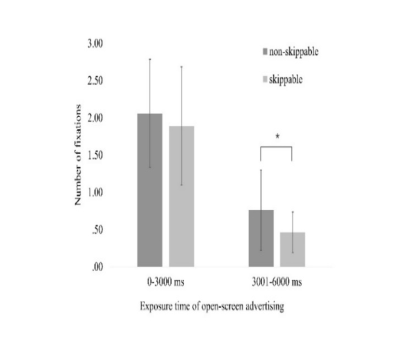
As was shown in Figure 1, the number of fixations had no significant dif- ference between the non-skippable (M = 2.06, SD = 0.74) and skippable (M = 1.89, SD = 0.80) groups in the first three seconds, t (38) = 0.71, p = 0.482. However in the last three seconds, participants had a higher num- ber of fixations under the non-skippable condition (M = 0.76, SD = 0.55) than the skippable condition (M = 0.46, SD = 0.28), t (38) = 2.20, p = 0.036, Cohen’s d = 0.71. The fixation duration had no significant difference betw- een the non-skippable (M = 638, SD = 255) and skippable (M = 510, SD = 206) groups in the first three seconds, t (38) = 1.77, p = 0.085. How- ever in the last three seconds, participants had a longer fixation duration under the non-skippable condition (M = 233, SD = 167) than the skippable condition (M = 92, SD = 86), t (38) = 3.47, p = 0.001, Cohen’s d = 1.12.
Figure 1: The number of fixations and fixation duration in the interest area of the brand name under the non-skippable and skippable conditions in the first and last three seconds. *p < 0.05, ***p = 0.001.
GENERAL DISCUSSION Through two studies, we examined how the forced exposure time of open- screen ads (realized by manipulating the appearance time of the skip but- ton) affected ad brands’ memory. We demonstrated that participants had a comparable memory performance on the ad brands between the skippa- ble and non-skippable conditions when the open-screen ads were forced to expose for three seconds. However, when this exposure time was shorte- ned to one second, participants had a higher memory performance under the non-skippable condition than the skippable condition. The eye-tracking experiment further demonstrated no significant differences in the number of fixations and fixation duration in the first three seconds between the skippa- ble and non-skippable conditions. These results indicate that setting a skip button after the open-screen ad is exposed for three seconds may be a win- win solution, enabling users to tolerate ads’ exposure time and advertisers to achieve an ideal advertising effectiveness.
Theoretical Contributions This research complements and develops the classic Attention-Interest- Desire-Memory-Action (AIDMA) model. According to this model, to make a purchase happen, an ad should attract consumers’ attention, inspire their interest, induce their potential needs and desires for consumption, and let them memorize it (Li 2012). The open-screen ad captures users’ attention through its sudden appearance and strong visual impact when launching the apps. In most cases, users will not make a purchase immediately but make it when they need it after forming a memory of advertising. Several resea- rchers have shown that brand recognition significantly impacts consumers’ purchase decisions (Drèze and Hussherr 2003; Li and Lo 2015). Our research demonstrated that without requiring participants to memorize the advertising
The Effects of Skip Buttons on Brand Recognition in Open-Screen Advertising 521
brands, they could form a relatively stable impression of these brands in three seconds. This result indicates that if advertisers want users to remember their brands, they need to let users passively process the ads for a period of time. We suggest that the factor of advertising viewing time should be integrated into the AIDMA model.
Practical Implications This research also provides two practical implications. First, we have a direct suggestion to launch open-screen advertising on mobile devices. We suggest that when publishing an open-screen ad, the ad can be forced to be exposed for three seconds, and then a skip button appears in the ad to give users the right to choose to skip the ad. Users will not have too many lousy user experiences due to the forced exposure time of three seconds (Liu et al. 2016). More importantly, our results indicated that three seconds was enough for users to process the advertising brand to a certain degree so as to ensure advertising effectiveness.
Second, our results showed that fixation time and the number of fixations were two good eye movement indicators to evaluate advertising effective- ness. This study used eye movement equipment to explore participants’ eye movement patterns on advertising brands with and without skip buttons. The results found that, within three seconds of the forced exposure of the ad, if the participants stared at the brand area for about 500-600 ms and generated about two fixations, they may recognize 60% of the previously presented advertising brands in the recognition test. It is worth mentioning that in our study, the participants were unaware that they would take the brand recognition test because our instructions only asked them to watch the ads. Moreover, the advertising picture we presented includes not only an advertising brand but also a product picture and an advertising message. Therefore, we believe that these two eye movement indicators, fixation time and the number of fixations, can be used to evaluate advertising effective- ness. For example, when we want to examine the advertising effectiveness of a perfume ad, we can assess whether users’ gazes are more focused on the areas we want the user to pay attention to.
Limitations and Directions for Future Research This research entails several limitations. First, the experimental materials only use static pictures with a few contents. However, our real life is full of many dynamic, well-made, and informative ads. Therefore, it is still unknown whe- ther the skip button will affect the advertising effectiveness of these dynamic open-screen ads. Second, the present study only used the memory of adverti- sing brands as an index to measure advertising effectiveness. However, every ad also contains a product picture and an advertising message. Participants may pay more attention to the product picture or the advertising message but pay less attention to the brand name under the skippable condition than the non-skippable condition. Therefore, we may need to find a more com- prehensive indicator that can consider all the contents presented in the ad. Third, in this study, participants watched advertising pictures simulating the
size of mobile phones on a computer. This situation may differ from people’s feeling of watching open-screen ads on mobile phones. However, conside- ring that many web pages also set up similar ads, the results of this study may also have reference significance for online advertising. In future resea- rch, we can further verify whether the results of this study are also applicable to web advertising. Last, our study does not completely simulate the scene of people being invaded by open-screen advertising in daily life, which may affect the generalizability of the results. In daily life, open-screen ads often appear when people open an app. People have expectations for using apps (Belanche et al. 2017), which may weaken their attentional resources inve- sted in the ads. Therefore, it is still unknown whether this expectation will affect advertising effectiveness.
ACKNOWLEDGMENT
This research was supported by the National Social Science Fund of China (16CSH047) and the Education Program for Young and Middle-aged Teacher of Fujian Province (JAT201381).
REFERENCES
Belanche, D., Flavián, C. and Pérez-Rueda, A. (2017). Understanding interactive online advertising: Congruence and product involvement in highly and lowly arousing, skippable video ads. Journal of Interactive Marketing, 37, pp. 75–88. Broadbent, D. E. (1958). Perception and communication. London: Pergamon Press. Cole, M. J., Gwizdka, J., Liu, C., Bierig, R., Belkin, N. J. and Zhang, X. (2011).
Task and user effects on reading patterns in information search. Interacting with Computers, 23(4), pp. 346–362. Cho, C. H. and Cheon, H. J. (2004). Why do people avoid advertising on the internet?. Journal of Advertising, 33(4), pp. 89–97. CTR. (2019). Investigation Report on Marketing Trend of Chinese Advertisers in
2019 [online]. Available from: https://www.sohu.com/a/312986356_100008673 [accessed 30 December 2021]. Drèze, X. and Hussherr, F. X. (2003). Internet advertising: Is anybody watching?.
Journal of Interactive Marketing, 17, pp. 8–23. Goodrich, K., Schiller, S. and Galletta, D. (2011). Intrusiveness of online video advertising and its effects on marketing outcomes. In Proceedings of ICIS 2011, Shanghai, China. pp. 1–10 Internet Society of China. (2021). Code of conduct for mobile Internet application
(APP) open-screen advertising [online]. Available from: https://www.isc.org.cn/w zgg/listinfo-39657.html [accessed 30 December 2021]. Jeon, Y. A., Son, H., Chung, A. D. and Drumwright, M. E. (2019). Temporal certainty and skippable in-stream commercials: Effects of ad length, timer, and skip-ad button on irritation and skipping behavior. Journal of Interactive Marketing, 47, pp. 144–158. Jones, P. R., Moore, D. R., Shub, D. E. and Amitay, S. (2015). The role of response bias
in perceptual learning. Journal of Experimental Psychology: Learning, Memory, and Cognition, 41(5), pp. 1456. Kim, K. K., Gravier, M. J., Yoon, S. and Oh, S. (2019). Active bidders versus smart bidders: Do participation intensity and shopping goals affect the winner’s joy in online bidding?. European Journal of Marketing. Volume 53, No. 4, pp. 585–606.
The Effects of Skip Buttons on Brand Recognition in Open-Screen Advertising 523
Li, H., and Lo, H. Y. (2015). Do you recognize its brand? The effectiveness of online in-stream video advertisements. Journal of Advertising, 44(3), pp. 208–218. Li, J. (2019). On the function and design trend of APP startup page. Art Education
Research(8), pp. 2. Li, X. D. (2012). Communication Characteristics of the Meanings of Advertising Works in the New Media Age. In Proceedings of the 9th International Conference on Innovation and Management. pp. 1418–1421. Liu, S., He, J. Q. and Li, Q. X. (2016). User experience research of mobile client app
system time. Modern Business, 91(28), pp. 187–188. Logan, K. (2013). And now a word from our sponsor: do consumers perceive advertising on traditional television and online streaming video differently?. Journal of Marketing Communications, 19(4), pp. 258–276. Meng, Q. M. (1988). Experimental studies on indexes of recognition. Acta Psycho-
logica Sinica(1), pp. 45–51. Oh, S., Yoon, S. and Vargas, P. (2019). “In-depth” incidental exposure: How processing difficulty and processing style affect evaluations of transparent overlay images. European Journal of Marketing, 53(2), pp. 279–98. Oshiba, T., Koike, Y., Tabuchi, M., and Kamba, T. (2002). Personalized advertisement-duration control for streaming delivery. In Proceedings of the tenth ACM international conference on Multimedia. pp. 21–28. Pashkevich, M., Dorai-Raj, S., Kellar, M., and Zigmond, D. (2012). Empowe-
ring online advertisements by empowering viewers with the right to choose: the relative effectiveness of skippable video advertisements on YouTube, Journal of Advertising Research, 52(4), pp. 451–457. Rayner, K. (1998). Eye movements in reading and information processing: 20 years of research. Psychological Bulletin, 124(3), pp. 372–422. Rayner, K. (2009). Eye movements and attention in reading, scene perception,
and visual search. Quarterly Journal of Experimental Psychology, 62(8), pp. 1457–1506. Reckless, G. E., Bolstad, I., Nakstad, P. H., Andreassen, O. A. and Jensen, J. (2013).
Motivation alters response bias and neural activation patterns in a perceptual decision-making task. Neuroscience, 238, pp. 135–147. Rueda, A. P. (2017). Understanding new online video advertising: the role of arousal and skippability on ad effectiveness (Doctoral Dissertation, Universidad de Zaragoza). Selker, R., Bergh, D., Criss, A. H., and Wagenmakers, E. (2019). Parsimonious esti-
mation of signal detection models from confidence ratings. Springer Open Choice, 51(5), pp. 1953–1967. Tencent Big Data. (2016). Mobile Page User Behavior Report [online]. Available from: https://bigdata.qq.com/article?id=2944 [accessed 30 December 2021]. CNNIC. (2021). The 47th China Statistical Report on Internet Develo- pment [online]. Available from: http://www.cac.gov.cn/2021-02/03/c_ 1613923423079314.htm [accessed 30 December 2021]. Williams, C. C. (2020). Looking for your buttons: The interaction of attention,
memory, and eye movements in visual search. Psychology of Learning and Motivation, 73, pp. 195–229. doi:10.1016/bs.plm.2020.06.003. Yang, Z. L. Guo, L. P. (1998). Review of Recognizing Indexes in Memory Research.
Journal of East China Normal University (Educational Sciences)(1), pp. 74–80.
LISTED IN THE AHFE DIGITAL BOOKSTORE CATALOGUE
Explore the complete digital volume
Usability and User Experience
Read this individual research paper free through the original publisher, or explore the full digital proceedings book.
ISBN 978-1-958651-15-5
Explore this ISBN in the AHFE Bookstore ↗Listed in the July 2026 bookstore catalogue; search by ISBN to confirm current availability · Digital book purchase optional