Iara Margolis, João Sampaio, Bernardo Providência (2022). Education in context and the variation of moods throughout Covid-19: An emotional design perspective, using the BRUMS methodology. In: Affective and Pleasurable Design. AHFE Open Access, vol. 41, pp. 272–281. https://doi.org/10.54941/ahfe1001807
The year 2020 was marked by the Covid-19 pandemic, where in addition to the whole situation of the danger of the virus, it had several emotional and social impacts. As a result of this scenario, in some places – such as Brazil – higher education classes have migrated to remote spaces. It is worth to notice that the educational sector is an important sector for the market and for society, and one of its metrics for strategic decisions is the understanding of student satisfaction. In turn, emotional design aims to understand the human being from an affective perspective, beyond functional issues. In view of this, this study aims to analyze the fluctuations of students' moods in the educational context, throughout the 2020 pandemic year, in the face of various milestones of the academic cycle, through the self-report tool BRUMS (Brunel Mood Scale) from the perspective of the emotional design. In total, there were 6 data collection moments, in two educational cycles, between April and December 2020, accounting for a total of 144 responses. As a result, it was possible to perceive the fluctuation of students' moods throughout the educational cycle in the pandemic period, evidencing the tension in the test periods, the fatigue during the lockdown, the vigor in the beginning and end of the semester. Anger was the least activated mood throughout the cycle, followed by depression. It was possible to perceive that BRUMS is a tool that helps in understanding mood, throughout the service cycle, enabling decision-making and planning of more user-centered services, in addition to a greater concern in emotional aspects to, in this case, promote a better academic experience in the educational context.
Emotional design (or affective design) aims to understand the design inter- face, desires and needs of the human being beyond functional issues. This implies the emotional understanding and affective properties of this relati- onship (Ng and Khong, 2014). This area focuses on studying how external stimuli evoke internal emotions in human beings and how these emotions can be measured, understood and, obviously, used within design (Helander et al., 2015). Moods, in addition to being related to the emotional state itself, are also associated with human responses and decision-making. Humor is
Education in Context and the Variation of Moods Throughout Covid-19 273
understood as a temporary phenomenon, but its initial or final state is not clearly known, as well as its real reasons (Keltner et al., 2014).
The POMS is a self-report tool that was developed in 1971 in the psychia- tric outpatient clinic. Initially, it consisted of 65 analysis items, using a 5-point Likert scale, ranging from “not at all” to “extremely”, analyzing six subsca- les. These subscales, when analyzed separately, help in the study of specific mood change (Berger & Motl, 2000; Johansson et al., 2008). Despite the successful validation of the method (Inoue et al. 2003), it was reduced to the POMS-A by Terry et al. (1999), using and validating 24 analysis items for young people aged 11 to 18 years, under the six subscales of the original POMS structure: anger, depression, confusion, fatigue, tension and mood. Due to its applicability in adults, the model is also known as BRUMS (Brunel Mood Scale) (Rohlfs et al., 2004). It is reinforced that these are subscales of moods, thus depression is a depressed mood state, which differs from clinical depression.
In the educational context, emotions and motivations interfere in learning, in the teaching and decision-making process (Brockington, 2011). Therefore, 2020 was the initial pandemic period, composed of a new, uncertain con- text with changes in personal, family, professional and social life. The study of the subject, in addition to understanding the student from an emotional perspective, can have an influence on the capture of learning, becoming a point that should be considered. It is important to highlight that BRUMS has its validation in the academic context (Coutts et al., 2011; Ribeiro, 2020). Therefore, this work aimed to analyze the fluctuations of students’ moods in the educational context, throughout the 2020 pandemic year, in the face of various milestones of the academic cycle, through the BRUMS self-report tool from the perspective of emotional design.
METHODOLOGY
On March 17, 2020, a lockdown was decreed in the city of Recife, Brazil. Between understanding what was going on and putting the actions into ope- ration, it took some time and only in April-2020 the remote classes started. At first, and without much clarity on what the pandemic would be, two captures of the BRUMS application were designed, the first at the beginning of remote classes with the new context of COVID-19 and the second at the end of the semester, to know the fluctuations over this period of time. However, the pan- demic lasted longer than imagined, and the semester ended with the city still in lockdown and with the confirmation of the permanence of remote clas- ses, at first only for the beginning of the second semester. Because of this, the research was extended to 4 more moments of the academic cycle. It should be noted that classes continued online throughout the second semester, despite the reduction of restrictions.
Therefore, 6 collections were made, with a total of 144 responses over the 2-semester pandemic study cycle, namely: (1) at the first start of remote clas- ses, at the first lockdown in April 2020; (2) late June, just after the close of the first semester; (3) September, when the class was formed (after the regi- stration period); (4) October, before the first week of exams; (5) November,
in the period between tests; (6) December, post exam period, when students were receiving their results. It is noteworthy that in this institution there are exam weeks, where in the period of 6 days (from Monday to Saturday), stu- dents take all tests of all subjects enrolled, two or three times throughout the cycle. The last week of exams is optional for those who passed the grade, or a “recovery” for those who did not reach the mean.
The BRUMS self-report tool was used using the Portuguese words (Rohlfs, 2006). The Table 1 presents the words used in Portuguese and the (pseudo)correspondence in English according to Brandt et al. (2016). But some terms do not match correctly, as validation has a cultural and linguistic issue. For this reason, words with a “*” indicate that there is no such faith- ful correspondence between languages. In the results, when referring to the moods, the term used in the previous table was mentioned. However, when the terms did not have a good correlation in the translation, the word was in parentheses, and the most appropriate word was on the outside.
The scale used was unipolar, with a 5-point Likert scale, starting from 1 to 5, as follows: 1 (nothing); 2 (a little); 3 (moderately); 4 (Very much); 5(Extremely). At the end of the words there was an optional space for those who wanted to explain the reason they were feeling the way they were treated.
Data were processed in Excel, using the BRUMS Score that is the sum of each subscale, ranging from 0 to 16 and presented as a percentage (Rohlfs, 2006), and also an analysis of the mean and median. The median for under- standing that in an ordinal qualitative scale the answers are analyzed in relation to the order of classification and not to the numerical value of the numbers (Belfiore, 2015). However, the median often levels the responses within the parameters of the scale itself, and therefore it was also analyzed from the perspective of the mean.
RESULTS AND DISCUSSION
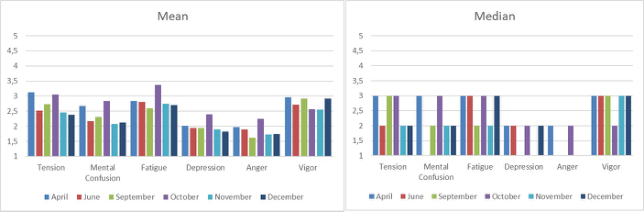
None of the 6 BRUMS subscales (either mean or median) had their value at the very (4) or extremely (5) levels, demonstrating that mood changes have moderate to non-existent activations. Figure 1 shows the graphs with a scale ranging from 1 to 5, from the perspective of each subscale, which shows the oscillation of moods throughout the academic cycle, with greater activation in the month of October, before starting the first exams week.
From the mean perspective, in a general analysis it is possible to see that the most activated mood were “fatigue” and “tension”. “Fatigue” ranked first with a mean of 3.37 in October, the month before the start of the second semester’s test cycle of the second semester, and in second place, “tension”, with a mean of 3.14 in April, at the beginning of the lockdown, and 3.05 also in October. “Anger” was the subscale with the lowest mean, mainly in September with 1.62 and having its highest mean in October, with a mean of 2.24.
When analyzed by the median, it is easier to see the activations of each of the subscales. In an analysis of the least activated to the most activated moods, we have the “anger” with activation “a little” in the months of April, at the beginning of the lockdown, and in the month of October, before the tests, and
Education in Context and the Variation of Moods Throughout Covid-19 275
Table 1. BRUMS words – Portuguese and English (Rohlfs, 2006; Brandt et al. 2016).
non-existent in the others. The “depression” subscale comes as the second minor, with activation “a little” in April, June and October, and non-existent in the other collection periods. The “mental confusion” had moderate acti- vation in the months of April and October, low activation in the months of September, November and December and inactivation in the month of June. The “tension” subscale had moderate activation in April, September, October and low activation in the other months. The “fatigue” had a mode- rate activation in the months of April, June, October, December and a low activation in the other months. Finally, the “vigor” had moderate activa- tion every month, except for the month of October. From the perspective of analysis by mean and median. The mean allows us to evaluate the results in a more comparative way between them, but the median allows us to have a clearer view of the activations of each subscale in view of the respondents’ answer.
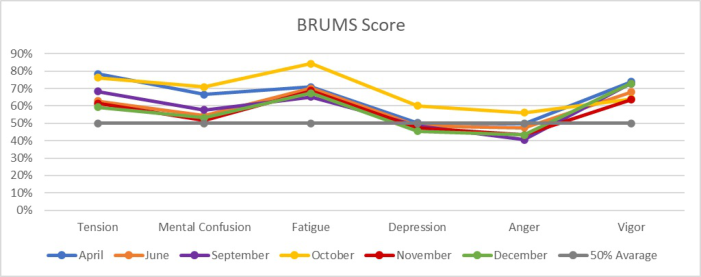
Figure 2: BRUMS Score.
Figure 2 demonstrates the BRUMS Score. Analyzing the responses from the perspective of the seasons of the year cycle, the month of October was the month that presented the worst BRUMS scenario, as it had the higher activation of “mental confusion”, “fatigue”, “depression” and “anger”, and the lowest activation of “vigor”. The second worst BRUMS score was in April, with higher activations of “tension”, and the second highest activa- tion of “fatigue”, “mental confusion”, “depression” and “anger”, but also it had the highest “vigor” activation. The months of December, November and September, respectively, presented the best BRUMS score.
An analysis was made of the lockdown period (first semester), where “mental confusion” and “tension” had a significant reduction, and “depres- sion” and “anger” practically maintains constancy. Analyzing the responses from de mood perspective, in April “tension”and “vigor”were the most acti- vated mood. In June were “fatigue” and “vigor”, in September were “vigor” and “tension”, in October were “fatigue” and “tension”, in November “fati- gue”and “vigor”, and December “vigor”and “fatigue”. In all academic cycle, “anger” and “depression” were the least activated moods.
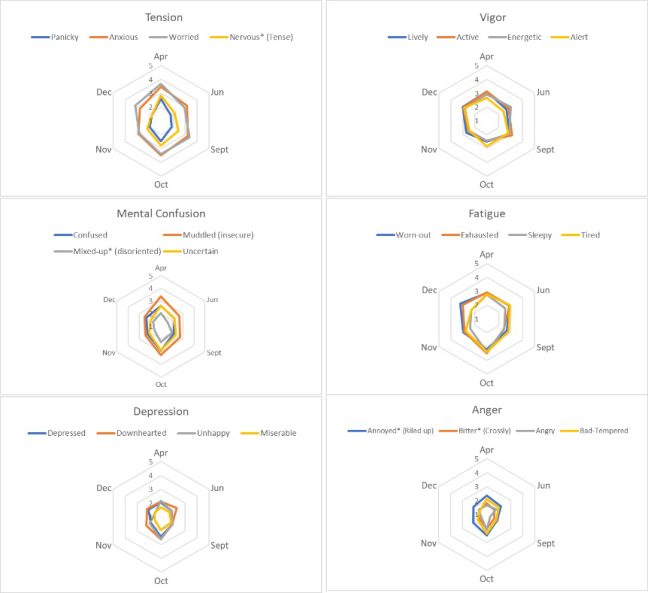
The mean was used in the polar graph to analyze moods in each subscale (see Figure 3). “Worried”, followed by “anxious” are the strongest items of “tension”. During the academic cycle “worried” had its greatest activa- tion at the beginning of the pandemic and in December, “anxious” in June. The “vigor” had its four dimensions moderately activated, with the “alert” being more evident before the tests (October), “active” at the beginning of the semester (September), “energetic” in June and “lively” in November. It was notorious that in “mental confusion” “insecurity” (*muddled) had a great prominence at the beginning of the lockdown (April), and was the most prominent item in the entire pandemic period analyzed. “Confused” is highlighted in the months of November and December. Under the “fati- gue” subscale, “exhausted” and “worn-out” are stronger in December and “tired”, along with the other two throughout the entire period. As alre- ady seen, the “depression” did not have strong activation, but what stands out is the low presence of “downhearted”, mainly in November and June. Finally, in the “anger” subscale, which also had a low activation, it has “riled
Education in Context and the Variation of Moods Throughout Covid-19 277
Figure 3: BRUMS subscales-words.
up” (*annoyed) with evidence in April, November and December, when compared to the others in the group.
Cronbach’s alpha was analyzed to measure the reliability of the tool and it was: 0.89 in April, 0.93 in June, 0.96 in September, 0.91 in October, 0.95 in November, 0.83 in December and when analyzed all together with the alpha value of 0.92. All being within the desired reliability.
Open answers were also analyzed. In April “insecure” (muddled*) was the most portrayed word, followed by “worried”, “tired”, “worn-out” and “anxious”. Two students addressed the issue of COVID-19, with the term “worried”, for one the reason was the job market, where he said: “The job market is getting more and more difficult and now with the virus it can make it even more difficult”, another student reported that he was worried about remote classes, since the computer broke and the computer parts were not expected to arrive because “the post office in my city closed indefinitely because of the covid”. “Insecurity” was linked to the future, as one of the students said: “Insecure, considering the future is uncertain” or another who said “Part of the insecurity is related to the lack of job opportunities.”
In the month of June, the most talked about mood was “anxiety”, as the comment “Anxiety has been constant, even when there is nothing to solve” but one person commented “lively” in a positive perspective, another said he was feeling “very sleepy”. Also, there were two comments linked to the
pandemic season: (1) “Exhausted. The worst academic period to date” and (2) “Anxious and worried, I believe it is with everything we are living, the uncertainties.”
In September, “anxiety” was the most discussed item, followed by “wor- ried”, “pressed”, “tired” and “insecure”. There were those who said that “they were feeling very good”, or “happy” and there were those who addres- sed the issue of remote classes ‘Sleepy, for me, is the point that stands out the most because I already work, daily in front of the computer”. And who managed to concatenate several moods together “Worn-out, Tired, Riled up (*annoyed), Tense (*nervous), Insecure (*muddled), Energetic (but having to do a lot of things is tiring)”.
In October, “anxious” was again the most discussed item, followed by “tired”and “worried”. Some students expressed the issue of the period before the exams “Anxious, especially during this period, I can’t eat or concentrate on anything else, pressure from teachers, pressure at work, family at home, everything together and it only gets worse these days before test”or “Anxious, I already have anxiety and in the exams period it increases”, or even “Exh- austed, without energy for anything, including to open the book and study for the tests”. Another student also spoke of the issue of empathy “Some tea- chers do not show empathy for the students…”. There was an approach on the format of online classes “classes are very tiring in the online mode. very productive, in terms of content, but tiring for so much information” and on the pandemic situation “Uncertainties about my professional life in the post- pandemic/recession”and, finally, a student even referred to the term “Panic”, when he wrote “Panic, worn-out, tense, anxious”.
In November again, “anxiety” was the most discussed item, followed by “tired”, “worried” and “downhearted”. It was also possible to see issues not related to the academic world “undecided, love life.” Another item reported was the “insecurity with the future” and also the effects of pressure on physi- cal and mental exhaustion: “Tired, Worried, Anxious. I have anxiety so some future things worry me a lot and wear me out both physically and mentally.” In addition to the pandemic factor: “Downhearted and Depressed. Due to all this quarantine moment that we are having and due to some psychological problems”.
Finally, in December, the most mood talked about was “active” (dispo- sition), followed by “tiring”, “anxious”, “exhausted” and “security”. The most relevant comments were: “Disposition, I thought I would be exhau- sted after such a troubled period and full of deadlines, but after I felt more willing”, “Insecure, despite trusting my work and studies, everything at a distance (remote mode) seems out of my control”, and “Downhearted and unwilling, the process has been tiring, reconciling work with the online class platform has been stressful and tiring.”
It was possible to notice that “anxiety” was the most popular item in the months of June, September, October and November. December was the only month that had a different mood, and with a positive character, being “dispo- sition”. It is also evident that at various moments the reality of the pandemic or the academic cycle, such as the exams, affected the mood of students.
Education in Context and the Variation of Moods Throughout Covid-19 279
From the perspective of using BRUMS for emotional design, since interfe- rence is detected in negative or positive moods in the face of certain events. In this way, it is possible to analyze the cycles and interactions with the service aiming at a better experience for the student. In general, a week of exams in a row provokes an activation of negative moods, with emphasis on “tension”, “fatigue” and “mental confusion”. And when it is close to the tests, a decre- ase in “vigor”. Given this example, this is an educational moment that can be redesigned to provide a better experience for students, thus providing a better well-being in the academic context.
In short, the “tension” was evident at the beginning of the pandemic and before the exams. “Fatigue”was prominent in the period before the first tests, but also during the lockdown of the first semester and the weeks of tests. The “vigor” had little change, being higher in the initial and final period of the semester. “Depression” was more present close to the exams period. The “anger” was the least evident mood, but it had its greatest activation in the period before the tests.
It was possible to observe the analysis of moods in the stratification of the profile (dedicated students, female and male, age). However, sampling does not support this type of stratification. For this reason, it was decided not to carry out this analysis and to see the possibility of replicating the study with this emphasis.
CONCLUSION
This research demonstrated that there are fluctuations in students’ moods in the study cycle in the educational context and these moods were affected at the beginning of the COVID-19 pandemic. Understanding the study cycle from an emotional perspective, it was possible to perceive that there is an activation of more negative subscales in uncertain periods (such as exam sea- son or the beginning of the pandemic), and there is a momentary decrease in moods after the end of the first tests and the receipt of the first grades, or at the end of the study cycle.
The study can be analyzed from 4 perspectives: (1) the subscales, where “vigor”, “tension” and “fatigue” were the most present moods through- out the analyzed period; (2) the educational cycle, where it was possible to perceive the fluctuation of moods, (3) the moods in the educational context of Covid-19, where it was possible to perceive at the beginning of the lock- down a higher activation of negative moods when compared to the end of the lockdown or the year (June and December) and (4) the application of the tool for emotional design, that can understand the user from an emotional perspective and design better products or services aiming at the experience and well-being.
This study has the limitation of having been applied only in one course of one institution in the first year of the Covid-19. And it has as a suggestion for future work a reapplication in a period without being a pandemic, for a better comparison of the results. In addition to a larger sample and other institutions and stratify the moods profiles of the students.
Thus, it was possible to perceive that BRUMS is a tool that helps in the understanding of mood fluctuations, as long as it is applied at several key moments of a service cycle, such as in the educational context. It can help to understand not only the moods involved with users, but also pro- vide insight into the causes of these activations, enabling more user-centered decision-making and service planning, as well as greater concern for the emotional situation. Which converges with the needs of “learning” and also with the goal of emotional design, to understand the human being beyond functional issues. This information, in addition, can help the educational organization as a whole (including teachers) to understand what students feel and also create new strategies to minimize this situation, generating an improvement in the quality of life and well-being of the student.
ACKNOWLEDGMENT
This initiative was supported through the Multiannual Funding of the Land- scape, Heritage and Territory Laboratory (Lab2PT), Ref. UID/04509/2020, financed by national funds (PIDDAC) through the FCT/MCTES.
REFERENCES
Berger B. G., Motl, R. W. (2000) “Exercise Exercise and mood: A selective review and synthesis of research employing the profile of mood states”. Journal of Applied Sport Psychology 12(1), pp. 69–92. doi: 10.1080/10413200008404214 Brandt, R., Herrero, D., Massetti, T., Crocetta, T. B., Guarnieri, R., Monteiro, C. B.
M., Viana, M. S., Bevilacqua, G. G., Abreu, L. C., & Andrade, A. (2016) “The Bru- nel Mood Scale rating in mental health for physically active and apparently healthy populations”. Health, 8(2), pp. 125–132. Doi: 10.4236/health.2016.82015 Brockington, J. G. (2011) “Neurociência e Educação: Investigando o papel da emoção na aquisição e uso do conhecimento científico”. Universidade de São Paulo, São Paulo. Coutts, R., Gilleard, W., Baglin, R. (2011) “Evidence for the impact of assessment on
mood and motivation in first-year students”. Studies in Higher Education 36(3), pp. 291–300. doi: 10.1080/03075079.2010.523892. Helander, M., Khalid, H., Hancock, P., Jeon, M. P., Seva. R., Bruder, R. (2015) “Affective design and EQUID: Emotional and ergonomic quality in product design and development”. in: Triennial Congress of the IEA 19, Elsevier, Melbourne, pp. 9–14. Inoue, N., Kuoda, K., Sugimoto, A., Kakuda, T., Fushiki, T. (2003) “Auto-
nomic nervous responses according to preference for the odor of jasmine tea”. Bioscience, Biotechnology and Biochemistry 67(6), pp. 1206–1214. doi: 10.1271/bbb.67.1206 Johansson, M., Hassmén P., Jouper, J. (2008) “Acute effects of Qigong exercise on mood and anxiety”. International Journal of Stress Management 15(2), pp. 109–207. doi: 10.1037/1072–5245.15.2.199 Keltner, D., Oatley, K., Jenkins, J. M. (2014) “Understanding emotions”. Hoboken:
Wiley. Ng, Y. Y., Khong, C. W. (2014) “A review of affective user-centered design for video games”. in: International Conference on User Science and Engineering (i-USEr) 3, IEEE, Shah Alam, pp. 79–84. doi: 10.1109/IUSER.2014.7002681
Education in Context and the Variation of Moods Throughout Covid-19 281
Ribeiro, I. M. (2020) “Mapeamento da hedonomia e das experiências emocionais: A percepção do aluno no ensino superior sob a perspectiva do design emocional”. Universidade Federal de Pernambuco, Recife. Rohlfs, I. C. P. M. (2006) “Validação do teste de BRUMS para avaliação de humor
em atletas e não atletas brasileiros”. Universidade do Estado de Santa Catarina, Florianópolis. Rohlfs, I. C. P. M., Carvalho, T., Rotta, T. M., Krebs, R. J. (2004) “Aplicação de instrumentos de avaliação de estados de humor na detecção da síndrome do excesso de treinamento”. Revista Brasileira de Medicina do Esporte 10(2), pp. 111–116. Terry, P. C., Lane, A. M., Lane, H. J., Keohane, L. (1999) “Development and vali-
dation of a mood measure for adolescents”. Journal of Sports Sciences 17(11), pp. 861–872. doi: 10.1080/026404199365425
LISTED IN THE AHFE DIGITAL BOOKSTORE CATALOGUE
Explore the complete digital volume
Affective and Pleasurable Design
Read this individual research paper free through the original publisher, or explore the full digital proceedings book.
ISBN 978-1-958651-17-9
Explore this ISBN in the AHFE Bookstore ↗Listed in the July 2026 bookstore catalogue; search by ISBN to confirm current availability · Digital book purchase optional