Tanja Boljanic, Matija Strbac, Jovana Malesevic, Vladimir Kojic, Nikola Topalovic, Goran Bijelic, Milos Kostic (2022). Design of the Heart Rate Measurement Module in a Telemonitoring Device for First Responders Deployed in Extreme Environments. In: Cognitive Computing and Internet of Things. AHFE Open Access, vol. 43, pp. 50–57. https://doi.org/10.54941/ahfe1001838
This paper presents results of the SIXTHSENSE project, a research and innovation action within the H2020 program, aiming to develop new methods for unobtrusive monitoring of first responders based on multimodal sensing. The goal is to determine Heart Rate signal from ECG recorded by a multi sensor smart patch in the specific conditions the first responders are facing on their deployments. In addition to the challenges commonly faced when processing ECG signals recorded by wearables in high intensity activities, the work presented tackles the issues of noise generated by active sensors collocated with the ECG electrodes. Furthermore, the ergonomic requirements of the targeted users, namely firefighters and mountain rescuers, imposed positioning the multi sensor smart patch on the user’s back, making the analysis of recorder ECG signal more challenging. Initial experiments were conducted to determine the optimal electrode position on the back for ECG recording, and the design of the patch that would allow robust measurement of the signals, while not impeding the user during intense physical activity.Analysis of different algorithms for ECG signal processing was performed, considering both the specific distortions for ECG signals recorded on the back, and the effects of active system modules on the acquisition, namely electrotactile stimulation and iontophoretic analyte extraction.The prosposed multi sensor patch design and processing algorithm are presented and demonstrated in experiments simulating relevant conditions for the application of interest.
Wearable devices for electrophysiological monitoring incorporated within smart textiles represent popular and growing market with numerous appli- cations in healthcare and fitness (Liu et al., 2020). However, commercially available devices are simple activity trackers incorporated in armbands and smart watches (Degroote et al., 2020). Currently, there are no comprehensive systems for continuous monitoring physiological strain of first responders. The presented work is part of the SIXTHSENSE project1, a research and innovation action with the aim to develop just that, a wearable health monito- ring system with closed loop tactile biofeedback, that allows first responders in hazardous situations to sense their current health status.
Design of the Heart Rate Measurement Module in a Telemonitoring Device 51
One of the most used direct indicators of the physical states is the Heart Rate (HR). Specifically, in combination with the gastrointestinal temperature, HR makes up the physiological strain index (PSI), a “real-time” monito- ring tool of the overall state of the physiological strain. The PSI has been found a good indicator of current wellbeing status of the first responders in extreme environments (Carballo-Leyenda et al., 2018; Rodríguez-Marroyo et al., 2012) and is a key element in the SIXTHSENSE decision support system. The HR is a relatively robust measurement, as here the ECG signal analysis is reduced to the R peaks detection, which is possible even in prese- nce large artefacts (Paradiso et al., 2005). However, there are many potential sources of noise, such es electromyogram, baseline drift caused by sudden movement or breathing, motion artifacts due to unstable electrode-skin con- tact, T waves with high-frequency characteristics similar to QRS complex, etc. (Dohare et al., 2014). Additionally, in a vast majority of wearable appli- cations the standard 12-lead approach for ECG recording is unfeasible, and finding the optimal locations for electrodes accounting for anatomic vari- ability, ease of use and minimization of movement artefacts, is a highly research topic (Cai et al., 2017). Placement in the chest region is prevalent, as it facilitates the signal recording and is often convenient from the usabi- lity perspective (Prats-Boluda et al., 2016). However, sometimes measuring ECG on the back is an application requirement, and despite the non-standard location, its feasibility was demonstrated in a study for detection of optimal recording position covering the entire trunk (Cho and Lee, 2015). Among the four top rated locations, two were found in both sides of the latissimus dorsi muscle. Additionally, from the clothing engineering perspective, these locations coincide with the least dynamic zone on the trunk.
To address issues related to varying types of noise and electrode place- ment schemes, there are many different algorithms for HR detection, with specific advantages. In this paper three were considered. The most popu- lar and often used as the referent one is Pan-Tompkins algorithm (Pan and Tompkins, 1985), based on digital analysis of slope, amplitude and width of signals. The second is the a-QRS method based on adaptive thresholds fluctuating in respect to both noise and signal using the averaging and ada- ptive approach (Hooman, 2022). The last one is the wavelet analysis method prosed by (Mahmoodabadi et al., 2005).
This paper presents the custom electrode for measuring ECG that is inte- grated into Multi Electrode Array (MEA) basis, intended to be positioned on the back due to overall system requirements. Results are obtained in an expe- riment where three subjects performed functional tasks the first responders are facing on their deployments. Additionally, the subjects were exposed to electrotactile stimulation (ETS) to examine its effect on the ECG signal.
METHOD
Setup The ECG recording electrodes used in the test were a part of the sensing multi electrode array developed for the SIXTHSENSE project. The center- to-center distance between the two active electrodes was 158 mm, and the
52 Boljani´c et al.
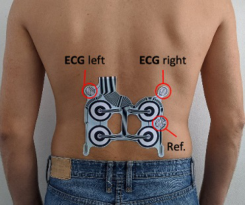
Figure 1: Left: recording multielectrode array with approximate placement on the sub- ject. Middle: A subject during the test with the multielectrode array secured by an elastic girdle. Right: The ETS electrode.
reference electrode was at 75 mm below the right active electrode. Their radius was 20 mm, and each was covered with hydrogel (AG735, Axelgaard, Inc.). The recording multi-electrode array was placed over the subject’s lower back, with the active electrodes at the approximate level of T11/T12. To ensure stable electrode-skin contact the ECG pads were secured with a medi- cal tape and then covered by a stretchable girdle, as shown in Figure 1. The data acquisition and was performed with the SIXTHSENSE Alpha Mobile Device (AMD - Global Electronic Solutions, RS) using an ECG amplifier module (AD8232, Analog Devices, USA). The module was also secured with a medical tape to avoid potential noise due to connection cables and ampli- fier movements. The data was sampled at 1 kHz and stored in the device SD card for offline processing. Polar H10 was used as a referent heart rate sensor to determine the physiological strain in function of the maximal HR, calculated as 208 – 0.7*(age) (Tanaka et al., 2001). It was positioned on the central line below the chest with its elastic belt. The AMD prototype was also used to produce electrotactile stimulation (ETS) artefacts through a multiele- ctrode array with 8 active pads and a common reference electrode (Figure 1, right), placed centered around the midaxillary line, as presented in the setup of (Štrbac et al., 2021). Only the six smaller were used. The ETS was perfor- med with rectangular current controlled biphasic pulses with 300 µs width, at 30 Hz. The current amplitude was set at 200% of sensory threshold for each subject, at each pad following the conclusion of (Maleševi´c et al., 2021). Here it ranged between 5 and 7 mA. The stimulation was played throughout the test in cycles of 0.5 s stimulation at each of 6 used pads, followed by one second pause.
Three healthy volunteers (two female, one male; between 25 and 33 years old) without any known cardiological disorders participated in the study. The study was conducted at the Institute of Medical Physiology “Richard Burian”, Faculty of Medicine, University of Belgrade, Belgrade, Ser- bia. The experimental protocol including the informed consent signed by the participants was approved by the local ethics committee.
Protocol The test had eight phases, each lasting for one minute, designed to simulate some of the specific tasks usually performed by first responders of interest
Design of the Heart Rate Measurement Module in a Telemonitoring Device 53
(firefighters and mountain rescuers). The first six phases were performed on the treadmill in three levels of physical strain, without and with added ETS. The first two phases were the baseline, with the subject standing still with- out any perturbations and with only ETS. The third and fourth phase were with subjects walking on the treadmill at the pace that allowed maintaining the HR between 40% and 60% of the maximal HR, without and with ETS, respectively. The fifth and sixth phase were done in the same way, but with a pace and inclination that kept the HR between 60% and 80% of the maximal HR. The last two phases included simulated functional tasks. In the seventh phase the subjects used a fire-swatter simulating smothering the fire on the ground, while in the eight phase the task was to lift or lower a heavy box with handles (8 kg for females and 16 kg for mails) between the floor a waste high platform. Both stages were done for 60 seconds, starting from a rested state and at a high intensity.
Data Analysis As described in the previous sections, ECG data was collected for 60 seconds at 1 kHz sampling rate in each experimental phase. Three commonly used and publicly available methods for detection of R peaks were applied to determine which approach was best suited for the specific application: 1) the Pan-Tompkins (PT) method2; 2) The a-QRS method (Hooman, 2022); 3) The wavelet multiresolution transform (WT) method. The signal prepro- cessing was not included in the publicly available source code of the WT method, so the procedure from PT algorithm was used. Each method pro- vided locations of detected R peaks in the recorded signals. An outlier was defined as R peak when the HR value differed by at least 20% from the pre- vious HR value. Three measures of algorithm performance were used: 1) the total number of detected peaks; 2) the percentage of incorrectly detected R peaks, outliers 3) the longest signal interval containing only outliers
RESULTS
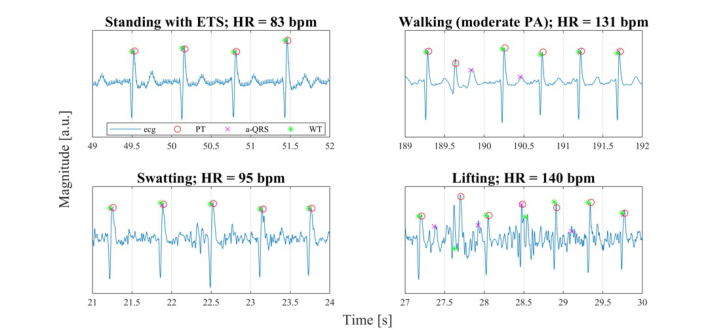
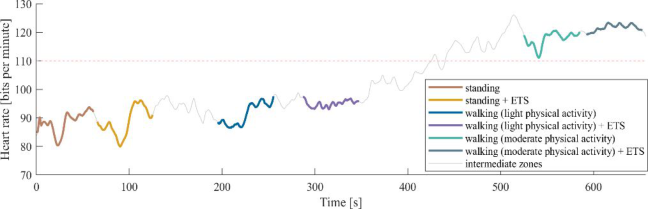
Figure 2 shows representative 3 s segments of measured ECG signals for each of eight phases with detected R peaks. Calculated HRs are also indicated for each signal. An example of calculated HR for a subject during the first six phases of the test is shown in Figure 3. The threshold of 110 bpm indicates the boundary between light and moderate physical activity. Finally, in Table 1 the three methods are compared in respect to the defined measures.
DISCUSSION
The aim of the presented paper was to investigate the possibility to relia- bly measure the Heart Rate with a multi-sensor electrode array positioned on the lower part of the back in scenarios faced by the first responders of interest, where both increased physical activity and electrotactile stimulation are present. As shown in Figure 2, these have produced notable artifacts in 2https://www.mathworks.com/matlabcentral/fileexchange/45840-complete-pan-tompkins- implementation-ecg-qrs-detector
54 Boljani´c et al.
Figure 2: Examples of recorded ECG signals during different phases of the test. Phases and calculated heart rates are labeled on subplot titles. Detected R peaks are marked according to the legend.Figure 3: Estimated heart rate during the first six phases of the test with the Pan- Tompkins method. Each phase is represented with different color, while intermediate zones are grey.
the recorded signal. However, the results shown in Table 1 indicate that all three applied methods could reliably identify the R peak and thus allow HR assessment in most conditions.
In general, the results in Table 1 show that the a-QRS method is having the worst performance, especially for the Subject 3. The signals shown in Figure 2 showcase examples of this issue. It appears that there is an atypically large T peak in the recorded signals of this subject, which is more pronounced at higher exertion levels. The adaptive algorithm of this method seems to be susceptible to this type of artefact and fails to discriminate between T waves with high frequency characteristics (similar to QRS complex) from the actual QRS complex. As the first wrongly identified R peak shifts the varying threshold to a level that induces further errors. Being that the overall performance of this method was inferior to the other two methods, its use in further stages will be reevaluated.
An observation of interest for the application is that the ETS does not seem to have any significant effect on the R peak detection, as the number of outliers is comparable between the paired conditions with and without
Design of the Heart Rate Measurement Module in a Telemonitoring Device 55
Table 1. Total number of detected R peaks (Beat), the percentage of outliers (Out) and the longest interval containing only outliers (Null) obtained by the three methods.
these artefacts. Even though the noise generated by the ETS system is several orders of magnitude higher than the ECG signal at the source, the recorded noise is significantly smaller. One of the possible causes of small interference could be the concentric design of the ETS electrode intentionally selected for this purpose (Jiang et al., 2014). Additionally, the used short pulses (300 µs), at 30 Hz are very susceptible to the standard preprocessing applied in R peak detection methods (Pan and Tompkins, 1985). Finally, the intensity of physical activity seems to be the main cause of erroneous detection of R peaks in all three methods. This is in line with earlier observations where activities entailing high level of body movement were identified as major contributors to inaccurate HR estimation (Pola and Vanhala, 2007). The unstable skin electrode contact was cited as the most probable cause of wrongly identified artefacts, which is in line with our observations. The relatively good results even in the high intensity activities can probably be attributed to the use of adhesive hydrogel and a tight-fitting elastic girdle. The highest levels of error were noted in the tasks of high intensity walking, swatting, and lifting. However, even in cases where over 50% of the detected R peaks were outlier, the longest period without correctly detected R peaks was not higher than
56 Boljani´c et al.
15s. This means that HR could be correctly assessed and updated at a rate of at least 4 times per minute, which is acceptable in all practical applications.
ACKNOWLEDGMENT
The authors would like to acknowledge that this research was fully funded by the European Union’s Horizon 2020 research and innovation programme under grant agreement No 883315.
REFERENCES
Cai, Z., Luo, K., Liu, C., Li, J., 2017. Design of a smart ECG garment based on conductive textile electrode and flexible printed circuit board. THC 25, 815–821. https://doi.org/10.3233/THC-170828 Carballo-Leyenda, B., Villa, J.G., López-Satué, J., Collado, P.S., Rodríguez-Marroyo,
J.A., 2018. Fractional Contribution of Wildland Firefighters’ Personal Protective Equipment on Physiological Strain. Front Physiol. 9, 1139. https://doi.org/10. 3389/fphys.2018.01139 Cho, H., Lee, J.H., 2015. A Study on the Optimal Positions of ECG Electrodes in a Garment for the Design of ECG-Monitoring Clothing for Male. J Med Syst 39, 95. https://doi.org/10.1007/s10916-015-0279-2 Degroote, L., Hamerlinck, G., Poels, K., Maher, C., Crombez, G., De Bourdeaudhuij,
I., Vandendriessche, A., Curtis, R.G., DeSmet, A., 2020. Low-Cost Consumer- Based Trackers to Measure Physical Activity and Sleep Duration Among Adults in Free-Living Conditions: Validation Study. JMIR Mhealth Uhealth 8, e16674. https://doi.org/10.2196/16674 Dohare, A.K., Kumar, V., Kumar, R., 2014. An efficient new method for the detection of QRS in electrocardiogram. Comput & Electr Eng. 40, 1717–1730. https://doi. org/10.1016/j.compeleceng.2013.11.004 Hooman, S., 2022. An online algorithm for R, S and T wave detection, MATLAB
Central File Exchange. Retrieved February 11, 2022. Jiang, L., Huang, Q., Zhao, J., Yang, D., Fan, S., Liu, H., 2014. Noise cancellation for electrotactile sensory feedback of myoelectric forearm prostheses, in: 2014 IEEE ICIA. Hailar, Hulun Buir, China, pp. 1066–1071. https://doi.org/10.1109/ICInfA .2014.6932807 Liu, J., Liu, M., Bai, Y., Zhang, J., Liu, H., Zhu, W., 2020. Recent Progress in
Flexible Wearable Sensors for Vital Sign Monitoring. Sensors 20, 4009. https: //doi.org/10.3390/s20144009 Mahmoodabadi, S.Z., Ahmadian, A., Abolhasani, M.D., Eslami, M., Bidgoli, J.H.,
2005. ECG Feature Extraction Based on Multiresolution Wavelet Transform, in: 2005 27th Conf Proc IEEE Eng Med Biol Soc. Shanghai, China, pp. 3902–3905. https://doi.org/10.1109/IEMBS.2005.1615314 Maleševi´c, J., Isakovi´c, M., Garenfeld, M.A., Došen, S., Štrbac, M., 2021. The Impact of Stimulation Intensity on Spatial Discrimination with Multi-Pad Finger Electrode. Appl. 11, 10231. https://doi.org/10.3390/app112110231 Pan, J., Tompkins, W.J., 1985. A Real-Time QRS Detection Algorithm. IEEE Trans
Biomed Eng. BME-32, 230–236. https://doi.org/10.1109/TBME.1985.325532 Paradiso, R., Loriga, G., Taccini, N., 2005. A Wearable Health Care System Based on Knitted Integrated Sensors. IEEE Trans Inform Technol Biomed. 9, 337–344. https://doi.org/10.1109/TITB.2005.854512
Design of the Heart Rate Measurement Module in a Telemonitoring Device 57
Pola, T., Vanhala, J., 2007. Textile Electrodes in ECG Measurement. Presented at the 2007 3rd IEEE ICON, Sensor Networks and Information, Melbourne, Australia, pp. 635–639. https://doi.org/10.1109/ISSNIP.2007.4496917 Prats-Boluda, G., Ye-Lin, Y., Bueno-Barrachina, J., Rodriguez de Sanabria, R.,
Garcia-Casado, J., 2016. Towards the clinical use of concentric electrodes in ECG recordings: influence of ring dimensions and electrode position. Meas Sci Technol. 27, 025705. https://doi.org/10.1088/0957-0233/27/2/025705 Rodríguez-Marroyo, J.A., López-Satue, J., Pernía, R., Carballo, B., García-López, J., Foster, C., Villa, J.G., 2012. Physiological work demands of Spanish wildland fire- fighters during wildfire suppression. Int Arch Occup Environ Health 85, 221–228. https://doi.org/10.1007/s00420-011-0661-4 Štrbac, M., Isakovi´c, M., Maleševi´c, J., Markovi´c, G., Došen, S., Jorgovanovi´c,
N., Bijeli´c, G., Kosti´c, M., 2021. Electrotactile Stimulation, A New Feedback Channel for First Responders. AHFE. Springer International Publishing, Cham, pp. 489–496. https://doi.org/10.1007/978-3-030-80285-1_56 Tanaka, H., Monahan, K.D., Seals, D.R., 2001. Age-predicted maximal heart rate revisited. J Am Coll Cardiol. 37, 153–156. https://doi.org/10.1016/S0735- 1097(00)01054-8
LISTED IN THE AHFE DIGITAL BOOKSTORE CATALOGUE
Explore the complete digital volume
Cognitive Computing and Internet of Things
Read this individual research paper free through the original publisher, or explore the full digital proceedings book.
ISBN 978-1-958651-19-3
Explore this ISBN in the AHFE Bookstore ↗Listed in the July 2026 bookstore catalogue; search by ISBN to confirm current availability · Digital book purchase optional