Juanjuan June He (2022). Design Thinking in Interdisciplinary Collaboration: Creating Innovative Solutions for Students' Community. In: Ergonomics In Design. AHFE Open Access, vol. 47, pp. 430–438. https://doi.org/10.54941/ahfe1001967
Design thinking is a mindset and toolkit to effectively support the process of problem-solving and product development. Expanding knowledge of design thinking to non-design major students helps introduce the methodology and enhance creativity to a broader audience. In the fall semester of 2021, many college students came back to campus after more than one and a half years of remote learning due to Covid-19. They were eager to participate in in-person activities and communities. However, they faced anxiety and uncertainty in the post-pandemic environment. This paper introduces the theory and methods using design thinking and collaboration to help interdisciplinary students tackle problems in their community. Some group projects from the Product Design program at Drexel University are used here as examples, including topics on female students’ safety on campus, bike storage issues, and making friends in the university. Within this course, students from diverse disciplines collaborated to generate innovative solutions. Students’ presentations and feedbacks show improved confidence in creativity and a great passion to pursue further study in the design-related curriculum.
Since the spring of 2020, the novel coronavirus greatly impacted the lear- ning experience for college students. On March 13, 2020, the United States declared a national emergency after the outbreak of the COVID-19 (The White House, 2020). Since then, a great number of college and univer- sity students transitioned from in-person to remote learning (Burke, 2020). In the fall semester of 2021, many students came back to their campuses after virtual learning for more than 18 months. They were eager to be invo- lved in academic activities and relationship building with in-person human interactions.
The elective course Design Thinking in Product Design at Drexel University enrolled students across the university campus from a variety of discipli- nes and programs including Marketing, Game Design, Entrepreneurship and Innovation, Design and Merchandising, and First-Year Exploratory Studies, etc. They ranged from freshman to senior, domestic to international students.
Design Thinking in Interdisciplinary Collaboration: Creating Innovative Solutions 431
Most of the students did not have previous experience in design thinking and design process. It was the first in-person course after a long-term remote lear- ning experience for these students. As the Pandemic chaos never happened before in the current context, no one had experience in how to manage it. This paper specifically focuses on the fall 2021 semester after the Pandemic lockdown period was lifted.
Design Thinking “Design thinking is an umbrella term encompassing the logics, practices and tools of design”(Cankurtaran and Beverland, 2020). It is a set of toolkits desi- gners utilize to provide innovative solutions to different areas of problems, including products, systems, and services. It is a “transformative mindset” (Brown, 2008) including five core principles in the design thinking process: research, synthesize, ideate, prototype, and test. During each step, specific skills are required to carry out the tasks in order to proceed to the next step. While for design students, various courses in each semester prepare them for the basic and advanced skills for each step of the process, the goal of inter- disciplinary students in this course is to familiarize them with the creative mindset, rather than the advanced skillset.
Interdisciplinary Collaboration “At the university-level, it is well known that interdisciplinary collaboration is important for research and innovation”(McDonald et al. 2018). Cross argues that design is part of everyone’s general education, in the same way as science and humanities and further suggests that “designerly ways of knowing” help develop cognitive skills and abilities in solving real-world problems (Cross, 1982). Design thinking and process should not be designers’ exclusive tools. Other professionals can benefit a great deal from learning it too.
This paper addresses the following questions: How do students from inter- disciplinary and cross-cultural backgrounds collaborate in a creative way? How can a design thinking course engage students who do not have design skillsets? How can we as educators evaluate an interdisciplinary course in which students are at different levels of the subject matter? Through this paper, learnings and challenges are explored through students’ projects and reflections.
LEARNING STRATEGIES AND OUTCOMES In the course Design Thinking in Product Design, a series of projects were introduced to ensure students comprehend the relevant methodologies and hone their skills along the process. For the one-month final project, small groups of 3 to 4 students were formed to work on a community-focused design project. Each group included students from different majors and back- grounds. They aimed to find a community, use design thinking methods to conduct research, analyze the findings, synthesize insights, create, and test solutions to solve the problems.
432 He
These students who participated in in-person classroom activities after a long-term virtual learning period seemed to have developed a heightened sen- sitivity to their surrounding environment. They proposed the final projects with a focus closely relevant to their own communities. They were passio- nate about their living environment, their relationships, and the surrounding material landscape of their daily lives. This course allowed them to practice using different design thinking tools for individual assignments in this class prior to jumping into the final project.
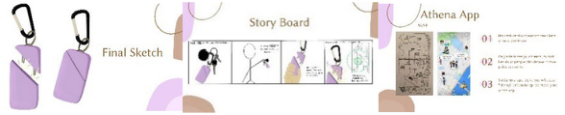
Research Starting from the research phase, students immersed themselves in conducting primary and secondary research into the communities they choose including their friends and their own lived experiences. Groups used research methods including Google surveys, observation, and interviews. With the encourage- ment and advice from the instructor, students pushed themselves out of their comfort zones to conduct interviews with third-party organizations and per- sonnel. For example, three students from Group 1 decided on solving the safety issue for female students walking or traveling alone in the urban col- lege environment, which is also a need for three female students in this team. They carried out an interview with public safety officers on campus and col- lected much more information than they expected. Additionally, they invited the instructor as one of the interviewees because she is a presumed target user. One student in the project reflective journey mapping described this part as the most enjoyable and fun session of her design process: “Intervi- ewing people was fun because it provided me with insight but I also got to learn about other people’s ideas and opinions towards using a certain pro- duct I was designing” (A. December 2021). Figure 1 shows the evolution of this idea.
Figure 1: Athena, safety alarm designed for urban college, Group 1 students, 2021.
Synthesis Non-design students face challenges in synthesizing and visualizing research data. Most students tended to use texts to describe their findings, especially for qualitative exploratory research. In this phase, students participated in in-class activities to familiarize themselves with the tools to convert words to visuals, including affinity mapping, journey mapping, storyboarding, SWOT analysis, etc. The instructor encouraged non-design students to learn by obse- rving how design students visualize their findings and collaborate together in a meaningful way. As Cross (1982) pointed out, mastering a designer’s way of thinking is like learning a new language that transforms “abstract patterns of
Design Thinking in Interdisciplinary Collaboration: Creating Innovative Solutions 433
Figure 2: Examples of students’ exploration of data visualization, 2021.
user requirements” into “the concrete patterns of an actual object”. Figure 2 represents examples of students’ exploration of research synthesizing and data visualization.
Ideation Students used the Product Personality Profile exercise to increase their under- standing to connect product features with user profiles. By analyzing the ‘product personalities’ of the tangible object examples the instructor brou- ght to the classroom, students’ imaginations were stimulated. They mapped out the emotional design elements embedded in the products and created the scenarios of their user experience.
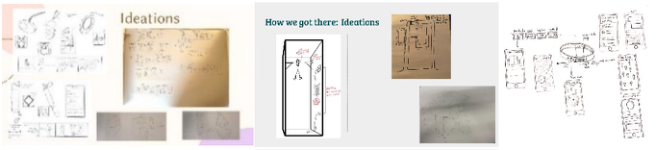
Based on the insights synthesized from the research process, students were encouraged by the instructor to ideate their concepts using a variety of media they were comfortable with, including 2D/3D computer software, hand dra- wing, digital drawing, collaging, performing, etc. Non-design students found this part to be the most difficult for them during the whole process. But they were intrigued by exposing themselves to the exercise and observing design students carrying out the task (see Figure 3).
Figure 3: Ideation and Prototyping Examples, 2021.
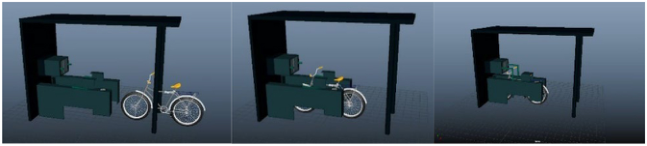
Prototyping Some students struggled with prototype making because they did not have prior experience. One student mentioned this “is my first ‘Arts & Crafts’ project after elementary school” (R. November 2021). The instructor offe- red them the liberty of choosing media to present the final product solution and provided resources to support them, including materials, training in the model shop, touring the hybrid lab (3D printers, laser cutters), etc. Even- tually, each team chose different solutions for their design, ranging from 3D printed models, hand-made foam block models, paper, cardboard and clay models. Figure 4 explores the 3D mechanism construction of Group 2’s
434 He
Figure 4: TrackRack, “The bike rack that’s got your back”. Group 2 Students, 2021.
project: TrackRack: The bike rack that’s got your back. The team used 3D modeling for the first time to explore the lock system to solve the bike safety issue. The prototype was 3D printed and presented on a smaller scale. Mem- bers of this team ride bikes daily and have faced bike theft problems before. The final design solution is closely related to their needs and comfort level.
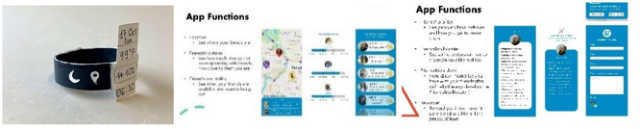
Relationship building among college students is essential to their growth and development. In the qualitative exploratory study of college student inter- personal and institutional relationships during the COVID-19 pan-demic, Vaterlaus, Shaffer, and Pulsipher (2021) conclude that “students reported feeling isolation, craving connection, and wanting a traditional college expe- rience.” Group 3 students dived deep into the college community to find a solution to make friends and maintain long-lasting friendships. The final product is a friendship bracelet and a relevant app. The app offers functi- ons including Friendship Status, Friend-ship Availability, Friends’ Profiles, Friendship Booster, Friendship’s Diary, and Friendship Reminder. All the members of Group 3 were freshmen. Thus, building relationships on cam- pus and in person is of great importance for them. Figure 5 shows the paper prototype of the bracelet and app interface 2D design.
Testing Since these product solutions are targeting students’ communities, students were able to quickly test them among peers and update their prototypes according to the feedback.
FACULTY CHALLENGES AND LEARNINGS During the teaching, the instructor encountered a couple of challenges that are worth looking into for future learning. Being a professional designer in
Design Thinking in Interdisciplinary Collaboration: Creating Innovative Solutions 435
the industry for more than a decade, coming back to academia brought the instructor new insights and discussions with readers.
Challenge 1 To increase the motivation and participation of the students, the instructor initially gave them the freedom to choose their teammates and practice their decision-making skills. During the first step of group forming, the students tended to gather together with other students they knew before enrolling in the course, or formed groups they felt more comfortable with in terms of gender, major, origin, years in school, and proximity in class seating. Some students were left out and could not find a team. This casual team formation became a problem in forming diverse teams. The instructor had to intervene in the group forming process to emphasize the benefit of the diversity of the teams. This intervention made sure that interdisciplinary and cross-cultural students can collaborate together.
Learning 1 Integrating diverse voices into cross-disciplinary teams needs effort and per- severance. In this innovative and collaborative course, it is essential to help increase students’ awareness of the benefits and justice of inclusive partner- ship. It’s vital to ensure an effective creative learning experience. In the future, the instructor assigning team members to each team could be a better solution.
Challenge 2 During the design process, students who were not from design-related majors faced difficulties in specific skills, such as using drawing as a tool to ideate concepts and making prototypes to test and validate solutions. These students understood the whole design thinking process but were lacking the skills to execute them.
Learning 2 It is essential to make sure that students comprehend the learning goals of this course is to 1) Learn the system of and tools of the design thinking process, 2) Collaborate in multi-disciplinary teams to achieve stronger, collective soluti- ons, 3) Stretch and grow your creative thinking capabilities, 4) Hone design specific techniques. However, since many students do not have prior training in design skillset courses such as design drawing or model making, their gra- des should not be measured at the same level as design students. Students are encouraged to use the skillset from their own majors to strengthen the design process, which makes them more confident and motivated working on the project. Furthermore, group projects support each member of the team to utilize one’s skillset to compensate another, so not everyone needs to be an expert on every part of the process.
436 He
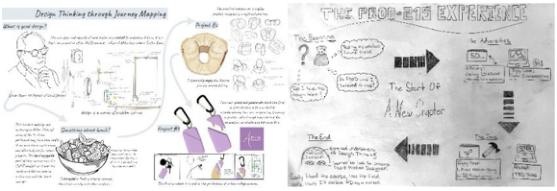
STUDENT REFLECTION Students reflected on the design thinking process at the end of the course by submitting a reflective journey mapping of their personal experience in this course (see Figure 6). They answer these questions in the mapping process 1) What did you enjoy most? 2)What did you enjoy least? 3) What was easiest? 4) Where did you struggle?
Figure 6: Two Examples of Students’ Reflective Journey Mapping.
The following comments were collected from the submitted reflective jour- ney maps. Most of the students expressed strong interest in continuing study in design-related fields. One student from the First-Year Exploratory Studies program said “Really like the course, love the field. Very likely I’ll pursue PD (product design) as a career.” Another student commented, “Ended up enjoying the class more than expected.” Students from non-design majors are excited to incorporate what they learned in their own majors into the design thinking process, “Applying what I learned in marketing such as target markets and feasibility of the product when thinking of ideas.”
Although some students talked about the difficulties of the final design project because this was their first-time encountering design thinking and process, many showed passion and excitement completing the teamwork. Most students were very excited and proud of the new friendship they formed despite some hurdles during the collaborating process. “Teamwork makes the dream work.” “Dream team is created: J.J.A.B.” “I am most proud and pas- sionate about this final project. Working with a productive interdisciplinary team was invigorating. Learning to problem-solve through research and idea generation was challenging but rewarding.”
Before the highlighted projects, students were asked to brainstorm 50 concepts as an exercise in Project 2 assignment. By generating quick sketches and rough concepts, the goal of the exercise is to use drawing to help them think and lead them to their final design direction. They struggled the most in this part. This is where non-design students were stretched beyond their comfort zones and needed more guidance and encouragement. “The process of creating 50 ideations was a mundane and stressful process for me. I felt myself redrawing the same ideas, and I did not branch out with my ideas.” However, once successfully completed this session, students were proud of the result, “I thoroughly enjoy the ideation process and sketching…” For the
Design Thinking in Interdisciplinary Collaboration: Creating Innovative Solutions 437
future class, this is an area where the instructor can provide more support and resources to help students with visualizing their ideas.
By the end of the course, some students were considering focusing their majors on product design and one sophomore student successfully applied to minor in product design. They were generally excited about the design pro- cess and more confident about solving problems using creative methods. One group of students was very committed to their team’s project and planning to continue the prototyping and testing process in future courses to bring the product to life.
CONCLUSION
Incorporating the design thinking process into an interdisciplinary collabo- rative environment across the university campus enables students to think beyond their comfort zone and create meaningful solutions. Design thinking should be a toolkit and mindset training available to everyone across diffe- rent disciplines. According to students’ refection and feedback, this course is better introduced in the early stages of education than later. Some senior students in the course expressed their interest in minoring in design, but it was too late for them since they would graduate soon.
The design thinking process boosted motivation and ownership for stu- dents to solve problems in their own communities. The collaborative team project bonded group members together and ensured positive energy despite the impact of COVID-19. During the collaboration phase, some students could not attend in-person classes due to personal reasons, but they mana- ged to check on each other as a team and made sure the project progressed smoothly. After completing the projects, most students reflected increased satisfaction in their relationship and friendship on campus and were proud of their group achievement.
The student’s final presentations demonstrated their improved skills and knowledge in the design thinking process. The research activities led the stu- dents to build their confidence and expand their understanding of their living environment on campus under the Pandemic circumstances. The analysis guided students from text-based critical thinking to visualized data pre- sentation. The ideation and model-making stage engaged students in the design “‘language’ of ‘modelling”’, “equivalent to aptitudes in the ‘langu- age’ of the sciences - numeracy - and the ‘language’ of humanities - literacy” (Cross, 1982).
By the end of the term, the instructor recognized that students across dif- ferent disciplines showed great confidence in creative thinking and practice. They were eager to pursue more learning opportunities from the design depar- tment and incorporate the skills into their majors. Compared to their mindset at the beginning of the term “Do I have the design talent”, “Not really sure what to expect”, “Heard of design, but never experienced it”, they were more confident: “Really rewarding to deliver + form a product that touches upon an issue everyone in the group faces”, “The most enjoyable class”, “Now I want to study design!”
438 He
REFERENCES
Burke, L. (2020). Colleges move classes online as coronavirus infects more. Inside Higher Ed. Brown, T. (2008). Design thinking. Harvard Business Review, 86(6), 84–92. Cankurtaran, & Beverland, M. B. (2020). Using design thinking to respond to
crises: B2B lessons from the 2020 COVID-19 pandemic. Industrial Marketing Management, 88, 255–260. https://doi.org/10.1016/j.indmarman.2020.05.030. Cross, N. (1982). Designerly ways of knowing. Design Studies, 3(4), 221–227. https: //doi.org/10.1016/0142-694X(82)90040-0. McDonald, West, R. E., Rich, P. J., & Pfleger, I. (2018). “It’s So Wonderful Having
Differ-ent Majors Working Together”: the Development of an Interdisciplinary Design Thinking Minor. TechTrends, 63(4), 440–450. https://doi.org/10.1007/ s11528-018-0325-2. The White House. (2020). Proclamation on declaring a national emergency concerning the novel coronavirus disease (COVID-19) outbreak. https: //trumpwhitehouse.archives.gov/presidential-actions/proclamation-declaring -national-emergency-concerning-novel-coronavirus-disease-covid-19-outbreak/ Vaterlaus, Shaffer, T., & Pulsipher, L. (2021). College student interpersonal and insti-
tutional relationships during the COVID-19 pandemic: A qualitative exploratory study. The Social Science Journal (Fort Collins), ahead-of-print(ahead-of-print), 1–14. https://doi.org/10.1080/03623319.2021.1949553
LISTED IN THE AHFE DIGITAL BOOKSTORE CATALOGUE
Explore the complete digital volume
Ergonomics In Design
Read this individual research paper free through the original publisher, or explore the full digital proceedings book.
ISBN 978-1-958651-23-0
Explore this ISBN in the AHFE Bookstore ↗Listed in the July 2026 bookstore catalogue; search by ISBN to confirm current availability · Digital book purchase optional