Amare Wibneh Mengistu, Ashish Kumar Singh, Sougata Karmakar (2022). Strategy for ergonomic validation of a physical mock-up involving limited user trial. In: Ergonomics In Design. AHFE Open Access, vol. 47, pp. 472–477. https://doi.org/10.54941/ahfe1001972
Background and Objective: It is practically impossible to find out an individual with a specific percentile for all the anthropometric dimensions. In traditional anthropometric compatibility evaluation, a large number of participants would be required to represent a specific percentile (say, 5th percentile) of different body dimensions. However, a user trial involving a large number of participants with intended percentile values is a tedious, time-consuming, and costly affair and in many cases not practically feasible. This paper presents a research strategy of how to validate the anthropometric compatibility of a physical mock-up by a small number of participants representing the extreme anthropometric variability of the target populations. Methodology: A case study on the user trial of a physical mock-up of a light armored vehicle (LAV) used by the Ethiopian army was carried out involving a few users from an ergonomic perspective. Following an anthropometric survey (32 variables) of Ethiopian army personnel (n =250 male), 12 key variables (06 dominant variables, 02 variables with less commonality, 03 variables with less correlation coefficient from their respective predictors, and one targeted variable ‘mass’) that account for the variability produced by the 32 original variables were identified using Principal Component Factor Analysis (PCFA) and regression analysis. Following this, Ethiopian army personnel who represent the boundary values (5th or/and 95th p values) of the identified key variables were identified from the targeted population. Thereafter, the compatibility testing (in terms of space occupancy, dimensional clearances, reaching distance, view field, operational activities, etc.) of the physical mock-ups were conducted with the identified subjects. Results: The 12 key variables found from PCFA and regression analysis were stature, sitting height, popliteal height, popliteal length, bideltoid breadth, hip breadth, elbow rest length, arm length, foot length, foot breadth, handbreadth, and mass. Total 07 army personnel were finally identified who represented the extreme measurement values (5th or/and 95th p values) of those key variables and were asked to volunteer for testing. Discussions: As demonstrated in the present study, it is possible to identify less number of key anthropometric variables that are representative of the overall anthropometric variability of the population by using PCFA and regression analysis. A minimal number of volunteers could be identified by using the extreme anthropometric values (5th or/and 95th p values) of the identified key variables. These volunteers could be deployed for user trials to ensure compatibility from an ergonomic perspective. Such an evaluation technique, involving less number of participants would confirm accommodating wide ranges of user populations as well as reduce the cost, time, and resources for physical trial.
It is practically impossible to find an individual with a specific percentile for all the anthropometric dimensions. For instance, two persons with simi- lar stature may differ in girth measurements/masses because of a lack of proportionality. Thus, many participants would be required to represent a specific percentile of different body dimensions (McDaniel, 2014). In traditi- onal anthropometric compatibility evaluation of physical mock-ups (PMUs) of workspaces, a large number of participants would be required to repre- sent a specific percentile (say, 5th percentile) of different body dimensions (Roebuck et al. 1975). However, a user trial involving many participants with
Strategy for Ergonomic Validation of a Physical Mock-Up Involving Limited User Trials 473
intended percentile values is a tedious, time-consuming, and costly affair and is not practically feasible in many cases. Since it is also impossible to find out a single person with a specific percentile, it requires using a controlled sampling technique of the testing subject identification (McDaniel, 2014). Therefore, the selection of subjects that comply with anthropometric com- patibility testing needs a controlled user trial to identify the minimum key variables that represent the large set of required variables. Generally, to accommodate wide ranges of the targeted populations, 5th and 95th p values of the users’ anthropometry characteristics are required to test workspaces’ compatibility (Wibneh et al. 2021a). Hence, a minimal number of volunteers can be identified for testing by using the extreme anthropometric values 5th and 95th p values) of the representative variables for the required large vari- ables. To identify the key variables, the larger data set containing redundant (strongly correlated) or irrelevant variables shall be removed in a minimum data set of the variables (Bermingham et al., 2015). Principal component factor analysis (PCFA) followed by regression analysis (Wibneh et al. 2021b) can also be utilized to identify the key variables that account for the large set of variables to identify user testing subjects.
This paper mainly presents a research plan on validating the anthropome- tric compatibility of PMUs by a small user group representing the extreme anthropometric variability of the target populations. This can be achieved based on the identified key variables (minimum data set of variables) that account for the large set of original variables. A case study was carried out on the user trial of PMUs of LAV used by Ethiopian army personnel.
METHODOLOGY
This study comprises two phases. The first phase presents the method on how to identify the minimum data set of variables (key variables) that represents the original large set of required variables; whereas the second phase presents how to identify a minimal number of human subjects that deployed for user trial of PMUs testing on the workspaces of Ethiopian LAV using the identified key variables.
Identification of the Key Anthropometric Variables In a subsequent prior study (Wibneh et al. 2021b), the case study on the measurement of 32 anthropometric variables representing body dimensions of Ethiopian male army personnel was carried out using IBM SPSS version 25 statistical tool. Thereafter, the 12 key anthropometric variables (the minimum data set) that account for 32 required original variables were identified using PCA followed by regression analysis. These 12 key variables were stature, sitting height, popliteal height, popliteal length, bideltoid breadth, hip bre- adth, elbow rest length, arm length, foot length, foot breadth, handbreadth, and mass (Wibneh et al. 2021b). They were identified based on component factor loadings, commonality values, and correlation coefficient of regres- sion analysis. Following clustering variables into closely related variables (higher-order category) using PCFA, variable with the highest factor loading
factor was identified as predictor/highest dominant variable in each com- ponent factor (Wibneh et al. 2021b). Variables with less commonality (less inter-correlation) were also included in a minimum data set. The regression analysis has also been used to identify variables with less correlation coeffi- cients (R) following with PCFA (which can reduce the tedious analysis of R using Pearson correlation). The variables with a higher factor loading coeffi- cient (> 60%) in each factor category along with commonality (>70%) were considered to be highly inter-correlated variables. Relevant body variables that had correlation coefficients (R) > 0.70 were also considered to be higher inter-correlated variables. Based on the aforementioned percentage values, 06 most dominant variables, 02 variables with less commonality, 03 vari- ables with less correlation coefficient from their respective predictors, and one targeted variable ‘mass’ that account for the variability produced by the 32 original variables were identified and included in a minimum data set for anthropometric compatibility test of PMUs.
Identification of Subjects and Evaluation Techniques of PMUs The user-trial of PMUs of LAV used by the Ethiopian army was carried out involving a few users from the ergonomic perspective. The 12 key varia- bles, which represent the 32 variables (Wibneh et al. 2021b), were taken into consideration during the selection of volunteers. Following this, a total of 07 participants who represented the extreme measurement values (close to 5th or 95th p) of those key variables were identified. These volunteers could be deployed for user trials to confirm compatibility (accommodating wide ranges of user populations) from the ergonomic perspective considering anthropometric variability (Roebuck et al. 1975). The anthropometric mea- surements of identified variables for each subject, along with their respective extreme values (close to 5th and 95th p), were presented as shown in Table 1. The body measurement procedure was based on Wibneh et al. (2020).
Following the proper identification of subjects, the compatibility testing of the PMUs was conducted with the identified subjects. The ergonomic design characteristics such as, space clearance, arm reach, posture condition, and view field analysis of the crew in operational activity can been evaluated through observation of pictorial representations of man-machine interaction. To test space accommodation capacity, while performing the user compa- tibility testing of the PMUs, the participants were asked to volunteer for testing with casual shoes and clothing, and their appropriate sitting/stan- ding and working postures were evaluated through an observational study (Aromaa et al. 2014).
RESULTS AND DISCUSSIONS Anthropometric Measurements of Identified Variables of the Testing Subjects
The anthropometric measurements of the 12 identified variables for testing subjects (n = 07) were presented in (see Table 1). The 5th and 95th p values of anthropometric measurement data of Ethiopian soldiers (n = 250 males)
Strategy for Ergonomic Validation of a Physical Mock-Up Involving Limited User Trials 475
Table 1. Measurements for the key anthropometric variables of the identified subjects along with the 5th and 95th p values of Ethiopian army personnel (n = 250 males).
All measurements are in cm unless specified. S1, S2… S7 =subjects used for user trial *Measurement values close to 5th p for anthropometric database of Ethiopian soldiers. #Measurement values close 95th p for anthropometric database of Ethiopian soldiers. Note. ST = stature; AL = arm length; SH = sitting height; ELH = elbow rest height; BB = bideltoid breadth; HB = Hip breadth; PH = popliteal height; BKL = Buttock to knee length; HBR = Hand breadth; FL = Foot length; FB = Foot breadth; M = Mass
were also given. The boundary (close to 5th and 95th p) values belonging to each subject were indicated by an asterisk (*) and number (#) signs, respectively.
From Table 1, no subject represented the specific percentile value (close to 5th or 95th p) values of all the 12 anthropometric variables. The majority of 5th p values of the variables were represented by S1 (07 variables), while S5 (06 variables) represented the majority of 95th percentile values of all the variables. Two manikins can be sufficient for digital mock-up testing in digital human modeling since a single manikin can be modified according to the specific percentile value of all the measured variables (McDaniel, 2014). However, in this particular study, the physical ergonomic evaluation requires 07 users for trial, as we had seen in Table 1. It is easy to estimate the sample size of participants if we use more than 32 variables for the identification of them for user testing.
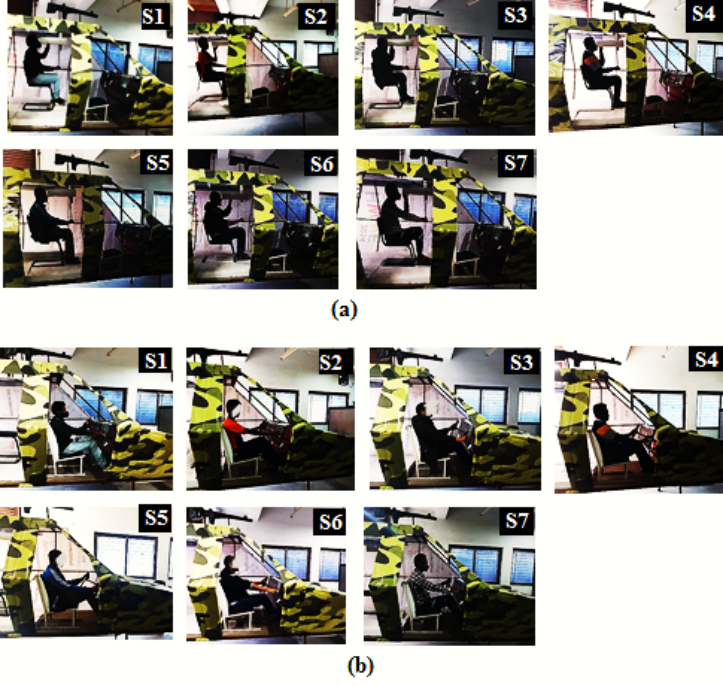
Anthropometric Compatibility/Accommodation Test The ergonomic design characteristics such as space clearance, arm reach, state of the posture and view field analysis of the crew in operational activity can be evaluated through observing the pictorial representations of man-machine interfaces as shown in Figure 1.
Figure 1 confirmed that the seat dimensions (seat cushion depth, width, height, backrest, and height) were acceptable. The driving posture adopted by
Figure 1: Crew posture adopted for compatibility test of (a) firing workspace in sitting posture (b) steering, and pedaling operation, and reaching to control dashboard.
the individual shows that the angles at various body joints are in the comfort range as defined by Porter & Gyi (1998). The headroom for uses to avoid head striking with a roof during jolts/ jerks and the legroom for regular pedal operation is also sufficient.
CONCLUSION
As demonstrated in the present study, limited user trial in occupant packaging of PMUs is most often used to find and test subjects because of various issues. A minimum number of users exhibiting extreme anthropometric values (5th or/and 95th p values) of the minimum data set of variables (12 key variables) can be used to validate (with certain boundary errors) the anthropometric compatibility of the PMU. This can be achieved by removing redundant varia- bles or identifying strongly correlated variables from the minimum data set of original large variables using variable reduction tools (PCFA and regression analysis). Such an evaluation technique is helpful to confirm accommodating wide ranges of user populations when limited user trial is required for PMU
Strategy for Ergonomic Validation of a Physical Mock-Up Involving Limited User Trials 477
testing. Therefore, it is highly recommended for researchers/designers to use this method even if they do not have a limited number of users.
REFERENCES
Aromaa, S., Viitaniemi, J., Helin, K., & Vento, A. (2014), “Ergonomic evaluation of cab design employing digital and physical mock-ups.” Advances in Ergonomics in Design, Usability & Special Populations: Part I, 16, 410. Bermingham ML, Pong-Wong R, Spiliopoulou A, Hayward C, Rudan I, Campbell
H, Wright AF, Wilson J.F, Agakov F, Navarro P, Haley CS (2015), “Application of high-dimensional feature selection: evaluation for genomic prediction in man.” Scientific reports, 5 p. 10312 Irshad, L., Ahmed, S., Demirel, O., & Tumer, I. Y. (2019), “Coupling digital human modeling with early design stage human error analysis to assess ergonomic vulnerabilities.” In AIAA Scitech 2019 Forum (p. 2349). McDaniel, J. W. (2014), “Workspace, Equipment and Tool Design. Work Space,
Equipment and Tool Design.” 29. Porter, J. & Gyi, D. (1998), “Exploring the optimum posture for driver comfort.”
Int. J. Vehicle Design, 19(3), pp. 255–266. Roebuck, J. A., Kroemer, K. H., & Thomson, W. G. (1975), “Engineering anthropometry methods.” (Vol. 3), John Wiley & Sons. Wibneh A., Singh A. K., & Karmakar S. (2020), “Anthropometric Measurement and
Comparative Analysis of Ethiopian Army Personnel across Age, Ethnicity, and Nationality.” Defence Science Journal, 70(4), 383. Wibneh, A., Singh, A. K., & Karmakar, S. (2021a), “Understanding the synthesis of anthropometric diversity and workspace dimensions in ergonomic design of light armored vehicle.” Hum. Factors Man. 31, 447–468. Wibneh, A., Singh, A. K., & Karmakar, S. (2021b, January), “Research Design for
Simplifying Anthropometric Data Collection Process Using PCA.”In International Conference on Research into Design, (pp. 71–82), Springer, Singapore.
LISTED IN THE AHFE DIGITAL BOOKSTORE CATALOGUE
Explore the complete digital volume
Ergonomics In Design
Read this individual research paper free through the original publisher, or explore the full digital proceedings book.
ISBN 978-1-958651-23-0
Explore this ISBN in the AHFE Bookstore ↗Listed in the July 2026 bookstore catalogue; search by ISBN to confirm current availability · Digital book purchase optional