Chutisant Kerdvibulvech (2022). Metaverse Applications for Location-based Virtual Reality. In: Human Factors in Virtual Environments and Game Design. AHFE Open Access, vol. 50, pp. 134–140. https://doi.org/10.54941/ahfe1002070
Graduate School of Communication Arts and Management Innovation, National, Institute of Development Administration, 118 SeriThai Rd., Klong-chan, Bangkapi, Bangkok 10240, Thailand ↗
Recently, the metaverse has considerably dominated tech headlines for researchers in the fields of human-computer interaction and human factors and ergonomics around the world, due to the advancement of its software and hardware. With its ability to immerse humans in a virtual, inexpensive, and safe world, it has greatly become popular in recent years, particularly virtual reality. Nevertheless, despite the extremely increasing attention to virtual reality, there is still very limited research work for summarizing and analyzing location-based virtual reality in which virtual reality tools are utilized for assisting humans to experience virtual reality by physically interacting with the environment. This paper proposes a new research study for investigating recent works of location-based virtual reality applications. After that, the evolution of virtual reality using location-based features is explored. Finally, we conduct a comparative analysis of virtual reality and augmented reality works, including location-based works in the past five years.
The metaverse is a network of three-dimensional virtual worlds facilita- ted using extended reality, augmented reality, or virtual reality tools for particularly beneficial purposes, such as social connection, productivity improvement, and virtual game creation. In recent years, it has gradually been a symbol of the future because it integrates many related areas of com- puter science and human factors to produce uniquely interactive experiences using tools and headsets of virtual reality and augmented reality—an immer- sive experience of a real-world environment that is added by graphical items. In addition, it has become tremendously popular with location-based features that allow an immersive interaction between human factors for both augmen- ted reality and virtual reality—a completely simulated experience that can be like or totally different from the physical world using generated graphical information.
In fact, there are pieces of research for building and/or investigating location-based augmented reality applications, such as Khan et al.’s work (Khan et al. 2021) for estimating the viewed position of virtual objects in
Metaverse Applications for Location-Based Virtual Reality 135
three-dimensional optical see-through (OST) augmented reality using Holo- Lens and Capece et al. work (Capece et al. 2016) for visualizing geolocated data on a client-server framework utilizing location-based augmented reality. More specifically on game design, there are also some existing works focu- sing on games of location-based augmented reality, such as Windleharth’s work (Windleharth 2020) for safety, identity, and information management of location-based augmented reality games in communities of practice, Pyae et al.’s work (Pyae et al. 2017) for studying experiences of the users in mobile location-based augmented reality applications and games, and Bhattacharya et al.’s work (Bhattacharya et al. 2021) for reconceptualizing the three main foundations of location-based games (exercise, exploration, and social intera- ction) during the pandemic period, particularly augmented reality. There are also several summarizing works for analyzing location-based augmented rea- lity works, including Oleksy and Wnuk’s work (Oleksy and Wnuk 2017) for exploring the purpose of location-based augmented reality applications and games in altering place-human relations, and Kerdvibulvech’s works (Kerdvi- bulvech 2021) (Kerdvibulvech 2022) for location-based augmented reality gaming market analysis. However, despite the recently considerable atten- tion to the metaverse, very small amounts of works study and summarize location-based virtual reality applications, especially in game design. Thus, in this paper, we present a new research study for investigating recent works of location-based virtual reality applications. We then explore the evolution of metaverse games for virtual reality using location-based features in an interdisciplinary perspective of human factors and ergonomics.
LOCATION-BASED VIRTUAL REALITY To begin with, location-based virtual reality is sometimes defined as a place of business or exhibition where virtual reality tools are used for helping people to experience virtual reality by physically interacting with the environment in a way they cannot, in their own home. For instance, the location-based virtual reality can allow people to hang around in a ghost house and a museum, run around in amusement parks, and/or walk around a warehouse with obsta- cles that are made of paper but look virtually like concretes or woods in the location-based virtual world. Therefore, due to the flexibility of many custom-designed spaces, it is deemed to give more possibilities to explore in many aspects, including multi-user virtual reality scenarios. Nevertheless, location-based virtual reality installations may have different requirements than virtual reality used in private settings. This section explores intere- sting location-based virtual reality works in the last five years in terms of human-computer interaction and human factors.
Wölfel et al. (Wölfel et al. 2020) give a good overview for discussing some challenges and possible solutions for improving and staging the experience of location-based virtual reality works. This is because these solutions can make more people who pass by the site participate and have an influence on the well-being of actual head-mounted display users, including maintaining a fee- ling of presence in the actual surroundings. In their work, they suggest several
136 Kerdvibulvech
design aspects for location-based virtual reality, such as safety and environ- ment blindness. For example, for safety standards, they recommend clearly defining a separation between each interaction area, so it can increase felt safety while using location-based virtual reality. For environment blindness, they suggest letting people rapidly blend realities, so that it is able to easily help them to solve some problems of blindness in setting up a location-based virtual reality installation.
In addition, Salandra et al. (Salandra et al. 2018) built a virtual reality location-based mobile application, called PeakLensVR, for detecting moun- tain peaks with an inexpensive virtual reality headset. Their application allows people to capture scenic images of 360° panoramic mountains using a smartphone and then depict such images enhanced with metadata about the mountain peaks, such as name peak, distance from the viewer, and alti- tude. Their application can later convert annotated panoramic images into Adobe’s XMP format aiming to help people to share easily and virally on social media. PeakLensVR is designed to extend the project from PeakLens— an augmented reality location-based mobile application built for taking and collecting photos of mountains. But this location-based virtual reality mobile application enables the recording of 360° panoramic images and their immer- sive replay virtually with a virtual reality device. Furthermore, Nash et al. (Nash et al. 2021) designed and presented a methodology utilizing a colla- borative zine for generating knowledge on virtual reality experiences using location-based features for young people from a network project from The Arts and Humanities Research Council (AHRC) and the Economic and Social Research Council (ESRC). In their work, during the pandemic lockdown period, they ask each participant to give details to consider the recollecti- ons of their personal experiences of events and activities on the virtual reality network. Besides, Lugrin et al. (Lugrin et al. 2019) proposed a framework for creating and investigating location-based virtual reality applications as a new kind of virtual reality museum (Lugrin et al. 2018). This location-based virtual reality museum is built to support many physically co-located users simultaneously in a hangar-scale tracking area (approximately 600 sqm) with more than ten times larger virtual space (about 7,000 sqm). Therefore, in their work, every visitor can walk and share the same real world, while he/she can share the same virtual space too. Moreover, Wienrich et al. (Wienrich et al. 2018) studied the gain of positive social cooperation and presence, including mutual importance, to enhance the experience of location-based features, spe- cifically the social experience, in wide-reaching multi-user virtual reality for an adventure in Germany’s Immersive Deck of Illusion Walk. In their study, interdependence can largely establish social cooperation and presence in a virtual reality setting indicated by the social experience of location-based features. They suggest scientific design principles for collective and social aspects by assisting the possible effects of cooperatively mastering a valo- rous challenge for location-based virtual reality hosts. More recently, Turkay et al. (Turkay et al. 2021) also studied qualitatively for understanding the attitudes toward virtual reality esports and the experiences of participating in a location-based virtual reality game using both a pre-interview and a post-interview design. In their work, eight competitive Counterstrike: Global
Metaverse Applications for Location-Based Virtual Reality 137
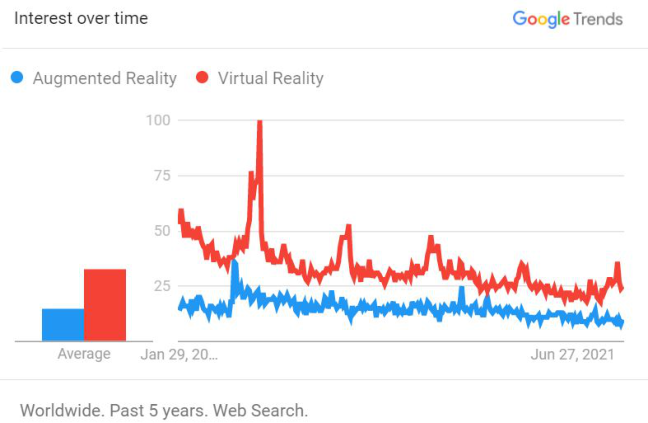
Figure 1: Comparison of Google trends worldwide for the keywords of “Augmented Reality” in blue color and “Virtual Reality” in red color in the past five years, collected on 24 January 2022.
Offensive players are selected from an esports club of a university in Australia for considering visceral and affective experiences in the virtual reality esports game. Therefore, using their qualitative study can assist design competitive location-based virtual reality esports more interactively.
In this way, it can be observed that location-based virtual reality can be used for different purposes to support and improve the experiences of people in the metaverse world. However, the works of location-based virtual rea- lity we found are relatively low, if compared with location-based augmented reality. Therefore, the following section will explain a comparative analysis between location-based augmented reality and location-based virtual reality for understanding the essential trends.
COMPARATIVE ANALYSIS BETWEEN LOCATION-BASED AUGMENTED REALITY AND LOCATION-BASED VIRTUAL REALITY In this section, we do a comparative analysis of augmented reality and vir- tual reality for the last five years. To analyze the trends of augmented reality and virtual reality comparatively, we collect data from Google Trends from 2017 to 2022. The collected data are analyzed from the popularity of top sea- rch queries in Google Search which is the largest market share among every available search engine. First, we compare the trends for two keywords with the same keyword length (two): “Augmented Reality” and “Virtual Reality”. Figure 1 shows Google Trends worldwide for the “Augmented Reality” and “Virtual Reality”keywords between 2017 and 2022. The vertical axis depicts the number of search interests of two keywords in Google Search, while the horizontal axis shows the period of the research study. The average number
138 Kerdvibulvech
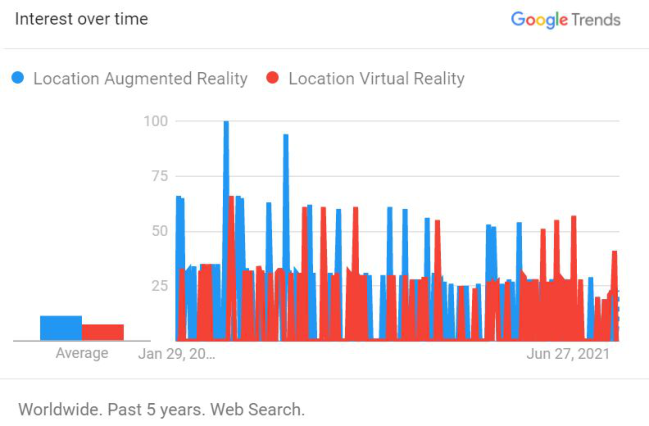
Figure 2: Comparative Analysis for the keywords of “Location Augmented Reality” in blue color and “Location Virtual Reality” in red color in the past five years from Google Trends, collected on 24 January 2022.
of search interests for “Augmented Reality” is 15, while the average number of search interests for “Virtual Reality” is higher than two times at 33. This means that augmented reality is more popular than virtual reality in terms of search queries. Next, we compare the trends for two keywords with the same keyword length (three): “Location Augmented Reality” and “Location Vir- tual Reality”. Figure 2 illustrates Google Trends worldwide for the “Location Augmented Reality”and “Location Virtual Reality”keywords between 2017 to 2022. Nonetheless, the average number of search interests for “Location Augmented Reality” is 12, while the average number for “Location Virtual Reality” is 8 which is lower. Obviously, virtual reality receives more popula- rity than augmented reality in terms of search queries. But when adding up the keyword “Location”, location-based augmented reality gains more popu- larity than location-based virtual reality. A possible reason is partly because of the variety and diversity of location-based applications in augmented rea- lity coming together with the high-speed internet in smartphones during these last five years. But, we believe, the trend can be reversed if giant tech com- panies, such as Meta, Apple, Google, Amazon, and Microsoft, are interested in majorly investing in location-based virtual reality research in the next five years.
CONCLUSION AND FUTURE DIRECTION This paper has investigated recent location-based virtual reality applicati- ons in different specific aspects of human-computer interaction and human factors and ergonomics to understand how the metaverse can help humans interact with the environment in a unique way. This is since location-based
Metaverse Applications for Location-Based Virtual Reality 139
virtual reality applications have various possibilities to improve the experie- nces of people in the metaverse world. We have also discussed the evolution of virtual reality using location-based features in the past five years. After that, a comparative analysis of virtual reality and augmented reality works in the past five years has been studied. We then compare location-based vir- tual reality and location-based augmented reality to see and predict the trends of the future.
Due to the trend rises and developments in the metaverse world generally, we believe that location-based virtual reality applications will receive a posi- tive impact from these in the future. However, we predict that it will not get a significant impact just like augmented reality or virtual reality generally. This is because of the need for physical places or exhibitions in some specific cases for location-based virtual reality, especially during the COVID-19 pandemic period, even though we believe that the metaverse and related technologies will be the heart of the post-COVID-19 era.
ACKNOWLEDGMENT
This research presented herein was partially supported by a research grant from the Research Center, NIDA (National Institute of Development Admi- nistration).
REFERENCES
Antonio La Salandra, Piero Fraternali, and Darian Frajberg. 2018. A Location-Based Virtual Reality Application for Mountain Peak Detection. In WWW ‘18 Compa- nion: The 2018 Web Conference Companion, April 23–27, 2018, Lyon, France. ACM, New York, NY, USA 8 Pages. Arpita Bhattacharya, Travis W. Windleharth, Cassandra Lee, Amulya Paramasivam,
Julie A. Kientz, Jason C. Yip, Jin Ha Lee: The Pandemic as a Catalyst for Rei- magining the Foundations of Location-Based Games. Proc. ACM Hum. Comput. Interact. 5(CHI): 1–25 (2021). Aung Pyae, Mika Luimula, Jouni Smed: Understanding Players’ Experiences in Location-based Augmented Reality Mobile Games: A Case of Pokémon Go. CHI PLAY (Companion) 2017: 535–541. Carolin Wienrich, Kristina Schindler, Nina Döllinger, Simon Kock, Ole Traupe:
Social Presence and Cooperation in Large-Scale Multi-User Virtual Reality - The Relevance of Social Interdependence for Location-Based Environments. VR 2018: 207-214 Chutisant Kerdvibulvech, “Geo-based Mixed Reality Gaming Market Analysis”.
Human Behavior and Emerging Technologies, vol. 2022, Article ID 1139475, 9 pages, 2022. https://doi.org/10.1155/2022/1139475 Farzana Alam Khan, Veera Venkata Ram Murali Krishna Rao Muvva, Dennis Wu, Mohammed Safayet Arefin, Nate Phillips, J. Edward Swan: Measuring the Perceived Three-Dimensional Location of Virtual Objects in Optical See-Through Augmented Reality. ISMAR 2021: 109–117. https://doi.org/10.1145/3184558. 3191559 Lugrin, J.-L., Kern, F., Kleinbeck, C., Roth, D., Daxery, C., Feigl, T., Mutschler, C.
& Latoschik, M. E. (2019). A Framework for Location-Based VR Applications. Proceedings of the GI VR/AR - Workshop, : Shaker Verlag. ISBN: 978-3-8440- 6887-0
140 Kerdvibulvech
J. -L. Lugrin et al., “A Location-Based VR Museum,” 2018 10th International Conference on Virtual Worlds and Games for Serious Applications (VS-Games), 2018, pp. 1–2, doi: 10.1109/VS-Games.2018.8493404. Kerdvibulvech C. (2021) Location-Based Augmented Reality Games Through
Immersive Experiences. In: Schmorrow D.D., Fidopiastis C.M. (eds) Augmented Cognition. HCII 2021. Lecture Notes in Computer Science, vol 12776. Springer, Cham. https://doi.org/10.1007/978-3-030-78114-9_31 Matthias Wölfel, Daniel Hepperle, Andreas Sieß, Jonas Deuchler: Staging Location- Based Virtual Reality to Improve Immersive Experiences. EAI Endorsed Trans. Creative Technol. 6(21): e5 (2020) N. Capece, R. Agatiello and U. Erra, “A Client-Server Framework for the Design
of Geo-Location Based Augmented Reality Applications,” 2016 20th Interna- tional Conference Information Visualisation (IV), 2016, pp. 130–135, doi: 10.1109/IV.2016.20. Nash, R; Yamada-Rice, D; Dare, E; Love, S; Main, A; Potter, J; Rodrigues, D; (2021) Using a collaborative zine to co-produce knowledge about location-based virtual reality experiences. Qualitative Research Journal 10.1108/QRJ-02-2021-0021 Selen Turkay, Jessica Formosa, Robert Cuthbert, Sonam Adinolf, and Ross Andrew
Brown. 2021. Virtual Reality Esports - Understanding Competitive Players’ Perceptions of Location Based VR Esports. In Proceedings of the 2021 CHI Conference on Human Factors in Computing Systems (CHI ‘21). Association for Computing Machinery, New York, NY, USA, Article 322, 1–15. DOI: https://doi.org/10.1145/3411764.3445073 Tomasz Oleksy, Anna Wnuk:Catch them all and increase your place attachment!
The role of location-based augmented reality games in changing people - place relations. Comput. Hum. Behav. 76: 3–8 (2017). Travis W. Windleharth: Identity, Safety, and Information Management within Communities of Practice in Location-based Augmented Reality Games: A Case Study of Ingress. AMCIS 2020.
LISTED IN THE AHFE DIGITAL BOOKSTORE CATALOGUE
Explore the complete digital volume
Human Factors in Virtual Environments and Game Design
Read this individual research paper free through the original publisher, or explore the full digital proceedings book.
ISBN 978-1-958651-26-1
Explore this ISBN in the AHFE Bookstore ↗Listed in the July 2026 bookstore catalogue; search by ISBN to confirm current availability · Digital book purchase optional