Cesar Guevara, Carlos Borja, Hugo Arias-Flores (2022). Mobile application design with augmented reality triggers. In: Human Factors in Virtual Environments and Game Design. AHFE Open Access, vol. 50, pp. 200–204. https://doi.org/10.54941/ahfe1002078
Mobile applications developed for educational topics are a playful contri-bution to the teaching-learning process. This research presents a mobile application generated from participatory design and user experience. This study presents the concept construction phase, the theoretical foundation of the proposal focused on human-computer interaction, in addition to the methodological process that allowed obtaining a final product framed in a research project that was articulated to a bonding project with the commu-nity. 189 children from public and private educational schools in the cities of Quito and Ambato, in Ecuador, aged between 6 to 8 years, participated. The research defined the scope of the application, its structure, require-ments, usability and navigability. For the development of the prototype, Unity was used, for the generation of the videogame and its functionalities. On the other hand, Cinema 4D was used for 3D modeling, together with Vuforia SDK for augmented reality. In addition, Adobe Audition was ap-plied for the generation of the audiobook complemented by Adobe Pho-toshop and Adobe Illustrator in the graphic theme. The application was created for Android and IOS mobile platforms.For the design of augmented reality triggers, illustrations with colored frames were used, making possible to clearly recognize on which pages the mobile device should be used. The project is in the final evaluation phase, and it is expected to conclude testing the participating educational schools, in which the Tobii Eye Tracker 4C device, an eye tracking tool, will be used, which will allow information to be re-collected about the impact and integration that this application generates on users, on the topic addressed, on the design and composition of the product and on the results obtained with the use of this human-computer interaction model.
The appearance of Covid-19 has generated a change in all activities worl- dwide, in which information and communication technologies have allowed these activities to continue (Guevara, 2020). In this context, mobile applica- tions of digital games or interactive children’s educational games are widely used as a complement to the teaching-learning process (Salvador-Ullauri, 2019). In the last decade, several investigations have been dedicated to explain these technological tools and their use as a complement in early childhood education. These applications do not always collect data that can serve as a
Mobile Application Design with Augmented Reality Triggers 201
guide in making decisions about the content, types and level of games that should be created as digital tools for training (Alcivar et al., 2019). The results based on learning experiences when using mobile applications have made possible to develop unique profiles for these educational applications, iden- tifying the learning experience in combined spaces as an opportunity for the design of mobile applications; in addition, embodied cognition, the device as a discovery machine, open playful design and mobile system thinking are other elements of the uniqueness profile of mobile technologies for learning. (Shafriri & Levy, 2018).
The integration of mobile devices into an educational framework that promotes a more active engagement with creativity and digital technology, through the lens of complex thinking and a constructivist, student-based approach to teaching, can create better learning. (Forget, 2019). In this sense, Augmented Reality has the ability to modify the location and time of the investigation, adding new, additional forms and methods. (Borja-Galeas & Guevara, 2021). The capabilities of augmented reality technology allow classes to be more interactive and knowledgeable. Students will have a 360 degree view of real world entities, interacting with those and generating a better understanding of the concepts. Thus, the learning curve decre- ases by increasing the productivity of the brain. With the development of smartphones, augmented reality is applied to a wider range. Augmen- ted reality can turn an ordinary classroom into an engaging experience (Roopa et al., 2021).
In this context, participatory design may appear similar to other partici- patory practices, such as co-design, but it differs in terms of the processes of interaction, or in the wording of the ‘mechanisms’ of program theory used and how the effects and its support are conceived (Hansen et al., 2019).
The objective of this research is to present a mobile application generated from participatory design and user experience. The construction phase of the concept is exposed, the theoretical foundation of the proposal focused on human-computer interaction, in addition to the methodological process that allowed obtaining a final product framed in a research project that was articulated to a community outreach project.
This article is structured as follows. Section 2 presents the materials, tools and methods used as a fundamental basis in the proposal. Section 3 pre- sents in detail the proposal for the generation of the mobile application based on the design of the user experience. The results of the proposal and a comparison with some related works are presented in Section 4. Section 5 presents the conclusions obtained from the results and future lines of research.
METHODS AND MATERIALS With the information obtained from the participatory design instruments (observation sheets, interviews and surveys), which were applied to the participants (n = 180) who were in an age range between 6 and 12 years old, we proceeded to carry out prototypes and their approval in stages.
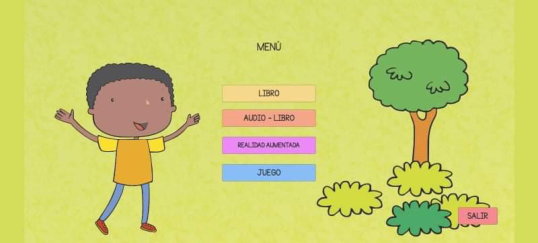
Figure 1: SuperNatu SuperNatu app home screen (Carlos Borja).
Stage 1. Prototype Design The application’s artwork was illustrated with Adobe Photoshop and sub- sequently exported in various formats (Murrell et al., 2020), scenes were vectored and structured in Adobe Illustrator to improve prototype fidelity (Morita, 2020). For the production of the 3D material, Cinema 4D was used to model the main character in 3D and generate multi-motion renderings (Lee et al., 2020). A sound product was built for the application, in which the language, music and sound effects were edited in Adobe Audition in its multitrack environment. (Murrell et al., 2020). Using the existing elements, animations were made in both 2d and 3d, level construction, game mechanics, augmented reality, user interface, sound integration, programming codes and everything related to the construction of the video game.
Stage 2. Application Development The different phases of the video game were structured in Unity as a multi- platform engine (Fritsch & Klein, 2018) and with the Vuforia SDK, augmen- ted reality triggers were generated for mobile devices, taking advantage of its computer vision technology that recognizes and tracks flat images and 3D objects in real time (Koca et al., 2019).
A PROPOSAL DEVELOPMENT This section describes the development of the mobile application with augmented reality triggers.
The theme of the developed application addresses the issue of environ- mental care and recycling. The mobile application has 4 sections, as shown in Figure 1.
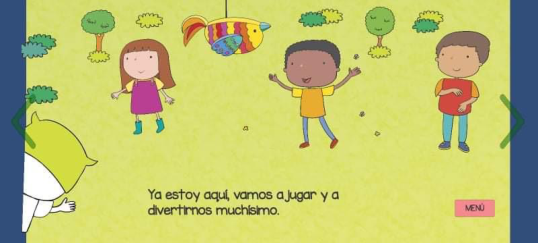
In the first section, an illustrated story with 2D animation is presented, as can be seen in Figure 2. The second section contains the audio book, in which a speaker and some children participated.
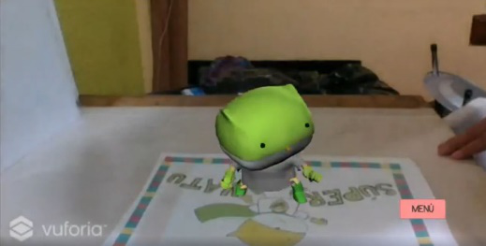
The third section presents animations with augmented reality of the main character of the story, as we can see in Figure 3. The application is accompa- nied by a printed document in which there are colored boxes, which are the triggers of augmented reality.
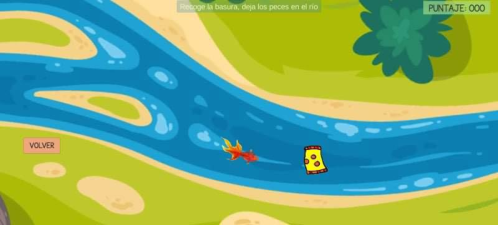
In the fourth section of the application, a video game was developed accor- ding to the theme of the story, as shown in Figure 4. It consists on 3 levels, all
Mobile Application Design with Augmented Reality Triggers 203
Figure 2: SuperNatu app audiobook screen (Carlos Borja).Figure 3: Screen of one of the levels of the video game of SuperNatu application (Carlos Borja).Figure 4: Screen of one of the levels of the video game of SuperNatu application (Carlos Borja).
focused on reinforcing the theme of recycling and garbage classification in a playful way. The player who achieves 100 points in each level will be able to get a diploma for his great work in recycling, this can be personalized and printed.
CONCLUSION
The problems generated by the Covid-19, forced to modify the develo- pment of the study, plus the methodology of participatory design allows
to adapt to the new environments that have been generated in this time of pandemic.
The development of the mobile application based on participatory design and user experience, considering the context and the public to which the product will focus, applying the morphological and compositional theoretical principles as requirements to address the issue of recycling in participants of 6 to 8 years, using augmented reality, has made possible to identify their needs and gradually modify the prototype.
Limitations: It was planned to continue the evaluation process in the participating schools, but due to the COVID-19, the final evaluation is postponed.
REFERENCES
Alcivar, N. I. S., Gallego, D. C., Quijije, L. S., & Quelal, M. M. (2019). Developing a Dashboard for Monitoring Usability of Educational Games Apps for Children. Proceedings of the 2019 2nd International Conference on Computers in Mana- gement and Business - ICCMB 2019, 70–75. https://doi.org/10.1145/3328886. 3328892 Borja-Galeas, C., & Guevara, C. (2021). Interactive Human-Computer Theoretical
Model of Editorial Design with Augmented Reality (pp. 580–585). https://doi.or g/10.1007/978-3-030-68017-6_85 Forget, B. (2019). Girls and Their Smartphones: Emergent Learning Through Apps That Enable. In Mobile Media In and Outside of the Art Classroom (pp. 77–101). Springer International Publishing. https://doi.org/10.1007/978-3-030-25316-5_4 Fritsch, D., & Klein, M. (2018). Design of 3D and 4D Apps for Cultural Heritage
Preservation (pp. 211–226). https://doi.org/10.1007/978-3-319-75826-8_18 Guevara, C., & Peñas, M. S. (2020). Surveillance Routing of COVID-19 Infection Spread Using an Intelligent Infectious Diseases Algorithm. IEEE Access, 8, 201925–201936. Hansen, N. B., Dindler, C., Halskov, K., Iversen, O. S., Bossen, C., Basballe, D. A.,
& Schouten, B. (2019). How Participatory Design Works. Proceedings of the 31st Australian Conference on Human-Computer-Interaction, 30–41. https://doi.org/ 10.1145/3369457.3369460 Koca, B. A., Cubukcu, B., & Yuzgec, U. (2019). Augmented Reality Application for Preschool Children with Unity 3D Platform. 2019 3rd International Symposium on Multidisciplinary Studies and Innovative Technologies (ISMSIT), 1–4. https: //doi.org/10.1109/ISMSIT.2019.8932729 Lee, J. Y., Lee, J.-W., Talluri, T., Angani, A., & Lee, J. B. (2020). Realization of Robot
Fish with 3D Hologram Fish using Augmented Reality. 2020 IEEE 2nd Interna- tional Conference on Architecture, Construction, Environment and Hydraulics (ICACEH), 102–104. https://doi.org/10.1109/ICACEH51803.2020.9366226 Roopa, D., Prabha, R., & Senthil, G. A. (2021). Revolutionizing education system with interactive augmented reality for quality education. Materials Today: Proce- edings, 46, 3860–3863. https://doi.org/10.1016/j.matpr.2021.02.294 Salvador-Ullauri, L., Acosta-Vargas, P., Jadán-Guerrero, J., Guevara, C., Sanchez-
Gordon, S., Calle-Jimenez, T., & Lara-Alvarez, P. (2019, July). Development of an accessible video game to improve the understanding of the test of Honey- Alonso. In International Conference on Applied Human Factors and Ergonomics (pp. 289–298). Springer, Cham. Shafriri, Y., & Levy, D. (2018). Uniqueness Profile of Mobile Applications for Learning (pp. 376–390). https://doi.org/10.1007/978-3-319-91152-6_29
LISTED IN THE AHFE DIGITAL BOOKSTORE CATALOGUE
Explore the complete digital volume
Human Factors in Virtual Environments and Game Design
Read this individual research paper free through the original publisher, or explore the full digital proceedings book.
ISBN 978-1-958651-26-1
Explore this ISBN in the AHFE Bookstore ↗Listed in the July 2026 bookstore catalogue; search by ISBN to confirm current availability · Digital book purchase optional