Hugo Arias-Flores, Sandra Sanchez-Gordon, Tania Calle-Jimenez (2022). E-Democracy and Accessibility: Challenges in the Ecuadorian Presidential Elections of 2021 During the Covid-19 Pandemic. In: Usability and User Experience. AHFE Open Access, vol. 39, pp. 265–271. https://doi.org/10.54941/ahfe1001716
People living with some type of disability continue to encounter barriers that prevent them from participating in society on equal terms and their rights continue to be violated. Among these rights, the full enjoyment of communication in an independent and accessible manner, using information and communication technologies, is a commitment acquired by the signatory countries of the Convention on the Rights of Persons with Disabilities. Inclusive and equitable access to full participation in democratic processes is fundamental. Elections to designate constitutional president and vice president of the Republic of Ecuador for the period 2021-2025 were held on February 7, 2021. Some 13 million citizens were called to vote, including more than 425,000 citizens with disabilities. In Ecuador, voting is compulsory for citizens between 18 and 65 years of age, and the voting document is requisite for access to services in government offices. Ecuador was the sixth country in Latin America to call its citizens to the polls amid the pandemic. This unprecedented situation forced the National Electoral Council to change the traditional voting process, including a larger number of polling stations and ordering voters to go to the polls unaccompanied to avoid crowds and minimize contagion. In this context, the National Electoral Council made available to citizens a website that allowed, among other features, to consult the voting location and follow the election results in real-time. The objective of this study was to identify accessibility barriers in these web pages for users using assistive technology. The methodology employed for the analysis was experiential introspection complemented with the use of two automatic evaluation tools based on the W3C Web Content Accessibility Guidelines and the Usability.gov guidelines. Accessibility and usability problems were found on the voting location consultation page. Additionally, the voting results page presented very serious accessibility problems to the extent that prevented blind users from obtaining such information.
Since 2020, the entire world has been affected by the losses caused by the Covid-19 pandemic, but no country can stand still, including at the politi- cal and institutional level. In this regard, several countries have suspended previously scheduled elections, while others have called for elections of governmental authorities. In the year 2020, in Latin America, there were six calls for elections, both local and presidential, which were rescheduled because of the pandemic. Their temporary prolongation has transformed the uses and customs of politics (Malamud & Núñez, 2020). In the year 2021 in the same region, voting was mostly presidential (in five countries) plus three calls for legislative elections (Calderón, 2021).
The first election of 2021 in Latin America in times of pandemic was held on February 7 in Ecuador, in which more than thirteen million citizens were summoned to elect president and vice-president, plus members of the Natio- nal Assembly and the Andean Parliament for the period 2021-2025 (CNN, 2021). In Ecuador, voting is compulsory for citizens over 18 years of age and optional for people with disabilities. In addition, 2.75% (471,020 people) of the population are registered as persons with disabilities (Sanchez-Gordon et al., 2020). Of these, 426,738 are registered to vote, with Guayas, Pich- incha, and Manabí being the provinces with the most voters in this group (García, 2021).
The National Electoral Council of Ecuador made available to citizens web pages to consult the voting location and to follow in real-time the development of the vote count. Ideally, these information options should allow people with disabilities to interact on equal terms that other citizens (Joviˇci´c, 2021), considering that people with disabilities use assistive techno- logies to access information on the Web (Arias-Flores et al., 2020). Visually impaired people use screen readers to read the information through key- board commands and audio output (Guevara et al., 2020). Another study shows that voting difficulties decrease voter turnout of people with disabi- lities by decreasing their perceived political influence (Schur et al., 2017). The quality of government website services, perceived value, and citizens continued use intention depend on factors such as accessibility and intera- ctivity (Li & Shang, 2020). The lack of quality has highlighted the neglect to serve citizens with disabilities, where exclusion is evident. Strategies to reduce the information gap for users with disabilities must respond to the diverse types of disabilities (Park, 2020). Compliance with international accessibility and usability standards such as W3C Web Content Accessibility Guidelines (WCAG) and Usability.gov guidelines enable users with and without disabili- ties to actively participate in democracy. In this context, the goal of this study was to evaluate the usability and accessibility of the web pages provided by the Ecuadorian government for this electoral process during the Covid-19 pandemic.
METHOD
The research methodology used in this study was developed in two phases. In the first phase, the methodology used was experiential introspection by a
E-Democracy and Accessibility: Challenges in the Ecuadorian Presidential Elections 267
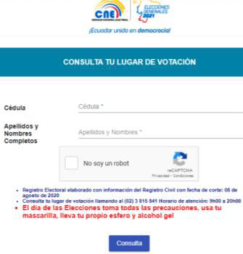
Figure 1: “Check your voting location” and “Election results” webpages.
blind researcher, who used a computer with Windows 10 operating system, Google Chrome Browser, Microsoft Edge Browser, and JAWS screen reader version 2020.
In the second phase, the authors used two automatic evaluation tools to identify additional usability and accessibility issues. The first tool used was the WAVE Web Accessibility Evaluation Tool, a free service by WebAIM at Utah State University. The WAVE tool checks the web pages against W3C Web Content Accessibility Guidelines (WCAG) version 2.0 non-compliances (WebAIM, 2022; Sanchez-Gordon et al., 2016). The tests were executed using the Google Chrome Browser and the WAVE Web Chrome Extension.
The second tool used was the SortSite Web Usability and Accessibility Checker, a commercial testing tool by PowerMapper (SortSite, 2022). Sort- Site checks for quality issues including accessibility, browser compatibility, broken links, legal compliance, search optimization, usability, and web stan- dards compliance. For accessibility, SortSite checks the web pages against W3C WCAG and the United States Section 508 accessibility guidelines. For usability, SortSite checks the web pages against United States’ Usability.gov guidelines.
The web pages of the National Electoral Council of Ecuador analyzed in this study were the page for voting location consultation, named “Check your voting location” (https://lugarvotacion.cne.gob.ec/consultaregistroelectoral/) with its corresponding location result pop-up window, and the page for real-time monitoring of the results of the election, named “Election results” (https://resultados2021.cne.gob.ec/).
RESULTS AND DISCUSSION
When navigating with the screen checker through the two official web pages analyzed in this study (see Figure 1), there were accessibility barriers for the visually impaired researcher. On the voting location consultation page, there were some accessibility problems in the text boxes, and in one of the browsers used, Microsoft Edge, a CAPTCHA did not allow the con- sultation process to continue. On the other hand, the election results page presented many accessibility problems, and the information could not be consulted.
The following are the problems encountered by the visually impaired rese- archer in the voting location consultation page and its correspondent location result pop-up window:
There are no navigation headers.
There are no navigation regions.
The text boxes for entering the citizen identity number and name are not properly identified.
When entering the identity card information, it does not allow character- by-character verification in the Microsoft Edge browser; on the contrary, Google Chrome does not present this problem.
The “I am not a robot” checkbox in the Google Chrome browser can be verified without any problem, on the other hand, in the Microsoft Edge browser you must try several times for it to be verified.
The CAPTCHA works properly with the Google Chrome browser. Never- theless, in Microsoft Edge, when a second query is generated, the CAPTCHA is not verified so the user must resort to requesting an audio challenge. In the prompts, it says to press the play button and then to repeat the audio to press control, but the audio played is in English. After trying several times, it was not possible to change the audio language. This limits the consultation and excludes users because if they do not know this language, they will not be able to enter. It should be noted that previous studies have found that Spanish speakers point out the difficulties of using interfaces in English (Sanchez-Gordon et al., 2021).
After verifying the CAPTCHA in the browser, the continue button is pro- perly labeled. However, for reading the voting location results, the screen reader works well in the Google Chrome browser, not so in the Microsoft Edge browser.
Regarding the web page for real-time monitoring of election results, the visually impaired researcher identified the following problems:
There are no navigation headers.
There are three navigation regions: navigation, main, and again main, which is confusing for the screen reader user.
No links are presented in the list of dignities.
The existence of a combo box for filters is identified. When selecting a province to consult, there is no button to indicate or manage the filtered information. Therefore, it is assumed that it is automatic since no confir- mation message of the requested filtering is generated. To verify, the blind user must navigate upwards line by line and there the selected province is displayed.
At the bottom of the results interface, a graph is generated, as well as several tables with information. However, with the screen reader, the blind user can only access the information on the number of processed tally sheets, the total number of voters, blank votes, and invalid votes. The most valuable information, i.e., the detail of the votes counted so far for each candidate, cannot be reviewed.
E-Democracy and Accessibility: Challenges in the Ecuadorian Presidential Elections 269
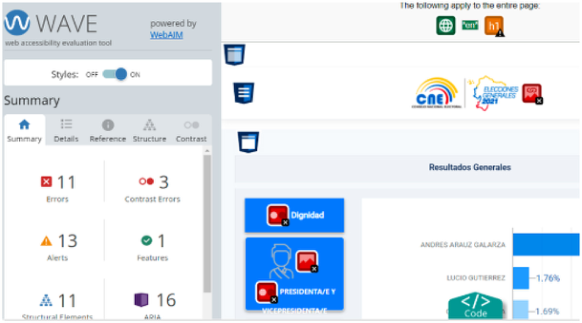
Figure 2: WAVE test summary for the election results page.
There is a button misidentified with the name “#”, which functionality is unknown.
As for the results of the automated tools. The WAVE test tool identified one error, one contrast error, and four alerts in the vote location consultation page; one error, one contrast error, and five alerts in the vote location result page; and eleven errors, three contrast errors, and thirteen alerts in the ele- ction results page. Figure 2 shows a sample of the WAVE results. Below is a list of the issues found by the WAVE tool:
Exceptionally low contrast between text and background colors (all pages). Adequate contrast is necessary for all users, especially users with low vision.
Missing form labels (all pages).
Missing alternative text (election results page).
Linked image missing alternative text (election results page).
Empty heading (election results page).
Empty link (election results page).
Empty table header (election results page).
Alert in all pages: Layout tables present. Layout tables are used to position content visually but can introduce reading and navigation order issues. Screen readers may interpret them wrongly as data tables.
Alerts in location consultation page and location result pop-up window: no heading structure, and no page regions.
Alerts in the election results page: select missing label, orphaned form label, missing first-level heading, table caption, device-dependent event, device-dependent event handler, and JavaScript jump menu.
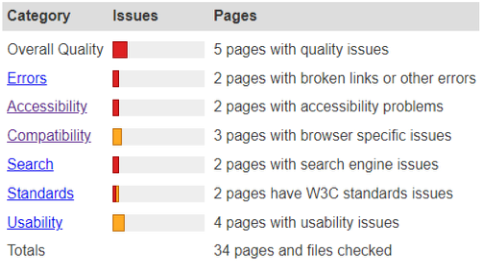
Finally, the SortSite tool identified additional problems. For browser com- patibility, SortSite found no critical issues regarding missing content of functionality, but it found major layout or performance problems for Inter- net Explorer, Firefox, Safari, Opera, iOS browser, and Android browsers. Also, it found minor layout or performance problems for Microsoft Edge and Google Chrome. For accessibility, SortSite found seven WCAG 2.1 Level
Figure 3: SortSite issues by category.
A non-compliances, for example, all onclick handlers should have an equi- valent onkeyup or onkeydown handler since some users are unable to use a mouse and use the keyboard instead. Also, SortSite found one WCAG 2.1 Level AA non-compliance referred to a CSS style that obscures the focus outline around focusable elements. For usability, SortSite did not find vio- lations of priority one Usability.gov guidelines but found four violations of priority two and three violations of priority three, including use of underlined text and use of font-sizes smaller than twelve points. For users over age 65, it is recommended to use at least 14-point fonts. Figure 3 shows a summary of the SortSite results by category.
CONCLUSION
The results of this study show that the Web pages provided by the Ecua- dorian government for the election event have accessibility problems when using assistive technologies, which limits access to information for visually impaired users. When using the screen reader JAWS with the browsers, it can be noted that the behavior and level of accessibility differ, being better for Google Chrome than for Microsoft Edge. On the real-time voting results consultation page, unfortunately, the most valuable information that the user needs to consult, which is the candidates who are participating and their vote counts, is presented only in a graphic format. Therefore, since the screen rea- der user does not have access to the information they need, this web page completely excludes visually impaired citizens. Automated tools proved use- ful to identify additional usability and accessibility issues for diverse types of disabilities.
REFERENCES
Arias-Flores H., Calle-Jimenez T., Sanchez-Gordon S., Nunes I.L. (2020) Contributions to improve accessibility and usability of academic journal management systems. Case Study: OJS. In: Nunes I. (eds) Advances in Human Factors and Systems Interaction. Advances in Intelligent Systems and Computing, vol 1207. Springer, Cham. https://doi.org/10.1007/978-3-030-51369-6_35
E-Democracy and Accessibility: Challenges in the Ecuadorian Presidential Elections 271
Calderón, J. (June 5, 2021). Latin America: elections intimes of pandemic (América Latina: elecciones en tiempos de pandemia). CELAG Website: https://www.celag. org/america-latina-elecciones-en-tiempos-de-pandemia/ CNN. (February 3, 2021). The ABC of the 2021 general elections in Ecuador (El ABC
de las elecciones generales 2021 en Ecuador). CNN Website: https://cnnespanol.c nn.com/2021/02/03/elecciones-ecuador-2021-fecha-candidatos-presidenciales/ García, A. (January 22, 2021). People with disabilities may be able to cast their votes with assistance (Personas con discapacidad sí podrán sufragar con asiste- ncia). El Comercio Website: https://www.elcomercio.com/actualidad/politica/per sonas-discapacidad-sufragio-asistencia-elecciones.html Guevara C. et al. (2020). Development of behavior profile of users with visual impair-
ment. In: Ahram T., Karwowski W., Pickl S., Taiar R. (eds) Human Systems Engineering and Design II. Advances in Intelligent Systems and Computing, vol 1026. Springer, Cham. https://doi.org/10.1007/978-3-030-27928-8_75 Joviˇci´c, S. (2021) ECHR v. UNCRPD: ending restrictions on voting rights of persons with disabilities. ERA Forum. https://doi.org/10.1007/s12027-021-00692-4 Li, Y., Shang, H. (2020) Service quality, perceived value, and citizens’ continuous-use
intention regarding e-government: Empirical evidence from China. Information & Management, vol 57(3), 103197, https://doi.org/10.1016/j.im.2019.103197. Malamud, C., Núñez, R. (September 22, 2020). Elections, crisis and pandemic in Latin America in the “new normal” (Elecciones, crisis y pandemia en América Latina en la “nueva normalidad”). Elcano Royal Institute Website: http://www.realinstitutoelcano.org/wps/portal/rielcano_es/contenido?WCM_G LOBAL_CONTEXT=/elcano/elcano_es/zonas_es/ari108-2020-malamud-nunez- elecciones-crisis-y-pandemia-en-america-latina-en-nueva-normalidad Sanchez-Gordon, S., Sánchez-Gordón, M., Luján-Mora, S. (2016) Towards an
engineering process for developing accessible software in very small entities, Proceedings of the Eleventh International Conference on Evaluation of Novel Software Approaches to Software Engineering, 241-246, https://doi.org/10.5220/ 0005900702410246 Sanchez-Gordon, S., Luján-Mora, S., Sánchez-Gordón, M. (2020) “E-Government accessibility in Ecuador: A preliminary evaluation”, Proceedings of the Seventh International Conference on eDemocracy & eGovernment, 50–57, https://doi.or g/10.1109/ICEDEG48599.2020.9096766 Sanchez-Gordon, S., Aguilar-Mayanquer, C., Calle-Jimenez, T. (2021) Model
for profiling users with disabilities on e-Learning platforms. IEEE Access, 9, 74258–74274. https://doi.org/10.1109/ACCESS.2021.3081061. Schur, L., Ameri, M., Adya, M. (2017) Disability, voter turnout, and polling place accessibility. Social Science Quarterly, 98(5), 1374–1390, https://doi.org/10.1111/ssqu.12373 PowerMapper (February 13, 2022). Web usability and accessibility checker. PowerMapper Website: https://www.powermapper.com/products/sortsite/ads/use- testing/ Park, E.Y. (2020) Digital competence and internet use/behavior of persons with
disabilities in PC and smart device use. Universal Access of Information Society. https://doi.org/10.1007/s10209-020-00782-z WAVE (February 13, 2022). About WAVE. WAVE Website: https://wave.webaim.or g/about
LISTED IN THE AHFE DIGITAL BOOKSTORE CATALOGUE
Explore the complete digital volume
Usability and User Experience
Read this individual research paper free through the original publisher, or explore the full digital proceedings book.
ISBN 978-1-958651-15-5
Explore this ISBN in the AHFE Bookstore ↗Listed in the July 2026 bookstore catalogue; search by ISBN to confirm current availability · Digital book purchase optional