Zikun Gao, Xinxiong Liu (2022). Design of Proton Radiotherapy Room Based on Environmental Psychology. In: Healthcare and Medical Devices. AHFE Open Access, vol. 51, pp. 261–268. https://doi.org/10.54941/ahfe1002126
Proton radiotherapy is currently a more advanced tumor treatment method in radiotherapy, which can accurately eliminate tumor cells while reducing damage to surrounding healthy cells. However, anxiety and depression often occur in cancer patients during treatment. On the one hand, it will cause the displacement of the lesion and affect the effect of radiotherapy. On the other hand, negative psychology is not conducive to physical rehabilitation. In this paper, the principle of environmental psychology is used to guide the design of indoor environment of radiotherapy from the perspective of visual and auditory senses. Through the influence of environment on psychology, the purpose of calming the mood of patients and improving the therapeutic effect is achieved, and it provides support and reference for the design of humanized radiotherapy room space in the future.
Cancer has become one of the major public health problems that seriously threaten the health of Chinese population. But in the course of treatment, 30% to 50% of cancer patients suffer from anxiety and depression due to concerns about their condition, which largely affects the effectiveness of cancer treatment. On the one hand, the tightness of the muscles cau- sed by tension will cause the actual tumor location deviation, resulting in radiotherapy deviation. On the other hand, a negative psychological state can affect the development of the disease through multiple systems in the body and is very detrimental to treatment and recovery. Depression can increase mortality by 39 % in adult cancer populations. Therefore, in the treatment of cancer patients, it is necessary to consider how to alleviate their depression and help them build confidence so as to improve the therapeutic effect.
THE INFLUENCE OF ENVIRONMENT ON PSYCHOLOGY Concept of Environmental Psychology
Environmental psychology theory is about the relationship between human and environment. As the object of the environment and the subject of creating the environment, the environment plays a role in People’s behavior patterns
and psychological activities. The application of environmental psychology in interior design is the effect and influence of interior space layout, space color and decorative elements on human psychology, and then study the psychological changes and reactions caused by the environment (Xilei Hu, 2018).
Using Environmental Psychology to Change Patients’ Psychology For proton therapy centers, radiotherapy indoor environment has a great impact on patients. The environment is special. The space of radiotherapy room is empty and needs to be completely closed during radiotherapy; the treatment equipment inside is large and bulky, with a strong sense of oppres- sion and a loud noise during operation. Such an environment is not conducive to easing the tension of patients.
Relaxing calm emotion is conducive to making the actual treatment area of patients in the radiotherapy process more consistent with the target area, and establishing a firm confidence in treatment, which has a positive effect on treatment and recovery. Therefore, it is necessary to scientifically establish a mental environment efficacy model for cancer patients based on environ- mental psychology. According to the patients’ personal state, to transform and adjust the color, material, sound, light and other aspects, to create a treatment equipment environment for patients, immediate preference, posi- tive adjustment of patients mentality, with proton radiotherapy and related medical services, improve the therapeutic effect.
APPLICATION OF ENVIRONMENTAL PSYCHOLOGY IN PROTON RADIOTHERAPY ROOM DESIGN Radiotherapy is one of the important means to treat cancer. As the most advanced new mode of tumor treatment recognized by the global medical community, proton beam has its unique physical characteristics – Bragg peak, compared with photon and electron rays used in conventional radiotherapy. Based on this feature, proton beam energy releases can be more concentra- ted in the tumor site, with normal tissues in front of the tumor, including skin, exposed to lower doses, while normal tissues after the tumor are expo- sed to almost zero doses. Therefore, proton therapy will bring better tumor control rate and lower incidence of normal tissue complications, and the comprehensive radiotherapy effect is better.
The project comes from The National Key Research and Development Program of China (No. 2016YFC0105306). This paper uses the proton radiotherapy room as a practical example of design to investigate how envi- ronmental psychology can be used to guide the design of radiotherapy spaces in order to reduce patients’ negative emotions of anxiety and depression during treatment, thereby enhancing treatment outcomes. According to envi- ronmental psychology, people are affected by the outside world through the five senses of sight, hearing, smell, taste and touch. This paper focuses on the visual and auditory aspects.
Design of Proton Radiotherapy Room Based on Environmental Psychology 263
Visual Aspect
1. Color Environment. Color has an important impact on the psychologi- cal and emotional well-being of people. Experiments have verified that when the human eye looks at colors, its pulse, respiration, brain waves, etc. will all change due to different colors. (Hui Zhu and Yudong Zhang, 2008). For example, a red environment will make people feel joyful, enthusiastic and exuberant, while a blue environment will make peo- ple feel calm, distant and open. Conventional radiotherapy room spaces are often color-coordinated with a white background and decorated with individual warm or cool shades. When designing the indoor color of pro- ton radiation therapy, a dominant color phase with a large area can be selected, and a regulatory color with a high color degree can be selected with a small area. Use a color palette of less than three colors, as more than three colors can be difficult for the eye to accept. Avoid using low brightness colors that make the patients feel tense and oppressed. Pale yellow can be used as the main color to make patients feel relaxed, open and happy (Yuanqin Wu, 2005).
2. Lighting Environment. Light is a necessary condition for the formation of visual work. It controls the circadian rhythm, and affects people’s emo- tions and cognition. It is closely related to physical health (Kun Zeng and Luoxi Hao, 2016). A light environment with low color temperature and low illumination (2 700 K, 100 lx) is more relaxing than a environ- ment with medium-high color temperature and high illumination (4 000 K, 1 300 lx) (Luoxi Hao et al. 2017). When radiotherapy is performed in the room, keeping the lighting design to low color temperature and low illumination is more conducive to the emotional stability of the pati- ents. In the treatment process, there are situations where doctors need high-intensity lighting such as debugging instruments for patients, so an adjustable illumination system can be used to meet different needs in different situations. Patients tend to feel drained while waiting before tre- atment. Lying facing the light source on the ceiling can also cause some pressure on them. Their attention can be diverted by projecting videos they like on the ceiling with lights to relieve tension.
Auditory Aspect
1. Noise Reduction. Noise is associated with various functional disorders of the human body. The psychological impact of noise on people is high- lighted by their mood (Li Shu, 2007). When the noise exceeds 60 dB, the disturbance generated by the environment can cause irritability, anxiety and depression (Hong Jiang et al. 2008). Radiotherapy machines make loud noises that need to be dealt with. There are two ways to reduce the impact of noise. One is to intervention in the transmission process. It can be done by using professional sound-absorbing and sound-insulating materials in the renovation process, with a double intervention to isolate the noise. Another one is to increase the transmission source. Another
264 Gao and Liu
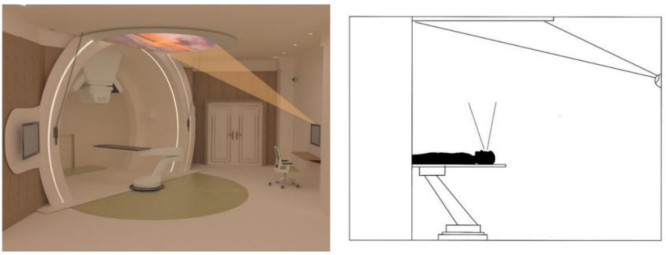
Figures 1 and 2: Interior view of radiotherapy room.
source of music can be added as a masking sound to divert the pati- ents’ attention from the noise, while creating a calmer and more relaxed atmosphere for the patients.
2. Music playback. Music can effectively reduce patients’ anxiety. Musi- cal sound waves cause the body to secrete substances such as hormones that are beneficial to health through the regulation of nerve and neuro- logical fluids (Guangrong Cai, 2001). Different patients have different life experiences and cultural backgrounds and have different prefere- nces for music, so different types of music can be offered to patients in order to maximize the effect of it on mood. Some nature sounds such as the sea, breeze and streams can reduce the patients’ anxiety level even more than ordinary music, even during the short period of radiotherapy (Largo-Wight E. et al. 2016).
PROTON RADIOTHERAPY ROOM DESIGN Presentation of Design Results
The design hopes to provide a comfortable treatment environment for pati- ents by enhancing the sense of home in the radiotherapy room. Reducing their anxiety and depression in order to enhance the outcome of cancer treatment.
In terms of vision, as shown in Figure 1 and 2, a large area of beige is used as the main color, supplemented by wood grain brown and small area of green. The beige makes the patients feel relaxed, the wood-grain brown adds a sense of intimacy and the green gives the patients a sense of hope. The combination of the three is warm and comfortable, with a more homely feel. The interior of the treatment chamber is upholstered in leather, effecti- vely replacing the coldness of conventional medical instruments with a softer, more comfortable and approachable feel.
As shown in Figure 3, a light source system with adjustable illumination levels is used to increase the level when doctors needs it and to maintain low level during treatment. Patients need to go through a long process of positioning before treatment, when a video of the patients’ preferences is projected on the ceiling to help ease their nerves.
In terms of hearing, to reduce the impact of instrument operation noise on patients, both sound-absorbing and sound-insulating features are used on
Design of Proton Radiotherapy Room Based on Environmental Psychology 265
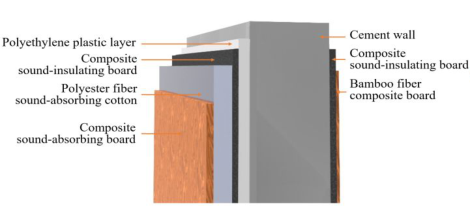
Figure 3: Lighting system for radiotherapy room.Figure 4: Sound-absorbing and sound-insulating materials.
the walls. As shown in Figure 4, from the outside to the inside are composite sound-absorbing board, polyester fiber sound-absorbing cotton and compo- site sound-insulating board. And noise reduction devices are installed on both sides of the rotating cabin. Play soft music that patients are familiar with and love during radiotherapy, which not only masks the noise, but also soothes the patients’ mood.
In addition to the senses of sight and sound, the design also takes into account the patients’ sense of touch and smell. The material chosen for the radiotherapy bed and the radiotherapy chamber wrapping is the PP mate- rial commonly used for medical equipment, increasing the hardness of the equipment shell while providing a degree of toughness. Set up a ventilation system and use air disinfection machines to reduce odor, keep the air clean and avoid cross-contamination.
ASSESSMENT OF DESIGN PRACTICE After completing the design of the proton radiotherapy room, a validation experiment was designed to assess whether the final design outcome met the aim of reducing patients’ anxiety.
1. Participants. A total of 40 participants were tested, including 20 radi- otherapy professionals and 20 radiotherapy patients in Wuhan Union Hospital of Hubei Province, China.
266 Gao and Liu
Table 1. Normality test of verification questionnaires.
Reduction of claustrophobia in the post-test (a. Lilliefors Significance Correction).
2. Experimental Materials. The experimental materials include a video of the interior design effect of the proton radiotherapy room and two que- stionnaires. Questionnaires were used to evaluate the existing proton radiotherapy room environment and the proton radiotherapy room envi- ronment designed in this paper. Both questionnaires asked the same questions and were scored using the six-point Richter scale ranging from “strongly disagree” (1 point) to “strongly agree” (6 points). 3. Test program. This experiment consists of two parts: pre-test and post- test. The participants evaluated the existing proton radiotherapy room environment and the proton radiotherapy room environment designed in this paper, respectively. 4. Experimental results. The normality test was performed on both pre-test and post-test questionnaire. If the data in both groups were smaller than the normal distribution, the paired sample T test was selected, otherwise, the paired sample rank sum test was selected. As shown in Table 1, since this experiment was a small sample normality test with a sample size of less than 100, observing the Shapiro-Wilk test data, all four sets of pre- test and post-test data had at least one column of data with a significance less than 0.05, so the paired sample rank sum test was chosen.
The four groups of data were analyzed by paired sample rank sum test. As shown in Table 2, the significance of the four groups of data were all less than 0.05, indicating that there was a significant difference between the pre-test and post-test data of this experiment.
The nonparametric test mainly compares the difference between the pre- and post-test by testing the median size of the two columns of data. The analy- sis shows that the medians of the pre-test and post-test in the four groups of data are respectively 3.00 and 5.00, 2.00 and 5.50, 3.00 and 6.00, 3.00 and
Design of Proton Radiotherapy Room Based on Environmental Psychology 267
Table 2. Test statistics of verification questionnaires.
Table available in the original PDF paper.
Reduction of loneliness in the
Reduction of anxiety in the pre-test/in the
Home atmosphere in the pre-test/in
pre-test/in the
Reduction of claustrophobia in the pre-test/in the
post-test the post-test
post-test post-test Z −3.765b −3.868b −3.693b −3.543b
.000 .000 .000 .000
Asymptotic Significance (2-sided) a. Wilcoxon signed-rank rest. b. Based on negative rank.
5.50. The post-test medians of the four groups of data were all larger than the pre-test medians. It can be seen that the design effect of this paper is signi- ficantly higher than that of general radiotherapy space in reducing patients’ anxiety.
According to the results of the validation experiment, the design practice based on environmental psychology principles in this paper can achieve the purpose of reducing patients’ anxiety and improving treatment outcomes.
CONCLUSION
Proton radiotherapy, as a current advanced technology for oncology tre- atment, has good prospects for development. In addition, the design of radiotherapy room space based on environmental psychology is of great significance to improve the treatment outcome by alleviating patients’ anxi- ety and depression during radiotherapy. It is hoped that the research in this paper will provide support and assistance in designing a psychologically appropriate and humane radiotherapy room space for patients.
REFERENCES
Guangrong Cai, Yi Qiao, Peiwen Li, Liping Jiao, Ying Hao, Luliang Xu. (2001). Clinical Application of Music Therapy in Oncology. Chinese Mental Health Journal, 2001(03), 179–181. Hong Jiang, Shuguang Li, Huaye Liu, Jiemin Huang. (2008). Investigation and
Analysis of Noise in General Hospitals. Chinese Nursing Management, 2008(03), 37–39. Hui Zhu, Yudong Zhang. (2008). Research on Color Psychology Based on Experimental Psychology. China Packaging Industry, 2008 (07), 48–51. Kun Zeng, Luoxi Hao. (2016). Exploration of Light and Emotional Experiment
Methods Suitable for Healthy Lighting Research. China Illuminating Engineering Journal, 2016 27(05), 1–8. Largo-Wight E, O’Hara B K, Chen W W. (2016). The Efficacy of a Brief Nature Sound Intervention on Muscle Tension, Pulse Rate, and Self-Reported Stress: Nature Contact Micro-Break in an Office or Waiting Room. HERD. 2016, 10(1). Li Shu. (2007). Research on Noise in Environmental Psychology and the Revision of
Mood Scale. Beijing Forestry University.
268 Gao and Liu
Luoxi Hao, Yixiao Cao, Zhe Cui, Kun Zeng, Rongdi Shao. (2017). Research Trends and Application Prospects of Light and Health. China Illuminating Engineering Journal, 2017 28 (06), 1–16. Xilei Hu. (2018). Exploration of the interior space design of environmental psycho-
logy in the medical simulation training center. Chinese and Overseas Architecture, 2018 (09), 182–185. Yuanqin Wu. (2005). The Psychological Effect of Color and its Application in Design.
Fujian Architecture, 2005 (Z1), 4–5.
LISTED IN THE AHFE DIGITAL BOOKSTORE CATALOGUE
Explore the complete digital volume
Healthcare and Medical Devices
Read this individual research paper free through the original publisher, or explore the full digital proceedings book.
ISBN 978-1-958651-27-8
Explore this ISBN in the AHFE Bookstore ↗Listed in the July 2026 bookstore catalogue; search by ISBN to confirm current availability · Digital book purchase optional