Kaat Kenis, Ivo Dewit (2022). A Product-Service System Approach to Light Therapy for Treatment of Seasonal Depression. In: Healthcare and Medical Devices. AHFE Open Access, vol. 51, pp. 269–277. https://doi.org/10.54941/ahfe1002127
Seasonal Affective Disorder (SAD), also known as seasonal depression, is a subtype of depression in which the patient is affected by hours of daylight received during specific seasons. Besides the classic symptoms of a depressive disorder, SAD causes hypersomnia and cravings for carbohydrates. SAD is caused by several psychological and biological mechanisms of which the shift of the circadian rhythm caused by an imbalance of melatonin is one. This specific mechanism can be treated using bright light therapy. During daily light therapy sessions, the user is subjected to a strong light source directed to the eyes. Although bright light therapy (BLT) is proven to be an effective non-pharmaceutical treatment, compliance and motivation of patients is low.In this paper, we analyse the specific needs and wishes of seasonal depression sufferers, to gain an understanding in the ways in which the light therapy market is currently lacking. By conducting in-depth interviews as well as diary surveys and field research, insights were collected to map the users’ needs and experiences. After a short analysis of the technical specifications and market segments of daylight lamps, a list of requirements was composed to support the design process of a new, innovate light therapy system in which there is a clear focus on user experience.This paper contributes to the literature on light therapy and SAD, offering a new user-centred angle to the theoretical line-up of research papers in order to increase therapy compliance and improve user experience during light therapy sessions.
In winter, most inhabitants of the Northern Hemisphere receive too little sunlight. Both light intensity and day length play an important role in the disruption of our hormone balance which affects our biological rhythm. For some, this can have a significant effect on their energy levels which can result in Seasonal Affective Disorder (Rohan, Roecklein and Haaga, 2009). An SAD patient experiences depressive episodes that can peak in either winter or summer and fade away with the arrival of the next season. The winter variant is the most common and, in addition to classic depressive symptoms, is characterized by ‘vegetative symptoms’ namely hyposomnia, complaints of overeating, sudden weight gain and sudden craving for carbohydrates. These symptoms are atypical of depressive disorders. Less common is the sum- mer (Magnusson and Boivin, 2009; American Psychiatric Association, 2013). SAD patients struggle with depressive symptoms for an average of 40% of the year. Given its high prevalence, consistent course, long duration and impli- cations on its environment, SAD is a significant mental health problem and
major challenge for our society. In addition to social implications, it has a significant economic cost.
SAD of the winter type can be effectively treated by bright light therapy (BLT) which can play a supporting role in the treatment of symptoms. During daily bright light therapy sessions, an intense artificial daylight is shone tow- ard the patient’s eyes to regulate the production of melatonin and serotonin. Timing and duration of the session are crucial in the effectiveness of the the- rapy and are therefore for the biggest obstacle to adherence (Terman and Terman, 2005). Since the discovery of its beneficiary effects in 1984 (Rosen- thal et al., 1984), light therapy has proven its efficacy. With results similar to those of antidepressants, a meta-analysis of 332 patients shows a remis- sion rate of 62% with morning light therapy sessions (Terman et al., 1989). Studies on the effectiveness of LT in other conditions such as non-seasonal depressive disorders, bulimia nervosa and ADD are promising but require further research (Terman and Terman, 2005; Oldham and Ciraulo, 2014).
The current market mainly offers light therapy devices that fall under the category of medical devices. A more holistic and use-oriented control of sym- ptoms could make treatment more enjoyable for patients and thereby also influence treatment adherence.
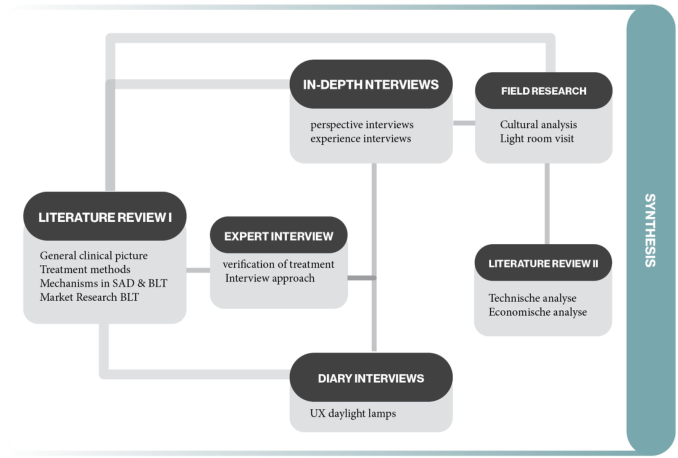
RESEARCH DESIGN This research adheres a product-service system approach (Dewit, 2019) by using selected methods from both understand and explore phases from the methodology (Dewit, 2018). The complete research design is pictured in Figure 1.
FINDINGS & DISCUSSION Literature Exploration
The prevalence of winter-type SAD varies with latitude and gender. There would be a clear relation between SAD prevalence and the amount of sun that the person in question is able to receive. In this hypothesis, SAD would mainly affect residents of northern areas, where sunlight is scarce during winter months (Rohan and Rough, 2017; Torres, 2020). Although most stu- dies confirm this hypothesis, there are others that cannot find a correlation between prevalence and latitude. An explanation could be traced back to the genetic influence in SAD. Ethnic groups, who have lived in northern areas for several generations, would have adapted to polar winters. An example of this can be found in Iceland, where the prevalence of SAD is exceptionally low in descendants of the indigenous population but high in immigrant groups (Magnusson and Boivin, 2009).
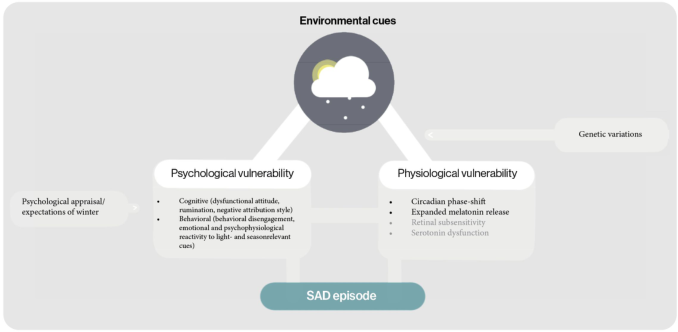
Despite many studies, SAD remains a somewhat mysterious condition. The mechanisms believed to underlie SAD can be categorized into biologi- cal and psychological mechanisms as shown in Figure 2. However, there is one environmental factor that is the main trigger in both narratives, which is the length of days in the environment where the patient is located (Rohan, Roecklein and Haaga, 2009).
A Product-Service System Approach to Light Therapy for Treatment 271
Figure 1: Research design.Figure 2: Mechanisms in SAD (Adapted from Rohan and Rough, 2017).
Most studies around the cause of SAD describe the Circadian Phase-Shift hypothesis as being most likely. This hypothesis describes a biological mecha- nism, specifically the effect of (the lack of) light on melatonin secretion which in turn influences our circadian rhythm. The circadian rhythm regulates our sleep-wake rhythm and synchronizes physiological processes with daylight. During winter months the lack of daylight can influence the sleep-wake rhy- thm of the patient, causing the patient to exhibit symptoms of hyposomnia. The administration of light therapy provides a corrective movement in rhy- thm and therefore has a direct impact on the energy levels of the patient in question. Serotonin plays an important role in the mechanisms behind SAD as well. Several trials have shown a fluctuation of up to 40% in serotonin
272 Kaat and Ivo
levels due to seasonal changes. Light has been shown to affect serotonin levels throughout the day (Oldham and Ciraulo, 2014).
The psychological mechanisms underlying SAD are often left out of the narrative when it comes to the development of light therapy lamps. By high- lighting these mechanisms as well, we hope to encourage an interdisciplinary approach to light therapy.
Three cognitive mechanisms were defined which impact the mood of SAD patients, the first being dysfunctional behavior due to irrational thoughts. A second mechanism is rumination, the repeated and prolonged focus on nega- tive feelings and its causes or consequences. The last mechanism, negative attributional style, indicates the thinking that negative events have a gene- ral and fixed cause. Some behavioral mechanisms at play in SAD patients are social withdrawal and a conditioned negative anticipation on seasonal changes (e.g., leaves changing color). For example, SAD patients will partici- pate less in so-called pleasant events during the winter than a non-depressed control group (Rohan, Roecklein and Haaga, 2009).
The psychological mechanisms, in contrast to the biological ones, can be treated by cognitive behavioral therapy, following a specific protocol designed for seasonal symptoms. This includes behavioral activation (i.e., identifying and scheduling specific pleasurable activities) and cognitive stru- cturing (i.e., capturing and challenging negative associations and core beliefs) (Rohan and Rough, 2017)
Interviews and Field Research The key insights gained during the seven semi-structured in-depth patient interviews, expert- and diary interview can be categorized into three areas.
Frustrations & limitations (1): the most common and invasive sym- ptoms arising from the interviewees’ depressive episodes were identified. Low energy levels resulted in excessive sleep and the sleepiness and lethargy in the darkest months of the year often resulted in a lack of vitality, which has a direct impact on the patients’ social life and for some resulted in dark thoughts. Most interviewees struggled with productivity which was often connected with a lack of a daily rhythm.
Self-awareness & activation (2): Most interviewees indicated an under- standing of possible remedies that could alleviate symptoms but activation to carry them out was not evident in all cases. Social contact as well as physical exercise were indicated as valuable remedies and were later verified as such by a clinical psychologist, experienced in the treatment of SAD. However, the gap between awareness and activation remained big. Some used alternative methods of symptom relief including breathing exercises, yoga, and medita- tion. In general, winter depression was little talked about with family and friends, even though it occurred frequently within the family. When it was talked about, symptoms were minimized by both the interviewees themselves and environment and in some cases even laughed off. The two Swedish par- ticipants indicated that open communication about seasonal changes made the topic of SAD easier to discuss.
Skepticism (3): The interviews uncovered a taboo surrounding the concept of SAD in Belgium, overall, there is a lack of recognition and awareness
A Product-Service System Approach to Light Therapy for Treatment 273
regarding SAD. Seasonal depression is often not the initial reason why pati- ents go to a psychologist. Often the diagnosis follows from the interview in which signs that may indicate SAD are identified. Light therapy is not a common treatment method in Belgian psychologists’ practices. Despite imple- mentation in the psychology courses at Belgian Universities (Sienaert, 2019). However, the psychologist in question did give tips that could be associa- ted with BLT, such as using lamps with high light intensity in the morning. Light therapy was known to all participants. Only two interviewees had considered purchasing a light therapy lamp but never pursued the decision. Three participants expressed doubts about its effectiveness. BLT, despite high efficacy ratios, is perceived as unreliable by patients as well as most health professionals.
Two diary interviews captured which elements of the current daylight lamps are desirable and which contextual factors need to be addressed. The regularity that BLT sessions require proved to be difficult. Especially on weekends and days off, getting up in time to follow the sessions is considered difficult but the diary that needed to be filled in during the week- long period worked well as an extrinsic motivator. The intensity of the light was initially labeled as annoying, but after a few sessions habituation occurred.
Two patient interviews took the research to Sweden, but it soon became clear that cultural differences played a big part in the way people cope with seasonal changes and thus SAD. One of the interviews in Sweden was con- ducted with a Belgian expatriate who lived in Sweden for two years. She emphasized the difference between Belgian and Swedish mentality. Because of the more extreme weather conditions in the north, light and seasons are woven into Swedish culture. Holidays such as Midsommar (i.e., holiday cele- brating the summer solstice and thus longest day of the year) are familiar to us all, but also Lucia and Walpurgis are holidays that are characterized by light and seasons. (Swedish Institute, 2021a, 2021b, 2021c) But light also plays a big role in the daily winter lives of the Swedes. They have the habit of lighting up each window of their home with lamps to literally bring light to the darkness of the streets. By placing so much focus on the lack of light and seasonal changes, there is an openness in Sweden about its effects that allows the topic of SAD to be more discussed.
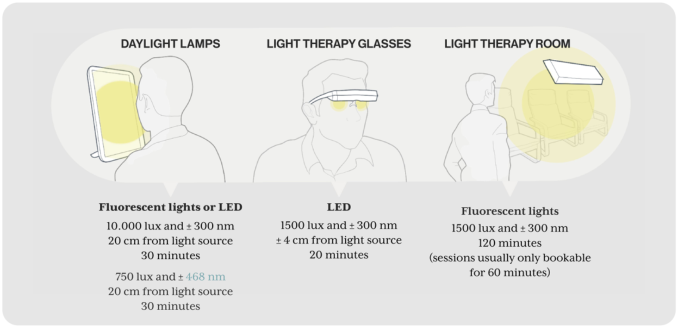
Technological Aspects BLT has been described as an effective nonpharmaceutical remedy for SAD patients and can be administered in a variety of ways pictured in Figure 3, although not all applications are equally effective. The best-known form of light therapy is that through the classic daylight lamps, but light glasses and light chambers are also used to alleviate SAD symptoms. The effectiveness of the therapy sessions is determined by five parameters, but the optimal scenario differs depending on the application used. Those specifications are distance of patience from light source (cm), wavelength (nm), light intensity (lux), duration of session (min) and timing of the session (variable per patient, dependent on the melatonin onset) (Magnusson and Boivin, 2009).
274 Kaat and Ivo
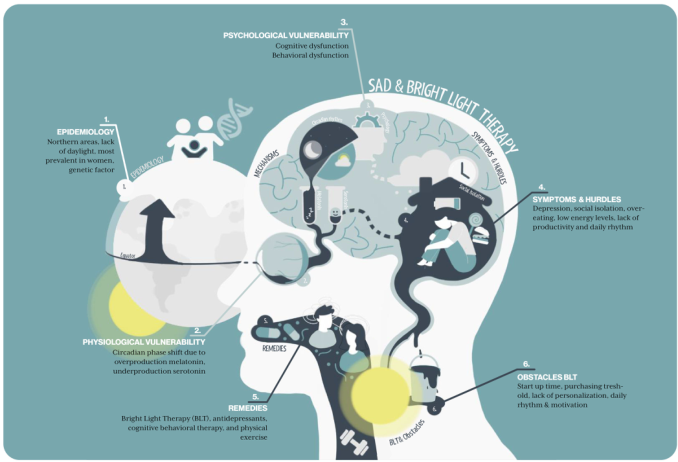
Figure 3: Light therapy applications and its specifications.Figure 4: Rich picture of the acquired insights regarding SAD and BLT.
Light therapy glasses, although easy to use, have not been extensively stu- died making proving their effectiveness more difficult (Terman and Terman, 2005). Light therapy rooms, at a light intensity of 1500 lux, are effective at daily visits of two hours (Rastad, Ulfberg and Lindberg, 2008; Rastad, Wetterberg and Martin, 2017), unfortunately most are only bookable for 60 minutes at a time. In light therapy rooms, white walls, light-colored fur- niture, and coats ensure the best possible reflection. The daylight lamp is the most proven form of light therapy and is therefore also considered the most reliable, although user experience is substandard.
A Product-Service System Approach to Light Therapy for Treatment 275
Economical Aspects Despite the fact that light therapy is a niche market, we see a large number of market players and great price dispersion. Beyond aesthetic values, few devices can distinguish themselves through functionality. On the one hand, we have the entry-level models with a limited number of functions and little attention to aesthetics. In a higher segment we find models that either claim to be more performant or put more focus on the aesthetic value of the lamp
CONCLUSION
By using in-depth interviewing techniques and diary interviews over a few days’ times, we were able to shine a light on some cultural implications as well as symptoms which have been less discussed in existing literature surrounding Seasonal Affective Disorder which are summarized in Figure 4. When we look at the most important factors when speaking about symptom relief in SAD we need to target social isolation, feelings of depression, low energy levels and lack of energy and productivity since these are the symptoms were identified as most disturbing To make a bright light therapy device that is effective and has a higher therapy compliance rate than the ones currently on the market, it is important to focus on these factors as well as the overall well-being and user experience of the patient. SAD is a complex condition involving both physiological and psychological mechanisms. All light therapy systems cur- rently on the market respond exclusively to the physiological mechanism of melatonin suppression. Therefore, there is a great opportunity in expanding the array of functions of a light therapy lamp by also evaluating the broader well-being of the patient and building a system that approaches SAD more holistically.
Functionally speaking, today’s light therapy lamps have experienced very little change since their first appearance in the 1980s. Despite a very wide range of mainly daylight lamps, little distinction can be made in terms of functions or design. The most notable changes that need to be made according to the conducted diary interviews would be to create a personalized type of care and schedules, considering the patients’ needs and preferences as well as a therapy system which can be integrated into an existing daily routine or can encourage said routine. Also, making users aware of the seasonal changes and their implications, may help them to overcome the negative anticipation which is often the first trigger of an SAD episode. The time of start-up of the session is one of the most difficult contextual factors to overcome since the efficiency of the session is linked to it. Therefore, it can’t be shifted to the preference of the user. Therefore, when designing the BLT system, it is important to make the start-up as intuitive and easy as possible to encourage users to participate in the session.
A system in which the patient feels more supported in their light the- rapy journey and is activated to get out of bed and into nature, would be a good start in tackling some of the most prevalent symptoms of SAD. A positive approach and the transformation of BLT into a daily habit are key to succeed in the mission to increase therapy compliance. The use of pri- nciples of Positive design (Desmet and Pohlmeyer, 2013), Biophilic Design
276 Kaat and Ivo
(Gillis and Gatersleben, 2015; Kellert and Calabrese, 2015) and Circadian Lighting design (Altenberg Vaz and Inanici, 2021) could be beneficial during the design process of such therapy system.
LIMITATIONS In this research, conclusions are drawn from a small population. Ideally, more patients as well as experts should be interviewed to get a picture that is more representative of the entire population of SAD patients.
REFERENCES
Altenberg Vaz, N. and Inanici, M. (2021) “Syncing with the Sky: Daylight-Driven Circadian Lighting Design,” LEUKOS - Journal of Illu- minating Engineering Society of North America, 17(3), pp. 291–309. doi:10.1080/15502724.2020.1785310. American Psychiatric Association (2013) Diagnostic and statistical manual of mental disorders: DSM-5. 5th edn. Washington DC: American Psychiatric Association. Desmet, P.M.A. and Pohlmeyer A.E. (2013) “Positive Design: An Introduction to
Design for Subjective Well-Being,” International Journal of Design, 7(3), pp. 5–19. Available at: www.ijdesign.org (Accessed: December 15, 2021). Dewit, I. (2018) PSS Design and Strategic Rollout. 1st edn. Antwerp: University of Antwerp. Dewit, I. (2019) Product-service system design, a synthesis approach. 1st edn. Gillis, K. and Gatersleben, B. (2015) “A Review of Psychological Literature on the
Health and Wellbeing Benefits of Biophilic Design,” Buildings 2015, Vol. 5, Pages 948–963, 5(3), pp. 948–963. doi:10.3390/BUILDINGS5030948. Kellert, S.R. and Calabrese, E.F. (2015) “The Practice of Biophilic Design.” Available at: www.biophilic-design.com (Accessed: January 18, 2022). Magnusson, A. and Boivin, D. (2009) “Seasonal Affective Disorder: An Overview,”
The Journal of Biological and Medical Rhythm Research, 20(2), pp. 189–207. doi:10.1081/CBI-120019310. Oldham, M.A. and Ciraulo, D.A. (2014) “Bright light therapy for depres- sion: a review of its effects on chronobiology and the autonomic nervous system,” Chronobiology international, 31(3), pp. 305–319. doi:10.3109/07420528.2013.833935. Rastad, C., Ulfberg, J. and Lindberg, P. (2008) “Light room therapy effective in mild forms of seasonal affective disorder—A randomised controlled study,” Journal of Affective Disorders, 108(3), pp. 291–296. doi:10.1016/J.JAD.2007.10.009. Rastad, C., Wetterberg, L. and Martin, C. (2017) “Patients’ Experience of Win-
ter Depression and Light Room Treatment,” Psychiatry Journal, 2017, pp. 1–11. doi:10.1155/2017/6867957. Rohan, K., Roecklein, K. and Haaga, D. (2009) “Biological and Psychological Mechanisms of Seasonal Affective Disorder: A Review and Integration,” Current Psychiatry Reviews, 5(1), pp. 37–47. doi:10.2174/157340009787315299. Rohan, K.J. and Rough, J.N. (2017) “Seasonal Affective Disorder,” in DeRubeis,
R.J. and Strunk, D.R. (eds) The Oxford Handbook of Mood Disorders. Oxford: Oxford University Press, pp. 254–265. Rosenthal, N.E. et al. (1984) “Seasonal Affective Disorder: A Description of the Syndrome and Preliminary Findings with Light Therapy,” Archives of General Psychiatry, 41(1), pp. 72–80. doi:10.1001/ARCHPSYC.1984.01790120076010. Sienaert, P. (2019) Psychopathologie. 3rd edn. Lannoo Uitgeverij.
A Product-Service System Approach to Light Therapy for Treatment 277
Swedish Institute (2021a) Lucia in Sweden. Available at: https://sweden.se/culture/ce lebrations/the-lucia-tradition (Accessed: December 14, 2021). Swedish Institute (2021b) Midsummer. Available at: https://sweden.se/culture/celebr
ations/midsummer (Accessed: December 14, 2021). Swedish Institute (2021c) Walpurgis Eve. Available at: https://sweden.se/culture/cele brations/walpurgis-eve (Accessed: December 14, 2021). Terman, M. et al. (1989) “Light therapy for Seasonal Affective Disorder. A review
of efficacy,” Neuropsychopharmacology, 2(1), pp. 1–22. doi:10.1016/0893- 133X(89)90002-X. Terman, M. and Terman, J.S. (2005) “Light Therapy for Seasonal and Nonseasonal Depression: Efficacy, Protocol, Safety, and Side Effects,” CNS Spectrums, 10(8), pp. 647–663. doi:10.1017/S1092852900019611. Torres, F. (2020) Seasonal Affective Disorder (SAD), American Psychiatric Associa-
tion. Available at: https://www.psychiatry.org/patients-families/depression/season al-affective-disorder (Accessed: October 12, 2021).
LISTED IN THE AHFE DIGITAL BOOKSTORE CATALOGUE
Explore the complete digital volume
Healthcare and Medical Devices
Read this individual research paper free through the original publisher, or explore the full digital proceedings book.
ISBN 978-1-958651-27-8
Explore this ISBN in the AHFE Bookstore ↗Listed in the July 2026 bookstore catalogue; search by ISBN to confirm current availability · Digital book purchase optional