Fabio Walter Nava, Laetitia Cook (2022). Hotels as an Alternative Property Investment Asset Class and its Funding Challenges in South Africa. In: Human Factors in Management and Leadership. AHFE Open Access, vol. 55, pp. 131–140. https://doi.org/10.54941/ahfe1002242
Institutional investors and corporates constantly strive for above-inflation yields in relation to investments in traditional real estate assets. This study set out to determine how hotels perform compared to traditional property investment asset classes in terms of investment yields and whether investors (property developers and institutional investment funds) consider the hospitality sector for investment or diversification of current portfolios. Furthermore, to determine how aligned the commercial banks, Development Funding Institutions (DFI), and Section 12J funds are with funding single hotel assets versus portfolio lending, and what their requirements are.Interviews were conducted to obtain in-depth and rich information from purposively selected respondents with experience in the sector after completing a preparatory questionnaire. Respondents included property developers, investors, financiers, tour operators, and hotel operators. Historically, hotel investors were very specific in their investment asset classes and usually solely focused on hospitality assets (specialist investors). This has changed with an increase in generalist investors coming to the market with exposure in a diversity of asset classes including the hospitality sector, and other alternative asset classes.Funding challenges, due to the operational risk associated with Hotel Management Agreements (HMA) is perceived by both financiers and developers or investors. Leases are the preferred income model but are seldom available in the hospitality sector, and often those that are made available, may not provide strong covenants required by financiers and developers or investors. Alternative funding is available in the form of Section 12J Venture Capital Companies (VCC) or from DFI’s, but both have their limitations. Recommendations for further research include funding challenges for a development or acquisition strategy at a single asset and portfolio level and expansion to Sub-Saharan Africa as it impacts many investors and international hotels brands with exposure in these regions.
Commercial banks are becoming increasingly knowledgeable when it comes to Hotel Management Agreements (HMA’s) and they show positive intent to become involved with the sector (JLL, 2018). In senior debt funding, lenders normally look for consistent and predictable cash flows like a fixed lease for
a commercial property. Hotels are an operational business rather than just a real estate letting entity. In addition, commercial banks would also rely on an experienced project management team, as developing a hotel is more complex than a commercial or retail asset. This is where Building Information Mode- ling (BIM) is used to great effect by the project management teams within the international hotel brands. All of this is vital in relation to understanding what lending covenants are required.
Commercial banks prefer lending against acquisitions or refinancing exi- sting assets, as this provides them with a trading history to lower the risk and assist in underwriting. This is not an area where the Development Funding Institution (DFI’s) tend to deploy capital as it does not meet their development role in Africa. A 12J Venture Capital Company (12J VCC) is a funding mech- anism created by the South African government to stimulate job creation by providing tax incentives to its investors for projects with significant econo- mic impact (Sacks, 2019). These funds could consider both acquisitions and developments (Sack, 2019), but the limit of fifty million rand as a total inve- stment per hotel development or acquisition has a restrictive affect in South Africa.
With an increasing focus by generalist real estate investors on the sector, it seems as if there is an increase in borrowing off existing portfolios. This attracts lenders to the hotel sector who previously did not have exposure to the asset class. Over time these lenders should become more comfortable with the industry, the pool of lenders will deepen, and liquidity and lending terms will improve. The banking sector in South Africa, but more specifically in Africa, is constantly changing and this impacts capital reserving require- ments. These changes, albeit slow and conservative, will affect each country’s central bank and filter through to the commercial banks, essentially affecting their ability to lend, their pricing, and in some cases their solvency. The hotel sector needs to educate lenders on the volatility that can occur through cycles as good operators are able to manage downside risk and maximise cash flow for debt servicing. Mezzanine lending is still in its infancy in the real estate sector in South Africa and Africa, where equity products are preferred (JLL, 2018). Alternative lenders are not currently active in the sector. Yet there are several owner operators who have their own listed bonds to reduce the cost of debt. Through consolidation of ownership and operations, this may increase.
The landscape of property investment in South Africa is changing. When the property cycle is at a certain stage, alternative property investment opti- ons or taking on investments outside of South Africa make for attractive options when desired yields are not being achieved in traditional property asset classes. Nedbank, the market leaders in South African commercial pro- perty finance, illustrated this by creating a Nedbank Africa team to deploy capital abroad. Hotels can provide a good alternative property investment asset class, but investors and banks alike would need to fundamentally under- stand the operational risk and the fact that leases are not available in hotel investments. The question is if the desired yields, Internal Rate of Return (IRR) or Return on Equity (ROE) are met with a viable project backed by a feasibility study, and what funding mechanisms are available to conclude such a development?
Hotels as an Alternative Property Investment Asset Class 133
LITERATURE REVIEW
Developers and investors are considering hotels as an alternative investment asset class as evidenced by the number of new entrants in the market. Many are still grasping the differences in risk between an HMA and lease. The availability of leases in the hotel sector are diminishing as the South African market comes to grips with the International Hotel Brands and their prefe- rences for HMA’s. Commercial banks are following this trend by increasing their comprehension of HMA’s, with DFI’s already cognisant of the risk impli- cations, and more responsive in assisting investors with funding. Investment in this sector is still in its infancy. Newell and McGreal (2015) investigate hotel investments and their contribution to commercial real estate at a glo- bal, regional, and country specific level between 2007 and 2014 by assessing 174,000 real estate transactions worth over $4.35 trillion of which hotels transaction made up 8.8% of global real estate transaction activity. Thus, it is clear that hotels are a stronger asset class globally compared to a regional level in South Africa.
The evolution of the HMA has changed the hotel investment outlook in South Africa. As stated by Tucker (1986), international sanctions against South Africa during the Apartheid era lead to the creation of hotel groups to service the country. There was no significant competition from internatio- nal brands and no need to follow emerging trends. The Southern Sun group, established in 1969 grew to 24 hotels in 1974 and dominated the industry in the 1970’s (Rogerson, 1990). Other local hotel groups emerged during the 1980’s, most notably the Protea Hotel Group and City Lodge. The South Afri- can hotel sector is unique in its structure, due to the isolation era that brought about a higher number of leased hotels in comparison to global norms of hotels operated through an HMA (Rogerson, 2012). The growth of tourism and international participation by companies in South Africa required the adaption to the international trend of HMA’s Most hotel owners in South Africa are not institutional investors, but pri- vate property companies (Nelson, 2012). Rogerson (2012) states that “South Africa shows patterns and differences with regards to hotels as an asset class compared to advanced economies, such as relatively poor levels of understan- ding of hotels by institutional investors, a perception that there are higher levels of investor risk in hotels com-pared to other traditional property clas- ses, knowledge gaps in relation to appropriate monitoring or benchmarking of the hotel property market, and a failure to establish boundaries between hotels as property or a business in the mind of an investor”. The Property sector remains an important aspect of the global economy and general fina- ncial and sovereign fiscal system. It accounts for R5,8trillion of the South African economy NCIB (2019) with hotels being the smallest recognised property sector.
JLL confirms the trend that hospitality investors (listed or non-listed entities) are transforming from specialist investors in hospitality to more generalist in all asset classes (JLL, 2018). In 2014, 38% of investors in hotels where specialists (hotels only) whilst the remaining 62% where generalists (multi-property investors). As of 2018 the percentage of specialists dropped
134 Nava and Cook
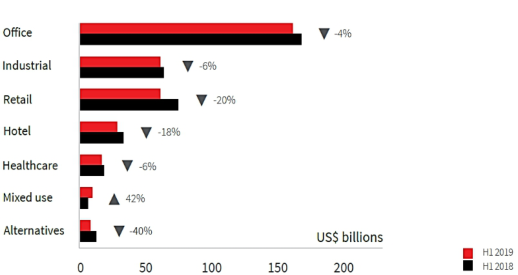
Figure 1: Global transactions by sector (JLL, 2019).
to 29% whilst the generalist increased to 71%. Alternative investments like hotels are becoming more lucrative to developers and investors alike. With continued pressure to deploy capital at scale, investors are seeking alterna- tives to fulfill their return requirements. Generalists are often better able to unlock debt due to their strong existing relationships and more diverse bala- nce sheets (JLL, 2018). Newell and Seabrook (2006) define the main factors influencing hotel investment decision making as financial (weight of 37.0%) and location (29.9%) factors followed by economic (14.5%), diversification (12.0%) and relationship (6.6%) factors. Finance factors are most important to equity investors and financiers.
In Sub-Saharan Africa, commercial banks have remained conservative in their risk appetite for funding hotel developments or acquisitions and not much has changed in their approach with lending to single hotel develo- pments. Lenders still prefer leveraging off existing portfolios, including well established hotels with consistent cash flow and more traditional property assets. one of the main reasons is the operational risk associated with the hotels (JLL, 2018). Commercial banks rely on consistent cash flows for debt serviceability such as income received from leases, but this is increasingly difficult to obtain in the market. DFI’s and commercial banks are however becoming more knowledgeable about HMA’s, but still look to mitigate risk with more consistent in-come streams. It is due to this that there has been an increased trend for mixed-use developments which would include a compo- nent of retail, commercial, hotel and branded residence in one development site (JLL, 2019). Global trends confirm that mixed-use properties are the only asset class that grew from 2018 to 2019 in terms of global transaction volumes as illustrated in figure 1.
The benefit of a mixed-use development is that once it is ready to take to market, it can provide income streams that mitigate much of the risk for the lender. Kane (2004) states that leases from the retail and commercial spaces provide consistent cash flows akin to a stable income asset, whereas the bran- ded residences can be sold on a pre-sales basis and a full cash sweep can be taken from these sales and be provided as equity into the hotel development.
Hotels as an Alternative Property Investment Asset Class 135
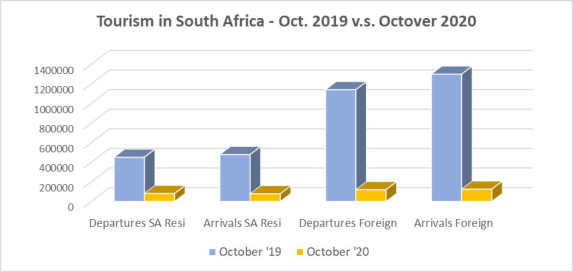
Figure 2: Tourism in South Africa (STATS SA, 2020).
Alternative funding for the hospitality sector is also available when inve- sting in a government approved Section 12J VCC as explained above. This allows tax deduction to encourage South African citizens to invest in the local economy but higher risk businesses, intent on job creations, is the imperative (Sack, 2019). This provides a good mechanism for developers to provide a product to the market and sell on a similar pre-sales model to that of a resi- dential sales model in a Venture Capital type business (STATS SA, 2020). The Section 12J incentive scheme has been halted by National treasury in June 2021, but the existing funds raised are still deployable within 48-month post closure of each VCC’s capital raise.
COVID-19 has without a doubt affected the hospitality and tourism sector the most severely in 2020-21. At the time of the South African first level five lockdown on the 15th of March 2020, occupancies had already dropped globally affecting hotel performance. The impact of travel restrictions, event postponement and cancellations, as well as the negative impact on individual travelers is confirmed by the number of travelers arriving in, and departing from South Africa. Figure 2 displays that Arrivals of Foreigners declined by 90,4% and Departures by 89,6% while arrivals by SA Residents decreased by 83,8% and departures by 82,2% (STATS SA, 2020).
METHODOLOGY
A major limitation to the study was the lack of readily available performa- nce data for the hospitality sector in South Africa. The most readily available source of published returns is the MSCI South Africa property index which provides performance on property returns on a cumulative basis since Decem- ber 1994. Hotels as a property asset class makes up 0.6% of total property asset classes with sector specific returns not made available.
Due to the lack of readily available performance data in the hotel sector, the study made use of mixed methodology (both qualitative and quantitative) as this method is a more pragmatic approach that provides the researcher the opportunity to use the research method best suited to a research problem without becoming distracted in the theoretical elements of the study (Teddlie & Yu, 2007). Unstructured in-depth interviews and structured open-ended questionnaires were conducted with a purposive sample of industry experts
136 Nava and Cook
including Hotel owners and operators, Hotel owner operators, Hotel fina- nciers, Section 12J financiers, and Hotel Property Consultants specialising in the field of hospitality. Data analysis was done through theory guided content analysis of a protocol of respondents’ narratives during which themes were identified and cross sectioned with data collected from secondary research to increase validity and reliability
RESULTS
Most of the developers, pensions funds or REIT’s indicated that variable income is not within their preferred mandate when investing in commercial property. This needs to change when considering the expansion of the sector. Financing is a challenge as traditional banks prefer hotels funded off an exi- sting portfolio of properties that have a stable income stream (JLL, 2019). Financiers and investors alike are now more attune to HMA’s than in the past. The majority of investors and developers have knowledge of alternative funding mechanisms (DFI’s or Section 12J funds), but most investors and developers still preferred commercial funders due to the perceived challenges with DFI’s and the limitation of Section 12J funds.
DFI’s are difficult to access due to their rigorous entry criteria which elimi- nates accessibility for several developers. The DFI’s will include partners like the Industrial Development Corporation (IDC), KZN Growth Fund, Nati- onal Empowerment Fund (NEF) and Development Bank of South Africa (DBSA). The DFI’s have strict Broad-Base Black Eco-nomic Empowerment (BBBEE) policies that rightfully promote investments that address issues of South Africa’s exclusionary past, but also limit the eligibility for some inve- stors and developers as they do not qualify in terms of the BBBEE criteria. DFI’s also predominantly look at developments or portfolio acquisitions or additions which restricts newcomers to the market.
The only other alternative, regarded more as mezzanine funding is to raise capital via a Section12J VCC. This has worked well for certain well- established hotel groups, but has limitations namely R50million maximum allowed per VCC the maximum allowed investment capped at R5milion per company and R2.5milion per individual.
There is a high level of fund inflow into Section 12J funds in need of inve- stment projects in the short term. Respondents confirm that the structure allows for the offtake of capital during the early stages of a project, providing a guarantee for a portion of the project, and makes it easier to approach len- ders to raise debt. Hotel assets generally have a longer-term holding period, which fits well with the minimum holding period in a 5-years. It was con- firmed by respondents with exposure to this funding model that hospitality assets are seen as a good addition to a Section 12J scheme as this asset class can be converted with relative ease into alternative use (e.g. apartments and student accommodation) and is complementary to mixed-use schemes that include large office components.
Many South African owner operator groups have used this structure effectively to roll-out their portfolio across the country. Various generalist investors are using it within mixed-use development schemes that include
Hotels as an Alternative Property Investment Asset Class 137
hotel or serviced apartment components. Investment in a Section 12J VCC should be about more than the tax incentive. Investors start the investment process with a favourable IRR due to the immediate tax benefit, but the skillset of the VCC team will determine how that IRR grows or erodes. Respondents involved with Section 12J funds confirm that it can be a daun- ting task to determine which VCC to trust with managing the capital and qualifying investors need to be confident that there is goal alignment. The VCC itself must have a solid business model, relevant experience, and tra- ction verticals to confirm ability to execute strategy and adhere to stringent governance protocols. When a tax incentive is involved extra caution should be taken to ensure that the investment structure and strategy are compliant with legislation. Hence the respondents’ perceived challenges around both DFI’s and Section 12J funds.
The data confirms that developers and investors alike are looking at alter- native investments during a downturn or where the market is bottoming out. It may seem less of a desire to pursue investment yield from assets in the hospi- tality sector as com-pared to traditional asset classes, but the current pressure on yields have necessitated diversification to higher performing assets in less traditional sectors. Hotels investors are no longer so specialist investors in hotels only. Results indicate that generalist investors are entering the market with more exposure to the hospitality sector.
Leases are still preferred to variable income contracts found with HMA’s which is the major challenge to investment in the sector. The main reason is the difficulty of funding as indicated by respondents with links to banks and other funders. Mixed-use developments have assisted with funding as it has not only diversified risk and cash flow consistency, but also increa- sed the opportunity for JVO models between property developers and hotel operators. Regarding funding difficulties locally and in Sub-Saharan Africa, many respondents spoke of the required capital stack and need for additio- nal equity. This is mostly due to funders reliance on fixed income (e.g. leases) when lending, but unavailable with hotel investments. Developers most often raise capital in the form of private equity or mezzanine funding. Private equity has many places to invest including other sectors that may have more stable income generation, thus more competition outside of the sector. Mezzanine funders are scarce in Sub-Saharan Africa and often have IRR requirements of over 20% rendering a development or acquisition unfeasible.
Other reasons for JVO models would be operational or hotel experience. Respondents spoke of having land banked a promising site earmarked for hotel development, but not having the correct expertise to proceed from plan- ning to completion stage. These challenges often lie with selecting the right operator for the hotel, understanding HMA’s and/or other contracts to be negotiated, as well as funding for the development. JVO partners are sele- cted carefully as the partner must have the right experience in the sector which is key for funders. Additionally, these operators may have stronger balance sheets that assists the developer (landowner) with successful fun- ding. Some international hotel operators secure the operation of a hotel by providing equity for a project. Many international hotel operators have key investors that are already in Sub-Saharan Africa and are attached to their
138 Nava and Cook
specific brands. JVO models can also be formed where these international hotel brands bring their known investor to a proposed development, provi- ding the security of operational expertise, and fulfilling the capital stack to ensure development completion.
Lastly, due to higher development- and operating costs of full-service hotels, the road to growth has seemed challenging as stated by two groups of respondents namely owners and investors. The focus on investment is perceived to have moved to budget and midscale segments where the demand fundamentals are optimal. The operators confirmed that new international brands were being introduced to compete in this sector. Examples include the disruption created by a specific well-known brand that now offers a quality product in strategic locations at prices below the market rates. Further pro- duct diversity in South Africa is expected with the introduction of new brands and new concepts around lifestyle, millennial travel and limited service offe- rings, targeting the niche segments that are possibly still underserviced, given the proliferation of Airbnb in certain core nodes.
DISCUSSION AND CONCLUSION Opportunity lies in the hospitality sector as it is the smallest in terms of market size compared to other sectors and provides an alternative when tra- ditional commercial assets struggle to gain market traction. Understanding hotel business fundamentals in making informed investment decision is para- mount to success in the sector. This study set out to determine how hotels as alternative asset class perform regarding yields in relation to investments, compared to traditional property investment asset classes. The results con- firm that favorable above inflation investment yields are evident in terms of ROI fundamentals, but, due to the equity required for funding of hotel assets, achieving the desired ROE hurdles remains problematic.
The study confirmed its main hypothesis namely that developers and inve- stors alike are considering hotels as an alternative investment asset class. However, South African financial institutions must now align their approa- ches to commercial property funding to meet the steadily increase in number of developers and investors investing in hotels. South African financial insti- tutions should further align with the dynamic nature of the hotel industry. The adoption process is equally slow for institutional investors. Despite lower yielding opportunities in the retail, commercial and industrial sectors, the cer- tainty of fixed income is still preferred to better longer-term yields through variable income. Thus, hotel assets with fixed leases are preferred to HMA’s. This remains a challenge as fixed lease agreements are rare in South Africa. More so, because owners still have a greater preference to apply for finance from traditional commercial banks compared to DFI’s.
The hotel industry in Sub-Saharan Africa’s hotel market is rapidly growing with more capital and equity markets entering the continent. A better under- standing of the sector has introduced new players to the market as confirmed by this study. The fastest growing markets were however the less mature markets outside of South Africa. The growing demand in these markets is
Hotels as an Alternative Property Investment Asset Class 139
resulting a pronounced supply of hotels. This is the hallmark of any fron- tier region and has characterised the evolution of almost all hotel markets. Investors are looking beyond the attractive demand fundamentals that chara- cterise the region, to carefully consider the supply landscape. A critical point is the disparity that exists within markets in Sub-Saharan Africa. In almost every major market across the region, hotels that are well located and able to align their product to the demand fundamentals, with a suitable distri- bution system, comfortably outperforming their competitors. This trend is important, as even in tough markets, there are still opportunities.
Although the uncertainties brought about by the COVID-19 pandemic is presently placing significant constraints on the industry globally, more so on an already stressed economy in South Africa, this pandemic will not last fore- ver. Current trends indicate that drive-to-destinations will recovery sooner than markets heavily reliant on international travel. This will certainly bode well for South Africa as compared to other African economies. Transactions will be more difficult as debt markets remain a challenge. Africa may in the short-term shift from a dominant development cycle to an acquisition cycle, but the long-term fundaments for hotel development in South Africa and Sub-Saharan Africa remain strong. Hotels as a real estate asset class require a longer investment horizon and will outlast the present situation.
The growth of investment in this sector will benefit other sectors in the economy, especially labour. Once the effects of the pandemic subside, and the property cycles turn, as is always the case, this will remain a very lucra- tive investment opportunity especially during portfolio diversification. The question remains, can financiers, investors, developers and hotel operators align their interest in order to expand a sector that has strong fundamentals for the long term, and that ultimately is a strong primary and secondary job creator needed in the region.
REFERENCES
JLL. (2018, October). Spotlight on Africa: An evolving landscape. An Overview of Hotel Real Estate in Sub-Saharan Africa. JLL publication for African Hotel Investment Forum summit. (pp. 2–10). JLL. Spotlight on Africa: Shifting Sands. An Overview of Hotel Real Estate in
Sub-Saharan Africa. (2019, October). Conference Proceedings of African Hotel Investment Forum Summit (pp. 3–15). Ethiopia: Addis Ababa. Kane, M. J. (2004, September). Multiple Sources Financing the Mixed-Use Development. The New York Law Journal, 29, (pp. 1–2). NCIB Business Overview – Property Finance. (2019, August 30). Conference Pro-
ceedings of Nedbank Group Commercial Property Finance (pp. 5). South Africa: Nedbank Group Commercial Property Finance. Nelson, G. (2012). CEO Hospitality Property Fund. In: C. M. Rogerson, (Ed.), Africa Insight, 42 (2), 200–213. Newell and McGreal. (2015). The significance of hotel investments in global capital
flows to real estate. International Journal of the Built Environment and Asset Management, 1 (4), 293–306. Newell and Seabrook. (2006). Factors influencing hotel investment decision making.
Journal of Property Investment and Finance 24(4): 279–291
140 Nava and Cook
Rogerson, C. M. (1990). Sun International: The making of a South African tourismus multinational. GeoJournal, 22 (3), 345–354. Rogerson, J. M. (2012). Hotels as a property asset class - International and South
African trends. Africa Insight, 42 (2), 200–213. Sack, J. (2019, September 12). What is a section 12J. Retrieved from https://jaltech.
co.za/section-12j-vcc/#what-is-section-12j STATS SA. (2020, October). Statistical Release PO352: Tourism and Migration.
Retrieved from http://www.statssa.gov.za/?page_id=1854&PPN=P0352.1 Teddlie, C. & Yu, F. (2007). Mixed methods sampling: A typology with examples. Journal of Mixed Methods Research, 1 (1), 77–100. Tucker, B. (1986). The international expansion of an enterprise of the semi-periphery:
South African Breweries Limited. Multinationals and the restructuring of the world economy. Beckenham: Croom Helm.
LISTED IN THE AHFE DIGITAL BOOKSTORE CATALOGUE
Explore the complete digital volume
Human Factors in Management and Leadership
Read this individual research paper free through the original publisher, or explore the full digital proceedings book.
ISBN 978-1-958651-31-5
Explore this ISBN in the AHFE Bookstore ↗Listed in the July 2026 bookstore catalogue; search by ISBN to confirm current availability · Digital book purchase optional