Francesco Aletta, Francesco Asdrubali, Maria Rosaria De Blasiis, Luca Evangelisti, Claudia Guattari (2022). Influence of soundscape in the experience of an urban area: a case study in Rome. In: Human Factors in Architecture, Sustainable Urban Planning and Infrastructure. AHFE Open Access, vol. 58, pp. 159–164. https://doi.org/10.54941/ahfe1002347
Over the last years several studies have demonstrated how the same environment can lead to different perceptual outcomes if the surrounding sounds change. Soundscape studies promote a user-centred approach for the characterization and management of acoustic environments in cities. There are several available protocols to gather perceptual data about how people experience the soundscapes in urban areas, and the most common tool is the “soundwalk”, a procedure where a group of people walks and stops at given locations in order to assess the acoustic environment, using some sound-related attributes (e.g., calm, pleasant, vibrant, chaotic, etc.). This research aims at evaluating the influence that different acoustic conditions together with specific environmental ones can induce on the pedestrians’ perception. In particular, the analysis was carried out within an artistically significant and culturally relevant urban district characterized by different traffic conditions, such as the archaeological area of the Colosseum in Rome. For this purpose, a soundwalk combined with a sound levels measurement campaign was organised in the archaeological area outside the Colosseum, during daytime and night time conditions, with a group of students applying the Method A of the ISO/TS 12913-2:2018, which addresses soundscape data collection. The results show how the correlations between the subjective responses and the measured data are significant and they can vary if the surrounding changes, both in terms of acoustical characteristics and environmental ones.
Over the years, many studies have shown that the same environmental conditions can induce very different emotional and perceptual states if the surrounding conditions change, particularly in terms of sound. In the built environment artificial sounds can affect citizens, causing annoyance. Arti- ficial sounds are defined as waves or vibrations generated from artificial
sources, such as the road traffic flows. It is well-known that noise pollution can lead to psychological discomfort or harmful health effects for people.
Recent studies have shown that millions of people are exposed to high noise levels. In accordance with the first report of the European Environ- mental Agency [EEA, 1995] on the European continent, 113 million people are exposed to sound pressure levels exceeding 65 dB(A) (indicated by the World Health Organization as a safety threshold), while 450 million peo- ple are exposed to levels higher than 55 dB(A). The same report suggests that, during the day, 65 dB(A) can be considered the maximum sound pres- sure level in the outdoor environment for guaranteeing appropriate indoor comfort conditions. The proposal for new residential neighborhoods is not to exceed an external environmental level of 55 dB(A). It has been estimated that approximately 9.7 million people in Europe are exposed to unacceptable levels of noise pollution throughout the day. The European Agency confirms the significance of the phenomenon in urban areas, where people are often exposed to levels above 75 dB(A). This is unacceptable since a prolonged exposure over time can cause the occurrence of auditory system diseases.
Although national policies and international guidelines (World Health Organization, 1999; WHO Regional Office for Europe, 2009; European Environment Agency, 2010) have been established for defining the limits in terms of sound pressure levels during the day and night, their reduction does not always correspond to a significant improvement in the quality of the environment perceived by users. It has been demonstrated that individual perceptions of an acoustic environment have a crucial role for the evalua- tion of an open space. Nevertheless, most international policies standardize and classify external areas only through the acoustic parameters of the sound environment. Consequently, the focus is only related on noise control (World Health Organization, 1999; European Parliament and Council, 2002). Seve- ral studies (Kang and Zang, 2010; Davies et al., 2013; Axelsson, 2015; Liu et al., 2017; Aletta et al., 2015) have demonstrated that acoustic comfort is not just a matter of noise level. Therefore, the reduction in sound levels does not necessarily lead to an improvement in the quality of life.
Soundscape studies promote an individual-centered approach aimed at characterizing and managing the urban sound environment (International Organization for Standardization, 2014). To date, various protocols exist to collect perceptual data about the individual experience of soundscapes in urban contexts, and one of the most common approaches is the soundwalk, a procedure where groups of people walk along a predetermined path, finished and stop at certain points to evaluate the quality of the soundscape using some attributes/adjectives associated with semantic scales (e.g. calm, plea- sant, lively, chaotic, etc.) (International Organization for Standardization, 2018; Aletta et al., 2019). The results show the correlations and/or associations between the subje- ctive responses and the acoustical measured parameters with the value of vehicular traffic. The outcomes of this study have the potential to inform the management of cultural heritage in terms of individual and holistic experience of the built environment.
Influence of Soundscape in the Experience of an Urban Area: A Case Study in Rome 161
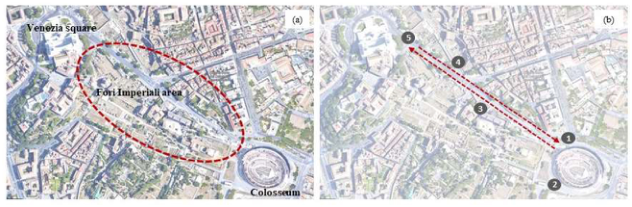
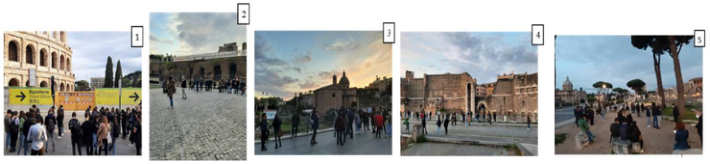
Figure 1: Colosseum archeological area (a); sound path and locations (b).Figure 2: The five measurement points during the soundwalk.
MATERIALS AND METHODS
This research was performed in accordance with the ISO/TS 12913-2:2018. It aims at assessing if a correlation between acoustic environment and traffic conditions exists, influencing the perception of a specific surrounding. It is well known how different environments can strongly influence sensations related to a specific acoustic condition. Moreover, sounds expected to be heard in a specific context play a crucial role when a judgment on the acoustic environment is requested.
The Investigated Area and the Measurement Campaign The analyzed case study was the Colosseum area, a famous archeological site located in Rome (Figure 1a). This area is divided in two different parts: one characterized by limited traffic flows (only public transport and approved vehicles) and pedestrians; the other characterized by the ordinary traffic con- ditions of the city center. Five measurements points were identified during the soundwalk. Measurement points 2, 3, and 4 belong to the first part and measurement points 1 and 5 to the second one (see Figure 2).
Starting from the soundwalk procedure recommended by the standard ISO/TS 12913-2:2018, the measurement campaign was performed, and the questionnaire was filled by the participants. Together with the questionnaire provided by the Method A of the standard, the experimental measurements campaign was carried out in April 2021, between 6.00–7.30 p.m. of a weekday, in order to combine the participants’ subjective response with the objective data provided by the measurements.
The participants were 46 students (26 women and 20 men) at the Roma TRE University, from different Departments, which voluntarily took part to
Table 1. Acoustic and Psychoacoustic parameters.
Table available in the original PDF paper.
Point SPL [dBA] N5 [sone] tuHMS R [asper] S [acum] FS [vacil]
the research. During the soundwalk an operator (non-participant) performed the binaural measurements by means of a head-mounted binaural recording kit. Aiming at analyzing the acoustic condition of the investigated area and understanding how people perceive that environment, binaural acoustical measurements were carried out in compliance with Annex D of the Standard, using a Head Acoustics SQobold with BHS II.
RESULTS AND DISCUSSION
The data analysis for the soundscape parameters was carried out accor- ding to the recommendations suggested by ISO/TS 12913-3 (International Organization for Standardization, 2019). Data analysis was carried out by exploiting all the responses obtained from the participants and the binaural measurements performed in each location.
Data collected during the soundwalk regarded the psychoacoustic and acoustic parameters together with the questionnaire responses. Table 1 lists the results of the binaural recordings carried out in the five different sites, in terms of sound pressure level (SPL), loudness (N5), Tonality (tuHMS), Roughness (R), Sharpness (S) and Fluctuation strength (Fls).
The psychoacoustic and acoustical measurements performed in each point during the soundwalk show the higher value of each parameter at points 1, 3 and 5. It can be expected for points 1 and 5, which are out of the pede- strian area and characterized by high traffic volumes. On the other hand, point 3 even if sited within the pedestrian area shows the highest values for each parameter, in particular with regard to sound pressure level, equal to 69.09 dB(A). This is probably due to the specific features of that measure- ment point. Indeed, it is characterized by different aspects: several people use to stop there due to the panoramic view; the bus stop is very close and is located at the intersection with Via Cavour, another main street in the area. The same results are confirmed by the obtained psychoacoustical parameters values.
Taking into account the responses to the questionnaires, as it can be seen in Table 2, the perception of the environment is coherent with the objective measurements. The responses were given on a scale from 1 to 5, where 1 means “Strongly agree”and 5 means “Strongly disagree”. Point 3 is perceived from the participant for most of the attributes considered as points 1 and 5, that is, as if it were a point characterized by a high traffic flow. The only difference was highlighted in the perception of natural sounds, clearly higher at this point than at points 1 and 5.
Influence of Soundscape in the Experience of an Urban Area: A Case Study in Rome 163
Table 2. Mean values and standard deviation of soundscape attributes for each measurement point.
Table available in the original PDF paper.
POINT 1 2 3 4 5 Mean S.D Mean S.D Mean S.D Mean S.D Mean S.D.
In this study the acoustical and overall environment of the Colosseum archeo- logical area were investigated by comparing acoustic environment and traffic conditions. Aiming at studying the relationships between participants’ perce- ption of the acoustical and overall quality of the analyzed site, subjective and objective data were investigated. Chosen acoustical and psychoacousti- cal parameters were taken into account and it was investigated how traffic conditions can affect the users’ final judgement.
During the analysis, it was verified that the two measurement points cha- racterized by a high equivalent sound pressure level, due to traffic conditions, were locations 1 and 5, with values of 62.17 dB(A) and 65.46 dB(A) respe- ctively. However, also point 3 is characterized by a high equivalent sound pressure level equal to 69.09 dB(A), due to the presence of the public tran- sport (bus stop) and at the crossing with another main road of the area. This measurement point is also characterized by many people visiting the archeo- logical site, whose seem to be important sound sources, due to the panoramic view. The sounds mainly perceived in the five measurement points are human beings, together with traffic noise and natural sounds.
In particular, locations 1 and 5, are characterized by constant and high traffic background noise, in fact artificial noise was selected as one of the mostly heard sources during the soundwalk in those sites. On the other hand, measurement points 2, 3 and 4 are in the pedestrian area which shows sound pressure level values lower than 55 dB(A), except for point 3 in which is located in a particular position, as it was previously described.
It is worthy to highlight how the of the acoustical and overall environment perception of the analyzed locations is strongly associated to visual features, being the measured acoustical parameters values comparable along all the soundwalk sites.
ACKNOWLEDGMENT
The authors would like to acknowledge all the participant to the soun- dwalk for the collaboration. This work was supported by the UCL Cities Partnerships Programme Funds 2020/21.
REFERENCES
Aletta F., Margaritis E., Filipan K., Romero V.P., Axelsson Ö., Kang J., Characterization of the soundscape in Valley Gardens, Brighton, by a soundwalk prior to an urban design intervention, in: Proc. Euronoise 2015, 2015: pp. 1547–1552. doi:10.13140/RG.2.1.4855.0807. Aletta, F., Guattari, C., Evangelisti, L., Asdrubali, F., Oberman, T., & Kang, J. (2019). Exploring the compatibility of “Method A” and “Method B” data collection protocols reported in the ISO/TS 12913-2:2018 for urban soundscape via a soundwalk. Applied Acoustics, 155(C), 190–203. doi:https://doi.org/10.1016/j.apacoust.2019.05.024 Axelsson Ö., How to measure soundscape quality, Euronoise 2015. (2015) 1477–1481. Davies W.J., Adams M.D., Bruce N.S., Cain R., Carlyle A., Cusack P., Hall D.A.,
Hume K.I., Irwin A., Jennings P., Marselle M., Plack C.J., Poxon J., Perception of soundscapes: An interdisciplinary approach, Appl. Acoust. 74 (2013) 224–231. doi:10.1016/j.apacoust.2012.05.010. European Environment Agency, Good practice guide on noise exposure and potential health effects, (2010). European Parliament and Council, Directive 2002/49/EC Relating to the assessment
and Management of Environmental Noise, (2002). International Organization for Standardization. (2014). ISO 12913-1:2014 Acoustics — Soundscape — Part 1: Definition and conceptual framework. Geneva: ISO. International Organization for Standardization. (2018). ISO/TS 12913-2:2018
Acoustics — Soundscape — Part 2: Data collection and reporting requirements. Geneva: ISO. International Organization for Standardization. (2019). ISO/TS 12913-3:2019 Acoustics — Soundscape — Part 3: Data analysis. Geneva: ISO. Kang J., Zhang M., Semantic differential analysis of the soundscape in urban open public spaces, Build. Environ. 45 (2010) 150–157. doi:10.1016/j.buildenv.2009.05.014. Liu A., Han X., Deng Z., Liu F., Relationship between Visual-auditory perception
and tourist satisfaction, in: Proc. InterNoise 2017, 2017: pp. 3587–3593. WHO Regional Office for Europe, Night Noise Guidelines for Europe, (2009). World Health Organization, Guidelines for Community Noise, (1999).
LISTED IN THE AHFE DIGITAL BOOKSTORE CATALOGUE
Explore the complete digital volume
Human Factors in Architecture, Sustainable Urban Planning and Infrastructure
Read this individual research paper free through the original publisher, or explore the full digital proceedings book.
ISBN 978-1-958651-34-6
Explore this ISBN in the AHFE Bookstore ↗Listed in the July 2026 bookstore catalogue; search by ISBN to confirm current availability · Digital book purchase optional