Lorena Vivanco, Alfredo Ordoñez, Natalia Pacurucu, Boris Orellana-Alvear (2022). Opportunities and challenges of citizen participation in the territorial planning system in Ecuador. In: Human Factors in Architecture, Sustainable Urban Planning and Infrastructure. AHFE Open Access, vol. 58, pp. 165–173. https://doi.org/10.54941/ahfe1002348
Fragmented public action and the limitations to coordinate national and local public policies with the involvement of citizens need to generate spaces and mechanisms for citizen participation linked to the planning processes of the different levels of government. In Ecuador (2008), citizen participation is a constitutional right of mandatory compliance for the entities and instruments part of the National Decentralized System of Participatory Planning. This study aims to analyze the normative aspects of the citizen participation system for territorial planning at the national and subnational level its opportunities. It challenges to promote the involvement of citizens in the formulation and updating of territorial planning instruments. To this end, an in-depth reading of national legislation is carried out, contrasted with the methodological guidelines of the official planning guides and information obtained from interviews with those who participate in the planning process. The results show that the structure of the participation model established constitutionally after a decade of operation has been limited to a legal process of mandatory compliance by the different levels of government. Participation spaces have been developed only at consultative and information levels. Then, there are no legitimacy processes of territorial planning instruments, which are necessary to implement normative and methodological adjustments that contribute to a new culture of the public planning to build the future development of the territory and its ordering.
Citizen participation is understood as: a mechanism of democratic deepe- ning in which individual and collective subjects intervene in public affairs; a social process, which requires different social forces to intervene in com- munal life in maintaining, reform or transforming the power structure to promote social change (social dimension) and deepen democracy (political dimension); a political process, which requires the action and intervention of individual and collective subjects in public activities as bearers of social inte- rests; and, a management instrument that allows translating into concrete actions the guidelines of state policies oriented to territorial development (Espinosa, 2009: 84; CLAD 2009: 2; Vivanco, 2016: 13). In Ecuador, citi- zen participation since the 2008 Constitution is established as a right which guarantees individuals, communities, peoples, nationalities, and collectives to participate in matters of public interest; a principle: citizens individually
and collectively participate in a protagonist manner in decision-making, plan- ning and management of public affairs and in the popular control of State institutions and society; and, a constitutional guarantee: the governments of the different subnational levels promote and implement, together with social actors, spaces, institutional procedures, instruments, mechanisms, and citizen participation initiatives, to guarantee public management in their ter- ritories (Arts. 61, 95, 134, 137 and 398, CRE/2008). The enshrinement of citizen participation as part of the rights of good living and its mandatory linkage in the formulation of territorial plans at all levels of government is a paradigm that is progressively developing through norms, jurisprude- nce, and public policies in Ecuador. The Planning and Public Finance Code (COPFP) states that the territorial plans of the decentralized autonomous governments (GAD) are formulated and updated with citizen participation. The participatory spaces established in the Constitution and other binding laws on participatory planning are applied. After a decade of the new Con- stitution and three periods of formulation of territorial plans that are updated at the beginning of each government administration that lasts four years in the country, it is appropriate to reflect on the application of the systems of citizen participation for the updating and approval of the territorial plans of the subnational governments, based essentially on the application of current legislation (Bastidas, Burbano and Ortiz, 2017) which allows building a com- prehensive synthesis of the characteristics of the system, its opportunities and challenges to improve the processes of citizen participation in the territorial planning instruments of subnational governments.
THE SYSTEM OF PARTICIPATION IN THE
SUBNATIONAL GOVERNMENTS The territorial organization of the Ecuadorian State contains regions (not confirmed), provinces, cantons, and rural parishes. Local governments enjoy political, administrative, and financial autonomy and are governed by pri- nciples of solidarity, subsidiarity, inter-territorial equity, integration, and citizen participation (Art. 238, CRE/2008). Among their functions in cor- respondence to constitutional competencies, all levels of government must promote citizen participation and social control. In the case of regional, provincial, cantonal and rural parish governments, they must implement a citizen participation system that allows for the advancement of democratic management.
All sub-national governments are obliged to implement a system of citizen participation of regional, provincial, cantonal and rural parish action that keeps coherence and correspondence with the National Decentralized System of Participative Planning (SNDPPP), which incorporates in its national and local structure: levels, mechanisms, and spaces of participation linked to the planning processes. For each national and subnational territorial planning instrument, there is a space for citizen participation, these are:
- National Development Plan (PND) and National Territorial Strategy (ETN): participation has a national scope through the Plurinational and Intercultural Citizen Assembly for Good Living -ACPIBV-.
Opportunities and Challenges of Citizen Participation 167
- Sectoral plans with territorial impact and Special Plans for strategic nati- onal projects: incorporates dialogues for sectoral participatory planning through the Sectoral Citizen Councils of the different ministries. - Territorial plans for the different levels of government: participation takes the form of citizen councils for regional, provincial, municipal and rural parish planning; and local assemblies, which ordinarily meet at least once a year and are chaired by the highest legislative authority, representatives of the various public and private actors (Art. 31, 41, 54, 64: COO- TAD/2010). Both spaces come from the Participation System of the GAD, whose purpose is to generate conditions and mechanisms of cooperation or collaboration for territorial development.
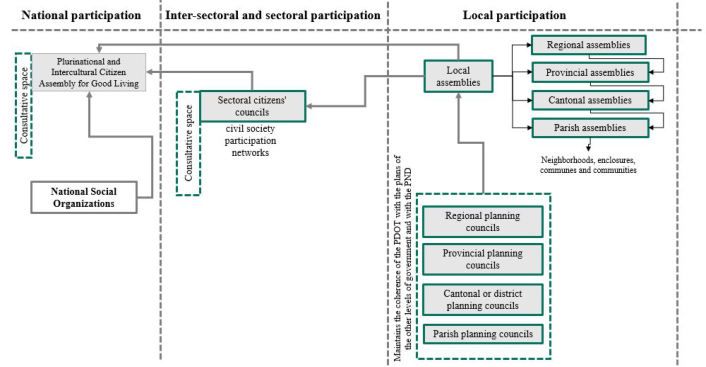
In this context, the Citizen Participation Systems are formed for the different sub-national levels, regulated by normative act maintaining their structure and denomination, as shown in Figure 1. Each local government has mustered and implemented this formal system of participation to create con- ditions and coordination mechanisms for territorial development, through sectoral or social interest groups for the formulation and management of plans; strengthen local democracy through the application of permanent means of transparency, accountability, and social control; promote the parti- cipation and involvement of citizens in decisions for territorial development; and promote training for active citizenship (Art. 304, COOTAD /2010).
ANALYSIS OF THE SPACES FOR CITIZEN PARTICIPATION PROVIDED FOR IN THE LEGISLATION FOR TERRITORIAL PLANNING
METHODS
Characteristics and purposes of the Citizen Participation system to analyze citizen participation in the territorial planning system, descriptive research of the participatory planning model defined in the 2008-2018 period is carried
out, making it unavoidable to compile, systematize and present the informa- tion researched on national legislation, which is contrasted with information from semi-structured interviews with those involved in the planning process (technicians, politicians, and citizens) on the application of the spaces for participation in the formulation, updating, and approval of territorial plans. The applied research method is deductive, based on an in-depth reading of the legal bodies, including the Constitution (2008), the Law of Participa- tion (2008), the Law of Participation (2008), and the Law of Participation (2008): Constitution (2008), Law of Citizen Participation (2010), Orga- nic Law of the Council of Citizen Participation and Social Control (2010), Organic Code of Territorial Organization, Autonomy and Decentralization -COOTAD- (2010), Organic Code of Planning and Public Finance -COPFP- (2010), Organic Law of Territorial Planning Land Use and Management -LOOTUGS- (2016) and its regulations (2019).
RESULTS
The results show that citizen participation is promoted within a decentralized state’s framework planning role as a necessary condition for good living in Ecuador. The LOOTUGS (2016) establishes the territorial planning instru- ments at the national and sub-national levels within the framework of the competencies of each level of government. Each device corresponds to a par- ticipation space integrated by: a political authority, a technical instance, and an instance of civil society representation (See Table 1).
The spaces that are part of the Citizen Participation System that have an impact on the national and sub-national territorial planning instruments are detailed below.
The Plurinational and Intercultural Citizen Assembly for Good Living ela- borates the National Development Plan and the National Territorial Strategy (PND-ETN).
The National Planning Council, which is the body that approves the PND- ETN, is composed of: The President of the Republic; four representatives of the GAD, one for each level of government; seven delegates from the execu- tive branch (ministers); the President of the Higher Education Council; the National Secretary of Planning and Development; and four representatives of civil society that make up the Plurinational and Intercultural Citizens’ Assem- bly for Good Living -ACPIBV-. It is the space for consultation and dialogue between the STPE and the citizenry to formulate, approve and monitor the PND-ETN (COPFP/ 2010: Art. 23; Art. 48, LOPC/2010).
The ACPIBV is made up of comprises: local assemblies, sectoral citizen councils, and national social organizations. From these spaces, four promi- nent citizen representatives are elected, one for each geographic region of the country and their alternates, who integrate the National Planning Council (Art. 49, LOPC/2010).
The ACIBV presents significant advances in integrating national, sector local participation spaces, with evident the characteristics of alternation, recognition of diverse identities, and territorial representation by geographic area (coast, highlands, east and east insular region). Perhaps its conformation
Opportunities and Challenges of Citizen Participation 169
Table 1. Global results of variables of citizen participation spaces in territorial planning, period 2008–2018.
Table available in the original PDF paper.
Variable of analysis
Instrumentos de planificación territorial
Espacios de participación ciudadana
Level or degree of participation Consultation and dialogue
National Development Plan - National Territorial Strategy
National Territorial Planning
Plurinational and intercultural Citizen Assembly for Good Living: comes from the Local Participation Assemblies of all levels of government and representatives of social organizations.
Special Plans for national strategic projects
Accountability; consultation and dialogue
Sectoral Citizen Councils: these are made up of social organizations in general in the following order of priority: (1) Organizations of national character; (2) Organizations of provincial character; (3) Organizations of local character or first degree. Intersectoral coordination agendas Sector Plans with an impact on the Territory Subnational Territorial Planning
Local Assembly of participation: delegates citizen instance for the confirmation of the regional, provincial, cantonal, and parish Planning Council, as appropriate.
deserves to be observed since its beginnings date from the second PND-ETN 2013–2017, there the STPE designed a participatory process that involved a representation of the citizen instance of the Planning Councils of cantonal and provincial level, from which was designated by province a principal repre- sentative and an alternate, to these delegates were added the representatives of the sectoral citizen councils and representatives of social organizations (a principal and a replacement). Thus, representatives from the three areas described above were guaranteed for each planning zone.
- The sectoral citizen councils in the formulation process of the sectoral plans of territorial incidence: they influence inter-sectoral participatory plan- ning, as inter-ministerial coordination spaces that promote sectoral instances of dialogue, consultation, and follow-up in the formulation and implemen- tation of national and sectoral policies (Art. 52, LOPC/2010). The Executive
Branch drives them through its sectoral Ministries with incidence ce in the formulation/updating of the Inter-sectoral Agendas and sectoral plans with territorial projection. This Council has an essential articulating role since it elects the delegate of the sectoral citizen council to the ACPIBV.
As of 2010, all coordinating and sectoral ministries were required to form sectoral Citizen Councils, which were not fully complied with. Up to 2012, out of the total number of Secretariats and Ministries in the country, four- teen Ministries (40%) complied with the constitutional provision. By 2013, twenty-one institutions (60%) conformed to this space (Ramírez, 2013: 151). The data evidence that the participatory planning process had minimal invo- lvement of the ministries. Therefore, in reduced cases, these participation spaces were conformed to contribute to the elaboration of sectoral plans (Orrantía, 2015: 63).
- Local assemblies and local planning councils, as instances of citizen participation in formulating territorial plans.
Local assemblies are spaces for public deliberation of citizens and dialogue with the authorities to influence the public policy cycle, the provision of servi- ces, and the management of public affairs (Art. 56, LOPC/2010). Each level of government in various representations of the territory organizes the Assem- blies, according to the extension of population concentration, guaranteeing plurality and inclusion mainly of social organizations and citizens. These spa- ces have the support of local authorities of the different levels of government or the Council of Citizen Participation and Social Control; and they consti- tute the first link for the designation of the citizen instance to the Planning Council, besides forming the nexus of interrelation between assemblies of different territorial levels - cantonal, provincial and regional assemblies-.
The local planning councils at the different levels of government are lin- ked to the SNDPP. They are responsible for formulating development plans and regional and sectoral policies to be developed based on the priorities and strategic objectives of the territory (Art. 66, LOPC/2010). These Councils are constituted and organized by the normative act at each level of govern- ment and are convened and chaired by the highest authority; they are formed according to the schemes shown in Table 2.
In the case of regions, provinces, and municipalities, each Council is made up of ten people, of which two are authorities of the local legislature, four public officials from the different departments, one delegate from the lower government; and three representatives of the citizen instance that represent at least thirty percent (30%) of citizen representatives and that according to what is established by the COPFP delegate the technical representation before the territorial Assembly of the corresponding level of government. These Councils are relevant for the formulation/updating of the regional, pro- vincial, and territorial parish plans; and the cantonal, territorial, and land use and management plan, since they issue the favorable resolution on the strate- gic development priorities, as an indispensable requirement for their approval before the corresponding legislative body; and, they know the monitoring and evaluation reports of the territorial plans of the respective levels of govern- ment (Art. 29, COPFP/2010). The Planning Council by law has the specific function of ensuring the consistency of the PDOT with the plans of the other
Opportunities and Challenges of Citizen Participation 171
Table 2. Confirmation of the planning councils of sub-national governments.
Table available in the original PDF paper.
Integration of local planning councils.
Sub-national territorial planning instruments Zone coordination agendas Provincial, territorial plans Cantonal Territorial Plans and Land Use and Management Plans Regional, provincial and municipal planning councils: (1) The highest authority of the local executive; (2) A representative of the local legislature; (3) A public servant in charge of the planning body; (4) Three GAD officials appointed by the highest authority of the local executive; (5) Three representatives delegated by the citizen participation bodies; (6) A representative of the rural parish, provincial and regional levels of government in the case of municipalities and provincial in the case of regions. Rural parish territorial plans Parish planning councils: (1) Chairman of the Parish Council; (2) A representative of the other members of the Parish Council; (3) An ad honorem technician or servant appointed by the Chairman of the Parish Council; (4) Three representatives delegated by the participatory bodies.
levels of government and with the PND-ETN (Art. 29, COPFP/2010). Howe- ver, in the best cases, their role has been to issue a favorable report to approve territorial plans as a prerequisite for their support before the corresponding legislative body (regional council, provincial council, municipal council, and Rural Parish Council). The PDOT-PUGS are approved in the same ordinance and through the same participatory and technical procedures provided for territorial plans by the STEP.
The role of the planning councils extends to the different phases of the formulation and updating process of the plans; therefore: it ensures the con- sistency of the territorial plan with the PND- ETN and with the goals of the other sub-national levels; it verifies the surface of the four-year budget programming and the investment plans with the respective territorial plan; it knows the monitoring and evaluation report of the territorial project of the individual levels of government; and, it delegates the technical representation before the territorial Assembly of the corresponding level of government (Art. 29, COPFP/2010; Art. 7, RLOOTUG, 2019). The participation spaces that come from grassroots organizations consti- tute the citizen instance of the regional, provincial, municipal, and parish planning councils, which send their delegates to the local assemblies, a space that articulates citizen participation in the sectoral and territorial planning of the different levels of government, even reaching their citizen delegates to the highest instance of involvement, which is the ACPIBV.
CONCLUSION
The absence of civil society in the planning processes is notorious; citizen participation has been of a merely consultative nature with no significant impact on decision-making regarding the use and occupation of the terri- tory and local development approaches. The sectoral citizen councils limit the right of participation of people who hold public office; and, in the case of the planning councils of the different levels of government, citizen represen- tativeness is not expressed only in the three delegates that make up the citizen instance, because they do not come from processes of citizen legitimacy, nor is the duration of their functions and their alternation established, a situation that should be adjusted in the current regulations.
As a good opportunity for the participatory process, the Constitution expands the rights of participation from the legality and formality of the institutionally, but at the moment of applying the spaces of the involvement in territorial planning, the formal system of citizen participation is not repre- sentative; it complies with a strictly legal formality. The different applicable norms regarding the scope and composition of the participating bodies con- fuse that the Technical Standard should clarify. There are inconsistencies between Article 66 of the Organic Law of Citizen Participation and Article 29 of the COPFP regarding the functions of the Planning Council; a partici- patory space can’t have the capacity to be in charge of the formulation of the territorial plan, it disrupts the competence of local governments to formulate and update territorial plans. This challenge must be overcome to improve the dispersed normative framework.
The participatory process of territorial plans must consider the content and scale of scale plan, the method, spaces, and mechanisms for participa- tion. The legitimacy and strength of the projects are closely linked to citizen participation; that is, the plan can be essentially the result of a participatory process that has the support of the population, political-administrative enti- ties, universities, unions, and other social organizations that may have a more strategic vision of the territory. Finally, the greatest challenge to overcome will be to achieve effective participation in the formulation and execution of territorial plans in the search for legitimacy, comprehensiveness, and sustai- nability of the participatory process through a proposal that incorporates citizen participation in a formal (legality) and informal (legitimacy) manner in the construction of the plan.
REFERENCES
Bastidas, C., Burbano, A. y Ortiz, S. (2017), “Balance de la Descentralización en el Ecuador: 1998-2016”. Quito: Gesellschaft für Internationale Zusammenarbeit (GIZ). Centro Latinoamericano de Administración para el Desarrollo (2009), “Carta
Iberoamericana de Participación Ciudadana en la Gestión Pública”. Dispo- nible en: https://clad.org/wp-content/uploads/2020/07/Carta-Iberoamericana-de- Participacion-06-2009.pdf
Opportunities and Challenges of Citizen Participation 173
Espinosa, M. (2009), “La participación ciudadana como una relación socio-estatal acotada por la concepción de democracia y ciudadanía”. Andamios, 5(10), 71– 109. Recuperado en 30 de enero de 2022, de http://www.scielo.org.mx/scielo.php ?script=sci_arttext&pid=S1870-00632009000100004&lng=es&tlng=es. López, M. F. (2015), “El sistema de planificación y el ordenamiento ter- ritorial para Buen Vivir en el Ecuador”. Geousp – Espaço e Tempo (Online), 19 (2), 297–312. Recuperado en 30 de septiembre de 2021, de http://dx.doi.org/10.11606/issn. 2179–0892. geousp.2015.102802. Orrantia, D. (2015) Análisis crítico de la planificación participativa en la elaboración
del Plan Nacional del Buen Vivir 2013–2017. Tesis de Maestría Publicada. Quito: Universidad Andina Simón Bolívar. Disponible en: https://repositorio.uasb.edu.e c/bitstream/10644/4890/1/T1900-MELA-Orrantia-Analisis.pdf [Consulta: 23 de octubre de 2018]. Secretaria Nacional de Planificación y Desarrollo (2010), “La participación ciudadana para la vida democrática”. Recuperado en 21 de diciembre de 2021, de https://www.planificacion.gob.ec/wp-content/uploads/downloads/2012/08/La -participaci%C3%B3n-Ciudadana.pdf Vivanco, L. (2016) La Participación Ciudadana: una visión sistémica en el marco del
ordenamiento territorial en el Ecuador. 1ra ed. Cuenca: Universidad de Cuenca.
LISTED IN THE AHFE DIGITAL BOOKSTORE CATALOGUE
Explore the complete digital volume
Human Factors in Architecture, Sustainable Urban Planning and Infrastructure
Read this individual research paper free through the original publisher, or explore the full digital proceedings book.
ISBN 978-1-958651-34-6
Explore this ISBN in the AHFE Bookstore ↗Listed in the July 2026 bookstore catalogue; search by ISBN to confirm current availability · Digital book purchase optional