Rita Ochoa, Alessia Allegri (2022). Mapping Intermittent Practices in Lisbon. In: Human Factors in Architecture, Sustainable Urban Planning and Infrastructure. AHFE Open Access, vol. 58, pp. 197–204. https://doi.org/10.54941/ahfe1002352
Worldwide, are emerging several forms of uses of space, activities, expressions, and relationships that enable and empower temporariness and sharing in the urban spaces: it is what we call Intermittent Practices (IP). IP are generating significant changes on the urban context and new challenges to policy, planning, and governance. The research project “Intermittent Lisbon. Temporary uses and sharing practices in the adaptive city” focuses on the distinctive sort of intermittences that occur in the different dimensions of public life, driving urban transformations and causing disruptions in the conventional relations between space, time and use.The present paper stems from this project and reports the mapping, systematization and interpretative reading of a collection of IP case studies. Using previously defined criteria, 10 examples will be addressed, covering the following five areas: 1. Housing and Working; Services, Leisure, Trade, 3. Culture and Artistic Action, 4. Mobility, 5. Public space and Community use.We consider that the reconceptualization of temporariness and sharing can lead to the definition of new disciplinary paradigms in which flexibility and adaptability become fundamental elements of the design processes. Therefore, a critical evaluation of this in progress phenomena is essential and an opportunity to rethink the way we live cities and design them, also in light of the pandemic crisis we have just experienced.Keywords: Intermittent Practices, Lisbon, Temporary uses, Sharing, Adaptive City
The research project “Intermittent Lisbon. Temporary uses and sharing practices in the adaptive city” explores spatial transformation processes trig- gered by practices and policies that enable and empower urban communities through temporary and sharing uses in urban spaces. All these forms of activi- ties, expressions, and relationships that enable and empower temporariness and sharing in the city, it is what we call Intermittent Practices (IP). Both planned or spontaneous, the IP generate the conditions or/and activate the transformation of the inhabited space. Different operating models, aiming for transitory and collaborative strategies, introducing different concepts and new kinds of design tools, open the path to different ways of defining the roles and responsibilities of architecture and the way we make our cities.
Addressing this complex reality, Intermittent Lisbon works on creating a bridge between research and action. Based on several case studies, the project aims to propose design tools and methods that drive urban changes using IP,
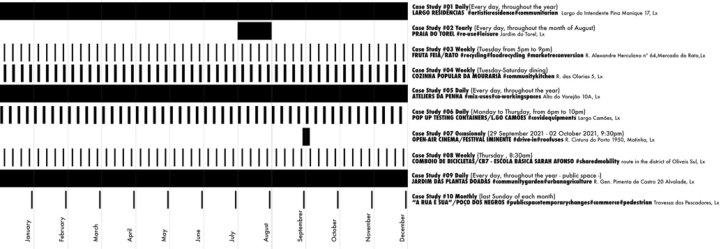
Figure 1: Periodicity_Durability of the IPs, over a period of one year. (Authors scheme, 2022).
encouraging an adaptive city. To explore this argument, the project’s temporal framework is 2012–2022 and the spatial focus is Lisbon Municipality.
The project is implemented through a research flow in which three stages are sequentially developed in time, being in permanent interaction: 1) SWI- TCH ON (Recognition and Mapping): a systematised open-access, online archive of Lisbon’s IP with a focus on relevant case studies, its features and processes; 2) CONNECT (Analysis and Discussion): an interdisciplinary assessment of the intermittent case studies impacts, synergies and potential contributions to transformative actions in the city, forming the Intermitte- ncies Circuit; 3) LIGHT UP (Future Scenarios and Forward-looking Tools): a design-oriented prospect in which future scenarios of urban transforma- tion, resulting from IP, are proposed, tested, and incorporated in the creation of urban design tools.
SWITCH ON_Mapping Intermittent Practices in Lisbon (How to Catalogue Non-Permanent and Non-Continuos Practices? How to Map Non-Fixed Events?)
The Intermittent Practices differ a lot in terms of their characteristics, and the role they play regarding fostering urban transformations. The cases we analyze span a diverse range, from pop-up shops to weekend-long festivals, from community gardens to co-working spaces, from digital platforms to physical constructions. They respond to particular and different conditions, and contexts while the only thing that unites them all is the certainty, or at least the expectation of a date of expiration (Fig. 1). Thus, they challenge us to develop tools for intervening and thinking about nonpermanent con- figurations as legitimate and productive category within the discourse on urbanism.
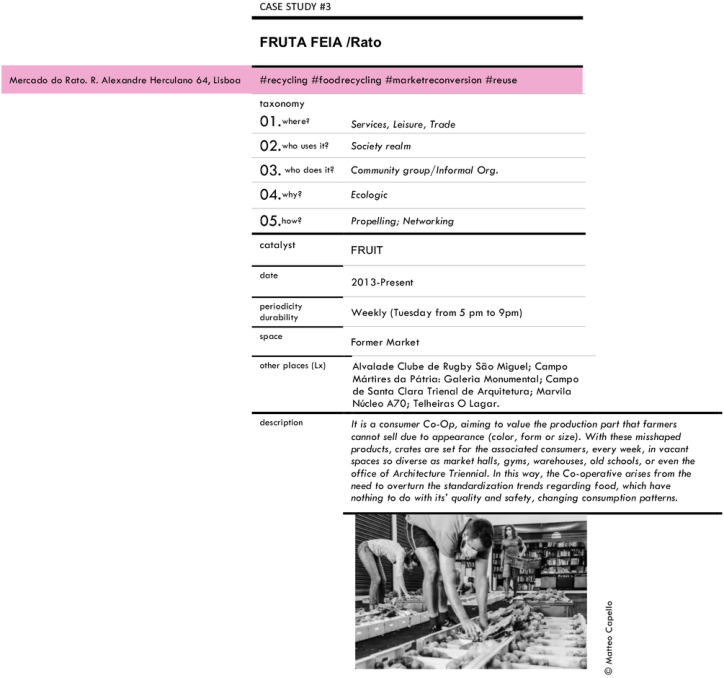
As IP are so very heterogeneous and diverse, and, unlike “normal” clas- sifications made by a range of elements that simultaneously support their continuity, our systematization is structured around clusters of cases confi- gured in diverse taxonomies, according to four questions: Where, Who uses, Who makes and Why (Fig. 2).
Mapping Intermittent Practices in Lisbon 199
Figure 2: Analysis sheet of case study #3: FRUTA FEIA/Rato. (Authors scheme, 2022). A summary sheet was made for each case study analyzed. Here is an example.
With the question “Where?” it is intended to designate the realm of a taxonomy’s action: i) Housing and Working; ii) Services, Leisure, Trade; iii) Culture and Artistic Action; iv) Mobility; v) Activism and Community Use.
With the question “Who uses it?” it is intended to classify the type of IP users and their relationship to the established society: i) Niche; ii) Society realm; iii) Starter.
The question “Who does it?” refers to the type of agents (lead organi- zation) of the IP and includes: i) Squatters/Citizen Activists; ii) Community Group/Informal Organization; iii) Architects/Artist Collective; iv) Small Scale Entrepreneurs/Developers; v) City Agency/Municipality.
“Why” refers to the dominant motivation behind a taxonomy’s action: i) Economic; ii) Ecologic; iii) Cultural; iv) Political; v) Social.
After this classification, in a more focused and operative approach, the IP will be analyzed for their contribution (impacts) and their ability to drive more transformative actions (synergies) in the city. In a first step to this analy- sis, the previous classification will be added a fifth cluster/question: “How”
200 Ochoa and Allegri
refers to the means through which this action is achieved, namely: i) Appro- priation/fill in (taking something for your own purposes, either legally or illegally, without having any effect on the place and for the time it is avai- lable); ii) Propelling (generating impulses for the programmatic profiling of a place or actions); iii) Coexisting (strengthening IP taking advantages from simultaneous existence of IP and formal permanent uses, or contrary); iv) Consolidation (turning something into a permanent or regular practice); v) Subversion (using a place for purposes other than those for which it was designed); vi) Networking (core group that builds its projects around its networks).
It is important to point out that this collection is not meant to be definitive, but rather evolving. A mapping like this, which focuses on the realities that respond to continuous changes, is, by definition, in progress. The idea of this classification always open, also reflects the form as we understand the research and the way to carry it out: we believe that researching also means experimenting.
Borrowing the tools and methods used in a laboratory, we look at the city as the scenario of “adaptive”urban projects. This means, we believe that tran- sformations are gradually changing as experiences advance. Then, we observe the corresponding reactions to each application, exploring the possibilities that are awaiting us in the subsequent stages. Therefore, the challenge is to think of the city as an open system in which the unexpected, the anomalous, and the possible can happen and coexist (Allegri et al., 2021).
CONNECT_sistematizyng Impacts, Synergies and Potential to Transformative Actions in the City Given the extremely wide universe of IP, a selection of these phenomena is analyzed in detail in packages of ten case studies, as the following.
Case Study #01: LARGO RESIDÊNCIAS is an independent organization that, through the promotion of cultural activities and social businesses, aims to contribute to local development, it being mandatory that the basis for the creation of all proposed interventions include at least one of the following points of inspiration and concern: the physical and the human heritage of the neighborhood. The three social businesses – accommodation, cafeteria and shop – occupy the same building where artists (residents and non-residents) and visitors coexist, thus allowing for very rich exchanges, in a format that guarantees its own sustainability.
Case Study #02: PRAIA DO TOREL is an initiative of the administra- tion of Santo Antonio district, with the support of various sponsors. Every August, the 18th century artificial lake of the Jardim do Torel is transformed into a public swimming pool, as well as its surroundings, covered with sand and equipped with sun umbrellas, becoming a beach. This festive event has given rise to many other recreational initiatives, including open-air cinema, the programming of activities for children, a climbing wall, gym classes, the installation of food tracks, etc.
Case Study #03: FRUTA FEIA/Rato is a consumer Co-Op, aiming to value the production part that farmers cannot sell due to appearance (color, form
Mapping Intermittent Practices in Lisbon 201
or size). With these misshaped products, crates are set for the associated consumers, every week, in vacant spaces so diverse as market halls, gyms, warehouses, old schools, or even the office of Architecture Triennial. In this way, the Co-operative arises from the need to overturn the standardization trends regarding food, which have nothing to do with its’ quality and safety, changing consumption patterns.
Case Study #04: COZINHA POPULAR DA MOURARIA is a non-profit association whose center is a kitchen open to all those who want to cook and get together. There is no table service: each person picks up their plate and sits wherever they want. Since cooking is a universal language, this project intends above all to involve all the resources existing in the neighborhood and its visitors, to provide a vast encounter of cultures, sharing gastronomy.
Case Study #05: ATELIERS DA PENHA is a 500 sqm co-working space, promoted and designed by Colectivo Warehouse in 2016. It offers a place that brings together the office space with a production and experimenta- tion shared workshop for Architects, Designers, Carpenters, Artisans, Artists, Sculptors and other creative people. It is also designed to operate as an “open door” to the city and its architects, artists, associations, etc. promoting mee- tings and events that make its residents known but also reflect on issues related to architecture, art and the city.
Case Study #06: POP UP TESTING CONTAINERS/Largo Camões. As the country enters the fifth wave of coronavirus pandemic, an expansive diagno- stic testing has been planned as a form of keeping the virus under control. This is the reason why the municipality of Lisbon, as well as other cities in the country and abroad, has increased the number of test centers, installing a set of containers cargo shipping containers in the main public spaces all over de city.
Case Study #07: OPEN-AIR CINEMA/FESTIVAL IMINENTE is born in 2016 from the curatorial collaboration between Iminente, Alexandre Farto alias Vhils and Underdogs Gallery. The Iminente Festival has conquered five cities in four countries, for a total of nine editions, with over three hundred international artists. Through exhibitions, shows, conferences, concerts, etc. it celebrates urban culture. The open-air drive-in cinema is one of the post- pandemic novelties.
Case Study #08: COMBOIO DE BICICLETAS/CB7 ESCOLA BÁSICA SARAH AFONSO born on the initiative of a group of parents who created in 2015 the CicloExpresso do Oriente, supported by the local Parish Cou- ncil and the Parents’ Association of the Parque das Nações Basic School. The Lisbon Bicycle Train is today a municipal program that involves 9 basic sch- ools. It provides that students, following a defined route and timetable, go to school by bicycle accompanied by adult monitors. The program aims to raise awareness and promote the habit of sustainable mobility during journeys to school, as well as increase, among children, the use of bicycles in real life and independently, offering a safe and fun alternative to the cars.
Case Study #09: JARDIM DAS PLANTAS DOADAS is an initiative of a citizen passionate about plants, Nuno Prates, who decided to transform the flowerbed in front of his study/library into a garden of tropical plants. The initiative of Nuno Prates made sure that the local administration, despite a
202 Ochoa and Allegri
first negative approach, started a program in which residents can apply and obtain a flowerbed to create their own (public) garden.
Case Study #10: A RUA É SUA/POÇO DOS NEGROS is a municipal pro- gram that started in 2019 and occurs on the last Sunday of each month, between May and December. The first event took place along the Avenida da Liberdade: the prestigious and central street, closed to car traffic, has given way to recreational and activities, street food, organic market and crafts. The program was very successful and was repeated in other areas of the city and planned for around 100 streets. Currently, due to the pandemic, it has changed its original intention to give more space to people in the streets, gua- ranteeing physical distance, promoting active mobility and supporting local commerce by increasing the areas for terraces and new spaces for leisure.
Each of the previous assessments are further explored through cross- disciplinary discussion to highlight the intersection and the complementa- rities between them, and their strength and capacity to impact the local scale, and to generate transformative actions in view of an adaptive city. To gua- rantee a common ground for discussion, a set of questions are addressed to each case study.
1. Regarding lessons and experience: i) to which extend do the IP respond to an urban spatial and social transformation framework? ii) to which extend do they influence new forms and expressions on open, flexible architectures and multipurpose and multifaceted urban actions? iii) to which extend do the IP establish a way of settlement (from transience to permanence)? iv) what’s the role of non-statutory tools (EU policy, governmental/local guidelines and funding priorities) in these processes?
2. Regarding the future potential: i) how do the IP respond and contribute to critical urban challenges (quick and low-cost responses, maximizing diffe- rences, active use, flexibility)? ii) how do the IP establish inter-relationships between the local and the urban scale and thus contribute to the strengthening of future design and planning?
After this systematization, we will be in position to define the Intermitte- ncies Circuits. Conceptually, it consists in a network of subtle and fragile transmission lines, which relate an almost imperceptible constellation of spaces and activities that turn on and off. But it has a strong propositio- nal potential: The Intermittences Circuit will be the key, in a next phase, to discuss and propose the Intermittent Practices both as catalysts (Esteve, 2015; Oswalt, Overmeyer and Misselwitz, 2013) and as an urban resource, to activate other transformations in the city.
CONCLUDING REFLECTIONS AND FUTURE WORKING HYPOTHESES What do a space for co-working, a fruit re-use network or a bicycle train have in common? What are the similarities between a set of Covid-19 testing containers and a community garden? Partaking values of temporariness and of sharing, all these Intermittent Practices point to ways of doing that are noticeably growing in the contemporary city, where “bottom-up” approa- ches, packages of small initiatives, and proximity processes seem best suited
Mapping Intermittent Practices in Lisbon 203
to unlock the potential of spaces and places, rather than long-term pro- posals. From this first set of cases is possible to formulate some initial hypotheses/working questions.
It is clear how the flexibility is a main characteristic of the examples illu- strated. The cases of Torel Beach or the Open Air-Cinema have the capacity to adapt to unexpected conditions, providing alternatives for the current urban design mechanisms. All these examples constitute the Intermittent City, a place where boosting functional arrangements is more important than the construction of an architectonic body, where openness prevails over rigidity and flexibility is valued over rigor. The Intermittent City is a conceptual instrument that encompasses a range of alternative forms of urbanism, allo- wing the idea of a more open urban approach. It challenges the notion of a city as a stable entity supporting how the way they must be planned would benefit by dissolving the division of temporal versus stable (Bishop and Wil- liams, 2010; Henneberry, 2017). If we analyze in the long term, temporality emerges as an important condition in the life cycle of every built environment.
The physical space of cities is evolving, mutating and becoming more mal- leable, and more open to change (Sennet, 2016). Always a city has been something like that, but today, urban environments face unremitting flows of human movements as well as an accelerated frequency of natural disa- sters and economic crisis. So, at the time in which uncertainty is a new norm, urban attributes like adaptability and openness seem to be fundamental. In this sense, the Intermittent City is also a sustainable city, where sustainabi- lity relies more on the city’s capacity to disassemble or reconfigure previous situations and relations. For cities to be sustainable, they need to change and facilitate changes, rather be limited by static and material configuration.
Finally, the Intermittent City aims a fair shared city (Sidorova et al., 2016), addressing the increasingly inequitable economic and social conditions. In different ways, cases as Largo Residências, Fruta Feia or Cozinha Popular da Mouraria, explore mechanisms and solutions to combat social inequalities. The result improves social connectivity that in turn offers more interaction and a potential for collaboration and sharing. It is often through the colla- boration of apparently different faction/parts that emerges a shared empathy that, in turn, increases mutual understanding and supportive actions (Patti and Poliák, 2017). These first ten cases demonstrate the ability to promote changes in the places where they occur and the ability to multiply by other contexts, in a domino effect. In similar practices, but also in similar ways of doing so (e.g. the reuse of vacant buildings for community practices). And not least important, they often have the capacity to influence urban planning and public policies. This is visible in how the Bicycle Train or the Jardim das Plantas Doadas started to be initiatives of citizens and are later incorpora- ted in municipal programs. This diversity creates a place where “patterns” of occupations, in time and space, determinate an urban landscape’s perception.
It is possible to define the hypothesis that, despite their small initiative character, many of these IP generate others and achieve broader impacts, at an urban level. Implying greater participation of citizens, each of these practices has impacts on its surroundings, but also on the city itself. It is the- refore important to follow their track, to observe its impacts and synergies,
204 Ochoa and Allegri
to take advantage of its potential and to consider them in future planning, but also to anticipate their risks. In fact, this is not a phenomenon that has already completed its entire path. On the contrary, as technology and the economy introduce many transformations, we are facing rapidly deve- loping dynamics and societal changes, that could be consolidated into new expressions in the coming decades, in all areas of urban life. In this context, from an action perspective, it is important to anticipate future scenarios of urban transformation resulting from the framework of temporary use and sharing, using speculative but reasoned exercises. This exercise may allow anticipating possible urban transformations that will result from the deve- lopment of Intermittent Practices, with the objective of encouraging more flexible architectures and a city that is more adaptable to the contemporary societal and urban dynamics.
ACKNOWLEDGMENT
The authors would like to acknowledge CIAUD. Universidade de Lisboa.
REFERENCES
Allegri, A., Benatti Alvim, A., Helena Abascal, E., Sabaté, J., Pedro Costa, J., & Schicchi, M.C. (Eds.). (2021). Research Tracks in Urbanism: Dynamics, Planning and Design in Contemporary Urban Territories (1st ed.). CRC Press. Bishop, P., Williams, L. (2012). The Temporary City. London: Routledge. Esteve, Manuel Bailo (2015). Against Indifference. Public catalysts. New York/Ba-
rcelona: Actar. Henneberry, J. (2017). Transience and permanence in urban development. Oxford: Wyle & Sons. Oswalt, P., Overmeyer, K., Misselwitz, P. (2013). Urban Catalyst: The Power of Temporary Use. Berlin: Jovis. Patti, D., Poliák, L. (eds.) (2017). Funding the cooperative city. Community finance
and the economy of civic spaces. Vienna: Cooperative City Books. Sennet, Richard (2006) “The Open City”, available at: https://urbanage.lsecities.net /essays/the-open-city Sidorova, M., Lammelova, Z., Bainakova, A., Fajmonova, V., Mazzini, M., Stará,
K. (2016). How to Design a Fair Shared City? 8 short stories based on equitable urban planning in everyday life. Prague: WPS.
LISTED IN THE AHFE DIGITAL BOOKSTORE CATALOGUE
Explore the complete digital volume
Human Factors in Architecture, Sustainable Urban Planning and Infrastructure
Read this individual research paper free through the original publisher, or explore the full digital proceedings book.
ISBN 978-1-958651-34-6
Explore this ISBN in the AHFE Bookstore ↗Listed in the July 2026 bookstore catalogue; search by ISBN to confirm current availability · Digital book purchase optional