João Rafael Santos, Tomás Nunes, Ariana Marques Da Silva, José Duarte, Ana Beja Da Costa (2023). Incremental public space networks as metropolitan infrastructures towards urban resilience and cohesion: decoding best practices in Lisbon, Portugal. In: Human Factors in Architecture, Sustainable Urban Planning and Infrastructure. AHFE Open Access, vol. 89, pp. 58–64. https://doi.org/10.54941/ahfe1003680
The paper offers a systematized perspective on a selection of complex public space projects delivered in Lisbon metropolitan area, through which three key rationales are discussed: 1) promotion of environmental resilience through green and blue infrastructure networks, 2) promotion of low-carbon mobility through improved conditions for walkability, active modes and access to public transport, 3) promotion of territorial cohesion through better connected and more cohesive neighborhood public spaces. Concluding remarks and contributions reveal the lessons learned on how each project’s rationale and systemic articulation complement each other, as well as the future prospects in terms of assemblage mechanisms towards an incremental logic of public space development.
Public space is widely acknowledged as a fundamental structure of urban space, giving shape to the most persistent elements of urban form, provi- ding a diverse range of services and a potent tool to engage with urban transformation (Clos, 2016, AAVV, 2018, Gray and CCCB, 2015). It also seen as a common ground on which social, economic and political dimen- sions intermingle, as a mirror of the societal organization, through its legal and normative arrangements, but revealing its tensions under multi- ple claims of property, use, access, and representation (Carmona, Magalhães and Hammond, 2008). Existing literature from the social and political scie- nces has mostly addressed these issues under the lens of social and cultural practices and the political construction of urban space and its role for sustai- nable urban development (Andersson, 2016). Another important field of research has addressed the role of public space under the lens of its ecolo- gical, infrastructural and morphological characteristics, hence highlighting its physical and material configurations, as part of wider spatial structures
Incremental Public Space Networks as Metropolitan Infrastructures 59
(i.e. urban fabrics, cities, ecological networks) (Shannon and Smets, 2010, Coelho, 2017, Battle, 2018). Nevertheless, besides design-oriented explora- tion (Solà-Morales, 2010, Secchi and Viganò, 2009, Cavalieri and Viganò, 2020), there has been limited approach to the forms and processes in space and time through which large urban areas – metropolitan areas and urban conurbations – have used public space as a multidimensional and ‘designed’ infrastructure in a coherent and multi-scalar approach. Such approach is the core hypothesis through which ‘MetroPublicNet – Building the foundations of a Metropolitan Public Space Network’ research project is addressing the experience of public space qualification projects in Lisbon Metropolitan Area (LMA), Portugal, since 1998, looking at their rationale, impact and poten- tial to shape a future metropolitan public space network (Santos and Matos Silva, 2021, Matos Silva and Beja da Costa, 2022, Santos and Carvalho, 2022). This paper presents one of MetroPublicNet’s methodological steps – the selection, decoding and discussion of several case studies in LMA – and discusses their relationship with urban planning rationales and potential for incremental development into a cohesive metropolitan network.
24 CASE STUDIES: CRITERIA, RATIONALES, AND SYSTEMIC DECODING
From a database of over 900 identified public space qualification interven- tions in LMA since 1998, twenty-four case studies was selected as relevant examples to better understand specific characteristics. Their choice was the combined result of four main criteria: 1) diversity in terms of location (at least 3 per each of LMA’s 18 municipalities), type (i.e. street, plaza, green park, waterfront, etc.) and opening date, 2) diversity of spatial and pro- grammatic complexity, 3) presence and/or potential for incremental (phased) development, 4) relevance as showcase of recurrent approaches in each of the three main rationales: i) green and blue infrastructures, ii) walkability and low-carbon mobility, iii) connected and cohesive neighbourhoods. In each case study, the fundamental rationales and policy goals behind their planning and funding are identified, allowing for a critical framework to assess their impact and contribution towards topical urban and territorial challenges.
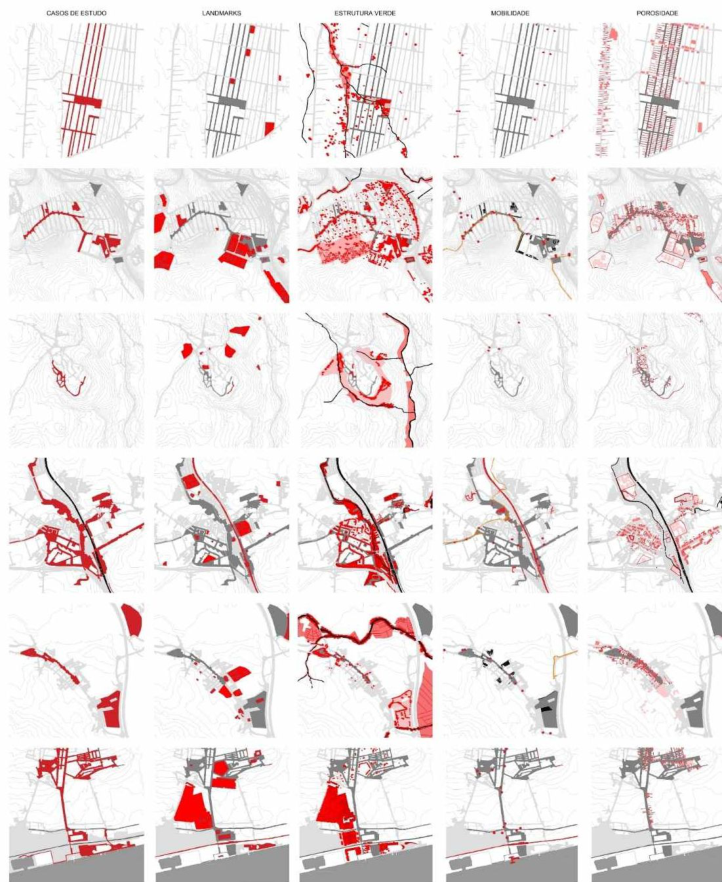
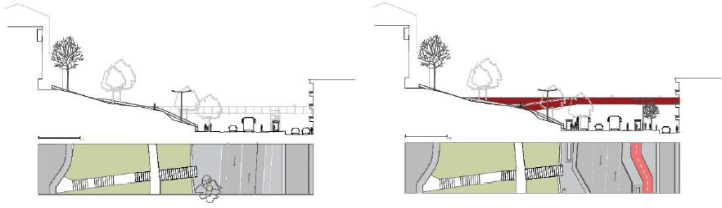
Graphical Decoding: Revealing Public Space Systems as Layers Each case study was graphically decoded and interpreted through a research- by-design approach. Figure 1 offers a selection of a comparative table of six case studies, in which six themes are identified for each case: 1) loca- tion of intervention, 2) landmarks and collective urban facilities, 3) mobility and accessibility, 4) green structure, 5) ground level porosity. The developed cartography allows for a comparative and synthetic decomposition of stru- ctural urban and territorial systems that coexist and integrate in public space. Figure 2 presents a more detailed representation of the projects developed in Vila Franca de Xira’s riverfront, one of the case studies, as an example of a complex and incrementally networked public space qualification process. Located on a riverine municipality north of Lisbon, it includes projects rela- ted to 1) pedestrian and cycle paths along Tagus river, with planned links
Figure 1: Example of comparative table of case study systematic decomposition. From top to down: Fernão Ferro (Seixal), Brandoa (Amadora), Leceia (Oeiras), Cacém (Sintra), Loures (Loures), Ajuda (Lisboa). (source: authors.)
to Lisbon’s riverfront, 2) redesign and urban integration of a national road as pedestrian friendly infrastructure, and 3) transversal connections to dense suburban residential neighborhoods, in which local community agriculture was promoted to actively reuse interstitial spaces.
Public Space Types and Planning Rationales Following the case study outline, an interpretative matrix offers a combined lens through which different types of public space intervention (i.e. linear
Incremental Public Space Networks as Metropolitan Infrastructures 61
Figure 2: Example of case study decomposition – Vila Franca de Xira / Tagus riverfront parks and N10 national road. Above: location of public space interventions; centre: systemic decomposition; below: before and after public space intervention schematic section. (source: authors.)
parks and ecological corridors, waterfront renewal, street re-profiling and sidewalk extension, local square revitalization, etc.) integrate planning rati- onales and goals. Table 1 offers a global perspective on the association of public space types and the prevailing rationale for each case study. The more complex and integrated interventions show the capacity to bridge different rationales and public space types (i.e. Sintra – Cacém urban requalifica- tion). However, even the simpler projects in terms of physical transforma- tion, may deal with complex territorial and social situations, as in the.
Table 1. Case studies matrix: 1) project rationale and 2) type of intervention (source: authors).
Table available in the original PDF paper.
Cascais – Tires/Manique roads, where pedestrian and bike lanes were added to created active mobility conditions in highly fragmented urban areas; and in the Amadora – Zambujal neighbourhood, where civic spaces were requalified in an economically deprived areas thus offering a more dignified, cohesive and better connected urban environment.
Towards Resilience and Cohesion Through Incremental Project Strategies Each case study is going through an incremental process of public space quali- fication interventions, mostly promoted and delivered by local municipalities across time, providing stronger linkages and continuities in relatively hetero- geneous and splintered territories, such as those of Lisbon and many other contemporary metropolises. This analytical framework is a useful tool to identify relevant tools of metropolitan spatial redevelopment and regenera- tion based on the incremental development of multiple forms of public space. Following MetroPublicNet’s main research hypothesis, public space’s con- tribution to metropolitan resilience and cohesion stems primarily from the networked assemblage of multiple interventions, more expressive in those related to green and blue infrastructure, thus creating a systemic and cohe- rent frame with greater impact on the whole than merely on the individual parts. With this in mind and having in consideration the processes identified in each case study and a more general perspective on recent metropolitan development in Lisbon, a framework that reinforces incremental public space development strategies was devised (Table 2).
Incremental Public Space Networks as Metropolitan Infrastructures 63
Table 2. Incremental strategies identified in the case studies (source: authors).
Table available in the original PDF paper.
CONCLUSION
The research process highlighted three main contributions: 1) a visual/graph- ical interpretation matrix through which different public space interventions are consistently represented in their multi-dimensional character, 2) a rela- tional approach between the programmatic rationality and the typological diversity of public space projects, and 3) a prospective toolbox to incremen- tally assemble multiple interventions into coherent and multi-scalar public space networks. Focusing on the latter two, it is possible to see the potential of linear continuities as particularly useful to promote more resilient ecosy- stemic features associated with green corridors, biodiversity flows, water stream restoration, and flood prevention, while also useful in terms of active modes of mobility. The logic underpinning a distributed network of nodes is relevant when considering the mobility-land use nexus, by creating a more equative and consistent coverage of transport hubs in strategic locations as well as complementary distribution of collective urban facilities. The use of passages and porosity strategies are important to foster active mobility modes, by decreasing the effect of spatial barriers and promoting accessi- bility for all, thus promoting social cohesion. Selective and asymmetrical differentiation can be better suited for achieving positive discrimination in terms of investment aiming at social cohesion, prioritising areas lacking basic infrastructure and creating connection to often splintered socially deprived districts. Finally, bringing qualified public spaces to landscape references and collective identity areas can have a relevant impact on the cultural and
political dimensions of planning and governance, creating a more aware, demanding and participatory metropolitan community.
ACKNOWLEDGMENT
This research was supported by Portuguese national funds through the Fun- dação para a Ciência e a Tecnologia (FCT, I. P.) under the grant PTDC/ART- DAQ/0919/2020 (MetroPublicNet: Building the foundations of a Metropo- litan Public Space Network to support the robust, low-carbon and cohesive city: Projects, lessons and prospects in Lisbon).
REFERENCES
AAVV (2018). Re-visiting Metropolitan Barcelona. Public Space 2013-2017, Barcelona: Àrea Metropolitana de Barcelona. Andersson, C. (2016). “Public Space and the New Urban Agenda.”, The Journal of Public Space 1(1), 5–10. Battle, E. (2018). “Fusing nature, public space and city”, in: AAVV. Re-visiting
Metropolitan Barcelona. Public Space 2013-2017, Barcelona: Àrea Metropolitana de Barcelona, 290–295. Carmona, M., de Magalhães, C., Hammond, L. (2008). Public Space: The Management Dimension. London: Routledge, 71–80. Cavalieri, C., Viganò, P. (2020) The Horizontal Metropolis, A Radical Project.
Zürich: Park Books. Clos, O. (2016). Espace (s) public (s) métropolitain (s): Travaux 2013–2015. Lille: ADU Lille Métropole. Coelho, R. (2017). Designing the city from public space. A contribution to (re) think
the urbanistic role of public space in the contemporary enlarged city. The Journal of Public Space 2(1), 95–108. Gray, D., Centre de Cultura Contemporània de Barcelona, eds. (2015). Europe City: Lessons from the European Prize for Urban Public Space. Zürich: Lars Müller Publishers. Matos Silva, M., Beja da Costa, A. (2022). “Lisbon’s Metropolitan Public Space
Network as an opportunity for the management of the urban water cycle”. Proceedings of the AHFE 2022 International Conference - Human Factors in Architecture, Sustainable Urban Planning and Infrastructure. Santos, J. R, Carvalho, L. S. (2022). “Who plans and funds public space qualification projects? Policy, planning and delivery schemes in Lisbon metropolis”. Proceedings of the AHFE 2022 International Conference - Human Factors in Architecture, Sustainable Urban Planning and Infrastructure. Santos, J. R., Matos Silva, M. (2021). “Public Space as a Metropolitan Network.
Making the Bridge Between Policy and Design in Lisbon Metropolis”. Proceedings of the AHFE 2021 Virtual Conference on Human Factors. Secchi, B., Viganò, P. (2009). Antwerp, Territory of a New Modernity. Rotterdam: Sun. Shannon, K., Smets, M. (2010). The Landscape of Contemporary Infrastructure.
Rotterdam: NAi Publishers. Solà-Morales, M. (2010). “The Impossible Project of Public Space”, in: Carrera, J.
et al., eds., In Favour of Public Space: Ten Years of the European Prize for Urban Public Space. Barcelona: CCCB/ACTAR, 24–32.
LISTED IN THE AHFE DIGITAL BOOKSTORE CATALOGUE
Explore the complete digital volume
Human Factors in Architecture, Sustainable Urban Planning and Infrastructure
Read this individual research paper free through the original publisher, or explore the full digital proceedings book.
ISBN 978-1-958651-65-0
Explore this ISBN in the AHFE Bookstore ↗Listed in the July 2026 bookstore catalogue; search by ISBN to confirm current availability · Digital book purchase optional