João Rafael Santos, Luís Sanchez Carvalho (2022). Who plans and funds public space qualification projects? Policy, planning and delivery schemes in Lisbon metropolis. In: Human Factors in Architecture, Sustainable Urban Planning and Infrastructure. AHFE Open Access, vol. 58, pp. 295–302. https://doi.org/10.54941/ahfe1002364
The article presents intermediate findings from “MetroPublicNet” research project, in which in which over one thousand delivered public space projects in Lisbon Metropolitan Area (Portugal) were identified and mapped. It offers a specific analysis of the projects delivered under the 2014-2020 EU funding framework, looking for its inception, rationales, funding and delivery frameworks. This focus on public sector-led projects allows for a sharper look in terms of policy priorities, programmatic guidelines and their impact in shaping Lisbon’s recent metropolitan development.
The article present’s intermediate findings from “MetroPublicNet - Buil- ding the foundations of a Metropolitan Public Space Network to support the robust, low-carbon and cohesive city: Projects, lessons and prospe- cts in Lisbon”, a three-year project initiated in 2021 and funded by the FCT, the Portuguese national research agency, which aims at mapping, decoding, assessing and discussing the result of 20 years of public space improvements in Lisbon Metropolitan Area (LMA) (Santos and Matos Silva, 2021).
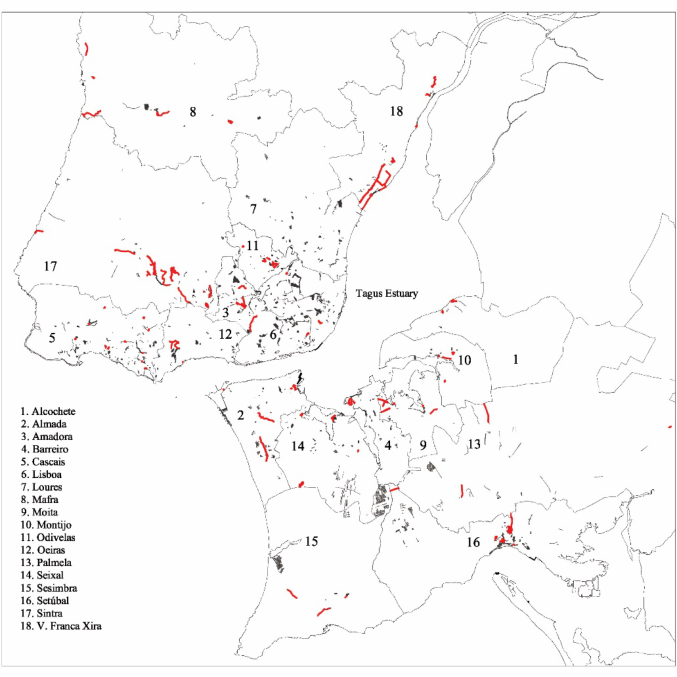
After an initial task in which over one thousand delivered public space projects were identified and mapped (Figure 1), specific analysis were develo- ped to understand its inception, rationales, funding and delivery frameworks. Virtually all of these projects were delivered by public sector entities, with municipalities holding the lion share, followed by central administration institutions. Since the research project is particularly aimed at addressing qualification interventions, private-led urban expansion schemes are not con- sidered, despite their role as the main promoters of new public spaces which are then handed over for municipalities for maintenance and qualification. This focus on public sector-led projects allows for a sharper look in terms of policy scrutiny and assessment.
Figure 1: Public space projects in LMA (1998–2020). In red: funded by Portugal 2020 framework (Authors. Project MetroPublicNet, 2022).
Particularly important in this overview is the impact of EU funding frameworks and associated policies, which not only define programmatic gui- delines and priorities, but also a procedural array of strategic planning tools. Considering the 2014–2020 period – and within the scope of the partnership agreement, Portugal 2020, established between the EU and Portugal – a wide range of soft planning instruments were undertaken. Among these, the PEDU, a strategic plan for urban development, stands out as it was undertaken by all of LMA’s 18 municipalities.
Conceptually, this research task combines two perspectives. One regards the aims and rationales involving public space qualification as expressed in urban policy frameworks; the other considers the procedural nature of these policies, that is, their configuration as planning and delivery tools.
Given this recent centrality of public space at the heart of urban policies, we seek, on the one hand, to recognize the real territorial extension of this public space protagonism in public policy and, on the other hand, to understand what are the characteristics of this simultaneity: the temporal concentration and wide typological diversity of dozens of projects in public space.
Who Plans and Funds Public Space Qualification Projects? 297
PUBLIC SPACE PROJECTS UNDER THE 2014–2020 EU FUNDING FRAMEWORK The project identified 139 effectively delivered public space projects funded under 2014–2020 EU-Portugal Partnership Agreement Framework in LMA (Portugal 2020; 2021). The global investment amounts to 148 million euro under two Programs: the POR-Lisboa (Regional Operational Program of Lisbon) and the POSEUR (Sustainability and the Efficient Use of Resources Thematic Operational Program). Further, investments are organized under three main Priority Axes. Five under the ‘Promoting the adaptation to climate change and risk prevention and management’ Prioritary Axis (aprox. 13% of the global investment, with 85% EU co-funding); 23 under the ‘Preserving and protecting the environment and promoting the efficient use of resources’ Prioritary Axis (aprox. 10% of global investment, with 50% EU co-funding); and 140 under the ‘Sustainable urban development’ Prioritary Axis taking the lion share (aprox. 77% of global investment, with 50% EU co-funding). The ‘Sustainable urban development’ Axis is further divided in three investment priorities, splitting the 77% of investment among the promotion of low carbon mobility (47%), urban environment improvement and urban revita- lization (17%) and support to disadvantaged communities (13%) (Table 1). The PEDU is used to frame projects under the ‘Sustainable urban develo- pment’ Prioritary Axis, then further organized under the 1) PAMUS (Sustai- nable Urban Mobility Action Plan) for the low carbon mobility investment priority; 2) PARU (Urban Rehabilitation Action Plan) for the urban revi- talization investment priority; and 3) PAICD (Integrated Action Plan for Disadvantaged Communities) for the disadvantaged communities investment priority.
In terms of geographical distribution, the municipalities of Alcochete, Lou- res, Setúbal and Mafra have a higher proportion of funding when compared to more central municipalities such as Lisbon, Amadora, Oeiras, Cascais, Sintra or Almada, taking into account their population size as a criterion. On one hand this is the result of specific funding assigned to territorial risks, such as flood prevention projects in Loures and Setúbal, and to the inve- stment in public space improvement in social housing and disadvantaged neighborhoods in Vila Franca de Xira (Table 2).
PLANNING RATIONALES AND SPATIAL IMPACT A central argument in MetroPublicNet research project is that policy priorities and the procedural design of specific planning tools and fun- ding frameworks have relevant spatial impact in the assemblage of mul- tiple projects into larger and more coherent public space networks. In order to outline this nexus between territorial process and product, two dimensions are briefly outlined: 1) a typological systematization of the studied public space projects and 2) the characterization of one of the most important planning tools used in their inception and funding process.
298 Santos and Carvalho
Table 1. Distribution of public space qualification projects in LMA funded by Portugal 2020 funding framework. (Authors, based on Portugal 2020, 2021).
Table available in the original PDF paper.
Type of project Number of delivered projects Prioritary Axis 02 Promoting the adaptation to climate change and risk prevention and management
4
Riverfront 1 Water stream regularization and flood prevention SUB-TOTAL 5/€19 445 840 (13% of total investment)
Prioritary Axis 04 Preserving and protecting the environment and promoting the efficient use of resources
13
Park/vegetable garden around water stream Riverfront 5 Cultural heritage & facilities 4 SUB-TOTAL 23/€16 323 714 (10% of total investment)
Prioritary Axis 08 Sustainable urban development (planned under PEDU) Investment Priority: promotion of low carbon mobility (PAMUS)
Bicycle lane and walkability 63 Interfaces and parking 8 SUB-TOTAL 71/€72 874 738 (47% of total investment) Investment Priority: urban environment improvement and revitalization (PARU)
28
Urban restructure 2 Square and historical town requalification Waterfront 5 Water stream park 2 SUB-TOTAL 37/€26 754 613 (17% of total investment)
Investment Priority: support to disadvantaged communities (PAICD)
31
Public space in public housing neighborhoods SUB-TOTAL 31/€19 223 789 (13% total investment)
Who Plans and Funds Public Space Qualification Projects? 299
Table 2. Investment vs. population distribution of public space qualification projects in LMA municipalities. (Authors, based on Census 2021 and Portugal 2020, 2021).
Table available in the original PDF paper.
Municipality Population Investment in public % of LMA population
The Type of Implemented Projects and Their Impact on Metropolitan Network-Building Considering the typology of projects, MetroPublicNet identified nine main types, revealing programmatic priorities and a contributing to new forms of territorial and urban qualification: 1) riverfront requalification, namely those related to high landscape and scenic values, but also to urban regeneration in historical centers, fostering their attractiveness and the potential to use lar- ger tracts of metropolitan open spaces, (with a total of 11 projects delivered); 2) water stream regularization and flood prevention, with considerable stor- mwater management components, but also with the potential to structure green urban spaces (4 projects); 3) parks and vegetable gardens along water streams, mostly associated with the surrounding residential districts, exploi- ting the combined potential of green infrastructure, local food production and social inclusion (15 projects); 4) public space qualification associated with cultural heritage sites and urban facilities, aimed at reinforcing the urban integration of relevant cultural and social sites (4 projects); 5) bicycle lanes and walkability improvement in various situations, from comprehen- sive urban street redesign with traffic calming measures to the introduction of cycle and walkable lanes in inter-urban roads (by far the most common typology with 63 delivered projects); 6) improvement of transport interfa- ces and parking facilities, aimed at promoting the use of public transport (8
300 Santos and Carvalho
projects); 7) urban restructure operations, with new infrastructure, plot and land use redevelopment (only 2 projects delivered, given their complexity and private-ownership dependency); 8) square and historical town requalifi- cation, mostly aimed at urban revitalization and improvement of the urban built environment (28 projects); and 9) public space improvement in public housing neighborhoods (the second most common with 32 projects).
Although it is not the aim of this paper to discuss the evolution of these projects considering a longer period of analysis, preliminary findings and previous references suggest that recent projects reveal a stronger emph- asis on environmental sensitive areas, suburban/peripheral locations and sub-metropolitan level mobility links (local roads between different urban settlements or articulated with multimodal transport interfaces). Additio- nally, there is also a tendency to more scattered, punctual and smaller interventions, when compared to the 2000–2006 EU funding framework, in which larger and more integrated operations were planned and delive- red, replicating in a smaller scale the Expo 98 model of rather ambitious urban regeneration based on environmental and public space components. This model of “small Expos” was implemented throughout the Portuguese territory under the Polis Program, covering 39 cities (Partidário and Nunes Correia, 2004) and lasting over the 2007–2013 period under the designation of Polis XXI Urban Policy framework. The 2007–2013 EU funding framew- ork began this transition to a more selective and strategic distribution focused on thematic objectives, rather than large scale projects. Nevertheless, when looked on a long-term perspective, it is possible to identify lines of continuity and incremental assemblage of the multiple projects (Santos, 2016).
In terms of a metropolitan-wise perspective, this transition favored a netw- ork approach in comparison to an area-based approach. Instead of focusing on nodes of polarization, high urban intensity or historical settlement nuclei, the promotion of environmental requalification and active mobility as two major priorities fostered the delivery of linear spaces, such as water streams, riverfronts, urban streets or road networks. The most interesting situati- ons are those where these linear spaces combine multiple components (i.e. a linear urban park combining formal green spaces with nature-based solu- tions in areas of high ecological value, together with active mobility paths, well-connected to surrounding urban spaces and transport interfaces. This perspective is also fostering a more robust cooperation between different municipalities, with several projects being conceived as lines of continuity or as networks that cross various municipal boundaries.
The Role and Format of the Soft Planning Tools and Spaces: the Case of PEDU’S The issue of the planning framework under which these projects are concei- ved and to which specific funding is allocated can be discussed under the soft planning debate (Allmendinger et al, 2015). Portugal’s urban development policies have been strongly shaped by EU funding guidelines (Medeiros and Van Der Zwet, 2019; Cavaco, Florentino and Pagliuso, 2020), given the con- siderable dependency on them to drive public investment. These guidelines
Who Plans and Funds Public Space Qualification Projects? 301
are translated to national policies and decision-making processes and include very specific programming requirements. One example is the PEDU (Strategic Plan of Urban Development), a mandatory document to be drafted in order to apply for funding. Each application must be framed in the PEDU, which in turn follows the structure and priorities established on Portugal 2020.
The PEDUs had 3 strands, each associated with a specific line of EU funding within the scope of Portugal 2020: i) sustainable urban mobility; ii) urban regeneration and iii) support to disadvantaged communities. Alth- ough with nuances, the three strands incorporated types of actions that involved intervention in public spaces. For example: i) the creation of cycling corridors; ii) the rehabilitation of spaces in historic centers or iii) the qualifica- tion of spaces in precarious neighborhoods. Although the PEDUs incorporate different types of actions, those related to interventions in the public space ended up playing a leading role in the programming of EU funds. In line with relevant research addressing the topic of soft spaces of planning and its inter- twining with soft planning tools, the PEDU’s had a meaningful role in the way how these trends are shaping recent spatial transformation in Portugal and specifically in LMA, the country’s capital region.
Being a non-statutory planning tool, the PEDUs do not regulate land use and its transformation. They are, therefore, less relevant for urban property development rationales involving the private sector. On the other hand, they are directly linked with the financial framework of EU funding, with very strict delivery timeframes. This results in a very effective tool of urban action, particularly in a context of public space improvement, as the key actors are public authorities and most of the land is also public property. On the other hand, PEDUs tend to be conceived with a focused approach to the EU’s policy priorities and funding schemes, rather than on a local and metropolitan-wise strategic vision or with clear articulations with multi-sectoral urban poli- cies. As such, these PEDUs and their thematic follow-ups (PAMUSs, PARUs, PAICDs) can be regarded more as operative tools to frame funding applica- tions than on the strategic urban planning tool its name suggests. The direct correlation between them planning tools and the Portiugal 2020 investment priorities clearly shows a more procedural than strategic nature.
CONCLUSION
In Portugal, one of the most relevant effects of the so-called sovereign debt crisis at the end of the first decade of the 21st century - and which, to a certain extent, persists in 2022 - was the significant decrease in urbanization and building processes. Despite this situation, a large part of the production of (new) public space is still privately promoted, leaving public entities – i.e. municipalities - responsible for the maintenance and requalification of this public space.
With Expo 98 as a landmark, it is clear - throughout the Portuguese terri- tory and specifically in the LMA - that in the two following decades, public policies for urban requalification have assumed exceptional relevance. This relevance is reflected in the significant increase in approved projects and in
302 Santos and Carvalho
the amount of delivered public investment, with very relevant share from EU funds.
It should also be noted that, gradually but consistently, these projects and investments have been directed towards a double integrated logic: interven- tions tend towards a logic of territorial continuity, while at the same time, environmental sustainability is assuming the centrality of public policies of urban requalification.
ACKNOWLEDGMENT
This research was supported by Portuguese national funds through the Fun- dação para a Ciência e a Tecnologia (FCT, I.P.) under the grant PTDC/ART- DAQ/0919/2020 (MetroPublicNet: Building the foundations of a Metropo- litan Public Space Network to support the robust, low-carbon and cohesive city: Projects, lessons and prospects in Lisbon) and the grant PTDC/GES- URB/29170/2017 (Softplan: From Soft Planning to Territorial Design: Pra- ctices and Prospects).
REFERENCES
Allmendinger, Phil. Haughton. Graham, Knieling, Jörg. Othengrafen, Frank. (2015) Soft Spaces of Governance in Europe: A Comparative Perspective, London: Routledge. Cavaco, Cristina. Florentino, Rui, Pagliuso, Ana. (2020). Urban Policies in Portu-
gal. in Foregrounding Urban Agendas, Armondi, S. D., Gregorio Hurtado, Sonia (Eds.). Cham, Switzerland: Springer Nature Switzerland AG, pp. 49–73. Coelho, Rodrigo. (2017). Designing the City from Public Space. A Contribution to (Re)Think the Urbanistic Role of Public Space in the Contemporary Enlarged City. The Journal of Public Space 2(1):95. Medeiros, Eduardo, Van Der Zwet, Arno. (2019). Evaluating Integrated Sustai-
nable Urban Development Strategies: A Methodological Framework Applied in Portugal. European Planning Studies 0(0):1–20. Partidário, Maria do Rosário. Nunes Correia, Francisco. (2004) POLIS - The Portuguese Programme on Urban Environment. A Contribution to the Discussion on European Urban Policy, European Planning Studies 12(3): 409–24. Portugal 2020. (2021), Lista de Operações Aprovadas Portugal 2020 reportada
a 31 de Setembro de 2021 [excel file], Lisbon. https://portugal2020.pt/wp- content/uploads/PT2020-Lista-Operacoes_30setembro2021.xlsx Santos, João Rafael. (2016). Street Requalification Strategies: Recent Trends in Lisbon Metropolitan Area. in Street Forming | Re-forming – Transforming the 21st Century Street - Proceedings – 2nd City Street Conference. Beirut: Notre Dame University-Louaize, pp. 130–40. Santos, João Rafael. Matos Silva, Maria. (2021). Public Space as a Metropolitan
Network. Making the Bridge Between Policy and Design in Lisbon Metropolis. in Advances in Human Factors in Architecture, Sustainable Urban Planning and Infrastructure - Proceedings of the AHFE 2021 Virtual Conference on Human Factors. Cham, Switzerland: Springer Nature Switzerland AG, pp. 310–17.
LISTED IN THE AHFE DIGITAL BOOKSTORE CATALOGUE
Explore the complete digital volume
Human Factors in Architecture, Sustainable Urban Planning and Infrastructure
Read this individual research paper free through the original publisher, or explore the full digital proceedings book.
ISBN 978-1-958651-34-6
Explore this ISBN in the AHFE Bookstore ↗Listed in the July 2026 bookstore catalogue; search by ISBN to confirm current availability · Digital book purchase optional