Ji Won Gu, Ji-Hoon Hwang, Ryun-Seok Oh, Jun-Ho Choi (2022). Analysis of Pre-evacuation Time and EEG for Fire Alarm when Wearing ANC Earphones. In: Safety Management and Human Factors. AHFE Open Access, vol. 64, pp. 135–143. https://doi.org/10.54941/ahfe1002638
With the development of mobile technology and the progress of an Untact society, the number of people who listen to lectures or music in various urban environments is increasing. In response to such an increase in demand, Active Noise Canceling(ANC) earphones that remove ambient background noise or static and also enable stable listening have been developed, and the earphones are enjoying great popularity. However, these ANC earphones can put the user in a dangerous situation at any time because they block even major alarm sounds such as a car horn or fire alarm. In this study, 10 men and women in their 20s, who frequently use ANC earphones, were asked to listen to music by wearing ANC earphones without prior notification of the fact that a fire alarm sound was transmitted. After that, the fire alarm bell or emergency broadcast sound was randomly generated for them to recognise the fire situation, and the time it took to start evacuation was measured. And in all these processes, EEG was simultaneously measured to analyse changes in emotions such as arousal responses felt by the experimental participants As a result of the experiment, it was found that the case of transmitting an emergency broadcast made the participants start evacuation approximately 23 seconds faster than the case of sounding the fire alarm bell. However, as a result of correlation analysis with EEG values indicating arousal responses such as tension, irritability, and nervousness, the significance probability(p-value) was 0.825, indicating that there is no statistically significant correlation. Therefore, it was found that the participants’ awareness of the fire alarm sound decreased when wearing ANC earphones regardless of the types of the fire alarm whether it was an alarm bell or an emergency broadcast.
INTRODUCTION AND OVERVIEW Recently, there has been increasing interest in Bluetooth earphones equipped with an active noise control/cancelling (ANC) function, used to block exter- nal noise from earphones. However, ANC earphones have a problem in that they block not only the surrounding background noise, but also emergency alarm sounds designed to inform people about the occurrence of danger, such as honks and fire alarm sounds. The fire alarm sound serves as an important medium that accurately and swiftly motivates people to escape to a safe loca- tion, thus reducing the evacuation time (Proulx, 2007). In a study conducted by Proulx, occupants who underwent evacuation believed that an emergency situation was terminated and returned to their original places as soon as the fire alarm sound stopped. Based on this observation, Proulx emphasized the importance of fire alarm sounds (Proulx, 1995).
Table 1. Classification of types of experimental cases.
Table available in the original PDF paper.
Case I Case II Case III Case IV ANC function operation ON ON OFF OFF Types of fire alarms FBA EPAS FBA EPAS
Research on restrictions on the maximum output volume of ANC Blue- tooth earphones has been conducted to develop surrounding noise canceling technology and prevent hearing loss. However, few studies have analyzed the problem of emergency alarm sounds being removed when ANC earphones are worn (Hirave, 2011; Kuo, 2018; Struck, 2019). Only a small number of researchers have examined evacuation delays based on whether ANC earph- ones are worn in the field of human behavior in case of fire. In particular, the psychological and physiological responses of those who undergo an evacua- tion affect the total evacuation time during the response phase. Relevant data have been obtained primarily through interviews or surveys, but these data collection methods reflect the subjective opinions of participants and thus reduce data reliability (Christensen, 2008; Purser, 2008; Pan, 2007; Ren, 2008; Minh, 2010; Zhou, 2019). Thus, this study analyzed changes in sub- jects’ EEG to quantitatively measure their emotional or sentimental changes and identify the effect of these changes on evacuation delays.
METHODOLOGY AND EXPERIMENTAL CONTEXT Scenario
This study measured subjects’ EEGs and the evacuation delay time they exhibited before they recognized the fire alarm sound and performed the eva- cuation. To this end, 20 subjects were selected and divided into two groups: earphone wearers with the ANC mode turned on and earphone wearers with the ANC mode turned off. Experiments were carried out in a lecture room at P University, where ANC earphones were frequently used and where fire situ- ations could be practically implemented. The subjects were required to wear devices for EEG measurements. These experiments were conducted with the approval of the affiliated organization through an ethical review board (IRB NO: 1041386-202110-HR-56-01). In the experiments, subjects heard the fire bell alarm (FBA) and the alarm sound created from the emergency public address system (EPAS), which are generally used as fire alarm sounds. The fire alarm sounds used in the experiments were sound sources that complied with National Fire Safety Codes (NFSCs) 201 and 202, and the experiments were categorized into four cases (see Table 1).
Fire alarm sounds were played for 3 minutes according to ISO 8201, and the FBA was sounded at 90 dB based on a horizontal distance of 1 m. The EPAS sounded a 1 W siren at a horizontal distance of 25 m or shorter and delivered a message “Fire! Fire! Evacuate to the exit!” This study measu- red the EEGs of occupants when the FBA and EPAS broadcast sound were transmitted, as well as the pre-evacuation time required by using EEG measu- rement equipment and video cameras. Pre-evacuation time was defined as the
Analysis of Pre-Evacuation Time and EEG for Fire Alarm When Wearing ANC Earphones 137
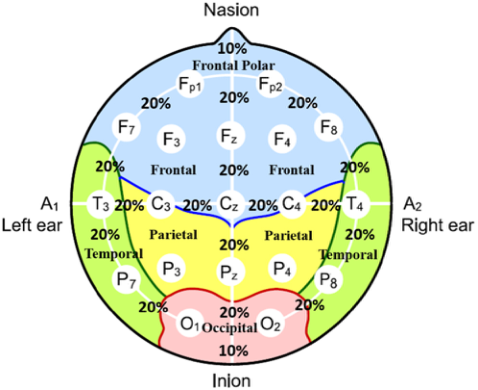
Figure 1: Locations of EEG measurement (Adapted from Bos, 2006)**.
amount of time that took a subject to stand up from his or her chair (Boyce, 2017; BSI, 2019).
Measuring Equipment The Quick-8 wireless EEG system developed by Cognionics was used to mea- sure EEG signals. The sampling rate was 500 Hz, based on 24 bits. The Bioteck Analysis system developed by Bioteck was used to investigate the EEG changes. Moreover, 20 channels, reference electrodes, and grounding electrodes were attached to the heads of the subjects according to an inten- tionally certified 10–20 electrode system (Khazi et al., 2012) (see Figure 1). This study measured the relative gamma power spectrum (RG), which indica- tes highly developed cognitive functions (e.g., tension, awareness, and stress), and the relative high beta power spectrum (RHB), which indicates a state of raised feelings (e.g., emotional anxiety, restlessness, excitement, and a feeling that a person shows when he or she performs a complex task), spectral edge frequency 50% (SEF50%), which is related to the degree of brain activation and attention, and spectral edge frequency 95% (SEF95%), which indicates the stress level. In the experiments, subjects wore AirPod Pro ANC earphones developed by Apple, which showed the highest purchase rate, and listened to the most popular songs on the chart when the research was conducted using these earphones. This study selectively turned on the noise-canceling mode, which enables a feed-forward (FF) microphone to detect external sound and attenuate it before it reaches the auditory organs, according to experimental cases (Case I, Case II).
Furthermore, the subjects were requested to avoid drinking alcohol, smo- king cigarettes, and eating or drinking caffeine, all of which can affect EEGs, on the day prior to the day of the experiments. They were also asked to get enough sleep to avoid drowsiness.
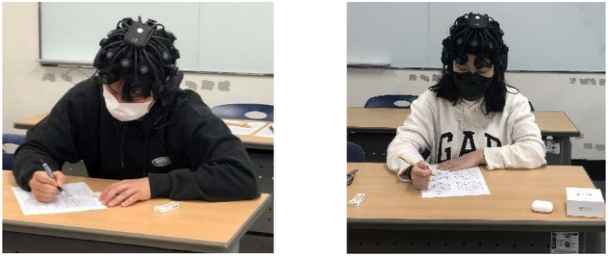
Figure 2: Examples of experiments conducted.
Procedure Volunteers signed an agreement regarding participation in the experiments, entered the lecture room, and wore EEG measurement equipment in comfor- table conditions. The subjects were asked to complete a survey while listening to music, which was irrelevant to the experiments of this study, to prevent them from predicting that fire alarm sounds would be delivered as part of the experiments. Moreover, all subjects were asked to leave the lecture room to prevent noise from disturbing them (see Figure 2).
Then, the fire alarm was sounded randomly and suddenly to measure chan- ges in the EEG of subjects and document their behaviors based on video camera recordings. When the subjects opened the door and left the lecture room within 3 min of the occurrence of the fire alarm, this study regarded that they successfully escaped from the location, and the experiment was con- sidered to have ended. When the subjects exhibited no response after 3 min following the occurrence of the fire alarm, the experiment was stopped. After the experiments were completed, participants were interviewed to investigate their motivation to evacuate.
DATA COLLECTION AND ANALYSIS PROCESS Results of Measuring EEGs and Pre-Evacuation Time to Identify the Recognition Degree of Fire Alarm Sounds
An independent sample t-test based on RG, RHB, SEF50%, and SEF95%, which indicate EEGs on awakening, was carried out to statistically verify the difference in the recognition degree of the FBA and the fire alarm sounded from the EPAS according to the operation state of the ANC function on the subjects’ earphones. As normality was not satisfied owing to an insufficient number of samples, the Mann–Whitney U-test was conducted (see Table 2). The data of two subjects, which were not converted owing to severe noise, were excluded from the analysis.
The result of calculating the pre-evacuation time was as follows: subje- cts in Case III (n = 5) and Case IV (n = 4), in which the ANC function was turned off, responded to the fire alarm more quickly by 43.8 secs and 53.5 secs, respectively, than those in Case I (n = 4) and Case II (n = 5), in
Analysis of Pre-Evacuation Time and EEG for Fire Alarm When Wearing ANC Earphones 139
Table 2. ANC Mode ON/OFF vs. Recognition and Pre-evacuation Time (s).
Table available in the original PDF paper.
ANC Fire Bell Alarm Emergency Public Address System ON Recognition Time Min. Max. Avg. Min. Max. Avg.
6 180 128.5 1 180 84.3 Pre-evacuation Time Min. Max. Avg. Min. Max. Avg. 13 180 137.3 8 180 123.8 OFF Recognition Time Min. Max. Avg. Min. Max. Avg. 1 105 38.7 1 14 6.7 Pre-evacuation Time Min. Max. Avg. Min. Max. Avg. 16 180 93.5 7 180 70.3
which the ANC function was turned on. Subjects in Cases III (n = 5) and IV (n = 4) tended to stop what they were doing to accurately listen to the fire alarm, stare in the direction from which the fire alarm was played, and concentrate on the sound (see Table 2). All the EEG data obtained from Case I were superior to those obtained from Case III. However, the superiority of the EEG data in Case I was statistically insignificant based on the following calculation results: RG p>.486, RHB p>1.00, SEF50% p>.486, and SEF95% p>.686. However, all EEG data obtained from Case IV were superior to those obtained from Case II. However, the superiority of the EEG data in Case IV was statistically insignificant based on the following calculation results: RG p>.556, RHB p>.063, SEF50% p>.413, and SEF95% p>.556 (see Table 3).
To identify the reasons for the aforementioned results, interviews with the subjects were analyzed. The analytic result indicated that subjects in Case I performed complex thinking processes to determine the situation because they could not listen to the fire alarm sound accurately as the ANC mode was turned on.
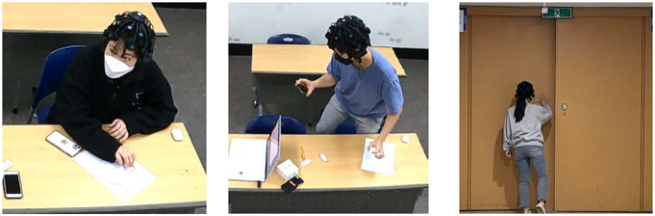
Consequently, their complex thinking processes increased their EEGs and pre-evacuation time delays (see Figure 3). In particular, comparatively high values were observed in the occipital lobe (O1), which is the visual proces- sing area, and parietal lobe (P8 and P7), which are responsible for physical movements and thinking processes, in Case I. These results indicate that the subjects in Case I showed frequent eye movements to analyze the surrounding conditions and performed thinking and recognition functions to understand the situation. In Cases III and IV, comparatively high values were observed at the occipital lobe (O1) and the temporal lobe (T3), which is associated with sound recognition function. These results indicate that the state of the ANC mode being turned off supported the subjects in Cases III and IV to recognize and focus on the fire alarm more intensively and explore their surrounding conditions more actively. The aforementioned results verified that the occu- pants showed arousal responses owing to an increasing level of nervousness, anxiety, stress, and concentration as soon as they heard the fire alarm.
The results of the analysis of the recognition degree of the fire alarm sound according to the operation state of the ANC mode are as follows. In the envi- ronment with the ANC function turned on (Cases I and II), subjects showed
Figure 3: Examples of subjects’ response and behaviors in relation to the fire alarm sound.
stronger arousal responses when they heard the FBA than when they heard the EPAS broadcast sound. However, these stronger arousal responses were determined to be statistically insignificant based on the following calculation results: RG p>.413, RHB p>.286, SEF50% p>.286, and SEF95% p>.730. In contrast, in the environment with the ANC function turned off (Cases III and IV), the subjects showed stronger arousal responses when they heard the EPAS broadcast sound than when they heard the fire alarm. However, the results of the significance test verified that such stronger arousal responses were statistically insignificant based on the following calculation results: RG p>.190, RHB p>.143, SEF50% p>.190, and SEF95% p>.286 (see Table 3). The results of analyzing the pre-evacuation time indicated that subjects in Case II evacuated more swiftly by 13.5 s than those in Case I and that subje- cts in Case IV evacuated more swiftly by 23.2 s than those in Case III. These results verified that the subjects showed more prompt responses when they heard the EPAS broadcast sound than when they heard the FBA, regardless of the state of the ANC function (see Figure 3). This study examined the mean values according to the channels to identify the reasons for such diffe- rences in the subjects’ responses. The analytic results showed that the EPAS broadcast sound activated the subjects’ parietal lobe (P8), which is primarily used to transmit information to the muscle before a person performs a move- ment due to external stimuli (Leshinskaya, 2015). Consequently, the subjects prepared themselves for evacuation more actively when they heard the EPAS broadcast sound than when they heard the FBA. In addition, subjects showed a strong response at the occipital lobe (O1) and rolled their eyes frequently when stimulated by the FBA. This study reviewed the interviews to identify the reasons for such strong responses and frequent eye-roll movements. The analytical results indicated that subjects recognized the FBA, which was pla- yed constantly, more easily than the EPAS broadcast sound, which was cut based on the unit of a syllable. However, they believed that FBA was caused by a malfunction or sounded as a test. Consequently, they frequently rolled their eyes to explore the surrounding areas.
Therefore, the result of analyzing the recognition degree of the fire alarm sound based on the EEG response in this study verified that the arousal response caused by the FBA did not differ from that caused by the EPAS bro- adcast sound. Thus, this study delivered a different result from an existing
Analysis of Pre-Evacuation Time and EEG for Fire Alarm When Wearing ANC Earphones 141
Table 3. ANC mode ON/OFF vs. recognition and pre-evacuation time (s).
Table available in the original PDF paper.
Division Analytic Case Group Statistics Mann–Whitney U Test Index
Avg Channel value (Max) Z p
ANC ON vs OFF RG I vs III 0.282 0.214 0.389(O1) 0.268(T3) −.866 .486 II vs IV 0.237 0.285 0.311(O1) 0.384(O1) −.735 .556 RHB I vs III 0.153 0.134 0.199(O1) 0.134(O1) .000 1.00 II vs IV 0.133 0.164 0.166(P8) 0.178(T3) −1.96 .063 SEF50% I vs III 16.711 12.797 24.395(O1) 12.797(O1) −.866 .486 II vs IV 13.633 17.151 18.870(P8) 24.085(O1) −.980 .413 SEF95% I vs III 45.173 42.905 47.355(O1) 45.276(P7) −.577 .686 II vs IV 43.982 45.629 46.306(O1) 47.183(O1) −.735 .556 FBA vsEPAS
RG I vs II 0.282 0.237 0.389(O1) 0.311(O1) −.980 .413 III vs IV 0.214 0.285 0.268(T3) 0.384(O1) −1.470 .190 RHB I vs II 0.153 0.133 0.199(O1) 0.166(P8) −1.225 .286 III vs IV 0.1334 0.164 0.134(O1) 0.178(T3) −1.640 .143 SEF50% I vs II 16.711 13.633 24.395(O1) 18.870(P8) −1.225 .286 III vs IV 12.797 17.151 12.797(O1) 24.085(O1) −1.470 .190 SEF95% I vs II 45.173 43.982 47.355(O1) 46.306(O1) −.490 .730 III vs IV 42.905 45.629 45.276(P7) 47.183(O1) −1.225 .286
study (Gu, 2021), which reported the significance of the EPAS broadcast sound in the analysis of the degree of recognition of the fire alarm sound based on the EEG response.
CONCLUSION
This study analyzed the level of subjects’ recognition of fire alarm sounds considering different types of fire alarm sounds and the operation state of the ANC function of earphones. The analytic results showed that subjects in Cases I and II, in which the ANC function was turned on, recognized the fire alarm sound later by 43.8 s and 53.5 s, respectively. However, these delays were not significant based on the RG, RFB, SEF50 %, and SEF95% results (p>.05). These results verified that subjects expressed arousal responses, such as anxiety, restlessness, and stress, when they heard the fire alarm, regard- less of the application state of the ANC mode. Subjects in Cases II and IV, in which the EPAS broadcast sound was delivered, expressed more prompt responses by 13.5 s and 23.2 s, respectively, than subjects in Cases I and III, in which the FBA was delivered, regardless of the application state of the ANC mode. However, the analytical results of EEGs verified that these differences in response were not significant (p>.05). Accordingly, it was determined that the fire alarm activated the brain areas of subjects related to relevant cognitive processes and mental activity, regardless of the types of fire alarm sounds.
Moreover, in the video analysis, the subjects appeared to be stable until the recognition time. However, the analytic results of the EEG showed that they encountered negative feelings, such as anxiety, restlessness, and nervousness.
A limitation of this study is that the research results cannot be generalized because of the insufficient number of samples obtained.
ACKNOWLEDGMENT
This work was supported by a National Research Foundation of Korea grant (no. NRF-2018R1A2B3005951), which was funded by the Korean govern- ment and was also supported by the “National Fire Agency” R&D program (20016433).
REFERENCES
Boyce, K., McConnell, N. and Shields, J. (2017). “Evacuation response behaviour in unannounced evacuation of licensed premises”. Fire and Materials, 41(5), 454–466. BSI Standards Publication, “Application of Fire Safety Engineering Principles to the
Design of Buildings, Part 6: Human Factor: Life Safety Strategies - Occupant Evacuation, Behaviour and Condition (Sub-system 6)”, PD 7974-6: 2019. Christensen, K., and Sasaki, Y. (2008). “Agent-based emergency evacuation simulation with individuals with disabilities in the population”, Journal of Artificial Societies and Social Simulation, 11(3), 9. Dong, W., Yu, C., and Zhibin, M. (2018). “Study of sound direction evacuation”.
In Journal of Physics: Conference Series 1107 (7), 072002. IOP Publishing. Fire Safety Engineering Group, University of Greenwich (2022). Available form: http://fseg.gre.ac.uk/fire/besecu.html Galea, E. R., Deere, S., Sharp, G., et al (2010). “Investigating the impact of culture
on evacuation behaviour”. In Proceedings of the 12th International Fire Science & Engineering Conference, Interflam 1, 879-892. Gwynne, S., Galea, E. R., Parke, J., & Hickson, J. (2003). “The collection and analysis of pre-evacuation times derived from evacuation trials and their application to evacuation modelling”, Fire Technology, 39(2), 173–195. Gu, J. -W. (2021).”Evaluation of Human Recognition and Affordance under the
Fire Alarm and Emergency Alert Message through EEG Measurement”, Master’s Thesis, Pukyong National University Hirave, P. P., and Pathak, B. (2011). “Fundamentals of active noise control for local cancellation of noise”. In 2011 3rd International Conference on Electronics Computer Technology 4, 246–249. Khazi, M., Kumar, A., and Vidya, M. J. (2012). “Analysis of EEG using 10:
20 electrode system”, International Journal of Innovative Research in Science, Engineering and Technology, 1(2), 185–191. Kuo, S. M., Chen, Y. R. and Chang, C. Y.,et al. (2018). “Development and evaluation of light-weight active noise cancellation earphones”. Applied Sciences, 8(7), 1178. Leshinskaya, A., and Caramazza, A. (2015). “Abstract categories of functions in
anterior parietal lobe”. Neuropsychologia, 76, 27–40. Minh, L. V., Adam, C.,and Canal, R., eat al. (2010).” Simulation of the emotion dynamics in a group of agents in an evacuation situation”. In International Confe- rence on Principles and Practice of Multi-Agent Systems 604-619. Springer, Berlin, Heidelberg. Padma. P. Hirave and Bageshree Pathak. “Fundamentals of active noise control
for local cancellation of noise”, Institute of Electrical and Electronics Engineers (2011).
Analysis of Pre-Evacuation Time and EEG for Fire Alarm When Wearing ANC Earphones 143
Pan, X., Han, C. S., Dauber, K., and Law, K. H. (2007). “A multi-agent based framework for the simulation of human and social behaviours during emergency evacuations”, Ai & Society, 22(2), 113–132. Proulx, G., Laroche, C., and Latour, J. C. (1995). “Audibility problems with fire
alarms in apartment buildings”. In Proceedings of the Human Factors and Ergo- nomics Society Annual Meeting 39(15), 989–993. Sage CA: Los Angeles, CA: SAGE Publications. Proulx, G. (2007). “Response to Fire Alarms”, Fire Protection Engineering, 33 (8), 8–14. Purser, D. (2010). “Comparisons of evacuation efficiency and pre-travel activity times
in response to a sounder and two different voice alarm messages”. In Pedestrian and evacuation dynamics 2008, 121–134. Springer, Berlin, Heidelberg. Ren, A., Chen, C. and Luo, Y. (2008). “Simulation of emergency evacuation in virtual reality”, Tsinghua Science and Technology, 13(5), 674–680. Struck, C. J. (2019). “Objective Measurements of Headphone Active Noise Cancela-
tion Performance”. In Audio Engineering Society Conference: 2019 AES INTER- NATIONAL CONFERENCE ON HEADPHONE TECHNOLOGY. Audio Engineering Society. Zhou, J., Jia, X., Xu, G and Jia, J.et al. (2019). “The Relationship between Different Types of Alarm Sounds and Children’s Perceived Risk Based on Their Physio- logical Responses”. International journal of environmental research and public health, 16(24), 5091.
LISTED IN THE AHFE DIGITAL BOOKSTORE CATALOGUE
Explore the complete digital volume
Safety Management and Human Factors
Read this individual research paper free through the original publisher, or explore the full digital proceedings book.
ISBN 978-1-958651-40-7
Explore this ISBN in the AHFE Bookstore ↗Listed in the July 2026 bookstore catalogue; search by ISBN to confirm current availability · Digital book purchase optional