Sebastian Sieberichs (2022). How Commercial Airlines can Mitigate Effects of COVID-19 Pandemic Induced Job Insecurity on Their Pilots' Flying Performance. In: Safety Management and Human Factors. AHFE Open Access, vol. 64, pp. 159–169. https://doi.org/10.54941/ahfe1002641
Job insecurity (JI) can negatively impact work performance. This effect poses particular challenges for safety-critical systems such as commercial airlines, as they rely on a high level of pilots’ flying performance. The purpose of this study was to investigate how COVID-19 pandemic induced JI affects pilots’ flying performance. 2084 pilots participated in an online survey. The results showed that JI can negatively impact pilots’ flying performance. However, the magnitude of this relation depended on the conscientiousness and rank of the pilots. The findings therefore underline the importance of conscientious work behavior - also and particularly in periods of increased job insecurity - and provide airlines with a field of action to mitigate risks resulting from decreased pilots’ flying performance due to the COVID-19 pandemic.
The COVID-19 pandemic presents multiple challenges to safety-critical systems such as commercial airlines. Sharply changing global conditions and a market environment exacerbated by the pandemic are intensifying airlines’ struggle to balance productivity against safety. The looming airline economic woes and the resulting threat to jobs are not hidden from pilots, fueling their perceptions of job insecurity (JI): Potential resulting negative effects on pilots’ flying performance might present airlines with particular challenges, because they may not guarantee job security due to the vague economic outlook for the future. Therefore, the objective of this study is to investigate the effect of JI on pilots’ flying performance and to identify alternative fields of action for airlines to mitigate the associated risk to flight safety.
Job Insecurity and Work Performance Job insecurity (JI) can be defined as “the perception of a potential threat to continuity in his or her current job” (Heaney et al., 1994: 1431) in combina- tion with an “overall concern about the future existence of the job”(Lee et al.,
2018; Rosenblatt, 1996: 587). JI refers to an existing job and is related to sub- jective feelings of loss of control and powerlessness (Lee et al., 2018). This perception of organizational members is often fostered by major changes in an organization such as anticipated downsizing of an organization adapting to changing market environments (Ito & Brotheridge, 2007; Lee et al., 2018). Following the social exchange theory, JI threatens the exchange relationsh- ips between organization and its members and can be seen as a stressor that consumes emotional and mental resources; moreover, organizational mem- bers tend to be more concerned about fair treatment in times of economic uncertainty than in periods of economic security (Hobfoll, 2001; Homans, 1958; Lee et al., 2018; Wang et al., 2015a). The effects of JI include not only decreased health and well-being and deteriorating attitudes toward the job, but also affect work performance and behavior (Lee et al., 2018). However, the evidence on the effect of JI on work performance is mixed and depends, for example, on whether the work performance is evaluated by the emplo- yee or by a superior (Cheng & Chan, 2008; Lee et al., 2018; Staufenbiel & König, 2010). Interpreted as a contextual characteristic, JI negatively impacts trust within the workplace (Dirks & de Jong, 2022; Jiang & Lavaysse, 2018). Decreased trust was shown to be related to reduced individual performance and decreased Organizational Citizenship Behavior (OCB) (Colquitt et al., 2007; Dirks & de Jong, 2022; Legood et al., 2021). OCB is a “typology of individual behavior at work that has positive con- sequences for organizations” (Curcuruto & Griffin, 2018: 30). In terms of safety in organizational contexts, Safety Citizenship Behavior (SCB) inclu- des behaviors that involve organizational members not only complying with the minimum requirements mandated by the organizations, but also going above and beyond and proactively striving to improve organizational safety (Curcuruto et al., 2015; Wishart et al., 2019). Especially in safety-critical organizations such as commercial airlines, SCB is an essential component to ensure safety (Reader et al., 2017). The reciprocal exchange processes assumed by social exchange theory are also often invoked to explain why organizational members exhibit SCB; trust is an essential prerequisite in this context, as described earlier (Reader et al., 2017; Zagenczyk et al., 2010). Pilots generally show an increased level of professional performance aspira- tion and conscientiousness (Hidalgo-Muñoz et al., 2021; Sieberichs & Kluge, 2021). A study with aviation safety experts showed that motivation regu- latory styles of identified regulation (My work is valuable because I can contribute to flight safety) (Moran et al., 2012; Tremblay et al., 2009) and intrinsic motivation (I enjoy my work) (Gagné et al., 2010) both can influ- ence pilots’ work behavior (Gerhart & Fang, 2015; Sieberichs & Kluge, 2021). In this context, motivational aspects might be explained by increased activity-goal pairing when pilots associate their task with enjoyment (Fish- bach & Woolley, 2022; Sieberichs & Kluge, 2021). Conscientiousness is one dimension of OCB and involves organizational members engaging beyond the minimum necessary within the scope of their job requirements (Organ, 1988; Wishart et al., 2019). Moreover, conscientiousness can be considered a strong predictor of safety-related work performance (Postlethwaite et al., 2009; Schmitt, 2014).
How Commercial Airlines Can Mitigate Effects of COVID-19 Pandemic 161
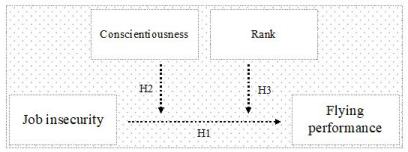
Figure 1: Research agenda.
Hypotheses Considering the aspects described in the introduction in the context of work motivational processes, JI can be considered a contextual motivational ante- cedent whereas flying performance can be defined a behavioral outcome; conscientiousness can be understood as an endogenous motivational process that influences the magnitude of this relationship (van den Broeck et al., 2019). As described earlier, the body of research provides evidence that JI can negatively affect work performance.
Therefore, it is suspected that this effect is also found in pilots with respect to their flying performance: H1: COVID-19 pandemic induced JI is negatively related to pilots’ flying performance.
As described earlier, conscientiousness is related to safety-related work per- formance; therefore, it is presumed that conscientiousness also affects the aforementioned relationship between JI and flying performance: H2: The magnitude of the negative relation between COVID-19 pandemic induced JI and pilots’ flying performance depends on the level of pilots’ conscientiousness.
Based on the author’s professional experience and following discussions with colleagues about the effects of COVID-19 on cockpit work behavior, this study will exploratively investigate whether the relationship formulated in Hypothesis 2 differs between captains and first officers: H3: The magnitude of the negative relation between COVID-19 pandemic induced JI and pilots’ flying performance depends on the level of pilots’ conscientiousness and differs between captains and first officers.
The research agenda is summarized schematically in Figure 1.
This study picks up on a recommendation by Lee et al. (2015) that fur- ther research should investigate the effect of JI on organizational members’ experience and behavior.
METHODS
A non-experimental, correlative research design was chosen to test the hypo- theses. Data originate from an airline-internal online survey about effects of the COVID-19 pandemic on the experience and behavior of pilots. The items
162 Sieberichs
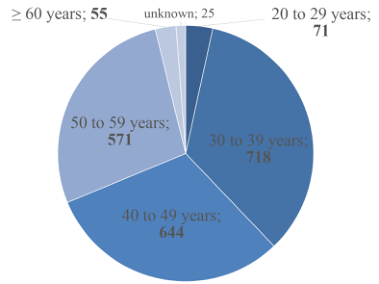
Figure 2: Age distribution of the participants.
used in this research paper represent only a portion of the items used in the questionnaire. Participants were pilots of a major Western commercial airline operating short- and long-haul flights. The sample consisted of n = 2084 participants. 1093 (52.4%) participants indicated their rank with first offi- cer, 958 (46.0%) with captain, and 33 did not specify. 990 (47.5%) indicated to fly short-haul, 1062 (51.0%) indicated to fly long-haul, and 32 did not specify. The age of the participants is shown in Figure 2.
In the survey questionnaire, participants were asked to indicate their level of individual agreement with various statements; a verbal, bipolar rating scale with neutral middle category was used. The scale was presented from left to right and consisted of five intervals from 1 = “I strongly disagree” to 5 = “I strongly agree”.
The items were constructed inductively by subject matter experts of the airline’s safety department based on their professional experiences and feed- backs from pilots on their experience and behavior with respect to the COVID-19 pandemic. The questions were formulated as personalized sta- tements paying special attention on a simple sentence structure and linguistic comprehensibility while avoiding universal expressions and multiple state- ments in one item. The questionnaire was formulated in the native language of the participants and was translated into English by the author and another person for the presentation in this paper; a translation software with artificial intelligence was used. A pretest was conducted with several pilots and some items were adjusted consequently.
Flying performance was measured with four items. An example item was “I have the impression that I currently make more errors in the cockpit than usual”. The internal consistency of the scale in this study was in a good range (Cronbach’s α = .82) (Blanz, 2015).
Job insecurity was measured with four items. An example item was “I am worried to lose my job”. The internal consistency of the scale in this study was in an acceptable range (Cronbach’s α = .79) (Blanz, 2015).
Conscientiousness was measured with two items. An example item was “Since March 2020, I have observed a diminished demand on my professio- nalism as a pilot”. In this study the Spearman-Brown-Coefficient measuring
How Commercial Airlines Can Mitigate Effects of COVID-19 Pandemic 163
the reliability of this two-item scale was in an acceptable range (ρy1y2 = .74) (Eisinga et al., 2013).
The pilots were invited by email to participate. Further emails were sent as reminders, and the study was promoted several times on the airline intranet and via the safety app on pilots’ mobile devices. The data collection period ranged from mid-December 2020 to the end of February 2021. Answering the entire questionnaire took about 20 minutes. The participants received no incentives for participation. Research ethics were observed according to the airline’s internal criteria and requirements for conducting surveys. For example, the participants were informed about the voluntary and anony- mous participation and confidential processing of the data before processing the questionnaire. No calculation of the required sample was performed in advance.
The IBM SPSS-Software (version 28) was used for analyses. Overall, more than 5% of data were missing; the MCAR test according to Little was signi- ficant (χ2 [340] = 658.40, p < .001) indicating data not missing completely at random (MCAR). Datasets with missing data were therefore excluded from the analysis. Linear relations of variables involved were assumed after a visual inspection of the scatterplot with LOWESS smoothing. The col- linearity statistics were inconspicuous with the largest Variance Inflation Factor (VIF) = 1.21. A visual inspection of the standardized estimated values and the standardized residuals yielded indications of heteroskedasticity and the PP-plots of observed and expected cumulative probabilities yielded indi- cations of violated residuals’ normal distribution requirements. Therefore, heteroscedasticity-consistent standard errors and bootstrapping were used. For the evaluation of outliers, leverage values with hm > .0029 and exter- nally studentized residuals ti > |3| were evaluated. As no misunderstandings, input errors, or boycotts could be detected, all complete datasets were inclu- ded for analysis. For the evaluation of influential data points, changes in regression coefficients (DfBETAS > .044) and in predicted ˆy-values (DfFITS > .088) and Cooks Distances with D > .0019 were evaluated. Because no subpopulations or unique participants were expected, the hypothesis was tested using all complete datasets (Cohen, 2003; Field, 2013; Graham, 2009; Li et al., 2016).
To test hypothesis one, a linear regression model was calculated. To test hypotheses two and three, moderated multiple regression models involving two-way interactions between JI, conscientiousness and rank were calcula- ted with ordinary least squares (OLS) regression using the PROCESS 4.0 macro (Hayes, 2017). Bootstrapping with 5000 iterations together with heteroscedasticity-consistent standard errors (HC3) was used to calculate confidence intervals; moreover, the Johnson-Neyman technique was used (Hayes & Cai, 2007; Hayes & Matthes, 2009).
RESULTS
The descriptive statistics and correlations for study variables are presented in Table 1. Values between .10 ≤r ≤.30 correspond to a weak effect, between .30 ≤r ≤.50 to a moderate effect, and r > .50 to a strong effect (Cohen, 2013).
164 Sieberichs
Table 1. Descriptive statistics and correlations for study variables.
**p < .01. Note. M = mean, SD = standard deviation; Likert-scale from 1 = “I strongly disagree” to 5 = “I strongly agree”. 1 = high (a) / low (b) expression of the measured construct, 5 = low (a) / high (b) expression of the measured construct.
Hypothesis one assumed that COVID-19 pandemic induced JI is negatively related to pilots’ flying performance. The hypothesis was accepted because JI had an influence on flying performance (R2 = 18.0; F (1,1406) = 308.86, p < .001). It was shown that JI was a significant predictor for flying performance (β = –0.360; t(1406) = –17.57; p < .001).
Hypothesis two assumed that the magnitude of the negative relation betw- een JI and flying performance depends on conscientiousness. The hypothesis was accepted: JI (t(3, 1391) = –13.03, p < .001, b = –.27), conscientiousness (t(3, 1391) = –12.32, p < .001, b = –.35), and the interaction between JI and conscientiousness (t(3, 1391) = 2.80, p < .01, b = .07) significantly predicted flying performance (F(3, 1391) = 175.32, p < .001, R2 = .26). The change in R2 by the interaction term amounted to 0.40% (F(1, 1391) = 7.83, p < .01, 1R2 = .004). As a result of the Johnson-Neyman technique, the conditional effect of JI on flying performance was significant for 97.28% of all mean centered values of conscientiousness ≤2.05 (t(1391) = –1.96, p = .05, 95% CI [–0.24, 0.00], b = 0.62).
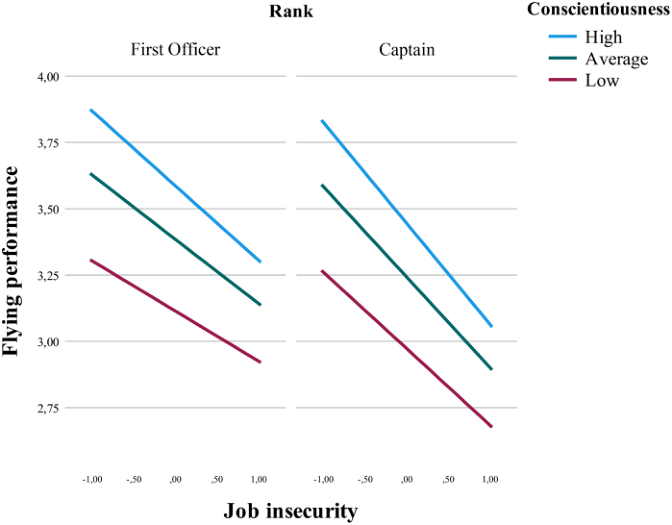
Hypothesis three assumed that the magnitude of the negative relation between JI due to the pandemic and flying performance depends on conscien- tiousness and differs between captains and first officers. The hypothesis was accepted: JI (t(5, 1371) = –2.10, p < .05, b = –.14), conscientiousness (t(5, 1371) = –11.98, p < .001, b = –.35), the interaction between JI and conscien- tiousness (t(5, 1371) = 2.55, p < .05, b = .07), rank (t(5, 1371) = –3.35, p < .001, b = –.14), and the interaction between JI and rank (t(5, 1371) = – 2.39, p < .05, b = –.10) significantly predicted flying performance (F(5, 1371) = 111.11, p < .001, R2 = .26). The change in R2 by the interaction term amounted to 0.70% (F(2, 1371) = 6.42, p < .01, 1R2 = .007). No statisti- cal significance transition points within the observed range of the moderator were found using the Johnson-Neyman technique. Figure 3 shows the condi- tional effect of JI on flying performance depending on conscientiousness and rank, shown for mean and ±1SD values.
DISCUSSION
The objective of this study was to investigate the effect of COVID-19 pande- mic induced JI on pilots’ flying performance and to identify fields of action for airlines to mitigate the associated risk to flight safety. The results indica- ted that JI may have a negative impact on pilots’ subjectively perceived flying
How Commercial Airlines Can Mitigate Effects of COVID-19 Pandemic 165
Figure 3: Conditional effect of JI on flying performance depending on conscientious- ness and rank.
performance. However, this effect depended on the level of pilots’ conscien- tiousness and the rank of the pilots: Higher levels of conscientiousness were related to higher levels of flying performance; for captains, the magnitude of the negative relationship between JI and flying performance was grea- ter than for first officers. Considering the effect shown in Figure 3 for first officers, for example, it became evident that first officers with low levels of JI and low levels of conscientiousness showed a comparable flying perfor- mance to pilots with high levels of JI but high levels of conscientiousness - conscientiousness thus appears to mitigate the negative effect of JI on flying performance. The results of this study confirmed the findings of various meta- analyses (Cheng & Chan, 2008; Sverke et al., 2002) regarding negative effects of JI on work performance - however, it should be underlined again that there are mixed findings in the state of research. The results confirmed research regarding the effect of conscientiousness on safety-related work behaviors (Postlethwaite et al., 2009) and extended the body of research regarding the moderating influence of conscientiousness on the relationship between JI and work performance. Moreover, it can be assumed that captains are generally older than first officers; age-related differences in conscientiousness and their effects on job-related characteristics were also shown in a study of Topino et al. (2021).
Limitations Readers should keep in mind that the assessment of flying performance invo- lved only self-assessment; Staufenbiel and König (2010) have already found
166 Sieberichs
that the type of assessment of work performance (self- or by others) affects the relationship between JI and work performance. Furthermore, the assumption of a linear relationship between the variables neglects curvilinear relationsh- ips between JI and conscientiousness as a facet of OCB, as shown in previous research (cf. Lam et al., 2015). Moreover, the reliability of two scales was only in an acceptable range.
About 1.5% of the responding pilots did not indicate their rank without giving reasons; the responses of these pilots could therefore not be included in the testing of the hypotheses. Considering that the questionnaire was com- pleted by pilots of only one commercial airline, the results should not be generalized to other airlines without further review. Moreover, the findings should not be generalized to pilots in other cultures without further verifi- cation, as cultural differences regarding JI should be assumed (cf. Lee et al., 2018). The approach suggested in this research places much responsibility on the individual pilot to mitigate effects of JI and neglects contextual factors that could be more actively improved by the organization itself.
Implications for Research Further research should preferably collect flying performance data using objective measurement methods such as flight data analysis. The exploratory findings regarding the differences between captains and first officers could not be explained by the data obtained in this study and need to be investigated by further research. Moreover, commercial pilots are often highly specialized in their job as a pilot, so JI should be considered more as career insecurity (cf. Lee et al., 2018); further research should address this aspect. In the course of future research, the influence of organizational justice on the effects presen- ted in this research should be considered (cf. Wang et al., 2015b). Research could also verify the results of this study in other safety-critical systems, such as clinical acute care settings or Non-Western cultures.
Implications for Airlines The findings of this study should alert airlines that pilots’ perceived job inse- curity (JI) can impact their flying performance; thus, in dealing with their pilots, they should basically avoid increasing JI unnecessarily. The findings regarding the impact of conscientiousness on the effect of JI on flying perfor- mance provide airlines with a concrete field of action for mitigation: They should encourage their pilots to act conscientiously - irrespective of any potential JI. This might be achieved through training measures, safety-related bulletins, or other company-internal communication measures.
Ensuring safety in high-risk systems requires a shared responsibility of the organization and its members: If both take this responsibility seriously, the chances remain favorable that not more accidents will occur during the COVID-19 pandemic than before.
How Commercial Airlines Can Mitigate Effects of COVID-19 Pandemic 167
ACKNOWLEDGMENT
The author would like to acknowledge the participating pilots for their par- ticipation in the study and the colleagues from safety department for their great effort in preparing the survey.
REFERENCES
Blanz M (2015) Research Methods and Statistics For Social Work: Fundamentals And Applications. 1st Ed. Stuttgart: Kohlhammer. Cheng GH-L and Chan DK-S (2008) Who Suffers More from Job Insecu-
rity? A Meta-Analytic Review. Applied Psychology 57(2): 272–303. DOI: 10.1111/j.1464–0597.2007.00312.x. Cohen J (2003) Applied Multiple Regression, Correlation Analysis for the Behavioral Sciences. 3rd ed. Mahwah, NJ: Erlbaum. Cohen J (2013) Statistical Power Analysis for the Behavioral Sciences. Abingdon:
Routledge. Colquitt JA, Scott BA and LePine JA (2007) Trust, trustworthiness, and trust propensity: A meta-analytic test of their unique relationships with risk taking and job performance. Journal of Applied Psychology 92(4): 909–927. DOI: 10.1037/0021-9010.92.4.909. Curcuruto M and Griffin MA (2018) Prosocial and proactive “safety citizenship behaviour” (SCB): The mediating role of affective commitment and psychological ownership. Safety Science 104(104): 29–38. DOI: 10.1016/j.ssci.2017.12.010. Curcuruto M, Conchie SM, Mariani MG, et al. (2015) The role of prosocial and
proactive safety behaviors in predicting safety performance. Safety Science 80: 317–323. DOI: 10.1016/j.ssci.2015.07.032. Dirks KT and de Jong B (2022) Trust Within the Workplace: A Review of Two Waves of Research and a Glimpse of the Third. Annual Review of Organizational Psychology and Organizational Behavior 9(1): 247–276. DOI: 10.1146/annurev- orgpsych-012420-083025. Eisinga R, Grotenhuis MT and Pelzer B (2013) The reliability of a two-item scale:
Pearson, Cronbach, or Spearman-Brown? International Journal of Public Health 58(4): 637–642. DOI: 10.1007/s00038-012-0416-3. Field A (2013) Discovering Statistics Using IBM SPSS Statistics: And Sex and Drugs and Rock “n” Roll. 4. ed. Los Angeles, CA, USA: Sage. Fishbach A and Woolley K (2022) The Structure of Intrinsic Motivation. Annual
Review of Organizational Psychology and Organizational Behavior 9(1): 339–363. DOI: 10.1146/annurev-orgpsych-012420-091122. Gagné M, Forest J, Gilbert M-H, et al. (2010) The Motivation at Work Scale: Validation Evidence in Two Languages. Educational and Psychological Measurement 70(4): 628–646. DOI: 10.1177/0013164409355698. Gerhart B and Fang M (2015) Pay, Intrinsic Motivation, Extrinsic Motivation,
Performance, and Creativity in the Workplace: Revisiting Long-Held Beliefs. Annual Review of Organizational Psychology and Organizational Behavior 2(1): 489–521. DOI: 10.1146/annurev-orgpsych-032414-111418. Graham JW (2009) Missing Data Analysis: Making It Work in the Real World. Annual Review of Psychology 60(1): 549–576. DOI: 10.1146/annu- rev.psych.58.110405.085530. Hayes AF (2017) Introduction to Mediation, Moderation, and Conditional Process Analysis: A Regression-Based Approach. Second edition. Methodology in the social sciences. New York, NY, USA: Guilford Publications.
168 Sieberichs
Hayes AF and Cai L (2007) Using heteroskedasticity-consistent standard error estimators in OLS regression: An introduction and software implementation. Behavior Research Methods 39(4): 709–722. DOI: 10.3758/BF03192961. Hayes AF and Matthes J (2009) Computational procedures for probing interactions
in OLS and logistic regression: SPSS and SAS implementations. Behavior Research Methods 41(3): 924–936. DOI: 10.3758/BRM.41.3.924. Heaney CA, Israel BA and House JS (1994) Chronic job insecurity among automobile workers: Effects on job satisfaction and health. Social Science & Medicine 38(10): 1431–1437. DOI: 10.1016/0277-9536(94)90281-X. Hidalgo-Muñoz AR, Mouratille D, El-Yagoubi R, et al. (2021) Conscientiousness in
Pilots Correlates with Electrodermal Stability: Study on Simulated Flights under Social Stress. Safety 7(2): 49. DOI: 10.3390/safety7020049. Hobfoll SE (2001) The Influence of Culture, Community, and the Nested-Self in the Stress Process: Advancing Conservation of Resources Theory. Applied Psychology 50(3): 337–421. DOI: 10.1111/1464-0597.00062. Homans GC (1958) Social Behavior as Exchange. American Journal of Sociology
63(6): 597–606. DOI: 10.1086/222355. Ito JK and Brotheridge CM (2007) Exploring the predictors and consequences of job insecurity’s components. Journal of Managerial Psychology 22(1): 40–64. DOI: 10.1108/02683940710721938. Jiang L and Lavaysse LM (2018) Cognitive and Affective Job Insecurity: A Meta-
Analysis and a Primary Study. Journal of Management 44(6): 2307–2342. DOI: 10.1177/0149206318773853. Lam CF, Liang J, Ashford SJ, et al. (2015) Job insecurity and organizational citizenship behavior: Exploring curvilinear and moderated relationships. Journal of Applied Psychology 100(2): 499–510. DOI: 10.1037/a0038659. Lee C, Huang G-H and Ashford SJ (2018) Job Insecurity and the Changing Work-
place: Recent Developments and the Future Trends in Job Insecurity Research. Annual Review of Organizational Psychology and Organizational Behavior 5(1): 335–359. DOI: 10.1146/annurev-orgpsych-032117-104651. Legood A, van der Werff L, Lee A, et al. (2021) A meta-analysis of the role of trust in the leadership- performance relationship. European Journal of Work and Organi- zational Psychology 30(1): 1–22. DOI: 10.1080/1359432X.2020.1819241. Li W-C, Braithwaite G, Greaves M, et al. (2016) The evaluation of military pilot’s
attention distributions on the flight deck. In: Proceedings of the International Conference on Human-Computer Interaction in Aerospace (ed. GA Boy), New York, NY, USA, 2016, pp. 1–6. ACM. DOI: 10.1145/2950112.2964588. Moran CM, Diefendorff JM, Kim T-Y, et al. (2012) A profile approach to selfdetermination theory motivations at work. Journal of Vocational Behavior 81(3): 354–363. DOI: 10.1016/j.jvb.2012.09.002. Organ DW (1988) Organizational Citizenship Behavior: The Good Soldier Syn-
drome. Postlethwaite B, Robbins S, Rickerson J, et al. (2009) The moderation of conscientiousness by cognitive ability when predicting workplace safety behavior. Personality and Individual Differences 47(7): 711–716. DOI: 10.1016/j.paid.2009.06.008. Reader TW, Mearns K, Lopes C, et al. (2017) Organizational support for the workforce and employee safety citizenship behaviors: A social exchange relationship. Human Relations 70(3): 362–385. DOI: 10.1177/0018726716655863. Rosenblatt R (1996) A test of a multidimensional model of job insecurity: the case
of Israeli teachers. Journal of Organizational Behavior 17: 587–605.
How Commercial Airlines Can Mitigate Effects of COVID-19 Pandemic 169
Schmitt N (2014) Personality and Cognitive Ability as Predictors of Effective Performance at Work. Annual Review of Organizational Psychology and Organizational Behavior 1(1): 45–65. DOI: 10.1146/annurev-orgpsych-031413-091255. Sieberichs S and Kluge A (2021) Why Commercial Pilots Voluntarily Report Self-
Inflicted Incidents. Aviation Psychology and Applied Human Factors 11(2): 98–111. DOI: 10.1027/2192-0923/a000216. Staufenbiel T and König CJ (2010) A model for the effects of job insecurity on performance, turnover intention, and absenteeism. Journal of Occupational and Organizational Psychology 83(1): 101–117. DOI: 10.1348/096317908X401912. Sverke M, Hellgren J and Näswall K (2002) No security: A meta-analysis and review
of job insecurity and its consequences. Journal of Occupational Health Psychology 7(3): 242–264. DOI: 10.1037/1076-8998.7.3.242. Topino E, di Fabio A, Palazzeschi L, et al. (2021) Personality traits, workers’ age, and job satisfaction: The moderated effect of conscientiousness. PLOS ONE 16(7): e0252275. DOI: 10.1371/journal.pone.0252275. Tremblay MA, Blanchard CM, Taylor S, et al. (2009) Work Extrinsic and Intrin-
sic Motivation Scale: Its value for organizational psychology research. Canadian Journal of Behavioural Science/Revue canadienne des sciences du comportement 41(4): 213–226. DOI: 10.1037/a0015167. van den Broeck A, Carpini JA and Diefendorff JM (2019) Work Motivation. In: Ryan RM, van den Broeck A, Carpini JA, et al. (eds) The Oxford Handbook of Human Motivation. Oxford University Press, pp. 506–524. DOI: 10.1093/oxfor- dhb/9780190666453.013.27. Wang H, Lu C and Siu O (2015a) Job insecurity and job performance: The mode-
rating role of organizational justice and the mediating role of work engagement. Journal of Applied Psychology 100(4): 1249–1258. DOI: 10.1037/a0038330. Wang H, Lu C and Siu O (2015b) Job insecurity and job performance: The moderating role of organizational justice and the mediating role of work engagement. Journal of Applied Psychology 100(4): 1249–1258. DOI: 10.1037/a0038330. Wishart D, Rowland B and Somoray K (2019) Safety Citizenship Behavior: A Com-
plementary Paradigm to Improving Safety Culture Within the Organizational Driving Setting. In: Ward NJ, Watson B, and Fleming-Vogl K (eds) Traffic Safety Culture. Emerald Publishing Limited, pp. 145–171. DOI: 10.1108/978-1-78714- 617-420191011. Zagenczyk TJ, Scott KD, Gibney R, et al. (2010) Social influence and perceived organizational support: A social networks analysis. Orga- nizational Behavior and Human Decision Processes 111(2): 127–138. DOI: 10.1016/j.obhdp.2009.11.004.
LISTED IN THE AHFE DIGITAL BOOKSTORE CATALOGUE
Explore the complete digital volume
Safety Management and Human Factors
Read this individual research paper free through the original publisher, or explore the full digital proceedings book.
ISBN 978-1-958651-40-7
Explore this ISBN in the AHFE Bookstore ↗Listed in the July 2026 bookstore catalogue; search by ISBN to confirm current availability · Digital book purchase optional