Jana-Sophie Effert, Birgitta Esser, Michael Buschermoehle, Jasmin Henze, Maren Warnecke, Rainer Surges, Salima Houta (2022). Usability Engineering for Medical Apps using the Example of an App for Epilepsy Self-Management with a Neurosensing System. In: Human Interaction & Emerging Technologies (IHIET 2022): Artificial Intelligence & Future Applications. AHFE Open Access, vol. 68, pp. 61–67. https://doi.org/10.54941/ahfe1002713
Background: Recognizing and documenting epileptic seizures in everyday life is fundamentally important for the precise therapy of those affected. However, studies on seizure diaries have shown that up to 45% of seizures that can be recorded via EEG are not documented by the diarists (Hoppe et al., 2007). To address this gap, the MOND project (Mobile Smart Neurosensing System for the Detection and Documentation of Epileptic Seizures in Daily Life) is working on a wearable neurosensor system. As part of this project, an app that is connected to the sensor is being developed to assist users with epilepsy management. Objective: This research aims at developing and evaluating a digital epilepsy diary that simultaneously shows the data collected via the sensor system and can be used as a tool simplifying the physician-patient-communication. The main objective pursued in this paper is to describe the user centered design process with focus on long-term usage support. Therefore, we address the following questions: How can seizure documentation be supported by the app design? Do an avatar concept and dialogue-based interaction promote long-term usage? Methods: We follow a user-centered design approach. The work is based on an app developed in the previous EPItect project (Houta et al., 2020), which was already evaluated in its basic functions but not so much regarding usability issues. User perspectives were included iteratively throughout the whole process: At the beginning, a heuristic evaluation was carried out to identify which features need to be revised. For considering the integration of the app into everyday life of patients, storytelling was used to describe the care process. Added to the requirements already known from the Epitect project, these findings culminate in a developed design for the MOND-App including an avatar-based prototype. User feedback was conducted before, during and after the design process through user workshops and semistructured interviews with a small sample (four patients). Results: The results of the evaluation phase show acceptance of the avatar concept, in particular with dialogue-like interaction being seen as superior to long texts. At the same time, there was skepticism about whether an avatar can really lead to increased motivation in the long term. The collected user feedback also shows which concerns arise regarding data protection and could thus prevent use, the areas in which certain input methods (such as lists) are particularly desirable, and the areas of the app that require increased customizability. These latter areas primarily concern the nomenclature of symptoms and seizure types, which is often created independently by patients. Conclusions: The results of the interviews show a high willingness to use the app, as important functionalities supplemented by suitable input formats and dialogue-like interaction were positively evaluated. At the same time, customizability – mainly in the naming and description of symptoms and seizure types outside clinical classifications – is an important aspect in the development of an app for epilepsy management. The long-term impact and use of such an app need to be assessed in follow-up studies after full development. Hoppe, C., Poepel, A., & Elger, C. E. (2007). Epilepsy: accuracy of patient seizure counts. Archives of neurology, 64(11), 1595-1599. Houta, S., Meschede, C., Beeres, K., Surges, R., & Klötgen, M. (2020). USER-CENTERED DESIGN AND EVALUATION OF STANDARD-BASED HEALTH TECHNOLOGIES FOR EPILEPSY CARE.
The main symptom of epilepsy is the recurrent occurrence of epileptic sei- zures, which bear a great risk for patients (Ramgopal et al., 2014). These seizures can result in accidents, injuries and premature deaths, but also limit autonomy, mobility and quality of life of affected individuals. Therefore, the main target of epilepsy treatment is to reduce seizure frequency and reach sei- zure freedom, if possible. Accordingly, physicians heavily rely on information regarding seizure type(s), intensity and frequency to choose and adapt the- rapy, mostly in form of anti-seizure medicine (Bidwell, 2015). The best way to capture this information is by video-electroencephalography (VEEG) moni- toring performed by trained clinical staff. However, this requires people with epilepsy to be hospitalized with no guarantee that seizures will occur during
this period (Baumgarter et al., 2001; De Cooman et al., 2014). Instead, pati- ents are usually asked to maintain a seizure diary. However, different studies have shown that seizure documentation by means of a diary is not reliable (Hoppe et al., 2007; Blum et al., 1996; Kerling et al., 2006). People with epi- lepsy only document about 50-70% of their seizures during the day and less than 20% of the seizures that occur at night (Bidwell et al., 2015). Reminder functions do not improve this, since seizures can be associated with impaired consciousness (Hoppe et al., 2007; Blum et al., 1996; Kerling et al., 2006). It is also not always possible to have seizures documented by others, e.g. rela- tives, because not all seizures can be observed or because another person is not always present, especially at night (Ramgopal et al., 2014; Bidwell et al., 2015). To address this gap, the MOND project is developing a wearable neuro- sensing system for automated seizure detection. As part of this project, an app connected to the sensor is being developed to assist users with epilepsy management.
This research aims at developing and evaluating an epilepsy self- management app, including a digital epilepsy diary, medication management and display of data collected via a connected sensor system. Also, the tool can be used to facilitate physician-patient communication. It has already been shown that for health apps just as for digital applications in general, usability is of importance for usage and success, especially the aspects of satisfaction, learnability and efficiency (Liew et al., 2019). Within the development of eHealth applications, there is a lack of published usability evaluations, espe- cially using qualitative methods that can lead to more specific insights on problems or necessary changes rather than show an overall measure of usa- bility (Maramba et al., 2019). The main objective pursued in this paper is to describe the user-centered design process with focus on long-term usage support. An established method to promote user experience, motivation and engagement is the usage of virtual avatars. For children, this has already been proposed in health applications, e.g. to promote healthier food choice (Hswen et al., 2013). Based on a qualitative evaluation of the app deve- loped within the MOND project, including a proposed avatar concept for epilepsy patients, this paper addresses the following questions: How can sei- zure documentation be supported by the app design? Do an avatar concept and dialogue-based interaction promote long-term usage?
METHODS
MOND App Conception and Design The development of the MOND app followed a user-centered design appro- ach. Therefore, users’ perspectives and opinions were included throughout the iterative design process. Starting with a stakeholder workshop, which included patients’ views on valuable factors when developing a system for epilepsy management, the concrete work on app-development was based on an app developed in the previous EPItect project (Houta et al., 2020). The basic functions were already evaluated but without focus on usability issues. To address these issues, we conducted a heuristic evaluation: Screenshots
Usability Engineering for Medical Apps using the Example of an App 63
from the EPItect app were discussed and analyzed by a team of usability designers and usability experts. To promote the user-centered focus within the whole project consortium, the main results of the heuristic evaluation were collected and discussed with project members and representatives of various stakeholder and user groups. Additionally, storytelling was used to illustrate a patient’s journey (including use of the app) from the first contact with the intended MOND system until daily use. With that work in mind, the concept of the EPItect app was further developed, and designs were changed to improve usability and motivation of use.
Evaluation The developed app concept and design was presented to a sample of 4 epilepsy-patients (3 female, 1 male) in semistructured interviews that lastet between one to two hours. Interviews were conducted via video phone call between June and August 2021. The interviews started with an introduction of the MOND project and previous handling of epilepsy management. Then, the patients were shown wireframes of the app to get an overview and gather first general impressions. Subsequently, the used avatar concept was pre- sented in detail, previous experiences were queried, and the possibility of enhancing long-term motivation through avatars was discussed. Emphasis in feedback was set on three aspects: 1) setup and entry into the app, including own definition and description of seizure classes. 2) quick import of seizures that were automatically detected and 3) detailed description of seizures. For this purpose, the corresponding wireframes were first shown in a realistic sequence, imitating a realistic use, before the participants gave feedback on the usability of the individual functions. Further parts of the interview cove- red the home screen arrangement, data visualization, gamification ideas and emergency situations.
In addition to the extensive interviews, the app concept was presented in a stakeholder workshop attended not only by patients but also by healthcare providers and insurance companies, who were asked to provide feedback on the app concept and design.
RESULTS
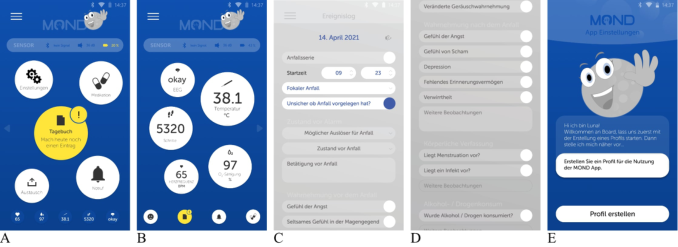
MOND App Concept and Design The developed app design comprises the following functions: 1) home screen (overview), 2) diary, 3) medication management, 4) display of sensor data, 5) seizure classification. The home screen is available in two different views, that can be freely chosen and changed by the user. It either displays the colle- cted vital data of the connected sensor, or it displays a function overview of the app (Fig. 1 A, B).
From the home screen, the diary can be accessed to write entries. Further- more, the medication management can also be accessed from the home screen (including reminders and a medication schedule). Sensor data collected via the MOND hardware can also be viewed in more detail. The design process of workshops, storytelling, and heuristic evaluation revealed the need to go
Figure 1: (A, B) The two possible home screen views, which can be changed by swiping. (C, D) List for seizure documentation. (E) Luna – Avatar concept.
beyond standard descriptions in seizure classification and retrieval. There- fore, in addition to classifications such as tonic-clonic seizures or absences, the app provides the option to specify and describe individual seizure types. This is done when the app is initially set up and can be customized later. For day-to-day use and documentation of each seizure, a checklist is provided to speed up documentation and thus increase the willingness to record many details. This list can be seen in Fig. 1 C, D.
An avatar concept was developed to facilitate interaction with the app and, above all, to help users get started with it. Following the project name MOND (German for moon), a moon was chosen as the avatar and named Luna. The avatar has three main functions: the introduction to the app (Fig. 1 E), the first explanation of individual functions, and through reminders and short interactions the promotion of long-term usage. To further increase individual frequency of use, a gamification concept, including the unlocking of further content and appearances of Luna, was developed.
Evaluation Avatar: The evaluation phase shows high acceptance of the avatar concept. The interaction is seen as more personal and Luna (or an Avatar in general) was seen as a “companion that provides assistance”. This was supported by other quotes on the interaction with the avatar: “I like it because it is funny and friendly”. Dialogue-like interaction was seen as superior to long texts, which were considered “dry” and compared to “a teacher with the pointing stick”. At the same time, there was skepticism about whether an avatar can really lead to increased motivation in the long term. The participants indi- cated high motivation of app usage just by giving suitable functionality and using notifications as reminders: “I also believe if you have the disease and have problems with it, everyone will use the app by themselves to help the therapy. It is an intrinsic incentive”. These expressions confirm that misses in epilepsy diaries are not simply due to motivational lack.
Desired (missing) content focus: Although the focus of the interview was on the usability concept, all interviewees addressed the topic of data pro- tection. Questions such as “When will the data be deleted again?” or “For
Usability Engineering for Medical Apps using the Example of an App 65
whom is the classification that I make actually intended?” indicate that tran- sparency should also be created within the app as to how the data is handled, who has access to it at what time, and how settings can be changed.
When describing seizures and presenting symptoms or previous conditions, the role of other people was highlighted. When documenting seizures, respon- dents often rely on feedback and assessment from their relatives, beyond their own experience. It was perceived as important to distinguish between observation of symptoms by the patients themselves and observation by a third person. This was seen relevant for the exchange with the physicians and should therefore be considered in the documentation.
Furthermore, the documentation of auras was emphasized as particularly important. These physical, emotional or sensory changes sometimes occur without a coming seizure or are understood as a separate seizure type. Other respondents interpreted the aura as covered in the app, since the “perception before the seizure”, which is queried in the event log of the app during a seizure, corresponds to the aura in their opinion. This means that there are also differences in personal nomenclature of different aspects of the epilepsy disorder which should be taken into account.
Customizability: In addition to the assessment of a perception or seizure as an aura, there are other areas of the app that require increased customizabi- lity. Dissatisfaction with other apps was reported because too few categories of classification are offered (e.g. minor vs. major seizure). One respondent, however, did not see the need for further classification due to currently having hardly any seizures. Overall, respondents reported two to four seizure types that they self-differentiated in their disorder. The concept of defining these seizure types themselves is perceived as new and welcomed: “It’s easier to set your own title and description.”; “The official seizure measures are way too complicated.” To ensure efficient physician-patient communication, this classification can be defined together with the physician who can translate the individual definitions in official nomenclature.
When documenting a seizure, the app offers the possibility to enter the symptoms, previous perceptions and environmental factors in the form of a checklist and text fields for specification. The suggested checklist was acce- pted by the respondents. The input was thus assessed as very fast, it “makes it easier, the most common points are given”. However, the given options in the design did not cover all necessary items. Patients identified further important symptoms, triggers and other factors in addition to those already presented. Therefore, in addition to the predefined checklist, it was desired to provide free text fields for further descriptions or even to integrate individual sym- ptoms and aspects (in the long term) as items in the checklist and thus to customize it.
Contrary to the desired individualizable aspects, a customizable presen- tation of the home screen (personalized arrangement of functions, etc.) was not considered important and the proposed presentation is accepted. Desired customizability is directly connected to the description and documentation of the own disease and symptoms.
CONCLUSION
We described the applied usability engineering processes and the used meth- ods to include user perspectives and feedbacks in the development of a medical app for epilepsy management including workshops, storytelling and heuristic evaluations that lead to a user-centered app concept. For a first evaluation, the concept and design were explored using a semistructured interview method with four patients. In this early stage of development, the feedback of a small sample already provides valuable insights for the ongoing development. The results of the interviews show a high willingness to use the app, as important functionalities supplemented by suitable input formats and dialogue-like interaction were positively evaluated. The avatar-based design was appreciated but questioned in the long-term effects on motivation to use the app. At the same time, customizability – mainly in the naming and description of symptoms and seizure types outside clinical classifications – is an important aspect in the development of an app for epilepsy management. Results show the importance of user integration in the process of technical development in the medical field. The long-term impact and use of such an app need to be assessed in follow-up studies after full development.
ACKNOWLEDGMENT
The project MOND is funded by the German Federal Ministry of Health based on a resolution of the German Bundestag (project identifier G512F11007).
REFERENCES
Baumgartner, C. (Ed.). (2013). Handbuch der epilepsien: Klinik, diagnostik, therapie und psychosoziale aspekte. Springer-Verlag. Bidwell, J., Khuwatsamrit, T., Askew, B., Ehrenberg, J. A., & Helmers, S. (2015).
Seizure reporting technologies for epilepsy treatment: A review of clinical infor- mation needs and supporting technologies. Seizure, 32, 109–117. Blum, D. E., Eskola, J., Bortz, J. J., & Fisher, R. S. (1996). Patient awareness of seizures. Neurology, 47(1), 260–264. De Cooman, T., Carrette, E., Boon, P., Meurs, A., & Van Huffel, S. (2014,
September). Online seizure detection in adults with temporal lobe epilepsy using single-lead ECG. In 2014 22nd European Signal Processing Conference (EUSIPCO) (pp. 1532–1536). IEEE. Hoppe, C., Poepel, A., & Elger, C. E. (2007). Epilepsy: accuracy of patient seizure counts. Archives of neurology, 64(11), 1595-1599. Houta, S., Meschede, C., Beeres, K., Surges, R., & Klötgen, M. (2020). USER-
CENTERED DESIGN AND EVALUATION OF STANDARD-BASED HEALTH TECHNOLOGIES FOR EPILEPSY CARE. Hswen, Y., Murti, V., Vormawor, A. A., Bhattacharjee, R., & Naslund, J. A. (2013).
Virtual avatars, gaming, and social media: Designing a mobile health app to help children choose healthier food options. Journal of mobile technology in medicine, 2(2), 8. Kerling, F., Mueller, S., Pauli, E., & Stefan, H. (2006). When do patients forget their seizures? An electroclinical study. Epilepsy & Behavior, 9(2), 281–285.
Usability Engineering for Medical Apps using the Example of an App 67
Liew, M. S., Zhang, J., See, J., & Ong, Y. L. (2019). Usability challenges for health and wellness mobile apps: mixed-methods study among mHealth experts and consumers. JMIR mHealth and uHealth, 7(1), e12160. Maramba, I., Chatterjee, A., & Newman, C. (2019). Methods of usability testing in
the development of eHealth applications: a scoping review. International journal of medical informatics, 126, 95-104. Ramgopal, S., Thome-Souza, S., Jackson, M., Kadish, N. E., Fernández, I. S., Klehm, J., ... & Loddenkemper, T. (2014). Seizure detection, seizure prediction, and closed-loop warning systems in epilepsy. Epilepsy & behavior, 37, 291–307.
Read this individual research paper free through the original publisher, or explore the full digital proceedings book.
ISBN 978-1-958651-44-5
Explore this ISBN in the AHFE Bookstore ↗Listed in the July 2026 bookstore catalogue; search by ISBN to confirm current availability · Digital book purchase optional