Jhordan Salazar, Erick Salinas, Alberto Flores, Jose C Alvarez, Narat Hasachoo (2022). Improving the level of service through an inventory management model for a spare parts marketing company. In: Human Interaction & Emerging Technologies (IHIET 2022): Artificial Intelligence & Future Applications. AHFE Open Access, vol. 68, pp. 742–750. https://doi.org/10.54941/ahfe1002801
This research study deals with the administration of spare parts, for machinery used by the mining and construction sector, in a trading company where there is a shortage of the stock of its high turnover items as a result of poor inventory management. The indicator of the average service level of the two most critical spare parts families marketed by the company is 73%, which is mainly caused by not applying the right forecasting method for demand and not based on a purchasing procurement model. To address this problem, the article shows an innovative proposal where the integration of a procurement module (Q,r), ABC Multicriteria analysis and demand forecasting methods for inventory management are considered. The main contribution of the model is to give the importance of inventory management and how it influences the profits of the company.
Companies in the commercial sector play an indispensable role in the world economy because of their contribution to GDP in different countries. At the national level, the commercial industry presented an increase of 38.06% for the month of June 2021 compared to the same month of the previous year, mainly due to the wholesale trade of machinery and equipment to the mining, construction and industry sectors (Instituto Nacional de Estadistica e Infor- matica, 2021). Similarly, the automotive commercial showed an increase of 79.89% due in part to the sale of motor vehicles, spare parts and accesso- ries and maintenance service (Instituto Nacional de Estadistica e Informatica, 2021). The present study uses as a research unit a large company dedicated to the commercialization of spare parts for the mining and construction sector. Inventory management is a fundamental factor for the success of an orga- nization and is one of the most difficult challenges to meet due to the large number of KPIs and uncertainty presented by demand that influence the deci- sion of the level of inventory available to supply orders. Stock shortages are
Improving the Level of Service Through an Inventory Management Model 743
directly related to the level of service offered by the company and is a rele- vant indicator to measure inventory management. The company maintains a service level of 73% for the highest turnover spare parts, which has generated emergency purchase cost overruns at $41 556 and lost sales costs at $32 614 in the 2021 period.
The ABC Multicriteria tool used for the classification of KPIs helps to deter-mine what type of inventory management policy should be assigned to them based on their criticality or importance, so several authors have used it to diagnose their inventory. Cabrera et al. (2019) employment in a cleaning products distribution company based on the following variables: frequency of sales, contribution margin and inventory level to determine its most cri- tical assets. Similarly, Gong et al. (2020) applied it to determine the most critical spare parts using the criteria of failure severity, probability of failure and probability of not detecting the failure. Finally, Cornejo et al. (2021) used the variables of demand, cost and delivery time for the classification of inventory in a company in the commercial sector. On the other hand, the procurement model or policy (Q, r) has allowed companies in the comme- rcial and manufacturing sectors that store spare parts to increase the level of service. Ramos et al. (2020) applied it in a marketer of spare parts in the automotive sector where it obtained as its main result a service level of more than 85% for fuel filters. Likewise, Ali et al. (2020) increased the level of service by 8.88% in a mining company in Brazil by applying a model (Q, r). Additionally, Rodríguez et al. (2020) applied a model (Q, r) in conjunction with a Kanban system in an automotive company in order to reduce the num- ber of inattentions in the company where it obtained as its main result a 61% reduction in the number of intentions.
The main objective of this research work is to propose an inventory mana- gement model that integrates the ABC Multicriteria tool, demand forecasts and a supply model (Q, r) to increase the level of service of the filters with greater rotation and criticality for the company under study.
Therefore, the development of the article is divided into four stages. In the first stage, the literature review was carried out. In the second stage, the diagnosis of the current situation of the company was carried out, identifying the main problem and its causes. In the third stage, the solution model is designed that uses the ABC Multicriteria tools, demand forecasts and cyclical counting. Finally, the conclusions of the work were made.
PROBLEM ANALYSIS This research was carried out in a company in the commercial sector founded in 1999 with branches in eight regions of Peru. The company is dedicated to the purchase and rental of light loading equipment, sale of spare parts and maintenance services. The main brands it markets are Caterpillar, Lincoln Industries, Mitsubishi and its main customers are the mining projects Las Bambas, Anglo American, Miski Mayo and Cerro Verde.
The company markets approximately 20 brands of spare parts to sup- ply the mining and construction sectors. For this reason, in order to select the most representative brand, an economic impact analysis is carried out
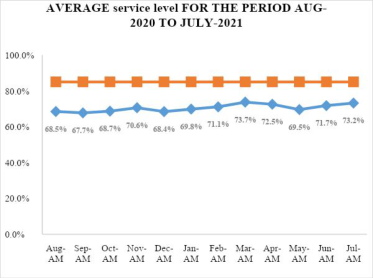
Figure 1: Service level comparison.
considering the variables of overcharge of emergency purchases and lost cost of sale, resulting in the Caterpillar brand with a representation of 40.32%. Additionally, within the Caterpillar line there are thirteen product fami- lies where each one represents an economic impact of the variables already mentioned. Emphasis was placed on selecting the spare parts families that represent 85% of the total economic impact through an analysis. As a result, it was determined that engine part and filter families account for 85.9% of Caterpillar’s total economic impact.
Being a company dedicated to the commercialization of spare parts mainly for the mining sector, it is essential to have a level of inventory that allows them to supply the mining companies in the correct time and quantity. Accor- ding to the study conducted by Sreeman and Kumar in the Singa-pore market (Sreeram & Kumar, 2019), the average service level of a company that sup- plies spare parts to the automotive sector represents 85.9%, in which the level of service is de-fined as the number of products delivered from the inventory in the first selection of orders with respect to the number of products ordered. The current aver-age service level of the engine parts and filters family was compared in Fig. 1.
An analysis of the current situation was carried out using a problem tree with frequencies to find the causes of the low level of service, which resulted in the following causes: inaccurate demand forecasting, inadequate purch- ase quantities and inaccurate inventory records. Additionally, a Pareto chart was used to address the most representative causes. As a result, it was found that the inaccuracy of the demand forecast and inadequate purchase quantity represent 92% of the total causes.
The inaccuracy of demand forecasting occurs mainly when the ERP system estimates a demand that does not agree with the real demand of the sale of the spare part, so the company buys a smaller number of spare parts thus gene- rating a stock breakage. On the other hand, the inappropriate amount of purchase is evidenced when a comparison is made between the real demand and the warehouse filling rate, and it is observed that the replenishment rate is much higher compared to the demand, so excess inventories are generated with lower turnover that impact financially through immobilized capital and decrease the purchasing power to buy category A spare parts (Senses et al.,
Improving the Level of Service Through an Inventory Management Model 745
2021). Under these two premises, the company is forced to buy with an addi- tional cost overrun of 20% of the value of a CAT spare part from a local supplier in case the customer agrees to wait one to three days to have the spare part. However, when this condition is not met, the company is affected by a cost of loss of sale for not serving the customer at the right time.
STATE OF THE ART Inventory management aims to manage goods and materials to meet demand without the need to incur excessive inventory costs. It also aims to deter- mine the parameters of how much and when to order. Trading companies seek to improve the level of service (Briseño-oliveros et al., 2019), (Ramos et al., 2020), (Mehdizadeh, 2020) and decrease excessive inventory storage (Kaushik et al., 2019), (Senses et al., 2021) to minimize the cost related to asset management, because there is a trade-off between the level of service and inventory investment . To achieve these results, the ABC Multicriteria analysis tools, model (Q, r) and demand forecasting are used.
The ABC analysis is a tool used to classify inventories into three large groups (A, B, C) according to their value and quantity that is based on the principle of 80%-20% Pareto and is interpreted as meaning that 80% of the annual investment is consumed by 20% of the items. To carry out the sele- ction of the inventory pol-icy to manage each group, considering the issues of costs and increase in service level, a correct classification of the ABC analysis (Mehdizadeh, 2020), (Tseng & Yu, 2019) is essential. Each group must be managed with a different provisioning policy: Those of A must be re-viewed critically, those of B imply a minor revision and finally those of class C with a sporadic revision (Emar et al., 2021). However, for the spare parts marke- ting sector, the use of additional criteria that affect inventory management is essential. There are several criteria to classify inventories according to their importance, so the multicriteria ABC analysis allows one to obtain a greater degree of optimization of inventory costs with respect to utility. The latter is evidenced in a study that uses a multi-criteria ABC classification analy- sis based on logistics and maintenance variables (delivery time and price) in order to optimize the inventories of spare parts of a company in the auto- motive sector, in this study a more accurate classification of spare parts is obtained as a result (Teixeira et al., 2018).
The continuous review provisioning (Q, r) model is the most appropri- ate for the most important or critical parts thanks to the closest monitoring. This model establishes the indicators of economic purchase lot (EOQ), repla- cement point (ROP) and safety stock (SS). This inventory policy is essential for the planning of economic purchase lots, safety stock, as well as for the optimization of the service level indicator that allow a reduction in logistics costs and an increase in the level of customer satisfaction (Gong et al., 2020).
On the other hand, research studies have been carried out that seek to reduce the shortage of KPIs with nonstationary stochastic demand (intermit- tent) through a replenishment policy (R, S). Hasachoo et al., (2019) applies this procurement model in a hospital opened in Thailand where it resulted in the lowest optimal total cost for the following service levels: 80%, 90% and 99%.
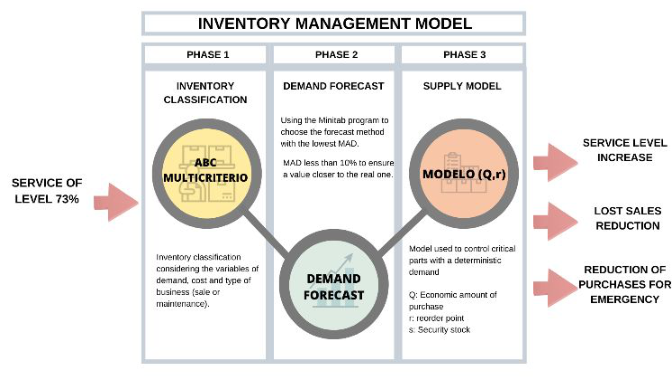
Figure 2: Proposed inventory management model.
CONTRIBUTION Proposal Model
The proposed model is developed based on inventory management with the following activities: Spare parts inventory classification, demand forecasting and inventory policy development (Model Q, r) (Gong et al., 2020). Likewise, it presents as a component the deficient inventory management. Fig. 2 shows the diagram of the model of the proposal.
It is important to mention that the proposed model will exclude spare parts with low and unstable demand frequencies because their behavior does not significantly impact model decision-making (Senses et al. 2021).
The main background used as a reference for the design of this model was developed by Ali, which proposes two model approaches (Q, r): The first approach consists of the out-of-stock cost for not attending directly from stock and the second, is the cost of pending orders to manage the inventory of spare parts in a mining company in Brazil in order to improve the level of service. It is important to emphasize that the main result obtained was an average inventory investment reduction of 56.9% and the service level was increased by 8.88% for the same frequency of orders that were managed under the min-max model and with a policy of periodic review per year (Ali et al., 2020).
Model Details Based on the previously proposed model, the methodology to implement the components of this research consists of three stages and an established sequence. The following are the stages of the model:
For the first stage, the ABC Multicriteria analysis is developed using the variables of demand, cost and type of business (spare parts for maintena- nce and / or direct sale) to the products by family. For this stage, the ABC Multicriteria model proposed by Castro Zuluaga et al. (2011) will be used,
Improving the Level of Service Through an Inventory Management Model 747
where it is proposed that by means of equation (1) the values between 0 and 1 should be normalized, because each criterion presents different units of mea- surement. In this way, values equal to or closer to 1 are of greater importance [[(yn)ij]]. Additionally, the total score obtained for each item organized from highest to lowest is obtained by equation (2).
Equations and mathematical formulas are available in the original paper PDF.
Where:
For the second stage, Minitab software will be used to forecast the annual demand for the most critical spare parts (category A). The program allows fitting the data to demand forecasting models and calculates the MAD (mean absolute deviation) indicator, which will serve as an indicator for selecting the best forecasting method. The data entered into the software are the demands collected over a period of one to two years. After selecting the method with the lowest MAD, the annual demand for each spare part is simulated for a period of twelve months, which will be used in the supply model (Q, r) as annual demand (D). In this way, it is sought to increase forecast accuracy and reduce the gaps between actual and forecast demand (Guimaraes et al., 2020).
Where:
n= number of months forecasted For the third stage, the concepts of safety stock, reorder point and econo- mic purchase lot are used for the spare parts selected by the ABC multicriteria analysis. There are currently two approaches to penalizing the low level of service, the first is to incur additional costs whenever the demand cannot be met directly from the stock (i.e., when a stock break occurs) and the second is to incur penal-ties proportional to the time that an order takes to be served (i.e. when there are delays in care). For the present study, the performa- nce of the model in terms of average investment in assets (inventory) and replenishment rate is analyzed, for which it is necessary to take into account the following parameters of Table 1:
Table 1. Provisioning model parameters (Q, R).
Table available in the original PDF paper.
symbol Description D Annual Demand (units) L Lead time (days) d Expected demand during lead time (units) σ L Standard deviation of demand during lead time A Replenishment order cost ($) C Unit purchase cost ($) Q Order quantity(units) R Reorder point (units) SS Security stock S Fulfillment rate service level σ D Deviation standard of demand
The calculations necessary for the development of the model Q, r is performed using the following equations: The order quantity (Q) is the lot that is ordered when inventory reaches a replenishment level and is estimated as follows:
Where:
A: Restocking order cost
D: Average annual demand
H: Unit maintenance cost per year The cost for maintenance for the study unit includes the cost of storage and physical space, taxes, and cost of obsolete inventory. Another fundamental aspect for the model is the reorder point, which indicates the moment at which the inventory must be replenished with the order quantity (Q). This concept is calculated as follows:
Where:
Z: It is the value calculated from the normal distribution table.
Likewise, another fundamental concept is the safety stock, which is the mini-mum amount of the inventory of a spare part that must be maintained to protect the fluctuation of demand or any scenario of shortages. This is calculated by the following equation:
Improving the Level of Service Through an Inventory Management Model 749
The measurement indicators used to validate the impact of the model are: Level of service (Sreeram & Kumar, 2019), mean absolute deviation (MAD) (Senses et al., 2021) and the percentage of cancelled sales.
CONSLUSIONS AND FUTURE WORK The spare parts trading company under study presents a problem of low level of service, which was determined in a focused manner to category A spare parts that are within the families of engine parts and filters, resulting in an average of 71%. This value presents a gap of 14% with respect to the level of the spare parts marketing sector. In order to mitigate this value, an exhaustive search of the literature that addresses the problem and the closest solution tools was carried out. It is important to mention that the research work focu- sed on the typology of inventory management where the ABC Multicriteria, demand forecasting and a supply model (Q, r) were obtained as tools.
Several success stories that have sought to solve the problem of the low level of service found in the literature allow to validate the tools proposed in this re-search. It is important to mention that the results obtained according to the development of the implementation of these tools can be visualized in a future publication of this research.
The proposed methodology will be applied in future research and it is expe- cted to achieve the reduction of emergency purchase cost overruns, lost sales cost, and service level increase by approximately 15% and 10% respectively.
REFERENCES
Ali, U., Salah, B., Naeem, K., Khan, A. S., Khan, R., Pruncu, C. I., Abas, M., & Khan, S. (2020). Improved mro inventory management system in oil and gas company: Increased service level and reduced average inventory investment. Sustainability (Switzerland), 12(19), 1–19. https://doi.org/10.3390/su12198027 Briseño-oliveros, H., Guzmán-garcía, L. A., Cano-olivos, P., & Sánchez-partida, D.
(2019). FORECASTING DEMAND IMPROVEMENT FOR REPLE- NISHMENT IN A RETAIL PAINTING COMPANY. 155–164. https://doi.org/10.22306/al.v6i4.143 Cabrera, R., Vargas, J., Shinno, M., Maradiegue, F., & Álvarez, J. (2019).
Design of a purchases and inventories management of a cleaning produ- cts distribute company. Proceedings of the LACCEI International Multi- Conference for Engineering, Education and Technology, 2019-July(July), 24–26. https://doi.org/10.18687/LACCEI2019.1.1.186 Castro Zuluaga, C. A., Velez Gallego, M. C., & Catro Urrego, J. A. (2011). Clasificación ABC Multicriterio: Tipos de Criterios y efectos en la asignación de pesos. Iteckne, 8(2). https://doi.org/10.15332/iteckne.v8i2.35 Cornejo, P., Moreno, W., Aparicio, E., & Del Carpio, C. (2021). Inventory Mana-
gement Model in the Commercial Sector to Reduce Inventory Levels through the Use of Demand Forecasts and Economic Order Quantity. ACM International Conference Proceeding Series, 83–87. https://doi.org/10.1145/3447432.3447441 Emar, W., Al-Omari, Z. A., & Alharbi, S. (2021). Analysis of inventory management of slow-moving spare parts by using ABC techniques and EOQ model-a case study. Indonesian Journal of Electrical Engineering and Computer Science, 23(2), 1159–1169. https://doi.org/10.11591/ijeecs.v23.i2.pp1159-1169
Gong, J., Luo, Y., Qiu, Z., & Wang, X. (2020). Determination of key components in automobile braking systems based on ABC classification and FMECA. Journal of Traffic and Transportation Engineering (English Edition), xxx, 1–9. https://doi.org/10.1016/j.jtte.2019.01.008 Guimaraes, C. B., Marques, J. M., & Tortato, U. (2020). Demand forecasting
for high-turnover spare parts in agricultural and construction machines: A case study. South African Journal of Industrial Engineering, 31(2), 116–128. https://doi.org/10.7166/31-2-2084 Hasachoo, N., Sirisawat, P., & Kaewket, T. (2019). Inventory Replenish- ment Policy for Medicines with Non-Stationary Stochastic Demand: The Case of a Newly Opened Hospital in Thailand. IEEE International Con- ference on Industrial Engineering and Engineering Management, 89–93. https://doi.org/10.1109/IEEM44572.2019.8978689 Instituto Nacional de Estadistica e Informatica. (2021, August). http: //m.inei.gob.pe/prensa/noticias/sector-comercio-crecio-3806-en-el-mes-de-j unio-de-2021-13072/ Kaushik, O., Jha, S., Kashyap, S., & Ojha, R. (2019). Inventory redu- ction using the optimal policy curve approach: A case study. Interna- tional Journal of Productivity and Quality Management, 28(1), 28–39. https://doi.org/10.1504/IJPQM.2019.102424 Mehdizadeh, M. (2020). Integrating ABC analysis and rough set theory to control the inventories of distributor in the supply chain of auto spare parts. Computers and Industrial Engineering, 139(xxxx), 105673. https://doi.org/10.1016/j.cie.2019.01.047 Ramos, E., Pettit, T. J., Flanigan, M., Romero, L., & Huayta, K. (2020). Inventory management model based on lean supply chain to increase the service level in a distributor of automotive sector. International Journal of Supply Chain Management, 9(2), 113–131. Rodríguez, S., López, H., Viacava, G., & del Carpio, C. (2020). Inventory plan-
ning and management in the automotive after-sales supply chain. Proceedings of the LACCEI International Multi-Conference for Engineering, Education and Technology. https://doi.org/10.18687/LACCEI2020.1.1.178 Senses, S., Golbasi, O., & S. Bakal, I. (2021). Optimization of the lubricating oil inventory policy applied in a mining company. Internati- onal Journal of Mining, Reclamation and Environment, 35(6), 451–470. https://doi.org/10.1080/17480930.2021.1876820 Sreeram, K., & Kumar, A. S. (2019). Service level improvement of an automotive company to the APAC markets in terms of availability of parts, shipment cost reduction and lead time reduction of supplying parts to the markets. AIP Conference Proceedings, 2128. https://doi.org/10.1063/1.5117980 Teixeira, C., Lopes, I., & Figueiredo, M. (2018). Classification meth- odology for spare parts management combining maintenance and logistics perspectives. Journal of Management Analytics, 5(2), 116–135. https://doi.org/10.1080/23270012.2018.1436989 Tseng, S. H., & Yu, J. C. (2019). Data-driven iron and steel inventory control policies.
Read this individual research paper free through the original publisher, or explore the full digital proceedings book.
ISBN 978-1-958651-44-5
Explore this ISBN in the AHFE Bookstore ↗Listed in the July 2026 bookstore catalogue; search by ISBN to confirm current availability · Digital book purchase optional