Bruno Cardoso, Luciano Moreira, António Lobo, Sara Ferreira (2023). Spotlighting distraction in artificial intelligence driver assistance systems. In: Intelligent Human Systems Integration (IHSI 2023): Integrating People and Intelligent Systems. AHFE Open Access, vol. 69, pp. 330–339. https://doi.org/10.54941/ahfe1002852
1 IC - Instituto da Construção, University of Porto, Portugal ↗
2 CETAPS - Centre for English, Translation, and Anglo-Portuguese Studies, Faculty of Arts and Humanities of the University of Porto, Porto, Portugal ↗↗
3 CITTA - Research Centre for Territory, Transports and Environment, Faculty of Engineering of the University of Porto, Portugal ↗
As artificial intelligence driver monitoring systems gain momentum in intelligent mobility, it is critical to analyse how distraction is defined and induced. This systematic review was specifically focused on studies conducted in driving simulators. A Boolean query was iteratively developed to retrieve articles from Scopus that fulfil the following criteria: (1) being an empirical study, (2) addressing driver distraction, (3) using a driving simulator, (4) aiming at developing an artificial intelligence monitoring system. After screening, 34 articles remained and were analysed according to four general themes: definition of distraction, characteristics of the scenarios used in the driving simulator, sampling of participants, and procedures. Results showed that the most common definitions of distraction consider it as a shift in the driver’s attention towards a secondary task, which implicates in a degradation of the execution of the primary task (i.e., driving the vehicle), and, consequently, a reduction in driving safety. Most articles described the scenarios used in the simulator in greater detail and, in some cases, variations in traffic density, visibility, and environmental conditions were observed. Furthermore, scripted critical events in the scenario (e.g., car in front of the participant breaking) were also used. Recruitment and samples varied greatly between studies, with the smallest population consisting of two and the largest of 97 participants. Despite the sample size, participants still needed to meet eligibility criteria such as having a driver’s license, possessing minimum driving experience, health prerequisites, being part of a specific group, age, and gender. Procedures and tasks were not always described in detail. However, several studies described an initial moment where participants could familiarize themselves with the simulator without taking measurements, while fewer reported that participants were allowed to familiarize themselves with the tasks. Session length varied from eight to 90 minutes. Regarding the operationalization of distraction in experiments, some studies required drivers to perform a single type of distraction-inducing task (mental calculations, use of In-Vehicle Information System (IVIS), cell phone operation, and manual tasks) with varying difficulty levels. Still, most studies relied on a combination of different tasks, such as cell phone use, physical tasks (e.g., drinking, moving objects, and applying makeup), and IVIS use. Results showed studies favour the description of the digital systems over the experiment design and procedures and a preference for locating the studies at the individual level of analysis, precluding a broader understanding of human behaviour as socially constructed and signified. We argue that articulation with higher levels of analysis would bring relevant explanations for actual road behaviour and personal and social factors should be considered when developing driver monitoring systems aimed at reducing distraction. Our results may assist future studies within the same scope, guiding the definition of effective experimental designs to test artificial intelligence driving monitoring systems, while contributing to a more holistic understanding of driver’s behaviour.
Road accidents account for approximately 1.3 million deaths and between 20 and 50 million non-fatal injuries in the world every year (WHO, 2022). Besides the human suffering, a heavy economic burden is associated with these accidents, impacting national economies and costing countries appro- ximately 3% of their annual gross domestic product (WHO, 2022). The Final Report of the eSafety Working Group on Road Safety (European Commis- sion, 2003) identified that human error was involved with 95% of road accidents, and, among the causes of human error, distraction is one of the most frequent as it has been associated with 5% to 25% of all crashes in Europe (European Commission, 2012). If we focus only on fatal crashes, the numbers are still alarming, as a recent study in the United States identified that 7.7% of all fatal crashes were distraction-related (Qin et al., 2019). In Norway, distraction by the use of mobile phones contributed to between 2% and 4% of all fatal crashes, and other distractions were associated with about 10% of all fatal crashes (Sundfør et al., 2019). However, even if these numbers seem high, they may underrepresent the true participation of distraction on road crashes, as it significantly increases crash risk (Dingus et al., 2019). One possible explanation for this difficulty in accessing the true impact of driver distraction in road crashes may be attribu- ted to how studies have inconsistently defined it in the past (Beanland et al., 2013, Regan et al., 2011). Furthermore, the definition of distracted driving is relevant in the context of empirical studies as it directly influences its operati- onalization in driving simulators. Efforts to reach a more consistent definition of driver distraction, or driver diverted attention as the author names it, sta- tes that it is “the diversion of attention away from activities critical for safe driving toward a competing activity, which may result in insufficient or no attention to activities critical for safe driving” (Reagan et al., 2011, p. 1776).
Identifying and decreasing distracted driving is essential to increase road safety, but presents a series of challenges which were not always possible to overcome. Nevertheless, with the integration of intelligent driver assistance systems, it is possible to identify the driver state and alert the driver in real time, decreasing crash risk (Halim et al., 2016, Horberry et al., 2021). This systematic review aims to identify how distraction is defined and induced in simulator studies, and to reach these objectives, two research questions were developed: Q1: How is distraction defined in simulator studies aimed at developing intelligent driver assistance systems?
Q2: What are the characteristics of the scenarios, the sampling of parti- cipants, and the procedures used in simulator studies aimed at developing intelligent driver assistance systems?
METHODS
This systematic review aims to identify how distraction is defined and induced in simulator studies aimed at developing intelligent driver assistance systems. Through the research question previously established, it was possible to deter- mine the eligibility criteria that guided the development of the search process, which consisted of: (1) being an empirical study, (2) addressing driver distra- ction, (3) using a driving simulator, and (4) aiming at developing an artificial intelligence monitoring system.
Following these criteria, the search plan was defined and conducted through an iterative process, where the Boolean search was tested and impro- ved until the largest number of relevant studies was obtained. The final iteration of the Boolean search can be seen in Table 1.
Table 1. Boolean search parameters.
Table available in the original PDF paper.
Search section Search terms Part 1 (TITLE-ABS-KEY (“distract*” AND “driv*” AND “simulator”) Part 2 AND TITLE-ABS-KEY (“machine learning” OR “artificial intelligence” OR “deep learning” OR “learning Systems” OR “learning algorithms” OR “neural networks” OR “AI”))
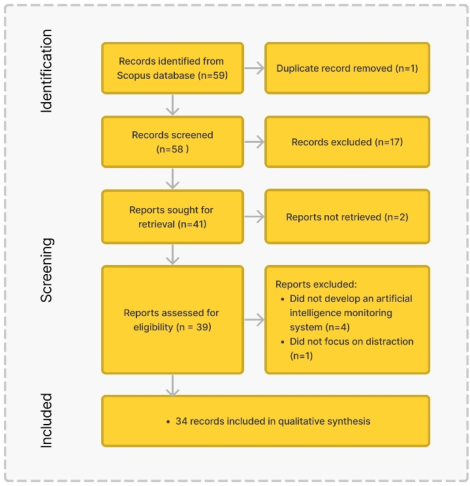
The final search was conducted on November 2nd, 2022, in Scopus (Else- vier, 2022), and yielded 59 results. These results first went through an abstract screening and then through an eligibility analysis of the full text, resulting in 34 studies selected for this systematic review (Figure 1). Following this process, the selected articles (listed, numbered, and summa- rized in Supplementary chart 1) went through an in-depth analysis and rele- vant information was organised and codified into a database. Furthermore, descriptive statistics and frequencies were obtained.
RESULTS
Q1: How is distraction defined in simulator studies aimed at developing intelligent driver assistance systems?
Distracted driving was defined by 17 studies, and these definitions were grouped according to similarities in focus, terminology, and references. The first group focused on the shift in the driver’s attention from the driving task towards a secondary task, which implicates in a reduction in road safety. One example that may illustrate this group was present in the article with the ID 1 (Ahangari et al., 2021): Distracted driving is defined as diverting a driver’s attention from driving to other behaviors, tasks, or situations that reduce the driver’s ability to sustain awareness and be in full control of the vehicle.
Spotlighting Distraction in Artificial Intelligence Driver Assistance Systems 333
Figure 1: Flow of information through the different phases of the systematic review.
The second group associated distracted driving with the delay of informa- tion essential to maintain road safety due to the driver being compelled or induced to shift attention away from the driving task. It is possible to identify in article ID 4 an example of the definitions of distracted driving present in group two (Aksjonov et al., 2018): Anything that delays the recognition of information necessary to safety maintain the lateral and longitudinal control of the vehicle (driver’s primary task) due to some event, activity, object or person (driver’s secondary activity), within or outside the vehicle that compels or tends to induce the driver’s shifting attention away from the fundamental driving task by compromising the driver’s auditory, biomechanical, cognitive or visual faculties or combinations thereof.
Finally, the last group consisted of articles with IDs 29 and 30 (Xie et al., 2021, Xie, 2020) and defined distracted driving as: Driver engagement in internalized thoughts.
It was also possible to identify that ten studies classified distraction into dif- ferent types, and while most organized distractions into “manual”, “visual”, and “cognitive”, one study recognized the categories: “visual”, “cognitive”, and a “combination of visual and cognitive”.
Q2: What are the characteristics of the scenarios, the sampling of parti- cipants, and the procedures used in simulator studies aimed at developing intelligent driver assistance systems?
Scenario Twenty-seven reports provided more information regarding the scenarios used in the simulator then the remaining seven (IDs 8, 14, 17, 21, 26, 27, 31). The majority of the studies classified at least one segment of their scena- rios as a “road”, followed by “highway”, “freeway”, “driving course”, “track”, and “interstate”. In four reports, variations in traffic density, visi- bility, and environmental conditions were observed; scripted critical events in the scenario (e.g., car in front of the participant breaking) were utilized in another four studies. Participants drove exclusively in urban environ- ments in five studies, while one focused on rural settings, and five used both.
Participants Recruitment and samples varied greatly between studies, with the smallest population consisting of two (ID 28) and the largest of 97 participants (ID 15) (M = 27, Mdn = 20, SD = 26.87). Despite the sample size, participants still needed to meet eligibility criteria such as having a driver’s license and a minimum driving experience, as it is possible to identify in Table 2. Two
Table 2. Eligibility criteria of studies.
Table available in the original PDF paper.
Criteria Definition and examples Driver’s license Participants were required to own a valid driver’s license in the country where the study took place (e.g., “All participants had a valid US driver’s license”) Minimum driving experience
Participants should present driving experience measured in years of experience or driving frequency (e.g., “two years of driving experience”, “drivers were supposed to drive a car on at least 4 days per week”) Health prerequisites
Be considered healthy by the standards of the study or not be in a state that could influence results (e.g., “be in self-reported good health and free from major medical conditions”, “Pregnancy, disease, sleep disorders, or evidence of substance abuse resulted in exclusion from the study”) Belonging to a specific group
Participants were recruited from specific groups (e.g., “students”, “members of the Interdisciplinary Training Network in Multi-Actuated Ground Vehicles (ITEAM) project”) Age Be a part of a specific age group (e.g., “age between 25-35”) Gender A specific gender distribution should be met in the study (e.g., “Gender has been controlled”, “the sample size (N = 37) was equally separated in terms of gender”) No previous simulator experience
Participants should not have taken part in driving simulator studies (e.g., “have not previously participated in a simulated driving study”) Previous simulator experience
Participants should have taken part previously in driving simulator studies (e.g., “with a previous experience on the driving simulator have been selected”)
Spotlighting Distraction in Artificial Intelligence Driver Assistance Systems 335
studies had requirements associated with driving simulator experience: in one case, no previous simulator experience was required, while another study required previous experience with the driving simulator. Participants were financially compensated in five studies.
Seven reports included recruitment information in the protocol. These studies relied on online advertisements, flyers, e-mail, newspaper ads, and referral. Studies had mostly male participants, with an average of 66.38% if we account all studies (Mdn=61.25, SD=15.88). The youngest participant was aged 18, and the oldest 55 years old.
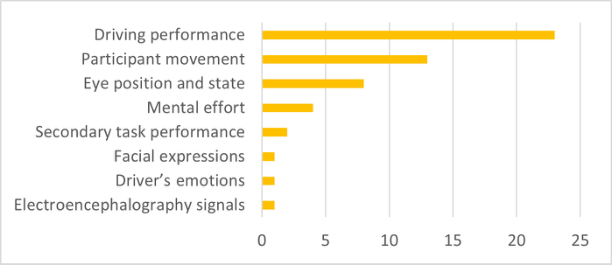
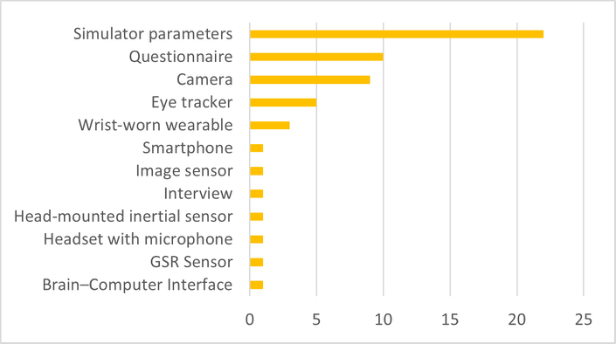
Procedures Procedures and tasks were not always described in detail. However, fif- teen studies described an initial moment where participants could familiarize themselves with the simulator without taking measurements, while four reported that participants were allowed to familiarize themselves with the distraction-inducing tasks. Session length varied from eight to 90 minutes (M=48.4, Mdn=45, SD=32.86). The most frequent measurements colle- cted in studies were driving performance, which was assessed by measures such as speed, lane position, brake force and so on, followed by parti- cipant movement, and eye position and state. Figure 2 displays the com- plete list of measurements and corresponding frequencies. The data was collected from the driving simulators, followed by questionnaires, came- ras, and eye trackers. Figure 3 displays a list of every instrument used by frequency.
Figure 2: Frequency of measurements collected.
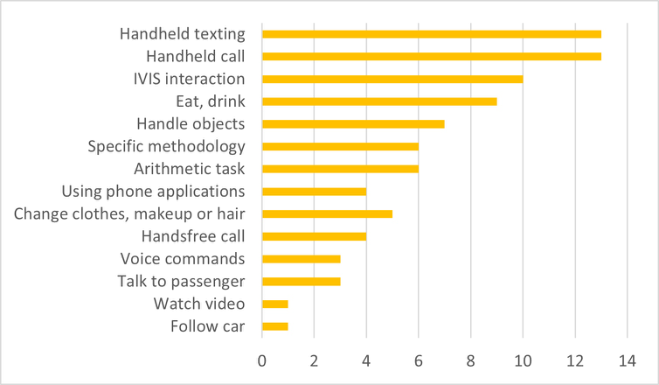
The most frequent task used to induce distraction was handheld texting and handheld calling, followed by IVIS interaction, and eating/drinking. Figure 4 lists every distraction-inducing task organized by frequency in studies. The specific methodologies developed to induce distraction were N-Task, SURT, and driver motor distraction task. Nine studies indicated that they followed a fixed order of tasks, while five reported randomizing tasks.
Figure 3: Frequency of instruments utilized to collect data.Figure 4: Frequency of distraction inducing tasks in studies.
DISCUSSION
The objectives of this analysis were to understand how distraction is defi- ned and induced in simulator studies aimed at developing intelligent driver assistance systems. A search in the database Scopus was conducted and the reports that met the eligibility criteria were analysed. The results indicate that studies favour the description of the digital systems over the experiment design and procedures; a thorough description of the applied methodologies was expected, but that was not always the case. This lack of detail makes it difficult for future studies to reproduce the experimental settings and accu- rately compare results. Previous literature has already identified the need for a clearer methodological description in similar studies (Heus et al., 2019, Collins and Moons, 2019).
It was also possible to identify a preference for locating the studies at the individual level of analysis, precluding a broader understanding of human
Spotlighting Distraction in Artificial Intelligence Driver Assistance Systems 337
behaviour as socially constructed and signified (Doise and Valentim, 2015). The relevance of understanding human behaviour in context has been iden- tified in the past, and could potentially be used alongside with the individual level of analysis observed. Higher levels of analysis would bring relevant explanations for actual road behaviour, as shown for example in Pianelli et al. (2010) studies that used the social representations framework. In fact, social representations would allow us to better understand personal and social factors and should be considered when developing driver monitoring systems aimed at reducing distraction. Social representations are influenced by ideologies and common values from specific environments, and aid us in understanding the construction of individual attitudes within group dynamics (Pianelli et al., 2010). Further studies should also consider the used artificial intelligence algorithms and their results.
CONCLUSION
This systematic review was conducted as a first step in a larger copromoted project (BBAI) aimed at developing an intelligent driver assistance system. 34 studies that were retrieved from the database Scopus and deemed rele- vant for this study were analysed. Results indicated that studies favoured the description of the digital systems over the experiment design and the individual level of analysis. Future studies should try to provide more detai- led reports of the procedures used in their experiments, while also trying to include the analysis of human behaviour as socially constructed and signi- fied. The results of this study may assist future studies within the same scope, guiding the definition of effective experimental designs to test artificial intel- ligence driving monitoring systems, while contributing to a more holistic understanding of driver’s behaviour.
ACKNOWLEDGMENT
This paper is a result of project BBAI - Brain Behavior analysis using the most advanced Artificial Intelligence and Computer Vision, with refere- nce NORTE-01-0247-FEDER-069809, co-funded by the European Regional Development Fund (ERDF), through the North Portugal Regional Opera- tional Programme (NORTE2020), under the PORTUGAL 2020 Partner- ship Agreement. This research was also supported by FCT - Fundação para a Ciência e a Tecnologia, I.P., under the projects UIDB/04097/2020, UIDB/00081/2020, and LA/P/0056/2020 and by the Base Funding allocated by the FCT/MCTES (PIDDAC) to CITTA - Research Centre for Territory, Transports and Environment (UIDB/04427/2020).
REFERENCES
AHANGARI, S., JEIHANI, M., ARDESHIRI, A., RAHMAN, M. M. & DEHZANGI, A. 2021. Enhancing the performance of a model to predict driving distraction with the random forest classifier. Transportation research record, 2675, 612–622.
AKSJONOV, A., NEDOMA, P., VODOVOZOV, V. & PETLENKOV, E. In-vehicle information system as a driver’s secondary activity: Case study. 2018 IEEE 15th International Workshop on Advanced Motion Control (AMC), 2018. IEEE, 523–528. BEANLAND, V., FITZHARRIS, M., YOUNG, K. L. & LENNÉ, M. G. 2013. Dri-
ver inattention and driver distraction in serious casualty crashes: Data from the Australian National Crash In-depth Study. Accident Analysis & Prevention, 54, 99–107. COLLINS, G. S. & MOONS, K. G. 2019. Reporting of artificial intelligence prediction models. The Lancet, 393, 1577–1579. DINGUS, T. A., OWENS, J. M., GUO, F., FANG, Y., PEREZ, M., MCCLAF-
FERTY, J., BUCHANAN-KING, M. & FITCH, G. M. 2019. The prevalence of and crash risk associated with primarily cognitive secondary tasks. Safety Science, 119, 98–105. DOISE, W. & VALENTIM, J. P. 2015. Levels of Analysis in Social Psychology.
In: WRIGHT, J. D. (ed.) International Encyclopedia of the Social & Behavioral Sciences (Second Edition). Oxford: Elsevier. ELSEVIER. 2022. Scopus [Online]. Available: [Accessed 02/11/2022]. https://www.
scopus.com. EUROPEAN COMMISSION 2003. Final Report of the eSafety Working Group on Road Safety. European Commission Directorate-General for the Information Society Media. EUROPEAN COMMISSION 2012. Final Report 2012. CARS 21 High Level Group
on the Competitiveness and Sustainable Growth of the Automotive Industry in the European Union. HALIM, Z., KALSOOM, R., BASHIR, S. & ABBAS, G. 2016. Artificial intelligence techniques for driving safety and vehicle crash prediction. Artificial Intelligence Review, 46, 351–387. HEUS, P., DAMEN, J. A., PAJOUHESHNIA, R., SCHOLTEN, R. J., REITSMA, J. B.,
COLLINS, G. S., ALTMAN, D. G., MOONS, K. G. & HOOFT, L. 2019. Unifor- mity in measuring adherence to reporting guidelines: the example of TRIPOD for assessing completeness of reporting of prediction model studies. BMJ open, 9, e025611. HORBERRY, T., MULVIHILL, C., FITZHARRIS, M., LAWRENCE, B., LENNÉ, M., KUO, J. & WOOD, D. 2021. Human-centered design for an in-vehicle truck driver fatigue and distraction warning system. IEEE Transactions on Intelligent Transportation Systems. PIANELLI, C., ABRIC, J.-C. & SAAD, F. 2010. Rôle des représentations socia-
les préexistantes dans les processus d’ancrage et de structuration d’une nouvelle représentation. Les Cahiers Internationaux de Psychologie Sociale, Numéro 86, 241–274. QIN, L., LI, Z. R., CHEN, Z., BILL, M. A. & NOYCE, D. A. 2019. Understanding driver distractions in fatal crashes: An exploratory empirical analysis. Journal of Safety Research, 69, 23–31. REGAN, M. A., HALLETT, C. & GORDON, C. P. 2011. Driver distraction and
driver inattention: Definition, relationship and taxonomy. Accident Analysis & Prevention, 43, 1771–1781. SUNDFØR, H. B., SAGBERG, F. & HØYE, A. 2019. Inattention and distraction in fatal road crashes–Results from in-depth crash investigations in Norway. Accident Analysis & Prevention, 125, 152–157.
Spotlighting Distraction in Artificial Intelligence Driver Assistance Systems 339
WHO. 2022. World Health Organization Road traffic injuries report [Online].
World Health Organization. Available: https://www.who.int/news-room/fact- sheets/detail/road-traffic-injuries [Accessed 13/11/2022]. XIE, Z. Recognition of driving distraction using driver’s motion and deep learning.
Proceedings of the 2020 IISE Annual Conference, 2020. XIE, Z., LI, L. & XU, X. 2021. Real-time driving distraction recognition through a wrist-mounted accelerometer. Human factors, 0018720821995000.
LISTED IN THE AHFE DIGITAL BOOKSTORE CATALOGUE
Explore the complete digital volume
Intelligent Human Systems Integration (IHSI 2023): Integrating People and Intelligent Systems
Read this individual research paper free through the original publisher, or explore the full digital proceedings book.
ISBN 978-1-958651-45-2
Explore this ISBN in the AHFE Bookstore ↗Listed in the July 2026 bookstore catalogue; search by ISBN to confirm current availability · Digital book purchase optional