Jeanfrank Teodoro Dantas Sartori (2023). From machine knowledge and knowledge management to a unified human-machine theory: proposal for conceptual model. In: Intelligent Human Systems Integration (IHSI 2023): Integrating People and Intelligent Systems. AHFE Open Access, vol. 69, pp. 379–385. https://doi.org/10.54941/ahfe1002857
Academic research in Knowledge and knowledge management tends to focus on issues related to producing, storing, organizing, sharing, and retrieving data, information, and knowledge for and from humans, and on how to make use of machines for those and other related purposes. Therefore, hardware and software are usually seen more as support and means but, as technology exponentially evolves, there are already many machine learning algorithms, artificial intelligence, and other resources where it is hard for a human mind to fully comprehend the rationale behind its outcomes, results, predictions, processing, or decisions taken, even though they might be shown to be precise and of high quality. There are theoretical e technical efforts to address it, such as the concept of Explainable AI, but it is conceivable that knowledge from machines may not be, in the present or in the future, both efficient and adequately translatable to traditional human-comprehensive knowledge. That knowledge might one day be only usable by other machines in a yet unknown approach of knowledge sharing between them, in a specific way designed for them and perhaps, in the future, also by them: a machine perspective of knowledge and knowledge management. In addition, machine knowledge may not be available only in the explicit form but also in a manner somehow analog to human tacit knowledge, as for instance, a given AI may acquire a rationale that is beyond what its stored bytes can express. That might be also evidence of a context in which perhaps it may be only able to be socialized between machines, in a tacit to tacit “transfer”, not with nor for humans. Furthermore, keeping machine knowledge secure might be far more complex than mere data storage security and policy, as a simple copy of those data may be insufficient for representing and recovering a previously developed machine knowledge, implying that traditional information management is no longer enough. Much is still needed to advance on the topic of machine knowledge, as an approach to data, information, and knowledge from and for machines is needed, in what could be called machine knowledge management (MKM). But that is not the final step needed, as from these machine knowledge and knowledge management concepts emerge the need for a unified theory with human counterparts, that addresses the complex aspects of coexistence and interactions of both clusters of knowledge, with implications for Human-Autonomy Teaming (HAT), and how both can work together in the present and future challenges. Therefore, the aim of this research is to advance toward the proposal of a theoretical model for machine knowledge and knowledge management, on how that can be integrated with the analog human versions in a unified human-machine model, and what might play the mediator role. Subsidiarily, it also discusses the need for a standardized and expanded concept of information and knowledge consistent with that model. Finally, topics are proposed for future research agenda. To achieve these research goals, the main methodologies adopted were the literature review and the grounded theory.
The unprecedented human intelligence proved so relevant that once develo- ped – in the so-called Cognitive Revolution – it made Homo sapiens dominant on the planet, imposing its supremacy over all other species of humans, some of which had superior physical attributes that were insufficient to overcome the cognitive force. That provided an unparalleled ability to learn from the environment and from other individuals, giving rise to knowledge in the level conceived today and to the ability to abstract, compare, combine, ima- gine, and communicate – language – in a complexity that makes human knowledge unique and unreachable to other animals that are limited to a more basic type of it, mainly linked to instinct, survival, and reproduction. Although other animals have some kind of communication, none comes close to the complexity of that produced by the human species, which enables transmitting and understanding content with a higher and deeper level of detail, including knowledge itself. In particular, this transmission occurs in a much more complete and efficient way between generations than the mech- anisms of genetic transmission on which the other species depend mostly, allowing the accumulation of knowledge. At the same time, the ability to continuously and in detail remember what has been learned or received from others through complete communication the cognitive triad that has shaped the Knowledge Revolution and the entire development of humanity throu- ghout history. These faculties – learning, remembering and communicating – created a virtuous process of development of the species by mutually leve- raging each other and together with other factors, such as natural selection, have shaped modern man and all the capacity of knowledge that is capable of producing (Harari, 2014; Polanyl, 1962).
That very capacity gave humanity the ability to continuously create techno- logies and evolve them, culminate in more recent centuries to the development of complex machines, that initially had the task of replacing humans in manual activities, performing routines faster and in higher scales, giving birth to the industrial revolutions. The first of them began at the end of the 18th century (with the first mechanical loom machine in 1784) and, lasting for about 200 years, was mostly propelled by the invention and adoption of steam and water powered machines, allowing the process of mechanization. The second industrial revolution, which occurred at the end of the 19th cen- tury, contemplated the implementation of assembly lines (the first of them in 1870), the use of electricity and mass production, with Henry Ford being one of its pioneers and exponents. The third industrial revolution, in turn, began around the 1970s, characterized by the use of computers and auto- mations. With it, a process of ex-post classified revolutions ended, that is, after they occurred, and can be characterized jointly by mechanization, ele- ctrification, division of labor and digitization. Finally, the fourth industrial revolution is also called industry 4.0 from the introduction of the German term “Industrie 4.0” in 2011 by Hannover Fair, and equivalent to what General Electric called industrial internet in the United States. Conceptually established ex-ante, therefore previously, it basically consists in the adoption of cyber-physical systems in industry, a phenomenon still in its initial phase in
From Machine Knowledge and Knowledge Management 381
this beginning of the 21st century (Ghobakhloo, 2018; Kagermann, Wahlster and Helbig, 2013; Dragicevic, 2019).
Industry 4.0 can be seen as a set of at least 14 technology areas and 12 principles that together are transforming industrial processes, production chains and the products themselves (Ghobakhloo, 2018). It is also associ- ated with the concept of technologies with exponential growth, since they are potentiated to each other promoting a continuously accelerated develo- pment, which in turn affects and transforms the industry, processes, and the production chain. And the changes in these allow the development of new technologies and thus creates a cycle in which a dynamic and rapid revo- lution is expected (Schlaepfer and Koch, 2015). Among those technologies are found machine learning and artificial intelligence, and historically their development derived much from the perceived difficulties to teach compu- ter how to solve problems. On early stages of a wider adoption of computer on organizations, for instance, engineers could not always understand nor translate to computer language the knowledge and rational from practitio- ners on many fields. One of the solutions came by providing machines with tools, especially algorithms, that enabled them to learn and to address coun- tless type of tasks by themselves, using the same group of underlying logic (Kubat, 2017).
ORGANIZATIONAL (HUMAN) KNOWLEDGE MANAGEMENT Knowledge is a very wide term, and the scope of this research is focused on it in the context of organizations, where it subsidizes decision-making, strategy definitions, innovation and ultimately the very survival and sustai- nability of a company in the long run. This relevance is even greater in the current extremely dynamic context (Choo, 1998; Nonaka, Toyama and Konno, 2000).
Such is this relevance that gradually grew the concern with the capture, storage and dissemination – according to the policies and guidelines of the firm – of knowledge, whose scientific and practical productions were gradu- ally grouped in a large area that became known as Organizational Knowledge Management (GCO) or implicitly only as Knowledge Management (GC). Some authors even attribute competence in the construction of knowledge to the main reason for the success of Japanese companies (Choo, 1998; Nonaka and Takeuchi, 1995).
GCO is currently predominantly based on the organization’s technologi- cal infrastructure, especially systems, databases, data warehouse and other tools, coordinated and used in an organized and systematized manner by Information Management. Thus, the intensity with which the company meets its informational needs is a limiting or potentiating aspect of Organizational Knowledge Management (Duffy, 2001; Jalilvand et al., 2019).
However, these flows are not only based on technology, but also on beha- vioral issues of psychological and social spectrum. The production of know- ledge and its sharing is understood as something that cannot be imposed, but rather favored and stimulated. Among the possible approaches, there is Ba – which can be translated as “place” – or the “enabling context” that offers the
382 Teodoro Dantas Sartori
necessary physical context, since “there is no creation without a place”. The concept is presented in Figure 3 (Nonaka, Toyama and Konno, 2000).
Nonaka, Toyama and Konno (2000) propose four forms of Ba, formed by the combinations of two modes of interaction – individual or collective – and two means – in person or virtual that integrate with the processes of conversion of tacit and explicit knowledge, expanding and enriching the description of the spiral of knowledge creation, as presented in Figure 4 (Nonaka, Toyama and Konno, 2000).
TOWARDS A UNIFIED HUMAN-MACHINE THEORY Machine learning and artificial intelligence have both a great number of applications, and for the purposes of the present research focus is given to its integration on the organizational context, where human-machine inte- ractions will be present even though in varying degrees, depending on the characteristics, activity, technology, management approach, maturity, and many other aspects of the company. Although such interactions in the ope- rational level have been present since the first industrial revolution, the era of Industry 4.0 brings that to the information and, more challenging, to the knowledge layers.
If the birth of machine learning and artificial intelligence had a root in the difficult to translate human problems to computer language, on the other hand, machines are increasingly often used to create knowledge in a context in which volume, complexity and speed of new data turn human abstra- ction hard or even impossible. But its intelligibility for humans is not limited only on the creation but also on its results’ presentation. Gradually more frequent, knowledge derived from algorithms are only comprehensive and (re)applicable for the machines themselves. That becomes even more com- plex if machine knowledge as having – or evolving to have – the equivalent of both tacit and explicit human forms of knowledge (Polanyi, 1966).
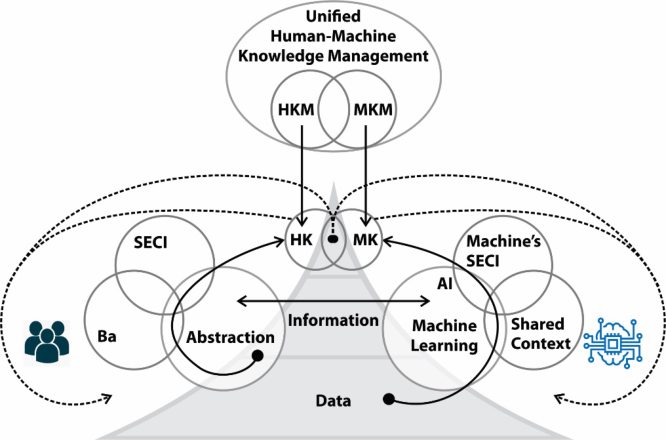
One possible approach to identify similarities, differences and bridges would be to compare characteristic of the informational pyramid – one con- solidated perspective in the organizational context – in both the human and machine perspectives. Perhaps data is – and may keep being – a common ground between both humans and machines. The way explicit data are stored may evolve but, as it is already done today, there should still be interpreters for future storage technology. But the volume of data is already presented as a challenge for humans as concepts like Big Data, BI tools and Data Mining, among many others, suggests that we are already not able to sit down and look for ourselves to those collections as our limitations impose dependency on machines and software to extract intelligible content. Therefore, it is no longer unusual that machine learning and AIs are already used as tools to help humans navigate on those data oceans.
Information, on the other hand, is here proposed as the level in which the split may start to occur more evidently and strongly. On current stage, mach- ines produce information – in the sense of interpretation of available data – bounded by two main approaches: a) reporting results to humans; b) kno- wledge base construction (the usage of the term “knowledge” is tricky here,
From Machine Knowledge and Knowledge Management 383
Figure 1: A Unified Human-Machine Knowledge Management Concept.
because it is more close to information), as the effort to build and upgrade databases of processed information for future usage, to boost and improve themselves on future analysis and executions. Although it is progressing, the second approach may evolve to give grounds to a new perspective of infor- mation, on a sense of interpretation of data – information creation – not only by machines but also for machines.
On the same sense, machine knowledge – in the sense analogue to the concept of human knowledge – might be too sophisticated to a human mind comprehension, produced on such a context, perspective, speed, and logic model particular to machines and that our access to it is limited, even with natural language capabilities like ChatGPT. Such knowledge may not be ade- quately translated to a human-comprehensive knowledge but useful just to other machines. It may reach a level where it will be needed that machines share knowledge between them, in a very specific way design for them – and perhaps by them, in the future.
In addition, machine knowledge may not be only explicit – like current seen on preponderant knowledge base approach – but also somehow analogue to human tacit, in a sense that a given AI acquires a logic that is beyond what its bits and bytes can express and therefore perhaps may be only able to be socialized (tacit to tacit “transfer”) between AIs, not to humans.
Therefore, it seems that it is insufficient to see machine knowledge as sim- ply a support to humans, specially in the context of organizations. Instead, machines need a knowledge approach of their own, that enables the full rea- lization of their potential. In addition, understanding and developing that on both the theoretical and applied perspectives, will stablish the grounds for the evolution of the human-machine integrations on the tactical and strategical levels of organizations.
And, perhaps more critical, the discussion on how knowledge manage- ment can exist in such scenario as all the theoretical background is stablished
384 Teodoro Dantas Sartori
on what now may be more precisely define only as Human Knowledge Management. Not only it is necessary that intense research effort is put on creating a Machine Knowledge Management theory, but also on an even more complex Unified Human-Machine Knowledge Management Theory, that studies, describes, develop, and integrate both branches of knowledge and knowledge management in the context of organizations. To efficiently achieve such goal, perhaps the start point of the scientific effort should lay on the creation of a new branch of academic research for the study of the epistemology of machine knowledge.
CONCLUSION
Knowledge sharing between machines may be as critical as it was for humans to develop the mechanisms to transmit knowledge between generations, as both seems to be the bedrock of accumulate, perpetuate and advance beyond the individual level, regardless of being a human or a machine. That is why whenever humans encounter a new situation or problem, it may be noti- ced that many aspects of it are not completely new because we have seen them in the past in some other contexts. Without the ability to accumulate knowledge collectively, machines will not be able to fulfil their potential. Already at the individual level, a machine algorithm, for instance, typi- cally needs a large number of training examples in order to learn effectively (Chen and Liu, 2016, p. 16).
But until now, academic literature appears to present the predominance of a single perspective for information science – the human one. Because of such approach, most research on the field addresses issues related to pro- ducing, storing, organizing and retrieving data, information and knowledge from humans and for humans or, in the other hand, to how humans use machines for those purposes. Machines are therefore seen as supporters and means, not an end on themselves.
Perhaps on a future not far away, that will no longer be the most effici- ent way to let machines learn and share information, not only to humans but between machines themselves. As their development and evolution are sustained and speeded, such academic approach will no longer support edge technology development. That means it will be needed data information and knowledge from and for other machines, not from nor for humans. Hard is the effort of predicting such future phenomenon but current state of the art suggest that maybe artificial intelligence shall follow a similar structured pattern, resulting in what is here called machine knowledge (MK).
On that sense, Internet of Things (IoT) – one of the technologies involved in the Industry 4.0 – may be just the first embryony steps of such approach, as it is one good example of a technology develop for the use of machines and to better enable the communication and data sharing mainly among them. This could be on day be understood as the first steps of a research area of infor- mation science as knowledge, practices and technology starts to be developed and applied primary for machines themselves, not for humans, even though that should still be embedded on it.
Consequently, the management of machine knowledge on an organizatio- nal context must progressively be understood far from a mere data storage
From Machine Knowledge and Knowledge Management 385
security and policy, as a mere copy of those data may be simply uncapable of representing and recovering a Machine’s Knowledge. In that sense, the “pro- blem of [machine] knowledge representation is still an active research topic with few mature results for practical use” (Chen and Liu, 2016), therefore much is still needed to advance on the topic of MK itself with implications on how it might be at least partially shared and managed on an organizational context. In other words, Information Management is no longer a sufficient mean to deal with these challenges.
Finally, a Unified Human-Machine Knowledge Management has the potential of not only sustain a totally new level of machines and of their contribution to business and technology development, but also to lay the grounds of a new industrial revolution in the future.
REFERENCES
Chen, Zhiyuan, Liu, Bing. (2016). Lifelong Machine Learning. Chicago: Morgan & Claypool Publishers. Choo, Chun Wei. (1998) The Knowing Organization. New York: Oxford. Dragicevic, Nikolina, Ullrich, André, Tsui, Eric, Gronau, Norbert. (2019) A conce-
ptual model of knowledge dynamics in the industry 4.0 smart grid scenario. Knowledge Management Research & Practice, Hong Kong, Volume 17, pp. 16. Duffy, Jan. (January 2001) The tools and technologies needed for knowledge management. Information Management Journal, Volune 35, No. 1, pp. 64–67. Friedenthal, Sanford, Moore, Alan, Steiner, Rick. (2008) A Practical Guide to SysML:
The Systems Modeling Language, Morgan Kaufmann; Elsevier Science. Ghobakhloo, Morteza. (2018) The future of manufacturing industry: a strategic roadmap toward Industry 4.0. Journal of Manufacturing Technology Management, Volume 29, No. 6, pp. 910–936. Harari, Yuval Noah. (2014) Sapiens: a brief history of humanity. Random House. Jalilvand, Mohammad Reza, Pool, Javad Khazaei, Khodadadi, Masood, Sharifi,
Mehdi. (April 2019) Information technology competency and knowledge mana- gement in the hospitality industry service supply chain. Tourism Review, Volume 74, No. 4, pp. 872–884. Kagermann, Henning; Wahlster, Wolfgang; Helbig, Johannes. (2013) Recommendations for implementing the strategic initiative Industrie 4.0: Securing the future of German manufacturing industry. Frankfurt: Acatech - National Academy os Science and Engineering. Kubat, Miroslav. (2017). An Introduction to Machine Learning (2nd ed.). Cham:
Springer. Nonaka, Ikujiro, Takeuchi, Hideyuki. (1995). The Knowledge-Creating Company: How Japanese Companies Create the Dynamics of Innovation. Oxford University Press. Nonaka, Ikujiro, Toyama, Ryoko, Konno, Noboru. (2000) SECI, Ba and Leadership:
A Unified Model of Dynamic Knowledge Creation. LRP - Long Range Planning, pp. 5–34. Polanyi, Michael (1962). Personal Knowledge: towards a post-critical philosophy.
2nd ed. Taylor & Francis Group. Polanyi, Michael (1966). The Tacit Dimension. 1st ed. New York: Doubleday & Company, Inc. Schlaepfer, R. C., Koch, M. (2015) Industry 4.0. Challenges and solutions for
the digital transformation and use of exponential technologies. Deloit. London, pp. 32.
LISTED IN THE AHFE DIGITAL BOOKSTORE CATALOGUE
Explore the complete digital volume
Intelligent Human Systems Integration (IHSI 2023): Integrating People and Intelligent Systems
Read this individual research paper free through the original publisher, or explore the full digital proceedings book.
ISBN 978-1-958651-45-2
Explore this ISBN in the AHFE Bookstore ↗Listed in the July 2026 bookstore catalogue; search by ISBN to confirm current availability · Digital book purchase optional