Tianyi Sheng, Xiaoli Qiu (2023). Scenario-based public nebulization equipment prototype design for inhaled vaccine application. In: Intelligent Human Systems Integration (IHSI 2023): Integrating People and Intelligent Systems. AHFE Open Access, vol. 69, pp. 755–762. https://doi.org/10.54941/ahfe1002898
Vaccination is becoming one of the most important epidemic control measures in the post-pandemic era, and the pandemic has accelerated the development of various forms of COVID-19 vaccines. The inhaled vaccine has entered clinical trials as a more convenient form of vaccination. However, the nebulization equipment used in the experiments was not specifically designed for the public health care scenario of inhaled vaccine nebulization. It could not reflect the advantages and characteristics of the inhaled vaccine. This study is based on the scenario-based design theory to design practical application solutions for inhaled vaccine nebulization equipment. Methods: Using a scenario simulation experiment and semi-structured interviews we identified the behavioral requirements of medical staff in the inhaled vaccination scenario and invited expert participants to validate. Results: Based on interview analysis, 20 behavioral requirements and an inhaled vaccine medical staff persona were identified. Five optimized scenarios were designed according to scenario-based design theory. Scenarios were evaluated by expert participants, and the prototype was developed based on feedback. The prototype design concept focused on "optimizing human-machine interaction", "improving disposable inhaler design", and "optimizing vaccine reagent dosing process". Conclusion: The prototype was evaluated by experts to be effective and reasonable for practical application scenarios of the inhaled vaccine. Scenario-based design can be a useful tool for innovative product design in public medical service scenarios.
In the post-epidemic era, vaccination has become one of the most direct aspects of prevention and control measures. With the largest immunization program ever implemented worldwide, medical research institutions are acti- vely promoting the development of new vaccines. In December 2021, the world’s first inhaled neo-crown vaccine, developed by Chen Wei’s team at the Chinese Academy of Military Medicine, achieved milestone results in Phase II clinical trials (Heida et al., 2022). The inhaled neo-crown vaccine uses a spe- cial device to nebulize the vaccine into tiny particles without any change in the formulation and enters the respiratory tract and lungs by inhalation. Nebu- lized inhalation requires only one-fifth of the dose of intramuscular injection (Semeniuk, 2021).
The experimental study of the inhaled vaccine has reached a breakthrough stage, and the social dissemination of the vaccine will be of great importa- nce. However, the experimental nebulization equipment used in the current research is traditional medical nebulized treatment equipment, which cannot fully reflect the advantages of the inhaled vaccine (Heida et al., 2022). There is no feasibility study and targeted improvement design for the specific scena- rio, which is fundamentally different from the traditional nebulized treatment scenario and requires a new targeted equipment design solution. Therefore, there is an urgent need to redesign the inhaled vaccine nebulization equipment for relevant experimental studies.
Since the inhaled vaccine is currently in the experimental research stage and there is a lack of user feedback in the actual vaccination situation, this study analyzed the results of interviews and simulated the public vaccination scenario of the inhaled vaccine based on the scenario-based design theory to achieve design requirements and develop the prototype.
METHODS
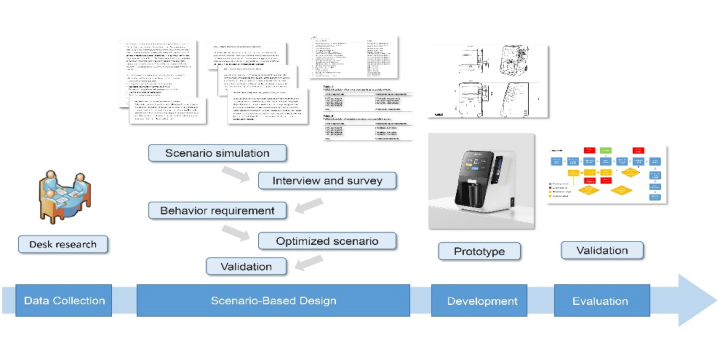
Scenario design is a design approach based on human-centered design, which reveals user needs through scenario descriptions or simulations. By summa- rizing and integrating elements within the scenario, expert participants are involved in the simulations and interviews for evaluation, which eventually leads to the core design requirements in that design scenario precisely (Bod- ker, 1999). This study used a combination of desktop research methods and questionnaires to analyze existing general vaccination scenarios and existing experimental equipment for inhaled vaccines to obtain basic data (Reeder and Demiris, 2010). The study simulated the scenario of public vaccination using the existing experimental equipment to provide a cognitive basis for the subsequent interviews and scenario-based design. Then a participatory design process was used to involve participants in the scenario simulation for interviewing. The interview process included semi-structured interviews, qualitative data analysis, scenario-based design, and scenario validation to obtain behavioral requirements in the existing inhaled vaccination scenario (Ciriello et al., 2019). Finally, the optimized scenarios were constructed based on the behavioral requirements and interview results. They were validated by the expert participants to achieve feedback for designing the prototype. Figure 1 outlines the research methodology and design process.
RESULTS
After the scenario simulation, we conducted interviews and obtained the participants’ perceptions of the inhaled vaccination scenario. Based on the opinions of the expert participants we obtained the following results.
Experts’ comments on the existing equipment. Almost all expert parti- cipants agreed that inhaled vaccines have specific advantages over general vaccines. However, the vaccination process requires the cooperation of the vaccinators to act correctly and regulate their behavior during the inhalation process, which generates a large cognitive load and increases the burden on
Scenario-Based Public Nebulization Equipment Prototype Design 757
Figure 1: Overview of study methods and design process..Table 1. Participant validation of behavior requirements as accurately reflected.
Table available in the original PDF paper.
Level of agreement Validated behavior requirements 6 of 6 participants 14 behavior requirements 5 of 6 participants 4 behavior requirements 4 of 6 participants 3 behavior requirements 3 of 6 participants - Total 20 behavior requirements
the medical staff. Another issue that was widely brought up by expert par- ticipants was the need to improve the refill reagent process. It requires the medical staff to manually disassemble the device and use a syringe to draw out the reagent before dropping it into the device.
Behavioral requirements. We created a persona and summarized 20 beha- vioral requirements based on interview information and participant characte- ristics (Reeder and Turner, 2011). At least four of the six expert participants believed that the 20 behavioral requirements accurately reflected the opera- tions that the medical staff was required to perform during vaccination. The validation results of the behavioral requirements are shown in Table 1. The 20 behavioral requirements can be grouped into 5 sub-scenarios according to the chronological order of the inhaled vaccination process (Table 2).
Preliminary optimization and validation. Based on the feedback we tried to describe the directions of improvement on structural forms and human- machine interaction processes of the equipment (Chun et al., 2020). We simulated inhaled vaccination scenarios and the validation results are pre- sented in Table 3. The validation results can be summarized as the design concepts for inhaled vaccine nebulizer equipment, including “design a clear display of nebulization parameters to optimize human-machine interaction,” “improve the design of disposable inhalers and redesign the vaccination pro- cess”, and “optimizing the dosing process of vaccine reagents to reduce the operations of medical staff”.
758 Sheng and Qiu
Table 2. Behavior requirements of medical staff.
Table available in the original PDF paper.
Behavior requirements Category Health information confirmation Information verification Identifying information confirmation and entry system Information verification Clean the equipment before vaccination Preparation Check equipment operation Preparation Check the nebulization parameter setting Preparation Check the function of refilling vaccine reagent Preparation Illustration of the inhaled vaccine essential information Interpretation and guidance Guide people to use the inhaler part of the equipment Interpretation and guidance Explain and guide people’s operations Interpretation and guidance Use the equipment to start nebulization Interpretation and guidance Monitor the vaccination process of the equipment Interpretation and guidance Guide user’s behavior during the vaccination Interpretation and guidance Take back the inhaler and discard the disposable part Interpretation and guidance Observe the residual amount of vaccine Refill vaccine reagent Dismantle the equipment to refill the vaccine Refill vaccine reagent Refill vaccine reagent Refill vaccine reagent Reassembly the equipment Refill vaccine reagent Clean the equipment each internal of vaccination. Clean up and disinfection Self-cleaning Clean up and disinfection Clean the equipment after all vaccination. Clean up and disinfection
Table 3. Participant validation of optimized scenarios as successfully improved.
Table available in the original PDF paper.
Level of agreement Validated optimized scenarios 6 of 6 participants 3 optimized scenarios 5 of 6 participants - 4 of 6 participants 1 optimized scenario 3 of 6 participants 1 optimized scenario Total 5 optimized scenarios
Feedback on optimized scenarios. Expert participants provided con- structive comments and feedback for each scenario after evaluation. The improved designs in these scenarios were implemented in the prototype development.
Participants noted that in the scenario of preparation before vaccination, the mobility of the equipment needs to be considered. Since most of the medi- cal staff is female and the location of the vaccination task is uncertain, the equipment needs to be able to be picked up by a woman with one hand and moved quickly. A foldable handle on the top is an acceptable design dire- ction. Secondly, the equipment needs a screen to display basic information and nebulization-related parameters before vaccination begins. Vaccines are produced by different companies, so each vaccine has its specifications for capacity and nebulization parameters. It needs to be easy to observe and adjust through the screen.
Scenario-Based Public Nebulization Equipment Prototype Design 759
The existing operating procedure requires the inhaler to be taken back after vaccination. This makes it necessary to disinfect the inhaler after each vaccination (de Boer et al., 2006). The experts suggested that using the inh- aler as a disposable component is the right direction, eliminating the need for recycling and repeated disinfection. The duration of a normal nebuliza- tion treatment is about 15 minutes, so the inhaler needs to be continuously attached to the device. According to the study, completing the vaccination of an inhaled vaccine requires only about 10 seconds of inhalation (Semeniuk, 2021). If the inhaler is used as a disposable component, all the components related to the operation can be integrated into the equipment host. It is more ergonomic and safe to have all parts that interact with people be disposable.
Participants proposed that using a syringe to inject the vaccine into the device was a redundant operation. Drawing the vaccine out of the vial automatically would increase the efficiency significantly. However, this requi- res biological experiments on the relevant structures and the piping in the equipment to ensure that they do not affect the vaccine reagents. It is an acceptable proposal to put the needle directly into the machine to eli- minate the injection process in an experimental phase like the prototype development. By designing the mechanical structure of the machine and the human-machine interaction to make the refilling of vaccine reagents a semi- automated process, we have a highly feasible and efficient solution. The concept of eliminating the need for the medical staff to disassemble the equi- pment and increasing the storage capacity of the equipment to reduce the frequency of refilling was approved by all subjects.
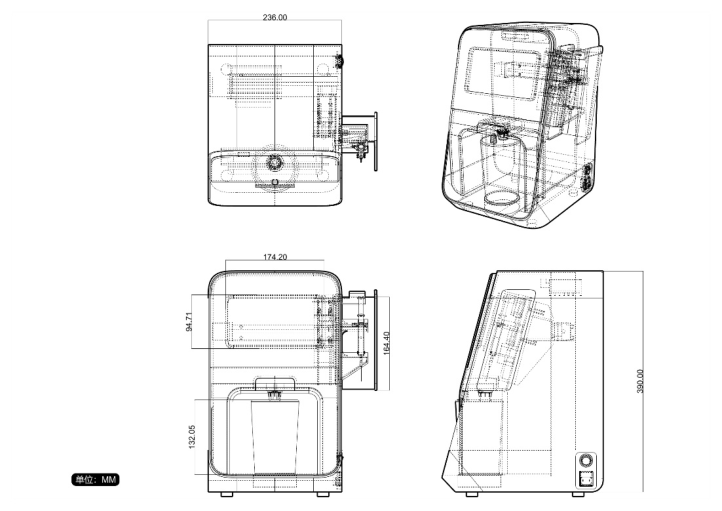
PROTOTYPE DESIGN Based on the feedback received from the scenario simulation and intervi- ews, a prototype was developed using the existing nebulization function module. The structure and dimensions of the prototype are shown in Figure 2. The main functional modules include the nebulization module, the display module, and the refill reagent module.
The nebulizer module uses a VMT nebulizer, which has outstanding nebu- lization effects and can produce fog quickly by dropping the medicine into it. The display module adopts a 164x100 mm touchscreen. The refill reagent module can be automatically ejected, and the syringe is automatically reset and pushed to nebulize according to the required dose after the medical staff manually puts it in.
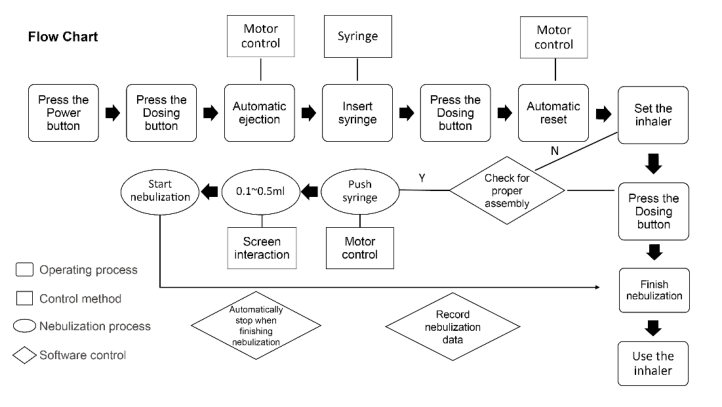
The workflow of the prototype is shown in Figure 3. Applying the pro- totype equipment to the inhaled vaccination scenario leads to an improved vaccination process. After checking the equipment, the medical staff presses the dose button and uses the syringe to draw up the vaccine reagent. After the dosing module is automatically ejected, she installs the syringe in the cor- rect position (one dosing operation every 10 vaccinations). Then she presses the dosing button again, waits for the equipment to finish resetting, and pla- ces the disposable inhaler under the nebulizer module. The vaccinator will take the inhaler on their own after the nebulization and be guided to the inh- alation area to finish the inhalation process according to pictures and text
760 Sheng and Qiu
Figure 2: Structure and size of the prototype.Figure 3: Flow chart of the prototype.
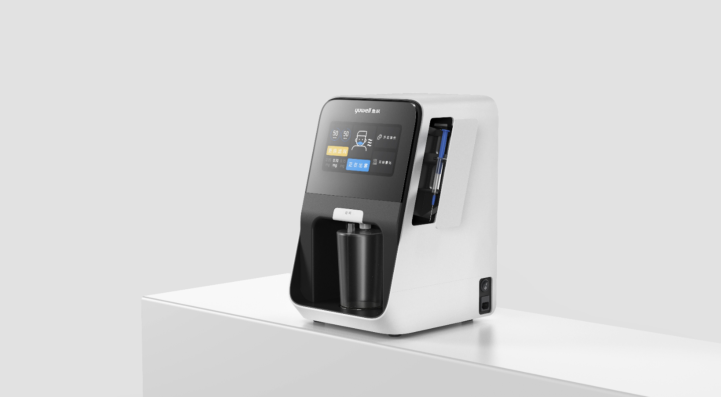
instructions. Finally, the disposable inhalers are discarded at the designated location. After all the vaccination tasks are completed, the medical staff disin- fects the equipment and cleans the remaining reagent in the storage structure of the nebulizer module. The rendering of the prototype equipment is shown in Figure 4. The prototype and its scenario were sent to the participants and received consistent positive responses.
Scenario-Based Public Nebulization Equipment Prototype Design 761
Figure 4: Rendering of the prototype.
DISCUSSION AND CONCLUSION The scenario context, behavioral requirements of medical staff, persona, and optimized scenarios in the inhalation vaccination scenario obtained from this study are of great significance. The inhaled vaccine study is still in the experi- mental stage, and data on user characteristics and related operations cannot be obtained from actual user feedback and behavioral tests. The feedback and results obtained from scenario simulation and user experiments in this study provide an important foundation for the continued advancement and implementation of inhaled vaccine device research. We validated 20 behavi- oral requirements and 5 optimized scenarios. This provides an overview of the workflow of complex public medical service scenarios and provides a basic understanding for the medical staff. The scenarios can be used as blue- prints for relevant public medical activity service system designs and can be modified to suit the actual situation.
A limitation of this study is that only medical staff with many years of experience in public medical activities were selected as expert participants in the experiment, and opinions from experts in vaccine-related biology were lacking. This also resulted in the inability to obtain opinions on biochemical indicators of the equipment structures and pipelines during the design pro- cess. We were unable to confirm the reliability of the design proposal, and a simpler and more efficient proposal was abandoned. More research is needed to generalize the results of this study’s work to practical situations once the inhaled vaccine research advances to the actual user testing stage.
Scenario simulation and interview evaluation based on scenario-based design theory provide an effective research method for innovative design projects that lack actual scenario information and user data. The approach we adopted has great significance for designers in the field of public medi- cal services. The methodology can also be applied to other design studies
762 Sheng and Qiu
of innovative medical products that are still in the development stage and provides a theoretical basis for such innovative research projects. The pro- totype developed in this study provided a detailed application solution for optimized inhaled vaccine nebulization equipment, including operational procedures, structures, models, and renderings. Its validity and rationality were verified by experts. An industrial design perspective solution is provided for advancing and practically implementing the inhaled vaccine nebulization equipment research.
REFERENCES
Bodker, S. (1999). Scenarios in user-centred design-setting the stage for reflection and action. Proceedings of the 32nd Annual Hawaii International Conference on Systems Sciences. 1999. HICSS-32. Abstracts and CD-ROM of Full Papers, Systems Sciences, 1999. HICSS-32. Proceedings of the 32nd Annual Hawaii Inter- national Conference On, Track3. https://doi.org/10.1109/HICSS.1999.772892 Chun Han Tsai, Ching Fen Chang, & Shuo-Fang Liu. (2020). Explore the Demands
of the Elderly by Integrating QFD and Scenario-Based Design. Ciriello, R. F., & Richter, A. (2019). Scenario-Based Design Theorizing: The Case of a Digital Idea Screening Cockpit. Business & Information Systems Enginee- ring: The International Journal of WIRTSCHAFTSINFORMATIK, 61(1), 31–50. https://doi.org/10.1007/s12599-018-0572-y de Boer, A. H., Hagedoorn, P., Westerman, E. M., Le Brun, P. P. H., Heijerman, H.
G. M., & Frijlink, H. W. (2006). Design and in vitro performance testing of mul- tiple air classifier technology in a new disposable inhaler concept (Twincer®) for high powder doses. European Journal of Pharmaceutical Sciences, 28(3), 171–178. https://doi.org/10.1016/j.ejps.2005.11.013 Heida, R., Hinrichs, W. L., & Frijlink, H. W. (2022). Inhaled vaccine delivery in the combat against respiratory viruses: a 2021 overview of recent developments and implications for COVID-19. Expert Review of Vaccines, 21(7), 957–974. Reeder, B., & Demiris, G. (2010). Building the PHARAOH Framework Using
Scenario-Based Design: A Set of Pandemic Decision-Making Scenarios for Con- tinuity of Operations in a Large Municipal Public Health Agency. Journal of Medical Systems, 34(4), 735–739. https://doi.org/10.1007/s10916-009-9288-3 Reeder, B., & Turner, A. M. (2011). Scenario-based design: A method for connecting information system design with public health operations and emer- gency management. Journal of Biomedical Informatics, 44(6), 978–988. https://doi.org/10.1016/j.jbi.2011.07.004 Semeniuk, I. (2021, December 13). How an inhaled vaccine might breathe new life
into the fight against COVID-19. Globe & Mail (Toronto, Canada), A1, A5.
LISTED IN THE AHFE DIGITAL BOOKSTORE CATALOGUE
Explore the complete digital volume
Intelligent Human Systems Integration (IHSI 2023): Integrating People and Intelligent Systems
Read this individual research paper free through the original publisher, or explore the full digital proceedings book.
ISBN 978-1-958651-45-2
Explore this ISBN in the AHFE Bookstore ↗Listed in the July 2026 bookstore catalogue; search by ISBN to confirm current availability · Digital book purchase optional